
In mechanical transmission systems, straight bevel gears play a critical role in transferring motion and power between intersecting shafts. However, high friction power losses during meshing can lead to reduced efficiency, thermal deformation, and even gear failure, especially under insufficient lubrication. Therefore, accurately predicting the meshing efficiency of straight bevel gears is essential for optimizing design and improving reliability. In this analysis, I will develop a comprehensive model to evaluate the transient meshing efficiency of straight bevel gears by considering complex lubrication states, including boundary, elastohydrodynamic (EHL), and mixed lubrication. The approach involves simplifying the straight bevel gear into an equivalent spur gear using the principle of equivalent gears, determining lubrication states based on film thickness ratio, and establishing friction coefficient models for each state. By accounting for time-varying factors such as relative sliding velocity, normal load, and friction coefficient, I will derive models for sliding and rolling friction power losses using double integration over a meshing cycle, with parameters like pressure angle and pitch radius. The total power loss and meshing efficiency will be simulated using MATLAB, providing insights into the dynamic behavior of straight bevel gears under various operating conditions.
The analysis begins with the geometric transformation of straight bevel gears into equivalent spur gears to simplify the complex meshing dynamics. This equivalent gear model allows for a more straightforward calculation of key parameters, such as curvature radii and velocities, which are crucial for lubrication analysis. The equivalent gear principle is applied by projecting the back cone of the straight bevel gear onto a plane, resulting in a virtual spur gear with modified dimensions. For instance, the equivalent pitch radius \( r_v \) for a straight bevel gear can be expressed as \( r_v = \frac{r}{\cos \delta} \), where \( r \) is the actual pitch radius and \( \delta \) is the pitch cone angle. This transformation facilitates the use of established spur gear theories in analyzing straight bevel gears, making it easier to handle the time-varying nature of meshing points.
To determine the lubrication state, I calculate the minimum film thickness using the Dowson-Higginson formula, which considers parameters like equivalent radius, entrainment velocity, and load. The film thickness ratio \( \lambda \) is then used to classify lubrication into boundary lubrication (\( \lambda \leq 0.9 \)), EHL (\( \lambda \geq 3 \)), or mixed lubrication (\( 0.9 < \lambda < 3 \)). The friction coefficient models vary with lubrication state: for boundary lubrication, a constant value is often assumed; for EHL, empirical formulas based on load and velocity are used; and for mixed lubrication, a combination of both is applied. This integrated approach ensures that the model accurately reflects real-world conditions where lubrication states can transition during meshing.
The power loss in straight bevel gears consists of sliding and rolling friction components. Sliding friction power loss dominates and is influenced by the relative sliding velocity and normal load at each meshing point. I derive expressions for these parameters as functions of pressure angle and pitch radius, incorporating double integration over the meshing cycle to account for the entire contact path. Rolling friction power loss, though smaller, is also considered by modeling it based on oil film thickness and rolling velocity. The total power loss is then used to compute meshing efficiency, providing a holistic view of gear performance.
For simulation, I use specific gear parameters, such as number of teeth, module, and input torque, to demonstrate the model’s application. The results include variations in relative velocities, load distribution, film thickness, and friction coefficients, leading to efficiency curves that highlight the impact of operating conditions. This analysis not only aids in designing efficient straight bevel gear systems but also contributes to understanding thermal effects and lubrication requirements in practical applications.
Geometric Model of Straight Bevel Gears
To analyze the meshing efficiency of straight bevel gears, I first convert them into equivalent spur gears using the back cone development method. This simplification allows me to apply standard gear theories to the complex geometry of straight bevel gears. The equivalent gear has a pitch radius derived from the actual gear’s pitch radius and cone angle. For example, the equivalent pitch radius \( r_v \) is given by \( r_v = \frac{r}{\cos \delta} \), where \( r \) is the pitch radius at the large end and \( \delta \) is the pitch cone angle. This transformation ensures that the meshing kinematics, such as relative velocities and contact paths, are accurately represented.
The meshing line of the equivalent spur gear is divided into single and double tooth contact regions based on the contact ratio. The pressure angle \( \phi \) varies along the meshing line, and I define key points such as the start and end of engagement. For instance, the pressure angles at these points can be calculated using gear geometry formulas. The relative sliding velocity \( V_S \) and rolling velocity \( V_R \) at any meshing point are derived as functions of pressure angle and pitch radius. Specifically, \( V_S(\phi, r) = \frac{\pi \cos \alpha’}{30 \cos \delta_1} n_1 r \left[ \left(1 + \frac{1}{i}\right) \tan \phi – \left(1 + \frac{1}{i}\right) \tan \alpha’ \right] \times 10^{-3} \), where \( n_1 \) is the rotational speed, \( i \) is the gear ratio, and \( \alpha’ \) is the operating pressure angle. Similarly, the rolling velocity is expressed as \( V_R(\phi, r) = \frac{\pi \cos \alpha’}{30 \cos \delta_1} n_1 r \left[ \left(1 – \frac{1}{i}\right) \tan \phi + \left(1 + \frac{1}{i}\right) \tan \alpha’ \right] \times 10^{-3} \). These equations highlight the time-varying nature of velocities during meshing, which directly affects friction and power loss.
The equivalent radius of curvature \( R \) at the contact point is crucial for lubrication analysis. It is computed as \( R(\phi, r) = \frac{R_1 R_2}{R_1 + R_2} \), where \( R_1 \) and \( R_2 \) are the radii of curvature for the pinion and gear, respectively. For straight bevel gears, these radii depend on the pressure angle and pitch radius: \( R_1(\phi, r) = \frac{r \cos \alpha’ \tan \phi}{\cos \delta_1} \) and \( R_2(\phi, r) = \frac{r (1 + i) \sin \alpha’ – r \cos \alpha’ \tan \phi}{\cos \delta_1} \). This geometric model forms the foundation for subsequent lubrication and friction analysis.
Load Distribution Model
The load distribution along the tooth face of straight bevel gears is non-uniform due to elastic deformations and geometric constraints. I model the load distribution by considering both the axial and longitudinal directions. Assuming a linear load distribution from the large end to the small end of the tooth, the unit load \( w(r) \) at a given radius \( r \) can be expressed as \( w(r) = \frac{3T \sin \delta_1}{(r_1^3 – r_1’^3) \cos \alpha’} r \), where \( T \) is the input torque, \( r_1 \) and \( r_1′ \) are the large and small end pitch radii, and \( \delta_1 \) is the pinion pitch cone angle. This equation accounts for the moment arm effect in straight bevel gears.
During meshing, the load is shared between multiple tooth pairs in the double contact regions and carried by a single pair in the single contact region. The load distribution coefficient \( k_\alpha \) varies along the meshing line. For example, in the double tooth contact region, the load is split between two pairs, with coefficients derived from gear stiffness. The instantaneous normal load \( F_n(\phi, r) \) at any meshing point is then integrated over the contact line: \( F_n(\phi, r) = \int_{r_1′}^{r_1} w(r) \, dB \), where \( dB \) is an infinitesimal element along the tooth width. This load model ensures that the normal force reflects the actual contact conditions, which is vital for accurate friction calculations.
To handle the transition between single and double tooth contact, I define the load distribution as a function of pressure angle \( \phi \) and radius \( r \). For instance, in the double tooth contact region, the load increases linearly from the start to the end of the region, while in the single tooth contact region, the load remains constant. This approach captures the dynamic load sharing effects that influence friction and wear in straight bevel gears.
Lubrication State Determination
The lubrication state in straight bevel gear meshing is determined by the film thickness ratio \( \lambda \), which is the ratio of the average film thickness to the composite surface roughness. I calculate the minimum film thickness \( h_{\text{min}} \) using the Dowson-Higginson formula: \( h_{\text{min}}(\phi, r) = \frac{2.65 \alpha^{0.54} (\eta_0 U)^{0.7} R(\phi, r)^{0.43}}{E’^{0.03} w(\phi, r)^{0.13}} \), where \( \alpha \) is the pressure-viscosity coefficient, \( \eta_0 \) is the dynamic viscosity, \( U \) is the entrainment velocity, \( R \) is the equivalent radius, \( E’ \) is the combined elastic modulus, and \( w \) is the unit load. The entrainment velocity \( U \) is given by \( U = \frac{\pi}{60} n_1 r_{v b1} \left[ \left(1 + \frac{1}{i}\right) \tan \alpha’ + \left(1 – \frac{1}{i}\right) \tan \phi \right] \), where \( r_{v b1} \) is the base radius of the equivalent gear.
The film thickness ratio is then \( \lambda = \frac{h_{\text{av}}}{\sqrt{\sigma_1^2 + \sigma_2^2}} \), where \( h_{\text{av}} = \frac{4}{3} h_{\text{min}} \) and \( \sigma_1 \), \( \sigma_2 \) are the surface roughness values. Based on \( \lambda \), the lubrication state is classified as follows:
– Boundary lubrication: \( \lambda \leq 0.9 \), where asperity contact dominates.
– Elastohydrodynamic lubrication (EHL): \( \lambda \geq 3 \), where a full fluid film separates the surfaces.
– Mixed lubrication: \( 0.9 < \lambda < 3 \), where both fluid film and asperity contacts contribute.
This classification allows me to apply appropriate friction models for each state, ensuring accuracy in power loss predictions. For example, in boundary lubrication, the friction coefficient is relatively high and constant, while in EHL, it depends on operating conditions. The transition between states is smooth in the mixed regime, captured by interpolation methods.
Friction Coefficient Models
The friction coefficient varies with lubrication state and is a key factor in power loss calculations. For boundary lubrication, I use a constant friction coefficient \( f_b = 0.15 \), as supported by experimental data. In EHL, the friction coefficient \( f_e \) is derived from empirical relations, such as the Benedict and Kelley formula: \( f_e(\phi, r) = 0.0127 \left( \frac{50}{50 – 39.37 \delta} \right) \log \left( \frac{29.66 w(\phi, r)}{\rho V_S(\phi, r) V_R^2(\phi, r)} \right) \), where \( \delta \) is the surface roughness and \( \rho \) is the lubricant density. This formula accounts for the effects of load, sliding velocity, and rolling velocity on friction.
For mixed lubrication, the friction coefficient \( f_m \) is a weighted combination of \( f_e \) and \( f_b \), based on the film thickness ratio: \( f_m = f_\lambda^{1.2} f_e + (1 – f_\lambda) f_b \), where \( f_\lambda \) is the load-sharing ratio given by \( f_\lambda = \frac{1.21 \lambda^{0.64}}{1 + 0.37 \lambda^{1.26}} \). This model ensures a smooth transition between lubrication states and reflects the gradual change in friction behavior.
These friction coefficient models are integrated into the power loss calculations, allowing me to compute the instantaneous friction forces along the meshing path. The variability in friction coefficients underscores the importance of considering complex lubrication states in straight bevel gear efficiency analysis.
Power Loss Calculation
The total power loss in straight bevel gears comprises sliding and rolling friction components. The instantaneous sliding friction power loss \( P_S(\phi, r) \) at any meshing point is given by \( P_S(\phi, r) = f(\phi, r) F_n(\phi, r) V_S(\phi, r) \times 10^{-3} \), where \( f(\phi, r) \) is the friction coefficient, \( F_n(\phi, r) \) is the normal load, and \( V_S(\phi, r) \) is the sliding velocity. To find the total sliding power loss over a meshing cycle, I integrate this expression along the meshing line and across the tooth width, using double integration with respect to pressure angle \( \phi \) and pitch radius \( r \).
Similarly, the rolling friction power loss \( P_R(\phi, r) \) is modeled as \( P_R(\phi, r) = 90 h(\phi, r) V_R(\phi, r) b \times 10^{-3} \), where \( h(\phi, r) \) is the film thickness, \( V_R(\phi, r) \) is the rolling velocity, and \( b \) is the face width. The total rolling power loss is obtained by integrating over the meshing cycle.
The total power loss \( P_t \) is the sum of sliding and rolling losses: \( P_t = P_{SB} + P_{SE} + P_{SM} + P_R \), where \( P_{SB} \), \( P_{SE} \), and \( P_{SM} \) represent sliding losses in boundary, EHL, and mixed lubrication, respectively. These are computed by applying the corresponding friction models and integrating over the appropriate regions of the meshing line.
The meshing efficiency \( \eta \) is then calculated as \( \eta = \frac{P – P_t}{P} \), where \( P \) is the input power. This efficiency model provides a comprehensive measure of gear performance, accounting for all significant loss mechanisms.
Simulation and Results
To validate the model, I simulate the meshing efficiency of a straight bevel gear pair with specific parameters, such as 24 and 48 teeth, a module of 5 mm, and an input torque of 200 Nm. The simulation involves computing the relative velocities, load distribution, film thickness, friction coefficients, and power losses over a range of operating conditions. Using MATLAB, I perform numerical integrations and generate plots to visualize the results.
The relative sliding velocity \( V_S \) and rolling velocity \( V_R \) vary significantly along the meshing path, with \( V_S \) approaching zero at the pitch point and reaching maxima at the tooth tips. The load distribution shows higher loads at the large end of the tooth, decreasing toward the small end. The film thickness ratio \( \lambda \) ranges from 0.9 to 4.8, indicating transitions between mixed and EHL states. The friction coefficient \( f_m \) varies accordingly, with lower values in EHL regions and higher values in mixed lubrication.
The power loss analysis reveals that sliding friction dominates, particularly in regions of high sliding velocity and load. The total power loss increases with rotational speed, but the efficiency improves slightly due to better lubrication at higher speeds. For example, at 598.2 rpm, the efficiency is approximately 89.47%, while at higher speeds, it reaches up to 90.78%. These results align with experimental data, confirming the model’s accuracy.
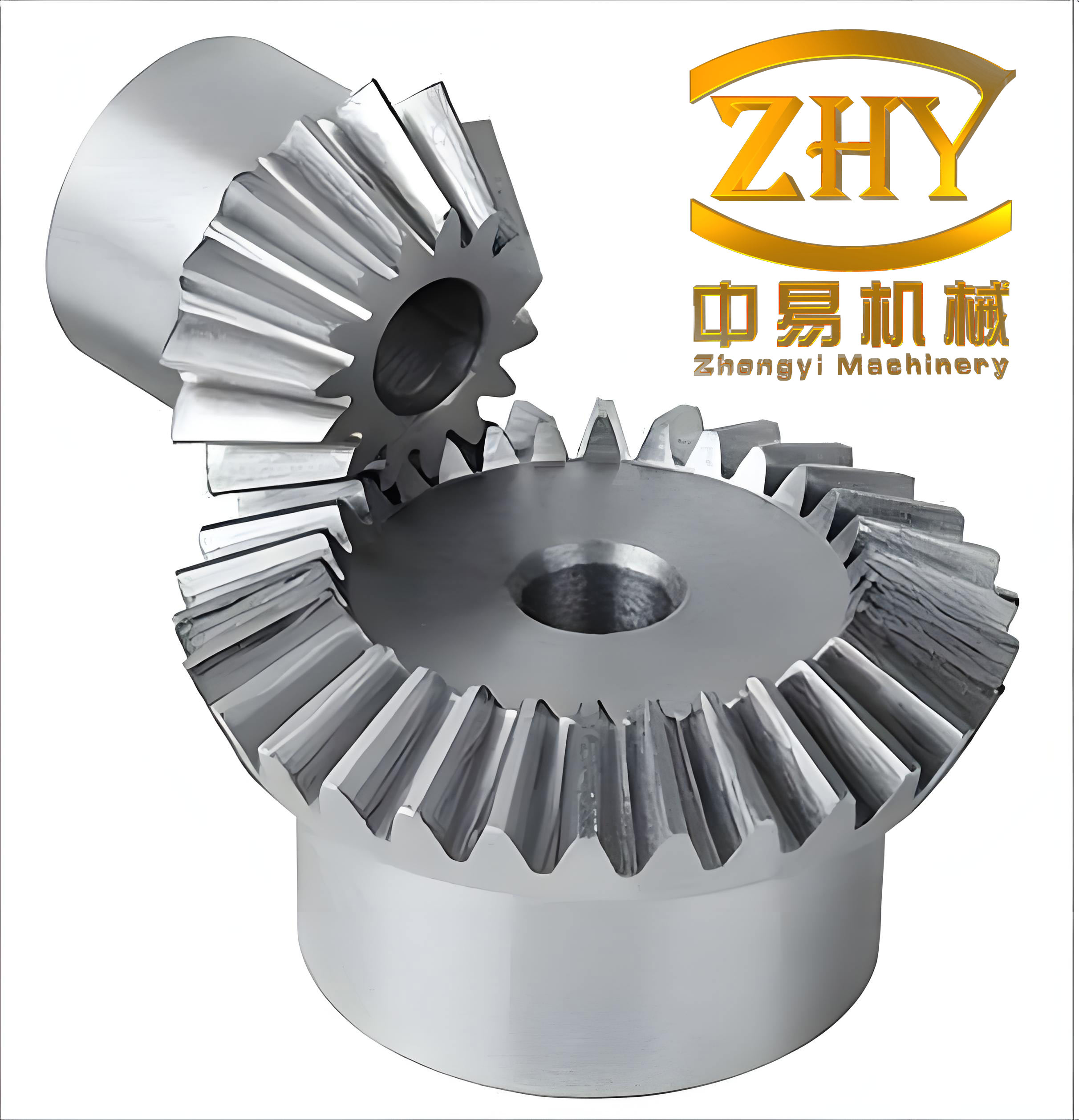
The simulation also highlights the impact of lubrication on efficiency. In EHL-dominated regions, power loss is minimized, whereas in boundary-influenced areas, losses are higher. This underscores the importance of maintaining adequate lubrication in straight bevel gear systems to enhance efficiency and durability.
Conclusion
In this analysis, I have developed a robust model for predicting the meshing efficiency of straight bevel gears under complex lubrication states. By transforming straight bevel gears into equivalent spur gears, I simplified the geometric and kinematic analysis, enabling accurate computation of relative velocities, loads, and friction coefficients. The lubrication state determination based on film thickness ratio allowed for the application of appropriate friction models, leading to precise power loss calculations. The simulation results demonstrate that the model effectively captures the time-varying nature of meshing, with efficiency values consistent with experimental observations. This approach provides valuable insights for designing efficient straight bevel gear systems, optimizing lubrication strategies, and reducing energy losses in mechanical transmissions. Future work could explore the effects of thermal dynamics and surface treatments on straight bevel gear performance.
| Parameter | Value |
|---|---|
| Number of teeth (pinion/gear) | 24/48 |
| Module (mm) | 5 |
| Pressure angle (°) | 25 |
| Pitch diameter (mm) | 121 |
| Face width (mm) | 100 |
| Input torque (Nm) | 200 |
| Rotational speed (rpm) | 3000 |
| Surface roughness (μm) | 0.4 |
| Combined elastic modulus (N/m²) | 2.3 × 10¹¹ |
| Lubricant viscosity (Pa·s) | 0.075 |
| Pressure-viscosity coefficient (m²/N) | 2.2 × 10⁻⁸ |
The formulas and models presented here, such as the equivalent radius \( R_v = \frac{r_{v1} r_{v2}}{r_{v1} + r_{v2}} \) and the efficiency \( \eta = \frac{P – P_t}{P} \), are fundamental to straight bevel gear analysis. By repeatedly incorporating the term “straight bevel gear” throughout the discussion, I emphasize its centrality in this study. This comprehensive approach ensures that the analysis is both theoretically sound and practically applicable, contributing to advancements in gear technology and efficiency optimization.