
In modern mechanical transmission systems, straight bevel gears play a critical role due to their simple design, ease of manufacturing, and absence of axial forces during operation. However, with the increasing demands for high precision in agricultural machinery and other industries, controlling the geometric accuracy of gear tooth surfaces has become essential. Traditional methods for measuring tooth surface errors on gear measuring centers often rely on theoretical data derived from machining principles or approximate involute profiles, which do not account for modifications like tooth surface corrections. This leads to measurement results that combine both modification errors and machining errors, making it difficult to isolate and address actual manufacturing inaccuracies. To overcome this, we propose a novel approach that extracts theoretical tooth surface data directly from the solid modeling of straight bevel gears, ensuring consistency between the designed and measured surfaces. This method leverages 3D modeling data, which is commonly used in precision forging processes for straight bevel gears, to provide accurate coordinates and normal vectors required for error measurement on gear measuring centers. By focusing on the solid model, we eliminate discrepancies caused by varying modification techniques across manufacturers, resulting in measurements that purely reflect machining errors. This paper details the methodology, theoretical foundations, and validation of this approach, emphasizing its practical applicability and advantages over conventional techniques.
The core of our method lies in utilizing the solid model of a straight bevel gear, which includes all geometric information such as tooth profiles and surfaces. In precision forging, which is a common manufacturing process for straight bevel gears, the mold cavity is designed based on this 3D model, incorporating any necessary modifications for improved meshing performance. By extracting measurement data directly from this model, we ensure that the theoretical reference surface matches the intended design, including any corrections. This is achieved through a combination of geometric calculations, coordinate transformations, and programming tools like UG Open API, which allow for automated extraction of points and normal vectors on the tooth surface. The process begins with defining a coordinate system based on the gear’s installation distance, followed by generating a grid of points on the axial cross-section. These points are then projected onto the tooth surface using rotational projection principles, and their coordinates and unit normal vectors are extracted for use in measurement systems. This approach not only enhances accuracy but also offers flexibility for different gear types, such as spiral bevel gears or cylindrical gears, making it a versatile solution for industrial applications.
To understand the theoretical background, consider the mathematical representation of a straight bevel gear tooth surface. Ideally, the tooth profile at the large end of a straight bevel gear is a spherical involute. However, due to the complexity of modeling spherical surfaces, an approximate involute based on the back cone is often used in engineering. In the axial cross-section coordinate system $S(X, Y, Z)$, where the origin $O$ is the design intersection point and the $X$-axis is the rotation axis, the tooth surface can be described using derived equations. Let $S_1(X_1, Y_1, Z_1)$ represent the coordinate system of the equivalent gear on the back cone, and $S_2(X_2, Y_2, Z_2)$ be the coordinate system for involute generation. The surface equation $\mathbf{r}_i$ and unit normal vector $\mathbf{n}_i$ for the tooth surface can be expressed as:
$$ \mathbf{r}_i = \mathbf{r}_i(\theta_i, u_i) $$
$$ \mathbf{n}_i = \mathbf{n}_i(\theta_i, u_i) $$
where $i = 1, 2$ denotes the pinion and gear, respectively, and $\theta_i$, $u_i$ are surface parameters. These equations are derived through coordinate transformations and geometric relations, incorporating parameters like pressure angle $\alpha_x$ and distance $R_x$. For instance, the transformation from the axial cross-section to the tooth surface involves nonlinear equations that can be solved iteratively. However, this traditional method faces challenges when modifications are applied, as the equations may not uniformly account for corrections, leading to inconsistencies in measurement benchmarks.
In contrast, our proposed method bypasses the need for explicit surface equations by working directly with the solid model. The extraction process involves several steps: First, the solid model file (e.g., in STL, IGS, or STP format) is imported into a CAD environment like UG, with the coordinate system aligned using the installation distance to ensure accuracy. The grid points on the axial cross-section are calculated based on gear parameters, such as the number of teeth, module, and pressure angle. A typical grid consists of 45 points (5 along the tooth height and 9 along the tooth length), arranged from the tooth tip to the root and from the small end to the large end. Each point $M(x, y)$ in the axial cross-section corresponds to a point $M^*(x^*, y^*, z^*)$ on the tooth surface, related through rotational projection:
$$ x = x^* $$
$$ y = \sqrt{(y^*)^2 + (z^*)^2} $$
This equation represents a nonlinear system that defines the mapping from the 2D grid to the 3D surface. To visualize and extract the data, we create circular models for each grid point using three-point arc functions in UG Open API, ensuring that the points lie on the tooth surface. The intersection between these projection lines and the tooth surface yields the exact coordinates of $M^*$, and the unit normal vectors are obtained by analyzing the surface properties at these points. This process is automated through custom scripts, providing a seamless way to generate the theoretical data needed for gear measuring centers.
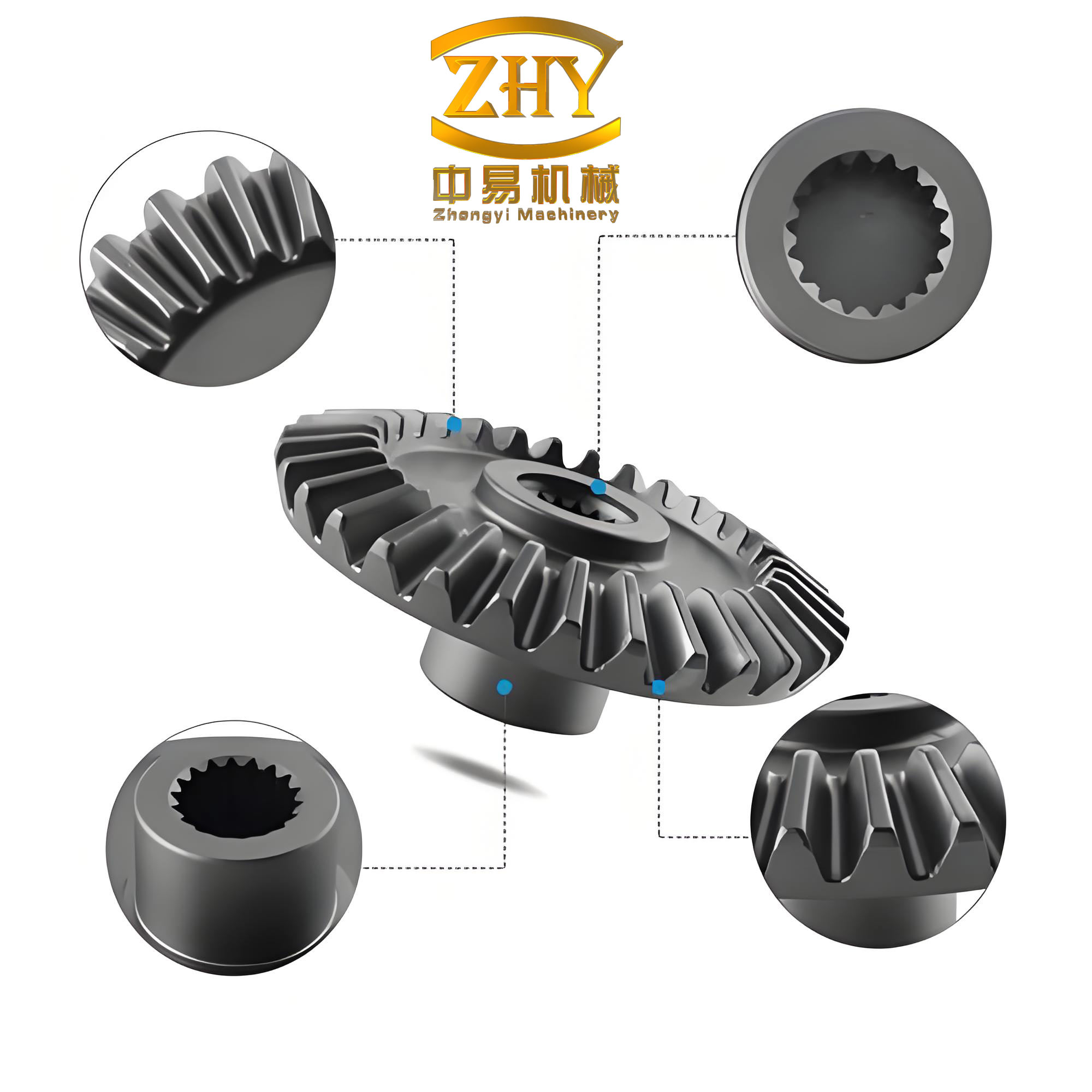
The implementation of this method relies heavily on UG Open programming tools, which enable interaction with the solid model. For example, the function UF_CURVE_create_arc_3point() is used to generate the rotational projection lines, and UF_CURVE_intersect() finds the intersection points with the tooth surface. The unit normal vectors are extracted using UF_MODL_ask_face_props(), which provides surface properties based on UV parameters. This integration allows for efficient data extraction, even for complex tooth surfaces with modifications. To illustrate, consider a case study involving a straight bevel gear pair with a pinion of 10 teeth and a gear of 18 teeth. The geometric parameters are summarized in Table 1.
| Parameter | Value |
|---|---|
| Number of teeth (pinion) | 10 |
| Module | 5.4000 |
| Face width (mm) | 17.0000 |
| Pressure angle (°) | 22.5000 |
| Installation distance (mm) | 57.0000 |
Using these parameters, the axial cross-section grid points are computed, as shown in Table 2 for a subset of points. These points serve as the basis for the rotational projection onto the tooth surface.
| Node Sequence | X (mm) | Y (mm) |
|---|---|---|
| 1 | 31.8329 | 22.2136 |
| 2 | 32.5462 | 21.0108 |
| 3 | 33.2674 | 19.8124 |
| 4 | 33.9851 | 18.6118 |
| 5 | 34.6829 | 17.4003 |
| … | … | … |
| 41 | 45.8539 | 31.9977 |
| 42 | 46.8813 | 30.2652 |
| 43 | 47.9203 | 28.5388 |
| 44 | 48.9541 | 26.8095 |
| 45 | 49.9592 | 25.0643 |
After applying the rotational projection and extraction process, the resulting tooth surface coordinates and unit normal vectors are obtained. For comparison, Table 3 presents a subset of data calculated using traditional surface equations, while Table 4 shows the data extracted from the solid model for the same points. The close agreement between the two sets, with errors on the order of 10^{-5} mm, validates the accuracy of our method. For instance, at node 41, the X-coordinate from the traditional method is 45.853874 mm, and from the solid model extraction, it is 45.8539 mm, resulting in an error of 0.000026 mm, which is well within the tolerance requirements of gear measuring centers.
| Sequence | X (mm) | Y (mm) | Z (mm) | X_n | Y_n | Z_n |
|---|---|---|---|---|---|---|
| 1 | 31.832898 | -1.29758 | -22.175648 | -0.2842225 | -0.810849 | -0.511605 |
| 2 | 32.546192 | -2.234023 | -20.891719 | -0.235741 | -0.874281 | -0.424333 |
| 3 | 33.267439 | -2.936866 | -19.593475 | -0.176659 | -0.931491 | -0.317987 |
| 4 | 33.985131 | -3.38366 | -18.301629 | -0.098791 | -0.979091 | -0.177824 |
| 5 | 34.682931 | -3.495263 | -17.045588 | 0.085685 | -0.984312 | 0.154234 |
| … | … | … | … | … | … | … |
| 41 | 45.853874 | -1.869106 | -31.943035 | -0.284225 | -0.810849 | -0.511605 |
| 42 | 46.881342 | -3.21801 | -30.093592 | -0.235741 | -0.874281 | -0.424333 |
| 43 | 47.920266 | -4.230424 | -28.223529 | -0.176659 | -0.931491 | -0.317887 |
| 44 | 48.95407 | -4.874012 | -26.362682 | -0.098791 | -0.979091 | -0.177824 |
| 45 | 49.95922 | -5.034771 | -24.553412 | 0.085685 | -0.984312 | 0.154234 |
| Sequence | X (mm) | Y (mm) | Z (mm) | X_n | Y_n | Z_n |
|---|---|---|---|---|---|---|
| 1 | 31.8329 | -1.2976 | -22.1756 | -0.2842 | -0.8108 | -0.5116 |
| 2 | 32.5462 | -2.2340 | -20.8917 | -0.2357 | -0.8743 | -0.4243 |
| 3 | 33.2674 | -2.9369 | -19.5935 | -0.1767 | -0.9315 | -0.3180 |
| 4 | 33.9851 | -3.3837 | -18.3016 | -0.0988 | -0.9791 | -0.1778 |
| 5 | 34.6829 | -3.4953 | -17.0456 | 0.0857 | -0.9843 | 0.1542 |
| … | … | … | … | … | … | … |
| 41 | 45.8539 | -1.8691 | -31.9430 | -0.2842 | -0.8108 | -0.5116 |
| 42 | 46.8813 | -3.2180 | -30.0936 | -0.2357 | -0.8743 | -0.4243 |
| 43 | 47.9203 | -4.2304 | -28.2235 | -0.1767 | -0.9315 | -0.3180 |
| 44 | 48.9541 | -4.8740 | -26.3627 | -0.0988 | -0.9791 | -0.1778 |
| 45 | 49.9592 | -5.0348 | -24.5534 | 0.0857 | -0.9843 | 0.1542 |
The advantages of this solid modeling-based approach are multifaceted. Firstly, it ensures that the theoretical data aligns perfectly with the designed tooth surface, including any modifications, which is crucial for accurate error measurement in straight bevel gears. Secondly, it reduces dependency on complex mathematical models that may vary between manufacturers, thus standardizing the measurement process. Moreover, the method is efficient and can be integrated into existing CAD/CAM workflows, minimizing manual interventions. The use of UG Open API facilitates automation, allowing for rapid data extraction even for large-scale production. Additionally, this technique can be extended to other gear types, such as spiral bevel gears or hypoid gears, where tooth surface modifications are common. By providing a direct link between design and measurement, it supports quality control in industries like automotive and aerospace, where precision is paramount.
In terms of mathematical rigor, the rotational projection model can be further analyzed using differential geometry. For a point $M(x, y)$ in the axial cross-section, the corresponding point $M^*(x^*, y^*, z^*)$ on the tooth surface satisfies the condition that the distance from the origin is conserved in the projection plane. This can be expressed as a constraint equation:
$$ f(x^*, y^*, z^*) = \sqrt{(y^*)^2 + (z^*)^2} – y = 0 $$
Combined with the surface equation $\mathbf{r}_i(\theta_i, u_i)$, this forms a system that can be solved numerically. The unit normal vector $\mathbf{n}_i$ is derived from the partial derivatives of the surface equation:
$$ \mathbf{n}_i = \frac{\frac{\partial \mathbf{r}_i}{\partial \theta_i} \times \frac{\partial \mathbf{r}_i}{\partial u_i}}{\left\| \frac{\partial \mathbf{r}_i}{\partial \theta_i} \times \frac{\partial \mathbf{r}_i}{\partial u_i} \right\|} $$
In the solid modeling context, these calculations are handled internally by the CAD software, ensuring high precision without explicit equation solving. This simplifies the process and reduces potential errors from approximations.
For practical implementation, we developed a custom tool within UG that provides a user-friendly interface for data extraction. Users can input gear parameters, select the tooth surface (left or right), and generate the theoretical data files directly. This tool automates the steps of grid calculation, rotational projection, and point analysis, outputting coordinates and normal vectors in a format compatible with gear measuring centers. The interface includes options to visualize the grid points on the solid model, enabling verification before extraction. This enhances usability and reduces the learning curve for operators.
In conclusion, the method of extracting theoretical tooth surface data from solid models offers a robust solution for measuring straight bevel gears on gear measuring centers. It addresses the limitations of traditional approaches by ensuring consistency between design and measurement benchmarks, particularly when modifications are involved. The validation through case studies demonstrates its accuracy and efficiency, with errors negligible for industrial standards. Future work could focus on extending this method to dynamic analysis of gear meshing or integrating it with real-time measurement systems. Overall, this approach represents a significant advancement in gear metrology, providing a reliable and flexible tool for quality assurance in the manufacturing of straight bevel gears and other complex gear types.