
In the field of mechanical engineering, the accurate modeling and simulation of gear systems are crucial for optimizing performance and reliability in various applications, such as robotics and automotive systems. This article focuses on the precise modeling and comprehensive analysis of a straight bevel gear train, which is commonly used in robotic joints for transmitting motion between intersecting shafts. The unique geometry of straight bevel gears, characterized by their conical shape and straight teeth, presents challenges in achieving high-fidelity models. Here, I describe my approach to developing a parameterized and precise model of a straight bevel gear train using advanced software tools, followed by dynamic simulations and finite element analysis to validate the model’s accuracy and performance. The goal is to provide a robust framework for analyzing such gear systems, with an emphasis on the straight bevel gear as a key component in complex mechanisms.
Straight bevel gears are essential for transmitting power between non-parallel shafts, typically at 90-degree angles, and are valued for their high load capacity and smooth operation. However, their complex geometry, which involves spherical surfaces, makes precise modeling non-trivial. In this work, I compare several modeling methods for straight bevel gears, implement a parameterized model based on spherical involute theory, and conduct simulations to assess dynamic behavior and stress distributions. The integration of tools like Pro/E, ADAMS, HyperMesh, and ABAQUS enables a holistic analysis, from geometric creation to system-level dynamics and component-level stresses. This approach not only ensures model accuracy but also facilitates optimization for real-world applications, such as in robotic joints where precision and durability are paramount.
To begin, I explore the primary methods for modeling straight bevel gears, which include the back-cone approximation, machining simulation, and theoretical derivation based on spherical involute principles. Each method has its advantages and limitations in terms of accuracy and computational efficiency. The back-cone approximation simplifies the geometry by projecting the gear onto a plane, but it introduces errors, especially for gears with small cone angles or large modules. The machining simulation method mimics actual manufacturing processes, such as those used in Gleason machines, but requires detailed knowledge of gear cutting techniques and complex coordinate transformations. In contrast, the theoretical derivation method, which relies on the spherical involute equations, offers high precision by directly modeling the gear’s true tooth profile. For this project, I chose the spherical involute approach due to its accuracy and suitability for parameterization, as it allows for direct control over key geometric parameters.
The spherical involute theory describes the tooth profile of a straight bevel gear as a curve generated on a sphere, ensuring that the gear meshes correctly without interference. The fundamental equations governing this profile are derived from the geometry of a base cone and a generating plane. Specifically, the coordinates of a point on the spherical involute can be expressed as follows:
$$ x = l(\sin \phi \sin \psi + \cos \phi \cos \psi \sin \theta) $$
$$ y = l(-\cos \phi \sin \psi + \sin \phi \cos \psi \sin \theta) $$
$$ z = l \cos \psi \cos \theta $$
where \( l \) is the cone distance, \( \theta \) is the base cone angle, \( \phi \) is the roll angle, and \( \psi \) is related to \( \phi \) and \( \theta \) by \( \psi = \phi \sin \theta \). Additionally, the base cone angle is linked to the pressure angle \( \alpha \) and pitch cone angle \( \delta \) through \( \sin \theta = \cos \alpha \sin \delta \). These equations form the basis for creating accurate tooth profiles in CAD software. By leveraging these relationships, I developed a parameterized model in Pro/E, where key dimensions are defined as variables, enabling rapid modifications and adaptations for different gear specifications. This parameterization is essential for studying the impact of geometric variations on performance, such as in robotic joints where multiple straight bevel gears interact.
In Pro/E, I started by establishing a parameter table that defines the fundamental attributes of the straight bevel gear. This table includes parameters like module, number of teeth, pressure angle, and pitch cone angle, along with derived relationships for dimensions such as cone distance and addendum. For instance, the cone distance \( r_x \) is calculated as \( r_x = \frac{m z}{2 \sin \delta} \), where \( m \) is the module and \( z \) is the number of teeth. Similarly, the addendum \( h_a \) is given by \( h_a = (h_{ax} + x) m \), where \( h_{ax} \) is the addendum coefficient and \( x \) is the profile shift coefficient. These parameters are linked through relational expressions in Pro/E, allowing for automatic updates when base values are changed. This parameterized approach ensures that the model remains consistent and accurate across different design iterations, which is critical for systems involving multiple straight bevel gears.
| Parameter | Symbol | Formula | Description |
|---|---|---|---|
| Module | \( m \) | Input | Defines tooth size at the large end |
| Number of Teeth | \( z \) | Input | Determines gear ratio and size |
| Pressure Angle | \( \alpha \) | Input | Angle between tooth profile and tangent |
| Pitch Cone Angle | \( \delta \) | Input | Angle of the pitch cone |
| Cone Distance | \( r_x \) | \( r_x = \frac{m z}{2 \sin \delta} \) | Distance from apex to pitch circle |
| Base Cone Angle | \( \theta \) | \( \theta = \arcsin(\cos \alpha \sin \delta) \) | Angle for spherical involute generation |
| Addendum | \( h_a \) | \( h_a = (h_{ax} + x) m \) | Height of tooth above pitch circle |
| Dedendum | \( h_f \) | \( h_f = (h_{ax} + c_x – x) m \) | Depth of tooth below pitch circle |
Using these parameters, I created the spherical involute curves for both the large and small ends of the straight bevel gear tooth. In Pro/E, I employed the “From Equation” tool to generate these curves based on the spherical involute equations. This involved defining the roll angle \( \phi \) over a range to produce the complete tooth profile. Next, I constructed surfaces by blending the curves, starting with the tooth flank surfaces and then adding the fillet surfaces at the root. The surfaces were trimmed and merged to form a solid tooth model, which was then patterned around the gear axis using a rotational array. The number of teeth in the array was controlled by the parameter \( z \), ensuring that the model updates automatically with changes in gear design. This process resulted in a precise 3D model of the straight bevel gear, with all features fully parameterized for flexibility.
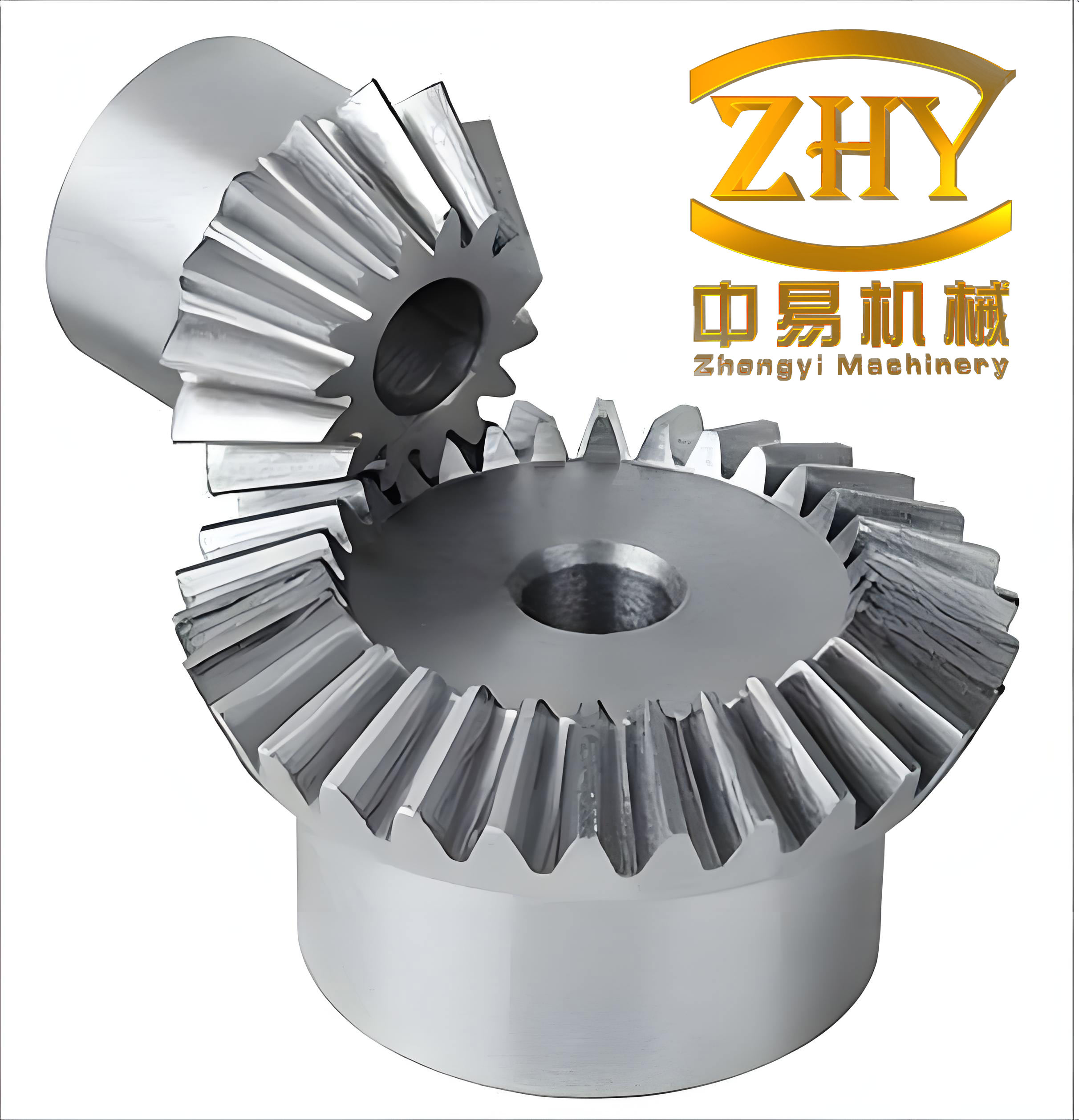
After modeling individual straight bevel gears, I assembled them into a gear train representative of a robotic joint mechanism. The assembly included multiple straight bevel gears arranged to transmit motion from input shafts to output joints, with careful attention to alignment and meshing conditions. In Pro/E, I used constraints to position the gears correctly, ensuring that the pitch cones intersect at a common apex and that the teeth engage without interference. The parameterized relationships extended to the assembly, allowing for automatic adjustment of positions and orientations when gear parameters are modified. This capability is vital for iterative design processes, as it reduces the time required for manual adjustments and minimizes errors. The final assembly was checked for global interference, confirming that all components fit together perfectly, which is a critical step before proceeding to simulations.
With the geometric model complete, I moved to dynamic simulation using ADAMS to analyze the system’s behavior under operational conditions. The straight bevel gear train was imported into ADAMS, where I assigned material properties, defined joints, and applied forces. Each gear pair was modeled with a contact force based on the IMPACT function, which accounts for stiffness, damping, and friction. The contact stiffness \( K \) was calculated using Hertzian contact theory, with values ranging from \( 4.98 \times 10^5 \) to \( 7.37 \times 10^5 \) N/mm depending on the gear pair, while damping was set to 100 N·s/mm to simulate lubricated conditions. Input drives were applied as step functions to avoid sudden shocks, and output loads were defined to represent typical operational torques. For example, one input shaft had an angular velocity defined as \( \text{step}(time, 0, 0, 0.5, 120^\circ/s) \), and the corresponding output load was \( \text{step}(time, 0, 0, 0.5, -200) + \text{step}(time, 1.5, 0, 2, 200) \) N·m. These settings allowed me to simulate the transient response of the straight bevel gear train and evaluate parameters like angular velocity and torque transmission.
The simulation results revealed important insights into the dynamics of the straight bevel gear system. The output angular velocities showed fluctuations around the input values, with average speeds closely matching theoretical predictions based on gear ratios. For instance, in a gear pair with a theoretical ratio of 1:1, the output speed averaged 90.38°/s compared to an input of 90.11°/s, indicating a minor error of 0.30%. However, in more complex arrangements with multiple stages, such as a two-stage straight bevel gear train, errors accumulated to around 2.50%, highlighting the impact of compounded tolerances and meshing imperfections. This analysis underscores the importance of precise modeling for predicting system performance, especially in applications like robotics where accuracy is critical. The straight bevel gear train demonstrated stable operation overall, but the simulations also identified areas for improvement, such as reducing backlash or optimizing tooth profiles for smoother motion.
| Component | Simulated Angular Velocity (°/s) | Theoretical Angular Velocity (°/s) | Relative Error (%) |
|---|---|---|---|
| Output Shaft 1 | 90.38 | 90.11 | 0.30 |
| Output Shaft 2 | 97.08 | 94.61 | 2.50 |
In addition to dynamic simulations, I conducted finite element analysis (FEA) to examine the stress distribution and contact behavior of the straight bevel gears under load. Using HyperMesh, I generated a meshed model of the gear pair, focusing on the teeth involved in contact. The mesh was divided into two regions: a fine hexahedral mesh (C3D8R elements) for the contact teeth to capture detailed stress patterns, and a coarser tetrahedral mesh (C3D10M elements) for the non-contact regions to reduce computational cost. This hybrid approach balanced accuracy and efficiency, allowing for a comprehensive analysis without excessive simulation time. The meshed model was then imported into ABAQUS, where I defined material properties, boundary conditions, and contact interactions. The gears were coupled to reference points representing their axes, and loads were applied as rotational velocities and torques to simulate real-world operating conditions.
The FEA results provided valuable data on the stress evolution during meshing. Initially, stresses concentrated around the gear hubs due to the applied boundary conditions, but as the gears engaged, the stress shifted to the tooth contact areas. The von Mises stress distribution showed that maximum stresses occurred along the tooth flanks, with values varying as the contact point moved from the toe to the heel of the straight bevel gear. I analyzed the contact stress at specific nodes over time, observing that stress peaks coincided with the entry and exit of teeth into the meshing zone. For example, at one node, the contact stress rose to approximately 450 MPa during engagement and dropped to zero upon disengagement. This pattern confirms the cyclic loading typical of gear operation and highlights the need for robust material selection and design. Furthermore, a path analysis across the tooth surface revealed that stress was relatively uniform in the central region but increased near the ends, suggesting potential areas for profile modification to reduce stress concentrations and improve fatigue life.
The contact stress distribution can be modeled using Hertzian contact theory, which for straight bevel gears involves complex curvature calculations. The maximum contact pressure \( p_{\text{max}} \) can be estimated as:
$$ p_{\text{max}} = \sqrt{\frac{F E^*}{\pi R^*}} $$
where \( F \) is the normal load, \( E^* \) is the equivalent modulus of elasticity, and \( R^* \) is the equivalent radius of curvature. For straight bevel gears, \( R^* \) depends on the local geometry and varies along the tooth length. In my analysis, the FEA results aligned well with this theoretical framework, validating the model’s accuracy. The simulations also emphasized the importance of including fillet radii and root details in the model, as these features significantly influence stress concentrations. By iterating on the design parameters, such as pressure angle or module, I could optimize the straight bevel gear for lower stress and longer service life, which is essential for high-demand applications like robotic joints.
| Parameter | Value | Description |
|---|---|---|
| Element Type (Contact Region) | C3D8R | 8-node linear brick elements with reduced integration |
| Element Type (Non-contact Region) | C3D10M | 10-node modified tetrahedral elements |
| Applied Torque | 100 N·m | Load on driven gear |
| Rotational Velocity | 31.4 rad/s | Input speed on driving gear |
| Simulation Time | 0.01 s | Duration for dynamic analysis |
Throughout this work, the straight bevel gear has been the focal point, demonstrating its critical role in transmission systems. The parameterized modeling approach enabled rapid prototyping and analysis, while the simulations provided deep insights into dynamic and structural behavior. The combination of Pro/E for geometry, ADAMS for dynamics, and HyperMesh with ABAQUS for FEA created a seamless workflow that can be adapted to other gear systems. This methodology not only validates the design but also identifies potential issues early in the development process, reducing costs and improving reliability. For instance, in robotic applications, where straight bevel gears are often used in compact joints, this approach ensures that the gears can handle varying loads without failure, contributing to overall system efficiency.
In conclusion, the precise modeling and simulation of straight bevel gear trains are essential for advancing mechanical design in fields like robotics and automation. By leveraging spherical involute theory and parameterization, I developed accurate models that faithfully represent the gear geometry. The dynamic simulations in ADAMS confirmed the theoretical performance, with minor errors attributable to system complexities, while the finite element analysis in ABAQUS revealed stress distributions that guide design improvements. This comprehensive analysis underscores the value of integrated software tools in engineering and provides a foundation for future work on straight bevel gears and similar mechanisms. As technology evolves, further refinements in modeling techniques and simulation algorithms will continue to enhance the performance and durability of straight bevel gear systems, enabling more efficient and reliable machines.