
In mechanical transmission systems, straight bevel gears play a critical role in transferring motion and power between intersecting shafts. The accuracy of gear tooth profiles directly influences performance, efficiency, and noise levels. Traditional modeling methods often approximate tooth profiles using conical involutes due to manufacturing constraints, but with advancements in rapid prototyping and powder metallurgy, the demand for higher precision has intensified. This paper focuses on analyzing the errors introduced by substituting spherical involutes with conical involutes in straight bevel gear modeling and presents a secondary development approach using UG/NX Grip to achieve accurate, parameterized 3D models. By leveraging spherical involute equations, the proposed method ensures minimal deviation from ideal tooth geometry, facilitating rapid and precise modeling for various applications.
The fundamental challenge in straight bevel gear design lies in the non-planar nature of tooth profiles, which are composed of spherical involutes. Historically, conical involutes have been used as a close approximation, but this substitution introduces errors that become significant in high-precision applications. In this analysis, I compare conical and spherical involutes by deriving their mathematical equations and evaluating coordinate discrepancies under different gear parameters. The results demonstrate that errors escalate with increasing module size and cone angle, necessitating the adoption of spherical involutes for optimal accuracy. Furthermore, I detail the development of a UG/NX Grip-based program that automates gear modeling, allowing users to input basic parameters such as module, number of teeth, and pressure angle to generate customized straight bevel gear models efficiently.
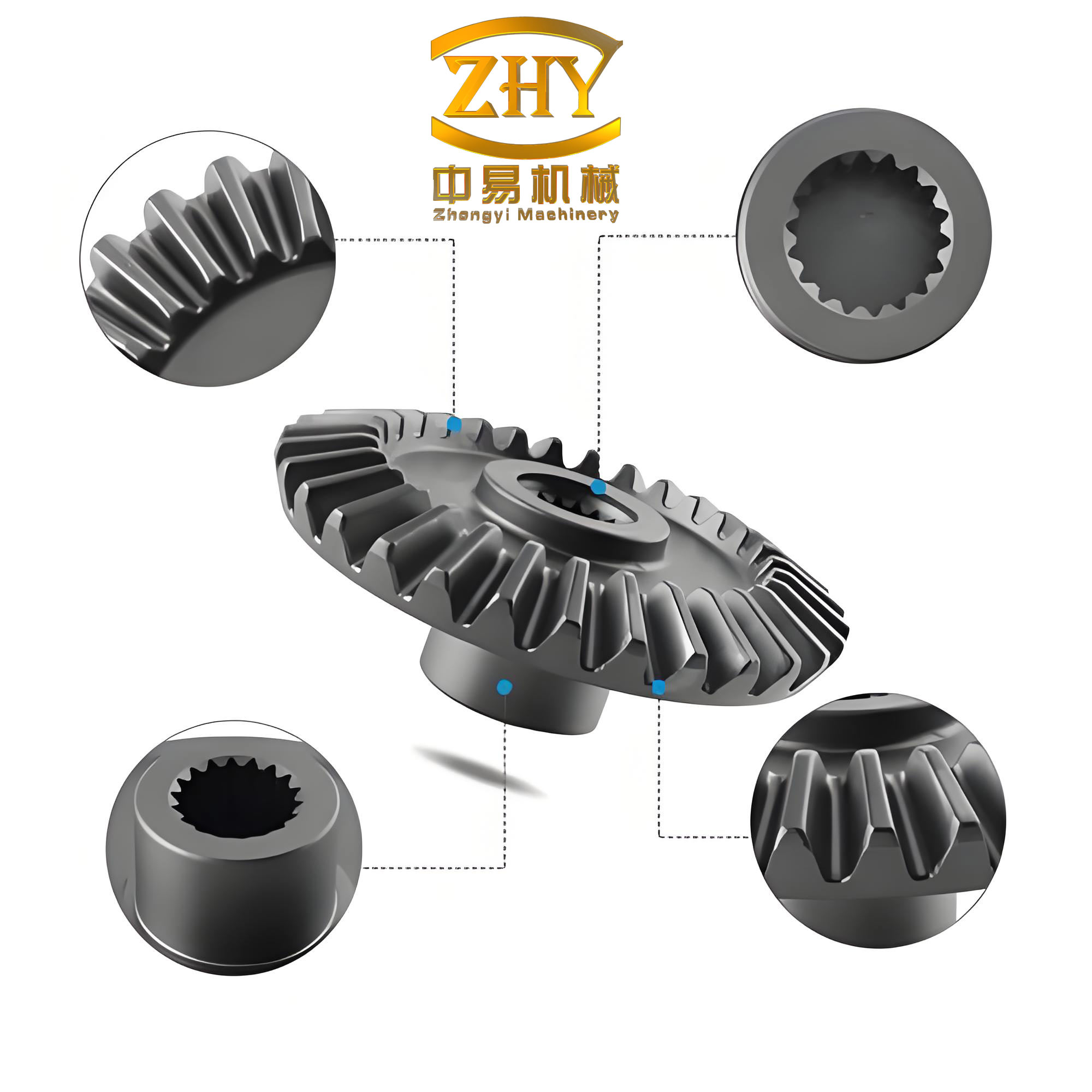
To quantify the errors between conical and spherical involutes, I derived the parametric equations for both curves. The conical involute, based on a developed back-cone surface, is represented in a 2D plane using standard involute equations. For a straight bevel gear, the radial distance \( r_k \) and roll angle \( \theta_k \) are given by:
$$ r_k = \frac{r_b}{\cos(\alpha_k)} $$
$$ \theta_k = \tan(\alpha_k) – \alpha_k $$
where \( r_b \) is the base radius, \( \alpha_k \) is the pressure angle at any point, and the Cartesian coordinates (x, y) are computed as:
$$ x = r_k \cos \theta_k $$
$$ y = r_k \sin \theta_k $$
In contrast, the spherical involute accounts for the 3D curvature of the gear tooth surface. Using a spherical coordinate system with radius R (equal to the outer cone distance), the coordinates (x, y, z) are defined as:
$$ x = R (\sin \beta \cos \psi + \cos \beta \cos \psi \sin \delta_b) $$
$$ y = R (\cos \beta \cos \psi – \sin \beta \cos \psi \sin \delta_b) $$
$$ z = R \cos \psi \cos \delta_b $$
where \( \psi = \cos \delta_b \cdot \beta \), \( \delta_b \) is the base cone angle, and \( \beta \) is an angular parameter. By varying \( \beta \), I generated discrete points along the involute curves and compared their coordinates to assess deviations. The table below summarizes the coordinate differences for various gear configurations, highlighting the impact of module size, number of teeth, and cone angle on error magnitude.
| Gear Parameters | Conical Involute Coordinates (x, y, z) | Spherical Involute Coordinates (x, y, z) | Coordinate Differences (Δx, Δy, Δz) |
|---|---|---|---|
| Module m=2, Teeth z=20, Cone Angle δ=arctan(20/10) | 18.7939, 0, 12.4123 | 18.6586, 0, 12.3230 | 0.1353, 0, 0.0893 |
| Module m=2, Teeth z=20, Cone Angle δ=arctan(20/20) | 18.7939, 0, 21.2061 | 18.7598, 0, 21.1677 | 0.0341, 0, 0.0384 |
| Module m=2, Teeth z=20, Cone Angle δ=arctan(20/40) | 18.7939, 0, 40.6031 | 18.7853, 0, 40.5846 | 0.0086, 0, 0.0185 |
| Module m=1, Teeth z=20, Cone Angle δ=arctan(20/20) | 9.3969, 0, 10.6031 | 9.3799, 0, 10.5838 | 0.0170, 0, 0.0193 |
| Module m=3, Teeth z=20, Cone Angle δ=arctan(20/20) | 28.1908, 0, 31.8092 | 28.1397, 0, 31.7515 | 0.0511, 0, 0.0577 |
| Module m=3, Teeth z=50, Cone Angle δ=arctan(50/20) | 46.9846, 0, 27.5384 | 46.4596, 0, 27.2307 | 0.5250, 0, 0.3077 |
| Module m=5, Teeth z=50, Cone Angle δ=arctan(50/20) | 70.4769, 0, 41.3076 | 69.6893, 0, 40.8460 | 0.7876, 0, 0.4616 |
The data reveals that errors in the x and z directions increase with larger module sizes and cone angles. For instance, when the module m=5 and cone angle is steep (δ=arctan(50/20)), the difference in x-coordinates reaches 0.7876 mm, which is substantial for precision gears. Additionally, the error distribution along the involute curve is non-uniform; it minimizes near the pitch circle and amplifies toward the base and tip regions. This nonlinear error pattern underscores the limitation of conical involutes in accurately representing the true spherical geometry of straight bevel gears.
To address these errors, I developed a secondary development program in UG/NX Grip, which enables parametric modeling of straight bevel gears using spherical involutes. The program structure comprises four main modules: human-computer interaction, parameter equation computation, tooth profile generation, and solid model creation. In the interaction phase, users input key parameters such as module (m), number of teeth (z), mating teeth (z_a), pressure angle (a), face width (B), and modification coefficient (x). The Grip code snippet below illustrates the parameter input dialog:
l10:
param/’Input Parameters’, ‘Module m’, m, ‘Teeth z’, z, ‘Mating Teeth z_a’, z_a, ‘Pressure Angle a’, a, ‘Face Width B’, B, ‘Modification Coefficient x’, x, respond
jump/l10:, stop:, , respond
Following parameter entry, the program computes the spherical involute points iteratively. For each angular increment, it calculates coordinates using the spherical involute equations and constructs spline curves for the tooth profiles. The core computation loop is implemented as:
do/l20:, fai, 0, 80, 0.5
pfai = fai * sinf(delta_b)
xt = R * (sinf(fai) * sinf(pfai) + cosf(fai) * cosf(pfai) * sinf(delta_b))
yt = R * (-cosf(fai) * sinf(pfai) + sinf(fai) * cosf(pfai) * sinf(delta_b))
zt = R * cosf(pfai) * cosf(delta_b)
pp(i, 2*fai+1) = point/xt, yt, zt
l20:
involute(i) = spline/pp(i, 1..161)
Here, ‘i’ denotes different sections (e.g., large end and small end of the gear tooth), and ‘involute(i)’ represents the generated spline curve. The program then mirrors these curves to form complete tooth profiles, ensuring symmetry about the gear axis. Next, it constructs the gear blank by revolving a composite curve around the central axis. Critical steps include coordinate transformations to align curves in the same plane and Boolean operations to subtract tooth volumes from the blank. For example, the coordinate system adjustment and circle generation are handled as:
csys1 = csys/pt(17), pt(1), pt(18)
&wcs = csys1
ln_gz(11) = circle/pt(20), pt(21), pt(11)
ln_gz(15) = circle/pt(22), pt(23), pt(16)
The solid modeling phase involves splitting the gear blank using the tooth profile surfaces and rotating duplicates to form all teeth. The Grip code for this operation is:
shape1 = split/solid(1), with, shape(1,2), iferr, stop:
do/l50:, i, 1, z-1
mat2(1,1..12) = matrix/xyrot, i*360/z
shape1(1, i+1) = transf/mat2(1,1..12), shape1(1,1)
l50:
do/l60:, i, 1, z-1
subtra/shape1(1,2), with, shape1(1, i+1)
l60:
This approach ensures that each tooth is precisely positioned, and the resulting model accurately reflects the spherical involute geometry. The program successfully generates straight bevel gear models with minimal user intervention, as demonstrated in output simulations where parameters like module and teeth count are varied. The automation significantly reduces modeling time while enhancing accuracy, making it suitable for applications in automotive differentials and industrial machinery.
In conclusion, the error analysis between conical and spherical involutes highlights the importance of using exact geometric representations for high-precision straight bevel gears. The secondary development in UG/NX Grip provides a robust solution for rapid, parameterized modeling, overcoming the limitations of traditional approximations. Future work could extend this method to helical bevel gears or incorporate dynamic simulation for performance validation. The integration of spherical involutes in CAD modeling marks a significant step toward achieving ideal gear tooth surfaces, ultimately improving the reliability and efficiency of mechanical transmissions.