
In modern industrial applications, straight bevel gears play a critical role in transmitting power between intersecting shafts, especially in heavy machinery such as mining equipment, wind turbines, and marine propulsion systems. The manufacturing of large straight bevel gears often presents challenges due to their size, complex geometry, and the need for high precision. Traditional machining methods rely on specialized tools like form cutters or ball-end mills, which can be inefficient or require large-scale equipment. To address these limitations, I explore the use of universal end mills for flank milling of straight bevel gears on five-axis CNC machines. This approach leverages the affordability, versatility, and efficiency of end mills while enabling the machining of large straight bevel gears on standard-sized CNC platforms. In this paper, I present a comprehensive method for solving the numerical control machining motion for straight bevel gears, including coordinate transformations, motion trajectory calculations, simulation validation, and experimental verification. The focus is on achieving accurate tooth profiles through flank milling with cylindrical cutters, which reduces costs and improves accessibility for manufacturing straight bevel gears.
The foundation of this work lies in the coordinate transformation from the workpiece coordinate system to the machine tool coordinate system. For a straight bevel gear, the tooth surface is defined in the workpiece coordinate system \( S_o (O_o – X_o Y_o Z_o) \). To facilitate machining on a five-axis CNC machine, I introduce intermediate coordinate systems: \( S_i (O_i – X_i Y_i Z_i) \) and \( S_j (O_j – X_j Y_j Z_j) \) for rotational adjustments, and an installation coordinate system \( S_w (O_w – X_w Y_w Z_w) \) to account for the offset between the gear’s rotational center and the machine’s workspace. Finally, the machine coordinate system \( S_m (O_m – X_m Y_m Z_m) \) defines the linear and rotary motions of the CNC machine. The transformation matrices between these systems are derived as follows:
$$ M_{io} = \begin{bmatrix} \cos a & -\sin a & 0 & 0 \\ \sin a & \cos a & 0 & 0 \\ 0 & 0 & 1 & 0 \\ 0 & 0 & 0 & 1 \end{bmatrix} $$
$$ M_{ji} = \begin{bmatrix} 1 & 0 & 0 & 0 \\ 0 & \cos c & -\sin c & 0 \\ 0 & \sin c & \cos c & 0 \\ 0 & 0 & 0 & 1 \end{bmatrix} $$
$$ M_{wj} = \begin{bmatrix} 1 & 0 & 0 & 0 \\ 0 & 1 & 0 & 0 \\ 0 & 0 & 1 & 0 \\ a_0 & b_0 & c_0 & 1 \end{bmatrix} $$
$$ M_{mw} = \begin{bmatrix} 1 & 0 & 0 & 0 \\ 0 & 1 & 0 & 0 \\ 0 & 0 & 1 & 0 \\ a_1 & b_1 & c_1 & 1 \end{bmatrix} $$
Here, \( a \) and \( c \) are rotation angles about the Z and X axes, respectively, while \( a_0, b_0, c_0 \) and \( a_1, b_1, c_1 \) are translation parameters. These matrices enable the conversion of cutter location data from the workpiece to the machine system. For instance, the cutter center coordinates \( [X’_o, Y’_o, Z’_o] \) in \( S_o \) transform to \( [X’_m, Y’_m, Z’_m] \) in \( S_m \) through the composite transformation:
$$ [X’_m, Y’_m, Z’_m] = M_{mw} M_{wj} M_{ji} M_{io} [X’_o, Y’_o, Z’_o] $$
Simplifying this yields the explicit expressions for linear motion:
$$ X’_m = X’_o \cos a – Z’_o \sin a + a_0 + a_1 $$
$$ Y’_m = X’_o \sin a \cos c + Y’_o \cos a \cos c – Z’_o \cos c + b_0 + b_1 $$
$$ Z’_m = X’_o \sin a \sin c + Y’_o \cos a \sin c + Z’_o \cos c + c_0 + c_1 $$
Similarly, the cutter axis vector \( \mathbf{p} = [p_X, p_Y, p_Z] \) in \( S_o \) transforms to \( \mathbf{p}_m = [p_{mX}, p_{mY}, p_{mZ}] \) in \( S_m \) as:
$$ p_{mX} = p_X \cos a – p_Z \sin a $$
$$ p_{mY} = p_X \sin a \cos c + p_Y \cos a \cos c – p_Z \cos c $$
$$ p_{mZ} = p_X \sin a \sin c + p_Y \cos a \sin c + p_Z \cos c $$
These equations form the basis for generating the linear motion trajectories (X, Y, Z) on the CNC machine. For rotary motions, I consider an XYZAB-type five-axis machine, where A and B represent rotations about the X and Y axes, respectively. The cutter axis vector \( \mathbf{p} \) is used to compute the swing angles A and B. The angle A depends on the sign of \( p_Y \):
$$ A = \begin{cases}
360^\circ – \arctan \left( \frac{p_Y}{\sqrt{p_X^2 + p_Z^2}} \right) & \text{if } p_Y > 0 \\
0 & \text{if } p_Y = 0 \\
-\arctan \left( \frac{p_Y}{\sqrt{p_X^2 + p_Z^2}} \right) & \text{if } p_Y < 0
\end{cases} $$
The angle B is determined based on the quadrant of \( p_X \) and \( p_Z \):
$$ B = \begin{cases}
\arctan \left( \frac{p_X}{p_Z} \right) & \text{if } p_X \geq 0, p_Z \geq 0 \\
180^\circ – \arctan \left( \frac{p_X}{p_Z} \right) & \text{if } p_X \geq 0, p_Z \leq 0 \\
180^\circ + \arctan \left( \frac{p_X}{p_Z} \right) & \text{if } p_X \leq 0, p_Z \leq 0 \\
360^\circ – \arctan \left( \frac{p_X}{p_Z} \right) & \text{if } p_X \leq 0, p_Z \geq 0
\end{cases} $$
With these formulas, I generate the NC program by processing cutter location data through a MATLAB script, which outputs the G-code for five-axis machining. This method ensures that the straight bevel gear tooth surfaces are accurately produced via flank milling. To illustrate the parameters involved, Table 1 summarizes the geometric specifications of a typical straight bevel gear used in this study.
| Parameter | Value | Parameter | Value |
|---|---|---|---|
| Module \( m_n \) (mm) | 20 | Face Width \( b \) (mm) | 100 |
| Number of Teeth \( z \) | 72 | Profile Shift Coefficient \( x_n \) | 0 |
| Pressure Angle \( \alpha_n \) (°) | 20 | Pitch Diameter at Large End \( D \) (mm) | 1440 |
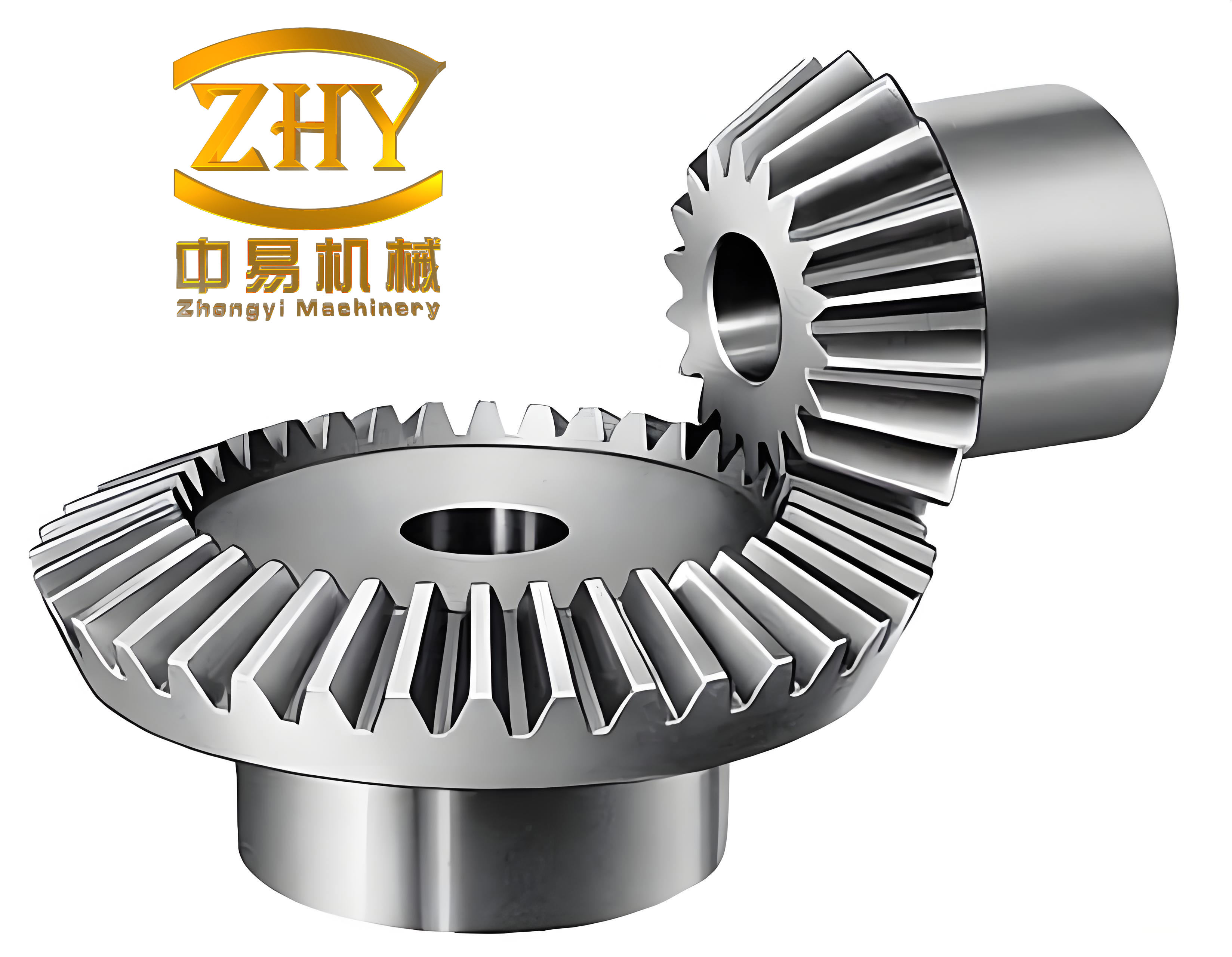
The machining process for straight bevel gears involves both roughing and finishing operations. Roughing is performed using a form cutter on a three-axis CNC machine to remove bulk material from the tooth slots, while finishing employs a cylindrical end mill with a diameter of 10 mm for flank milling on a five-axis machine. This strategy enhances efficiency and reduces dependency on large-scale equipment. The toolpath for finishing is planned based on the solved motion trajectories, ensuring that the cutter maintains optimal contact with the tooth flank of the straight bevel gear. The following figure illustrates a typical straight bevel gear, highlighting its conical geometry and tooth arrangement, which is essential for understanding the machining setup.
To validate the motion solution, I conducted a machining simulation using VERICUT software. A model of a five-axis CNC machine was built, and the NC program derived from the motion equations was loaded. The simulation included both roughing and finishing stages: roughing with a form cutter to create initial tooth slots, and finishing with the end mill to achieve the final tooth profile. The results showed that the machined tooth surfaces of the straight bevel gear closely matched the design model, with minor undercuts and overcuts within a tolerance of 0.05 mm. Specifically, undercuts occurred as isolated points due to residual material, and local overcuts were observed at the large end of the gear. These deviations are acceptable for most industrial applications and demonstrate the feasibility of using end mills for straight bevel gear machining.
Further validation was performed through actual machining on a DMU100 five-axis CNC machine. The straight bevel gear workpiece was mounted on the machine table, and the toolpaths were executed according to the generated NC code. After machining, the gear was measured using a coordinate measuring machine (CMM) to assess key parameters such as pitch deviation, profile error, and radial runout. The measurement results, summarized in Table 2, indicate that the gear met the accuracy standards specified in GB/T 10095.1-2022, achieving grade 7 for most parameters. This confirms the correctness of the motion solution and the practicality of the approach for straight bevel gear manufacturing.
| Parameter | Value (μm) | Standard |
|---|---|---|
| Single Pitch Deviation \( f_{pt} \) | 25.3 | Grade 7 |
| Cumulative Pitch Deviation \( F_p \) | 21.8 | Grade 7 |
| Radial Runout \( F_r \) | 38.3 | Grade 7 |
| Total Profile Deviation \( F_f \) | 5.6 | Within Tolerance |
| Profile Form Deviation \( f_f \) | 2.6 | Within Tolerance |
The advantages of this method are multifold. By using universal end mills, the cost of tooling for straight bevel gears is significantly reduced compared to specialized cutters. Moreover, the ability to perform five-axis flank milling on standard CNC machines makes it accessible for small to medium-sized manufacturers. The motion solution ensures high accuracy by accounting for the complex geometry of straight bevel gears through precise coordinate transformations and angle calculations. In practice, the machining parameters, such as feed rate and spindle speed, can be optimized based on the material and gear size. For instance, a feed rate of 100–200 mm/min and a spindle speed of 3000–5000 RPM are typical for steel straight bevel gears with modules around 20 mm.
In conclusion, I have developed and verified a numerical control machining motion solution for straight bevel gears that leverages end mills and five-axis CNC technology. The coordinate transformation matrices and motion trajectory equations enable accurate generation of tooth surfaces, while simulation and experimental results validate the approach. This method not only lowers manufacturing costs but also expands the capabilities for producing large straight bevel gears without relying on massive machinery. Future work could focus on optimizing toolpaths for different straight bevel gear designs or integrating real-time compensation for thermal and dynamic errors during machining. Overall, this contribution underscores the potential of advanced CNC strategies in enhancing the manufacturing of straight bevel gears for various industrial applications.