
In the realm of mechanical transmission systems, the straight bevel gear plays a pivotal role in transferring power between intersecting shafts, commonly found in automotive, printing machinery, and engineering applications. The demand for high-precision straight bevel gears has surged with the rapid growth of industries like automotive manufacturing, where components must endure rigorous operational conditions. However, traditional machining methods for straight bevel gears often face challenges such as low accuracy, high vibration, and noise due to mechanical limitations. As a manufacturer specializing in advanced machining solutions, I have explored the potential of numerical control wire electrical discharge machining (WEDM) to overcome these hurdles, offering a non-contact approach that enhances precision and versatility for producing straight bevel gears.
The conventional methods for machining straight bevel gears include gear planing, milling, and broaching machines, which rely on mechanical cutting tools. For instance, straight bevel gear planers use paired blades to generate tooth profiles through a generating motion, but they struggle with hardened materials and often require post-heat treatment grinding to achieve desired tolerances. Similarly, dual-disc milling machines and broaching equipment are limited by tool complexity, high costs, and restrictions on module size and tooth width. These mechanical processes introduce macroscopic cutting forces, leading to workpiece deformation and reduced surface quality. In contrast, WEDM employs a thin wire electrode to erode material through electrical discharges, enabling the machining of complex geometries without direct contact. This method is particularly advantageous for straight bevel gears, as it allows for the production of high-accuracy tooth profiles, even in hard-to-machine materials like stainless steel or titanium alloys.
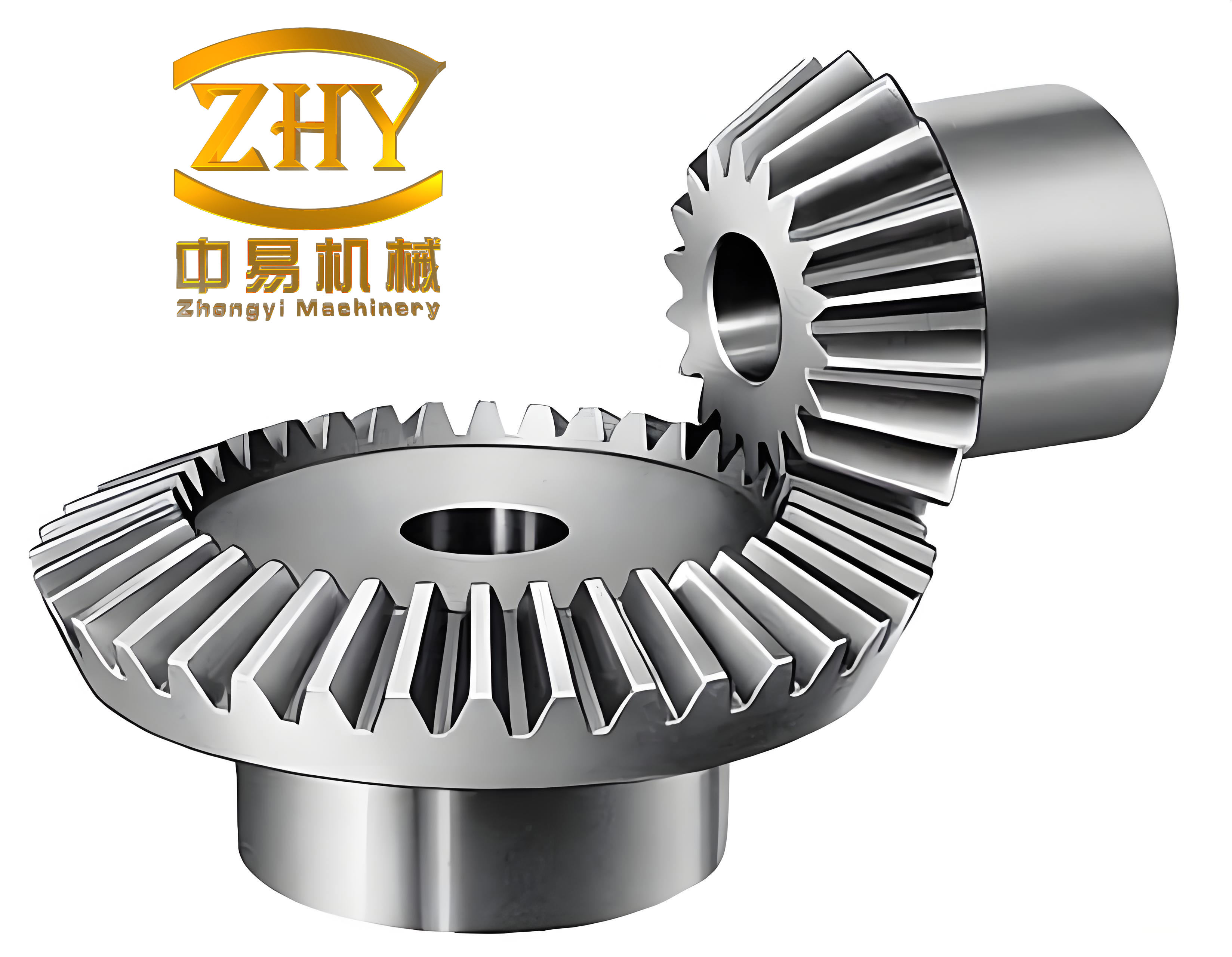
To understand the superiority of WEDM for straight bevel gear production, it is essential to delve into the machine structure and operational principles. A typical CNC WEDM system for straight bevel gears consists of a precision rotary table, wire feeding mechanism, wire guide feeding system, and a dielectric fluid supply with filtration. The workpiece, such as a gear blank, is mounted on the rotary table’s center, and the wire electrode—often made of molybdenum or copper—is positioned at an angle equal to the pitch cone angle of the straight bevel gear. This setup ensures that the wire’s path aligns with the gear’s theoretical profile, starting from the apex point (the gear’s spherical center) and extending to the base circle at the large end of the tooth. The CNC system synchronizes the rotary table’s rotation with the wire’s linear feed, following a programmed path based on the equivalent module of the straight bevel gear. For example, during machining, the wire remains stationary while the table rotates to form the tooth crest; then, it moves in coordination to generate the involute profile, and finally retracts to complete the tooth slot. This process is repeated for all teeth, resulting in a precise straight bevel gear with minimal deviation.
The mathematical foundation for machining straight bevel gears via WEDM involves gear geometry and kinematics. The equivalent spur gear parameters are used to program the wire path, as the straight bevel gear’s tooth profile can be represented by an involute curve in the transverse plane. The basic equation for the involute profile is given by: $$ r_b = \frac{m_n z}{2 \cos \beta} $$ where \( r_b \) is the base radius, \( m_n \) is the normal module, \( z \) is the number of teeth, and \( \beta \) is the spiral angle (for straight bevel gears, \( \beta = 0 \)). In WEDM, the wire’s position relative to the rotary axis is controlled by parametric equations derived from this geometry. For instance, the coordinates of the wire path for a straight bevel gear can be expressed as: $$ x = r \cos(\theta) + \Delta x, \quad y = r \sin(\theta) + \Delta y $$ where \( r \) is the instantaneous radius, \( \theta \) is the rotation angle, and \( \Delta x, \Delta y \) are the wire feed increments. This ensures that the machined tooth profile adheres to the standard involute form, critical for smooth meshing and low noise in transmission systems.
One of the key advantages of using WEDM for straight bevel gears is its ability to handle a wide range of materials and sizes without tool wear. Traditional machining requires specific cutters for different modules, leading to high costs and setup times. In WEDM, the same wire electrode can machine various straight bevel gear sizes, from small precision components to large industrial gears. Moreover, the process allows for multiple cuts—roughing and finishing—to achieve superior surface finish and accuracy. For example, a first pass might remove bulk material, while subsequent passes refine the tooth flanks to reduce roughness. The table below summarizes the performance parameters for high-speed (HS) and low-speed (LS) WEDM machines tailored for straight bevel gear production, highlighting their capabilities in terms of accuracy, surface roughness, and efficiency.
| Parameter | High-Speed WEDM | Low-Speed WEDM |
|---|---|---|
| Maximum Wire Speed | 8–12 m/s | 0.1–0.5 m/s |
| Best Achievable Accuracy | ±0.01 mm | ±0.002 mm |
| Surface Roughness (Ra) | 1.0–2.0 μm | 0.1–0.5 μm |
| Typical Material Removal Rate | 100–200 mm²/min | 50–100 mm²/min |
| Suitable for Straight Bevel Gear Sizes | Up to 500 mm diameter | Up to 1000 mm diameter |
In practical applications, the CNC programming for straight bevel gear WEDM involves generating tool paths based on gear design parameters. The wire electrode follows a trajectory that mimics the equivalent spur gear’s involute, with adjustments for the cone angle. The fundamental relationship for the pitch diameter of a straight bevel gear is: $$ d = m z $$ where \( d \) is the pitch diameter, \( m \) is the module, and \( z \) is the number of teeth. For WEDM, the wire feed rate \( v_f \) is calculated based on the material properties and desired surface quality, often derived from empirical formulas such as: $$ v_f = k \cdot E \cdot \frac{A}{t} $$ where \( k \) is a material constant, \( E \) is the discharge energy, \( A \) is the cross-sectional area of cut, and \( t \) is the thickness. This ensures efficient material removal while maintaining the integrity of the straight bevel gear teeth.
The benefits of WEDM for straight bevel gear machining extend beyond precision to environmental and economic factors. Unlike conventional machines that consume significant power—often tens of kilowatts—WEDM systems typically operate below 2 kW, reducing energy costs. The dielectric fluid, usually deionized water or water-based solutions, is environmentally friendly and can be recycled after filtration. Additionally, the absence of mechanical cutting forces minimizes stress-induced distortions, making it ideal for thin-walled or complex straight bevel gears. For large-scale production, WEDM offers flexibility; the same machine can produce prototypes and full batches without retooling, slashing lead times and costs. The table below compares key specifications of standard WEDM machine models designed for straight bevel gear applications, illustrating their versatility across different gear sizes and modules.
| Model Type | Max Workpiece Diameter (mm) | Module Range (mm) | Max Cone Distance (mm) | Tooth Count Range | Best Accuracy Grade |
|---|---|---|---|---|---|
| HS-WEDM Compact | 300 | 1–10 | 150 | 10–100 | ISO 6 |
| HS-WEDM Medium | 600 | 1–20 | 300 | 10–150 | ISO 5 |
| LS-WEDM Large | 1000 | 1–30 | 500 | 10–200 | ISO 4 |
| LS-WEDM Heavy-Duty | 2000 | 1–50 | 800 | 10–250 | ISO 3 |
To achieve optimal results in straight bevel gear WEDM, process parameters must be carefully calibrated. The discharge current, pulse duration, and wire tension influence the surface integrity and dimensional accuracy. For instance, a higher discharge energy increases the material removal rate but may elevate surface roughness, necessitating a balance for finishing cuts. The equation for the theoretical surface roughness \( R_a \) in WEDM can be approximated as: $$ R_a = C \cdot I_p \cdot t_on^{-0.5} $$ where \( C \) is a constant, \( I_p \) is the peak current, and \( t_on \) is the pulse-on time. By optimizing these parameters, manufacturers can produce straight bevel gears with tooth profiles that meet international standards, such as AGMA or ISO grades, ensuring compatibility in high-performance applications like wind turbines or aerospace systems.
In conclusion, the adoption of CNC WEDM for straight bevel gear machining represents a significant advancement over traditional methods, offering unparalleled precision, material flexibility, and cost efficiency. As industries push for lighter, stronger, and more reliable transmission components, this technology enables the production of straight bevel gears that excel in demanding environments. Through continuous innovation in CNC programming and machine design, WEDM is poised to redefine the manufacturing landscape for straight bevel gears, supporting global advancements in machinery and automation. The integration of real-time monitoring and adaptive control systems will further enhance the capability to produce custom straight bevel gears with minimal human intervention, paving the way for smarter, more sustainable manufacturing practices.
Furthermore, the scalability of WEDM machines allows for customization to specific straight bevel gear requirements, whether for small-batch prototypes or mass production. The non-thermal nature of the process reduces the risk of micro-cracks and residual stresses, which are common issues in conventional grinding. As a result, straight bevel gears machined via WEDM exhibit longer service life and improved performance in high-speed applications. The ongoing research in wire electrode materials and dielectric fluids promises to push the boundaries of what is possible, enabling the machining of straight bevel gears from advanced composites and superalloys. This evolution underscores the critical role of WEDM in meeting the future demands of industries reliant on precision gearing solutions.