
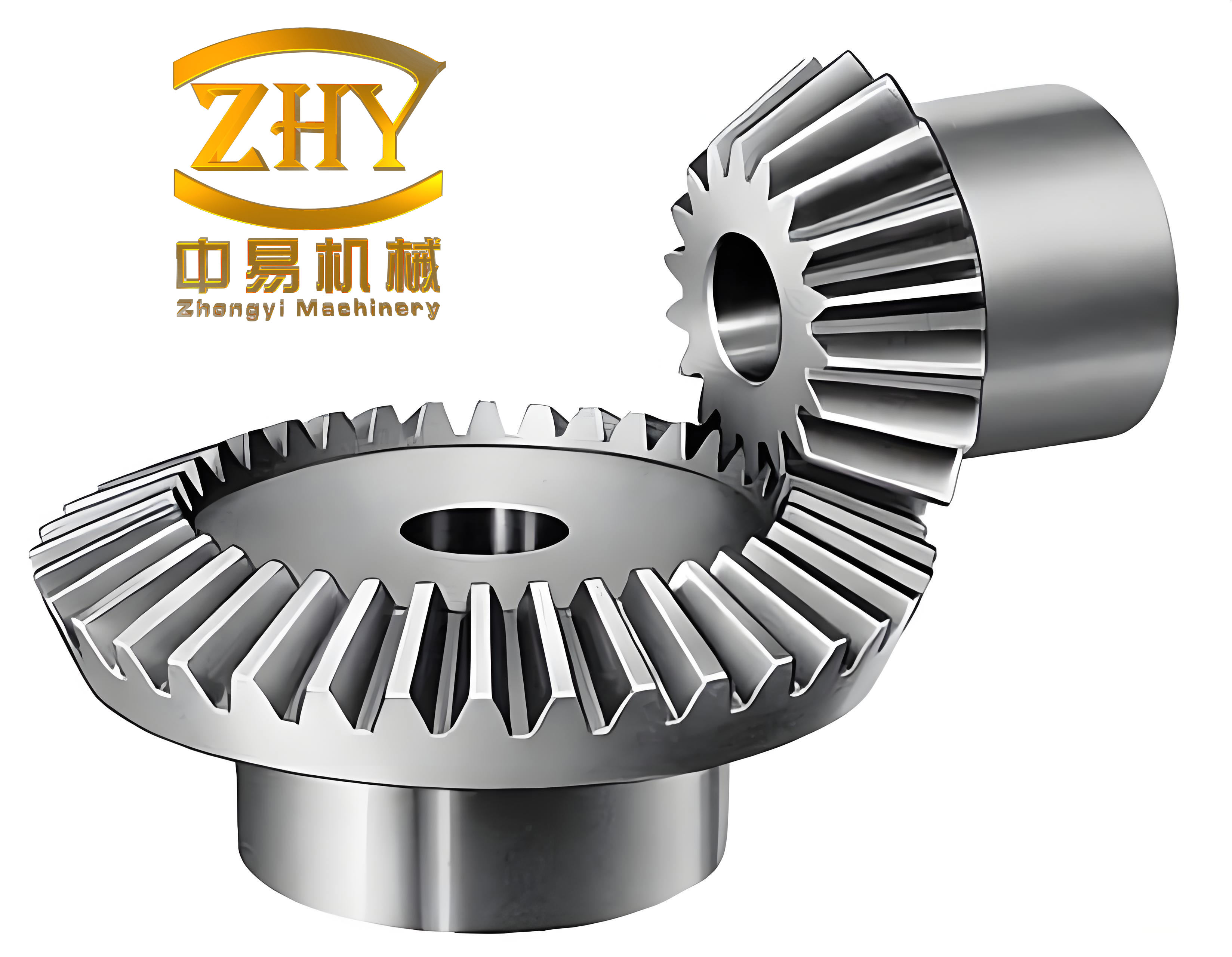
In this study, we focus on the dynamic behavior of straight bevel gears, which are widely used in transmission systems for aerospace, automotive, and heavy machinery due to their ability to change the direction of power transmission. However, under high-speed conditions, the primary failure mode of straight bevel gears is often fatigue pitting caused by dynamic contact stresses. These stresses are challenging to calculate accurately using theoretical formulas alone, necessitating advanced simulation approaches. We employ a parameterized design method in Creo to model straight bevel gears based on fundamental design parameters, enabling efficient customization and analysis. Using the multibody dynamics software RecurDyn, we develop a dynamic contact simulation model for a specific type of straight bevel gear. By applying rotational speeds and varying loads, we simulate the dynamic contact stresses during meshing and analyze how these stresses change under different load conditions. This research provides a practical dynamics foundation for further investigations into vibration and impact in straight bevel gear systems, ultimately contributing to improved durability and performance.
Straight bevel gears are essential components for transmitting motion between intersecting shafts, typically at a 90-degree angle. Their simple design and ease of manufacturing make them advantageous, but the sudden engagement of teeth along the face width can lead to impacts, noise, and reduced smoothness in operation. In high-speed applications, the repetitive contact stresses can result in fatigue failures such as pitting, which underscores the importance of understanding dynamic contact behavior. Traditional analytical methods often fall short in capturing the complex interactions during meshing, so we turn to multibody dynamics simulations for a more accurate assessment. Our approach integrates parameterized modeling with dynamic analysis to explore the stress variations and their implications for gear life.
To begin, we establish a parameterized model of the straight bevel gear in Creo, defining key parameters such as module, number of teeth, pressure angle, and cone angles. This allows for rapid generation of gear geometries and ensures consistency in design. The parametric relationships are derived from fundamental gear theory, enabling automatic updates to the model when parameters are modified. For instance, the spherical involute tooth profile is generated using equations that account for the gear’s geometry, ensuring accurate representation of the meshing surfaces. The parametric equations include variables for outer cone distance, root cone angle, face cone angle, and base cone angle, which are critical for defining the tooth shape. This parameterized approach not only streamlines the design process but also facilitates the exploration of different gear configurations for optimization.
The core of our dynamic analysis lies in the contact force calculation within RecurDyn, which utilizes a penalty-based method to handle contact nonlinearities. This method transforms contact problems into material nonlinearities, making it suitable for dynamic simulations. The normal contact force is modeled using a combination of elastic and damping components, based on Hertzian contact theory. The general form of the normal contact force \( F_n \) is given by:
$$ F_n = k \delta^{m_1} + c \frac{\dot{\delta}}{|\dot{\delta}|} \delta^{m_2} \delta^{m_3} $$
where \( k \) is the contact stiffness coefficient, \( \delta \) is the normal penetration depth between contacting surfaces, \( c \) is the damping coefficient, \( \dot{\delta} \) is the relative velocity at the contact point, and \( m_1 \), \( m_2 \), and \( m_3 \) are nonlinear exponents for the elastic force, damping force, and penetration, respectively. The contact stiffness \( k \) is derived from the material properties and geometry of the contacting surfaces, as per Hertz theory:
$$ k = \frac{4}{3} \sqrt{\frac{R_1 R_2}{R_1 + R_2}} \left( \frac{1 – \nu_1^2}{E_1} + \frac{1 – \nu_2^2}{E_2} \right)^{-1} $$
Here, \( R_1 \) and \( R_2 \) are the radii of curvature at the contact point, \( E_1 \) and \( E_2 \) are the elastic moduli, and \( \nu_1 \) and \( \nu_2 \) are the Poisson’s ratios of the two gears. For our simulation, we set the parameters as follows: dynamic friction coefficient of 0.1, maximum penetration depth of 0.01 mm, and nonlinear exponents \( m_1 = 1.6 \), \( m_2 = 1 \), and \( m_3 = 2 \). The stiffness coefficient \( k \) is set to 10,000 N/mm², and the damping coefficient \( c \) to 1 N·s/mm, ensuring realistic contact behavior during dynamic events.
In the parameterized design phase, we define the basic parameters of the straight bevel gear pair, as summarized in Table 1. These parameters include the number of teeth, module, pressure angle, and various cone angles, which are essential for generating the accurate geometry of the straight bevel gear. The spherical involute profile is constructed using parametric equations in Creo, allowing for the creation of reference curves such as the addendum circle, pitch circle, and dedendum circle at both the large and small ends of the gear. The tooth profile is then developed by blending these curves, resulting in a precise 3D model that can be easily modified for different designs.
| Parameter | Pinion | Gear |
|---|---|---|
| Number of Teeth | 17 | 35 |
| Module (mm) | 3 | 3 |
| Normal Pressure Angle | 25° | 25° |
| Pitch Cone Angle | 31°41’59” | 58°18’1″ |
| Face Cone Angle | 34°34’24” | 61°34’40” |
| Root Cone Angle | 27°48’28” | 54°48’50” |
| Cone Distance (mm) | 51.17 | 51.17 |
| Face Width (mm) | 12 | 12 |
The spherical involute equations used in Creo for generating the tooth profile are as follows:
$$ R = \rho $$
$$ \theta = \delta_f + (\delta_a – \delta_f) \times t $$
$$ \phi = \left( \frac{1}{\sin \delta_b} \right) \arccos \left( \frac{\cos \delta_b}{\cos \theta} \right) – \arccos \left( \frac{\tan \delta_b}{\tan \theta} \right) $$
where \( R \) is the outer cone distance, \( \delta_f \) is the root cone angle, \( \delta_a \) is the face cone angle, \( \delta_b \) is the base cone angle, and \( t \) is a parameter ranging from 0 to 1. These equations ensure that the tooth profile maintains a constant transmission ratio and smooth meshing characteristics. After creating the first tooth, we use pattern features in Creo to generate the full set of teeth, and all dimensions are linked to a parameter table for easy modifications. The assembled straight bevel gear model is checked for interference in Creo’s mechanism module, confirming zero interference and proper meshing before proceeding to dynamics simulation.
For the multibody dynamics simulation in RecurDyn, we import the 3D model and define the necessary constraints and contacts. The pinion is assigned a rotational speed, while the gear is subjected to a torque load to simulate real-world operating conditions. The material properties are set as follows: Young’s modulus \( E = 2.06 \times 10^5 \) MPa, Poisson’s ratio \( \nu = 0.3 \), and density \( \rho = 7800 \) kg/m³. The pinion’s rotational speed is set to 1500 rpm, which corresponds to an angular velocity of:
$$ \omega = \frac{2 \pi n}{60} = 157 \, \text{rad/s} $$
Given the gear ratio of 17:35, the theoretical rotational speed of the gear is calculated as:
$$ n_{\text{gear}} = n_{\text{pinion}} \times \frac{17}{35} = 750 \, \text{rpm} $$
To avoid abrupt changes that could cause excessive impacts, we apply the rotational speed and torque loads using step functions. The rotational speed function for the pinion is defined as \( 157 \times \text{STEP}(\text{TIME}, 0, 0, 1, 1) \), which ramps up from 0 to 157 rad/s over 1 second. Similarly, the torque load on the gear is defined as \( -X \times \text{STEP}(\text{TIME}, 0, 0, 1, 1) \), where \( X \) represents the maximum torque value, applied gradually to minimize initial shocks. We conduct simulations for different torque loads (0 N·mm, 50 N·mm, 250 N·mm, and 500 N·mm) to analyze the effects on dynamic behavior.
The simulation is run for a duration of 5 seconds with a step size of 500, and we monitor the rotational speeds and contact stresses over time. Under no load (0 N·mm), the pinion reaches the steady-state speed of 157 rad/s, and the gear oscillates around the theoretical speed of 76.257 rad/s. As the load increases, the speed fluctuations become more pronounced, indicating heightened dynamic interactions. For instance, at 500 N·mm load, the gear’s speed shows increased variability, reflecting the influence of torque on system stability. The contact stresses during meshing are critical for assessing fatigue life, and we observe that higher loads lead to greater stress magnitudes and more frequent variations. The maximum contact stress occurs during the initial engagement phase due to impact forces, reaching values up to 2636.6 N under no load, but this increases significantly with applied torque.
To quantify the results, we analyze the contact stress data across different load cases, as summarized in Table 2. This table highlights the maximum contact stresses and their variations, providing insights into the load-dependent behavior of the straight bevel gear pair. The data shows that as the load increases, the contact stress not only rises in magnitude but also exhibits more dynamic fluctuations, which could accelerate fatigue damage such as pitting. This underscores the importance of considering dynamic effects in the design and analysis of straight bevel gears for high-performance applications.
| Torque Load (N·mm) | Maximum Contact Stress (N) | Observations |
|---|---|---|
| 0 | 2636.6 | Stress peaks during initial engagement, with minimal fluctuations in steady state. |
| 50 | 2750.3 | Increased stress levels and more pronounced variations compared to no load. |
| 250 | 3100.8 | Significant stress rises and dynamic changes, indicating higher risk of fatigue. |
| 500 | 3500.5 | Highest stress magnitudes and frequent fluctuations, emphasizing load impact. |
In conclusion, our study demonstrates the effectiveness of using parameterized modeling and multibody dynamics simulation for analyzing straight bevel gears. The parameterized design in Creo allows for efficient generation and modification of gear geometries, while RecurDyn provides detailed insights into dynamic contact stresses under various operating conditions. The results reveal that contact stresses in straight bevel gears are highly sensitive to applied loads, with higher torques leading to increased stress levels and more dynamic behavior. This information is valuable for optimizing gear designs to enhance durability and reduce the risk of fatigue failures. Furthermore, the methodology established here serves as a robust foundation for future work on vibration and impact analysis in straight bevel gear systems, contributing to advancements in transmission technology. By leveraging these tools, engineers can better predict and mitigate issues related to dynamic performance, ultimately improving the reliability of straight bevel gears in critical applications.
The integration of parameterized design and dynamic simulation not only streamlines the development process but also enables a deeper understanding of the complex interactions in straight bevel gear meshing. As straight bevel gears continue to be integral in various industries, this approach supports the creation of more resilient and efficient transmission systems. Future research could explore additional factors such as thermal effects, lubrication, and material variations to further refine the analysis and extend the applicability of these findings. Overall, our work highlights the importance of dynamic simulation in addressing the challenges associated with straight bevel gear performance and longevity.