
In modern manufacturing, the demand for high-precision components like straight bevel gears has driven the development of advanced forming techniques. Cold precision forging, as a near-net shape process, offers significant advantages in material utilization, mechanical properties, and production efficiency. This article explores the optimization of cold precision forging for straight bevel gears, focusing on a novel composite process that combines open and closed die forging. Through finite element analysis and practical validation, we demonstrate how this approach enhances filling efficiency, reduces forming loads, and minimizes spring-back, ultimately improving the quality and precision of straight bevel gears.
Straight bevel gears are critical components in automotive differentials due to their smooth transmission, low noise, and high load-bearing capacity. Traditional machining methods for these gears often lead to material waste and reduced strength, whereas cold precision forging preserves metal fibers, refines grain structure, and increases gear strength by over 20%, bending fatigue life by approximately 20%, and impact strength by about 15%. The evolution of cold forging technology has positioned it as a key indicator of a country’s mechanical industry development level. However, challenges such as high forming loads and spring-back in conventional closed-die forging, or poor surface quality in open-die forging, necessitate innovative solutions. This study addresses these issues by proposing a composite process that integrates the benefits of both methods.
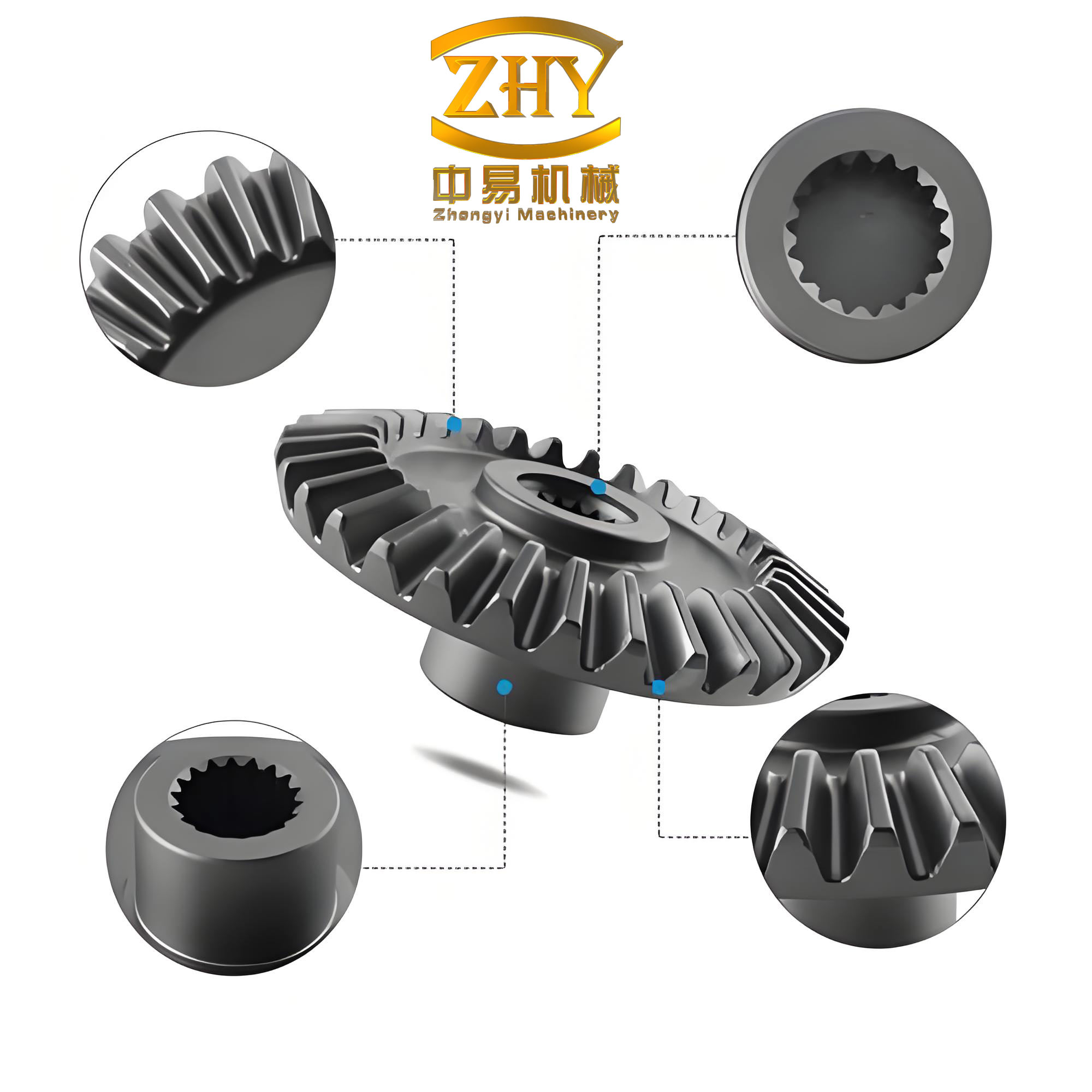
The design of the forging process for straight bevel gears begins with the development of a forging blueprint, which includes additional material for free forging surfaces to ensure complete die filling. The parting line is set at the junction between the back cone and the tooth profile, where the diameter is largest. Cold precision forging allows the tooth surface to be used without further machining, while the back cone serves as an installation reference with high precision requirements, reserving at least 1 mm of material. The central part of the forging features two holes with draft angles and a connecting web thickness of no less than 10 mm. The die assembly employs a three-layer prestressed structure to reduce forming loads and extend die life, as illustrated in the following table summarizing key design parameters for the straight bevel gear forging:
| Parameter | Value |
|---|---|
| Module (mm) | 5 |
| Pressure Angle | 22°30′ |
| Number of Teeth | 10 |
| Total Tooth Height (mm) | 8.94 |
| Pitch Diameter (mm) | 65 |
| Face Cone Angle | 45°28′ |
| Pitch Cone Angle | 37°34′ |
| Root Cone Angle | 31°44′ |
| Shaft Angle | 90° |
| Effective Tooth Height (mm) | 8 |
Three-dimensional modeling of the straight bevel gear forging and dies was performed using UG software, with the die comprising an upper punch, tooth cavity die, lower punch, and back cone die. The finite element model was established in Deform-3D, considering the symmetrical nature of the straight bevel gear, to simulate one-tenth of the gear and mirror the results for the entire component. This approach improves simulation accuracy and reduces computation time. The material for the straight bevel gear was defined as elastic-plastic, while the dies were treated as rigid. Given the absence of 20CrMnTi in the Deform database, 20MnCr5 was selected due to its similar properties. The forming speed was set to 30 mm/s based on press parameters, and a friction coefficient of 0.12 was used to account for lubrication with high-molecular-weight lubricants. Temperature effects were neglected, with the initial temperature at 20°C.
The optimization of the forging process for straight bevel gears involved comparing three schemes: closed-die forging (Scheme 1), open-die forging (Scheme 2), and the composite open-closed die forging (Scheme 3). In Scheme 1, the straight bevel gear is formed entirely in a closed cavity, resulting in high precision but elevated forming loads. Scheme 2 uses an open-die approach where material flows radially, reducing loads but compromising filling quality. Scheme 3 combines both methods: initial open-die forging allows material分流 to free surfaces, lowering loads, followed by closed-die forging to ensure complete tooth filling. The finite element simulations revealed that Scheme 3 achieved filling efficiency comparable to Scheme 1, superior to Scheme 2, while reducing the maximum forming load by approximately 10%. The following table summarizes the simulation results for the straight bevel gear forming processes:
| Scheme | Filling Efficiency | Max Forming Load (N) | Spring-back |
|---|---|---|---|
| Scheme 1 (Closed-Die) | Excellent | 5.94 × 10⁵ | High |
| Scheme 2 (Open-Die) | Poor | 4.15 × 10⁵ | Moderate |
| Scheme 3 (Composite) | Excellent | 5.46 × 10⁵ | Low |
The forming load in cold precision forging of straight bevel gears can be described by the following equation, which relates load to material flow stress and contact area: $$ F = A \cdot \sigma_f $$ where \( F \) is the forming load, \( A \) is the projected area of the deformation zone, and \( \sigma_f \) is the flow stress of the material. The flow stress for the straight bevel gear material, 20MnCr5, is influenced by strain and strain rate, and can be modeled using the Hollomon equation: $$ \sigma_f = K \cdot \epsilon^n $$ where \( K \) is the strength coefficient, \( \epsilon \) is the true strain, and \( n \) is the strain-hardening exponent. For the straight bevel gear forging, values of \( K = 1500 \) MPa and \( n = 0.2 \) were used based on material data. The reduction in forming load in Scheme 3 is attributed to the分流 of material during the open-die phase, which reduces the effective strain and stress concentrations.
Spring-back is a critical factor affecting the precision of straight bevel gears after forging. The spring-back amount \( \delta \) is proportional to the residual stress and forming load, and can be expressed as: $$ \delta = \frac{\sigma_r \cdot L}{E} $$ where \( \sigma_r \) is the residual stress, \( L \) is a characteristic length of the gear, and \( E \) is the Young’s modulus of the material. In the simulations for straight bevel gears, Scheme 3 exhibited lower spring-back due to the more uniform stress distribution and reduced peak loads. The relationship between forming load and spring-back is nonlinear, with spring-back increasing rapidly at higher loads, as shown in the following equation derived from the simulation data: $$ \delta \propto F^m $$ where \( m \) is an exponent greater than 1, indicating the sensitivity of spring-back to load changes. For straight bevel gears, minimizing spring-back is essential for achieving the required tooth profile accuracy without post-forging corrections.
The finite element analysis for straight bevel gears employed the updated Lagrangian formulation to handle large deformations. The equilibrium equation is given by: $$ \int_V \mathbf{B}^T \boldsymbol{\sigma} dV = \mathbf{F}_{ext} $$ where \( \mathbf{B} \) is the strain-displacement matrix, \( \boldsymbol{\sigma} \) is the Cauchy stress tensor, and \( \mathbf{F}_{ext} \) is the external force vector. The material model for the straight bevel gear included isotropic hardening, with the yield condition defined as: $$ f(\boldsymbol{\sigma}, \epsilon_p) = \bar{\sigma} – \sigma_y(\epsilon_p) \leq 0 $$ where \( \bar{\sigma} \) is the equivalent stress, and \( \sigma_y \) is the yield stress as a function of plastic strain \( \epsilon_p \). The simulation results for straight bevel gears showed that Scheme 3 not only reduced loads but also improved die life by avoiding the sharp load increases observed in Scheme 1.
Practical validation of the optimized process for straight bevel gears was conducted on a 650-ton hydraulic press, with no changes to other process parameters. The tooth cavity die was manufactured, and the forged straight bevel gears were inspected using red lead contact tests. The results confirmed that the composite process produced gears with normal contact patterns and stable transmission, maintaining product quality and precision. This demonstrates the feasibility of the composite open-closed die forging for straight bevel gears in industrial applications.
In conclusion, the composite cold precision forging process for straight bevel gears offers a balanced solution, combining the high filling efficiency of closed-die forging with the reduced loads of open-die forging. The straight bevel gears produced exhibit minimal spring-back, enhancing precision and reducing the need for post-processing. Finite element simulations serve as a valuable tool for optimizing forging processes, and the successful implementation of this method underscores its potential for widespread adoption in manufacturing straight bevel gears. Future work could focus on further refining the die design and material models to achieve even greater efficiencies for straight bevel gears.