
In the field of mechanical power transmission, straight bevel gears are widely used in various applications due to their simplicity and efficiency. However, one significant challenge associated with straight bevel gears is their high sensitivity to installation errors, which can lead to uneven load distribution, noise, and reduced lifespan. Traditional straight bevel gears operate with line contact, making them particularly vulnerable to misalignments such as axial offset, axial separation, and shaft angle errors. This sensitivity often results in contact patterns shifting towards the edges of the teeth, causing stress concentration and potential failure. To address this issue, we propose a comprehensive design methodology focused on reducing the installation error sensitivity of straight bevel gears through tooth surface modification. By implementing crowning modifications on the pinion tooth surface, we transition from line contact to point contact, thereby enhancing the stability of the contact pattern under various misalignment conditions. This article details the mathematical modeling, optimization process, and experimental validation of our approach, emphasizing the role of profile and longitudinal modifications in achieving low sensitivity straight bevel gear designs.
The foundation of our work lies in the modification of the tooth surface geometry to introduce a drum-shaped profile. For straight bevel gears, the unmodified tooth surface is generated using a straight-edged cutter moving along a linear path. The position vector and normal vector of the generating surface in the cutter coordinate system \( S_c \) are given by:
$$ \mathbf{r}_c(l, d) = [l, 0, d, 1]^T $$
$$ \mathbf{n}_c(l, d) = [0, 1, 0]^T $$
where \( l \) and \( d \) are parameters defining the cutter position. To achieve longitudinal modification, we alter the cutter trajectory to a parabolic path. The modified generating surface is described as:
$$ \mathbf{r}_c(l, d) = [l, -a l^2, d, 1]^T $$
$$ \mathbf{n}_c(l, d) = [2a l, 1, 0]^T / \sqrt{4a^2 l^2 + 1} $$
Here, \( a \) is the longitudinal modification coefficient, which controls the amount of crowning in the tooth length direction. For profile modification, we adjust the machine tool settings by modifying the roll ratio. The modified roll ratio \( I_f \) is expressed as:
$$ I_f = \frac{\cos \theta}{\sin \delta} + 2b (\phi_g + \phi_{0g}) $$
where \( b \) is the profile modification coefficient, \( \phi_g \) is the rotation angle of the cradle, \( \phi_{0g} \) is the initial cradle angle, \( \theta \) is the dedendum angle, and \( \delta \) is the pitch angle. These modifications collectively result in a drum-shaped tooth surface that facilitates point contact between the mating gears, significantly reducing the sensitivity to installation errors.
To further enhance the meshing stability and minimize the impact of misalignments, we develop an optimization model based on the differential surface geometry. The differential surface, which represents the difference in curvature between the two mating tooth surfaces, plays a crucial role in determining the contact behavior. The Gaussian curvature \( K_{12} \) of the differential surface at a contact point is defined as:
$$ K_{12} = k_{12n\alpha} k_{12n\beta} – (\tau_{12g\alpha})^2 $$
where \( k_{12n\alpha} \) and \( k_{12n\beta} \) are the relative normal curvatures along two orthogonal directions \( \alpha \) and \( \beta \) in the common tangent plane, and \( \tau_{12g\alpha} \) is the relative geodesic torsion along the \( \alpha \) direction. A stable contact pattern requires that the Gaussian curvature varies minimally along the path of contact and that its value at the reference point is sufficiently large to avoid line contact tendencies. The principal curvatures \( K_1 \) and \( K_2 \) of the differential surface, which correspond to the major and minor axes of the instantaneous contact ellipse, are given by:
$$ K_1 = k_{12n\alpha} \cos^2 \phi_1 + k_{12n\beta} \sin^2 \phi_1 + \tau_{12g\alpha} \sin 2\phi_1 $$
$$ K_2 = k_{12n\alpha} \sin^2 \phi_1 + k_{12n\beta} \cos^2 \phi_1 – \tau_{12g\alpha} \sin 2\phi_1 $$
where \( \phi_1 \) is the angle between the \( \alpha \) direction and the principal direction, calculated as:
$$ \cot 2\phi_1 = \frac{1}{2\tau_{12g\alpha}} (k_{12n\alpha} – k_{12n\beta}) $$
The length of the instantaneous contact ellipse along the major axis can be approximated using the formula:
$$ \Delta \delta \approx \frac{1}{2} K_1 \Delta l^2 $$
where \( \Delta \delta \) is the approach distance (taken as 0.00635 mm based on experimental data), and \( \Delta l \) is the semi-major axis length. To prevent excessive contact stress, we ensure that the length of the contact ellipse is at least one-third of the tooth width \( B \).
Our optimization model aims to minimize the installation error sensitivity by controlling the Gaussian curvature of the differential surface. The objective function is constructed as:
$$ f(a, b) = \max \sum_{i=1}^n \left| 1 – \frac{k_{12i} – k_{120}}{k_{120}} \right| $$
where \( k_{120} \) is the Gaussian curvature at the reference point \( M \), and \( k_{12i} \) are the Gaussian curvatures at points along the path of contact from start to end. The optimization variables are the longitudinal modification coefficient \( a \) and the profile modification coefficient \( b \). The constraints include:
$$ g(1) = a > 0 $$
$$ g(2) = b > 0 $$
$$ g(3) = \Delta l – \frac{B}{3} \geq 0 $$
These constraints ensure positive modification coefficients and an adequate contact ellipse length to avoid high stress concentrations. The optimization process involves iterative tooth contact analysis (TCA) to evaluate the contact behavior under various conditions.
To illustrate the effectiveness of our approach, we present a numerical example with a straight bevel gear pair. The gear parameters are summarized in the following table:
| Parameter | Pinion | Gear |
|---|---|---|
| Number of teeth \( Z \) | 10 | 16 |
| Module \( m \) (mm) | 7.65 | 7.65 |
| Pressure angle \( \alpha \) (°) | 22.5 | 22.5 |
| Shaft angle \( \Gamma \) (°) | 90 | 90 |
| Addendum \( h_a \) (mm) | 11.115 | 4.185 |
| Dedendum \( h_f \) (mm) | 4.685 | 11.615 |
| Face width \( B \) (mm) | 20.4 | 20.4 |
| Pitch angle \( \delta \) (°) | 32 | 58 |
| Tip angle \( \delta_a \) (°) | 39.332 | 62.62 |
| Root angle \( \delta_f \) (°) | 27.38 | 50.668 |
Through optimization, we obtain the modification coefficients \( a = 0.0046 \) and \( b = 0.003 \) for the pinion. The gear tooth surface remains unmodified. We perform tooth contact analysis (TCA) and loaded tooth contact analysis (LTCA) under a torque of 100 N·m to evaluate the contact patterns. The misalignment parameters are defined as follows: \( H \) for axial offset (positive indicating increased pinion mounting distance), \( V \) for axial separation (positive indicating pinion axis below gear axis), and \( \beta \) for shaft angle error (positive indicating increased shaft angle).
Under ideal conditions with no misalignment, the unmodified straight bevel gear exhibits line contact, whereas the modified pinion and unmodified gear exhibit point contact with a contact pattern width of approximately one-third the face width. The contact path is nearly perpendicular to the root cone. When subjected to misalignments, the contact pattern shifts slightly towards the toe or heel, but remains stable without edge contact. For instance, with a shaft angle error \( \beta = -2^\circ \), the pattern moves towards the toe; with \( \beta = 3^\circ \), it moves towards the heel. Similar behavior is observed for axial offset and separation errors. The loaded contact patterns, accounting for tooth deflection, show a broader distribution but maintain the same trend, indicating low sensitivity to installation errors.
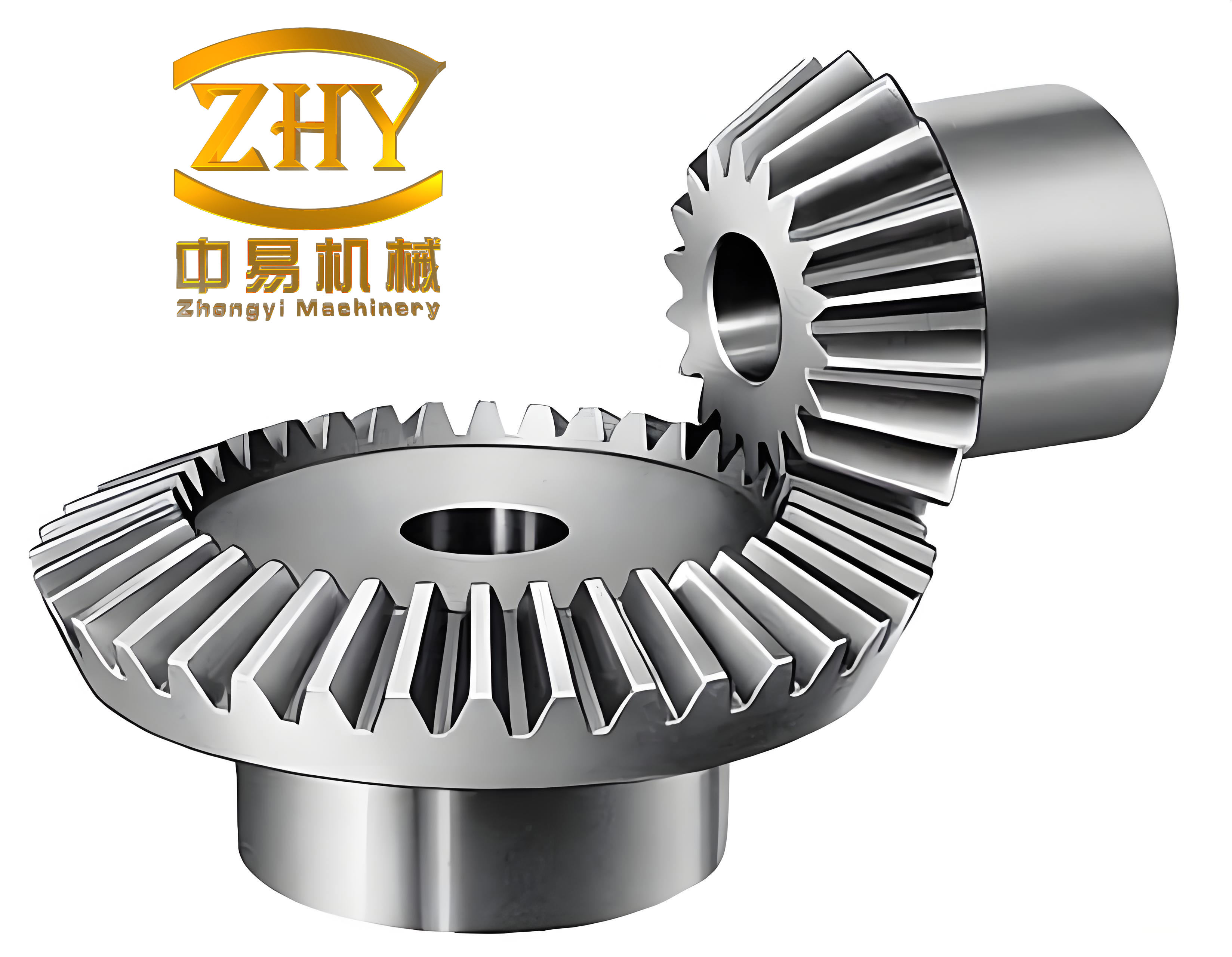
To validate our theoretical findings, we conduct experimental tests on a rolling contact testing machine. The pinion and gear are manufactured based on the digital tooth surfaces derived from our model. A ball-end mill with a diameter of 4 mm is used on a four-axis CNC milling machine to achieve the modified surfaces. The gear inspection results show a maximum deviation of 5 μm, with most working areas having negligible errors. The rolling tests under various misalignment conditions confirm the stability of the contact patterns. For example, with \( H = -1 \) mm and \( V = 0 \) mm, the pattern shifts towards the toe; with \( H = 1 \) mm and \( V = 0 \) mm, it shifts towards the heel. The patterns remain within the desired region, demonstrating that the total axial misalignment and separation can reach up to 30% of the normal module without adverse effects. This tolerance level is significantly higher than that of conventional straight bevel gears, highlighting the effectiveness of our design.
The success of our low installation error sensitivity design for straight bevel gears relies on the careful control of the differential surface geometry. By optimizing the modification coefficients, we achieve a balance between contact stability and stress distribution. The Gaussian curvature of the differential surface serves as a key indicator of sensitivity, with minimal fluctuations along the contact path ensuring consistent performance. The principal curvatures determine the size and orientation of the contact ellipse, which must be sufficiently long to avoid excessive pressure. Our approach not only improves the meshing quality of straight bevel gears but also extends their applicability in precision applications where misalignments are inevitable.
In conclusion, the proposed methodology for designing straight bevel gears with low installation error sensitivity involves tooth surface modifications through parabolic cutter trajectory and variable roll ratio. The optimization model, based on differential surface curvature control, effectively reduces the impact of misalignments on contact patterns. Experimental results validate the theoretical predictions, showing stable patterns under significant errors. This design enhances the reliability and performance of straight bevel gears in practical applications, making them more robust to assembly inaccuracies. Future work could explore the integration of this approach with advanced manufacturing techniques such as precision forging to further improve the efficiency and accuracy of straight bevel gear production.