
In modern industrial applications, straight bevel gears are widely used in automotive, machine tool, and engineering machinery sectors due to their ease of processing, low cost, and ability to change transmission direction. However, the increasing demands for high performance, low consumption, and reliability in these fields necessitate higher precision in straight bevel gear manufacturing. Tooth shape error, a critical geometric deviation, directly impacts transmission stability, instantaneous speed ratio, and noise levels. Traditional inspection methods, such as contact moulage testing, rely on subjective judgments and lack quantitative accuracy and traceability. To address these limitations, I propose an advanced measurement and evaluation method for tooth shape error in straight bevel gears based on the electronic generating principle. This approach leverages mathematical modeling and CNC gear measurement centers to achieve automated, high-precision assessments.
The tooth shape of a straight bevel gear is theoretically defined as a spherical involute. However, due to the impracticality of unfolding a sphere into a plane, engineering practices often approximate this using a back cone involute. The back cone, which can be expanded into a plane, allows for the use of an equivalent spur gear’s tooth profile to represent the theoretical tooth shape of the straight bevel gear with minimal error. This approximation forms the basis for measuring tooth shape errors in straight bevel gears. Common tooth shape errors include deviations such as “top fat and root thin,” “top thin and root fat,” and pressure angle variations, which arise from machining inaccuracies or improper process parameters. Accurately measuring these errors is essential for diagnosing and correcting manufacturing issues.
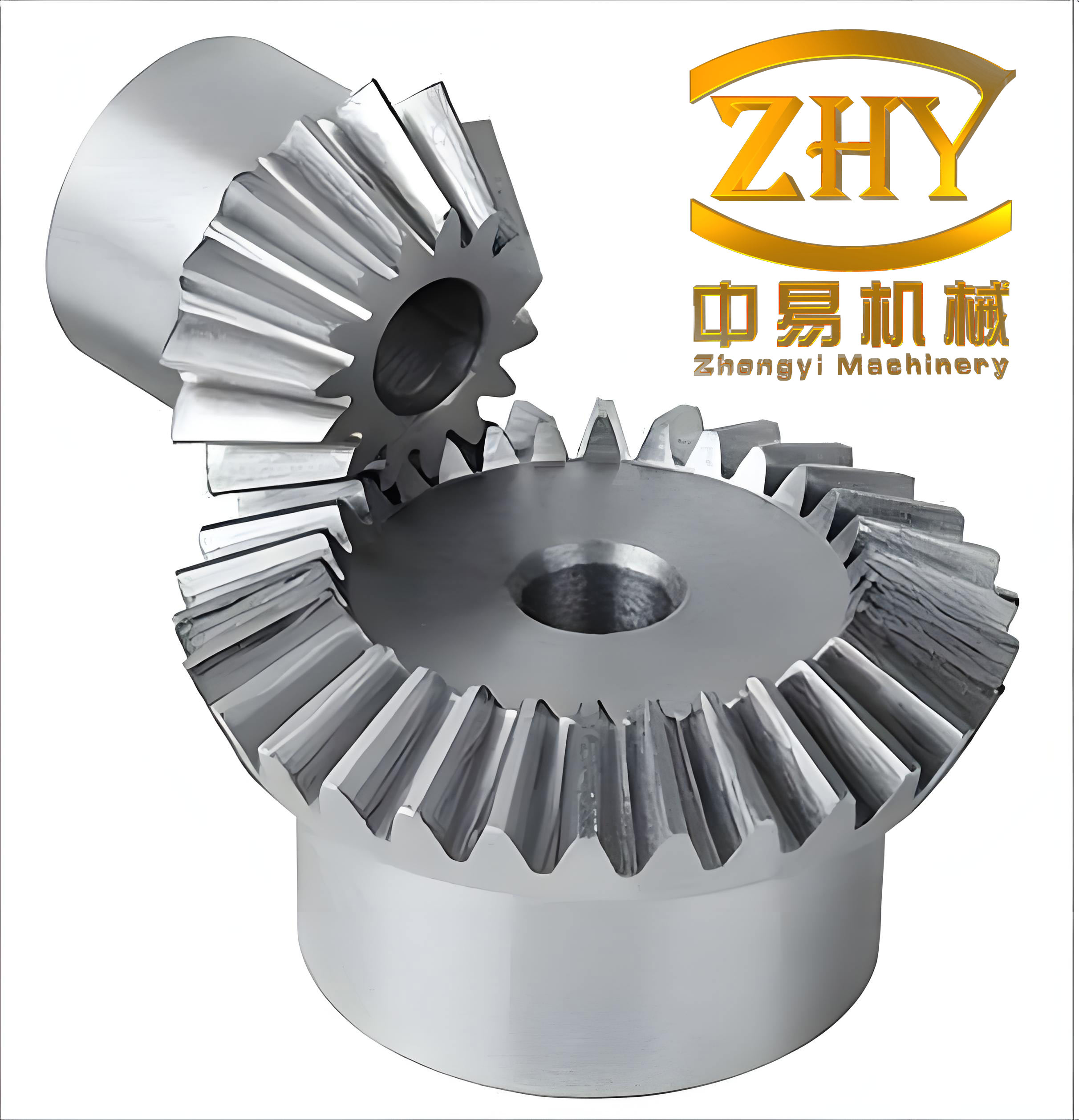
To establish a measurement model, I first derive the mathematical relationships for the tooth profile. The tooth shape error is defined as the normal distance between two theoretical tooth profiles within the working part of the gear, typically measured at the middle of the tooth width. The sensor probe trajectory during measurement follows the theoretical back cone involute curve. The development angle at any point P on the tooth profile, denoted as $\phi_p$, is calculated using spherical trigonometry principles. The formula is given by:
$$ \phi_p = \arccos \left( \frac{\cos \delta_p}{\cos \delta_b} \right) $$
where $\delta_p$ is the cone angle at point P, and $\delta_b$ is the base cone angle. The development angle at the measurement endpoint, $\phi_a$, is determined by substituting the tip cone angle $\delta_a$:
$$ \phi_a = \arccos \left( \frac{\cos \delta_a}{\cos \delta_b} \right) $$
For the starting point of measurement, the development angle $\phi_1$ is calculated based on the engagement with a plane gear, analogous to the method used for cylindrical gears. The formula is:
$$ \phi_1 = \arccos \left( \frac{\cos \delta_1}{\cos \delta_b} \right) $$
where $\delta_1$ is the working cone angle during engagement with a plane gear. This angle is derived as:
$$ \delta_1 = \arccos (\cos \delta \cos x + \sin \delta \sin x \sin \alpha) $$
with $\sin x = \sin \theta_a / \sin \alpha_0$ and $\theta_a = \delta_a – \delta$, where $\delta$ is the pitch cone angle and $\alpha$ is the pitch cone pressure angle. The base cone angle $\delta_b$ is computed as:
$$ \delta_b = \arcsin (\sin \delta \cos \alpha) $$
These equations form the foundation for the electronic generating method, which replaces mechanical generation with computer-controlled servo systems to trace the theoretical tooth profile.
The electronic generating method involves controlling multiple axes of a gear measurement center to simulate the theoretical tooth curve. In this setup, the straight bevel gear is mounted between centers, and a sensor probe is guided along the back cone involute path through synchronized movements of the rotary axis (W) and linear axes (Y and Z). The probe continuously scans the tooth surface, and the sensor readings are recorded to evaluate deviations from the ideal profile. This method ensures high traceability and automation, as the system operates in a closed-loop control environment. The software for this process is developed using object-oriented programming, modularizing functions such as data acquisition, error calculation, and result display to enhance maintainability and scalability.
To validate this method, I conducted experiments on a CNC gear measurement center. The straight bevel gear parameters used in the test are summarized in the table below:
| Parameter | Value | Unit |
|---|---|---|
| Number of Teeth | 20 | – |
| Pitch Cone Angle | 30 | degrees |
| Pressure Angle | 20 | degrees |
| Tip Cone Angle | 35 | degrees |
| Base Cone Angle | 28.5 | degrees |
During measurement, the sensor probe traced the tooth profile, and data points were collected to compute the tooth shape error. The results, processed using least squares evaluation, included total profile deviation, form deviation, and slope deviation. For instance, the slope deviation $f_{H\alpha}$ was measured as -0.1591 mm over an evaluation length $L$ of 23.457 mm. The pressure angle error $\Delta \lambda$ was calculated as:
$$ \Delta \lambda = \arctan \left( \frac{f_{H\alpha}}{L} \right) = \arctan \left( \frac{-0.1591}{23.457} \right) = -0.388^\circ $$
This indicates that the pressure angle of the straight bevel gear was larger than the theoretical value by 0.388 degrees, which can be corrected by adjusting machine parameters. The table below summarizes the error types and their characteristics observed in straight bevel gears:
| Error Type | Description | Common Causes |
|---|---|---|
| Top Fat and Root Thin | Excessive material at tooth tip and insufficient at root | Incorrect tool setting or wear |
| Top Thin and Root Fat | Insufficient material at tooth tip and excessive at root | Improper machine alignment |
| Pressure Angle Variation | Deviation from theoretical pressure angle | Tool geometry errors |
| Asymmetric Errors | One side within tolerance, the other not | Eccentric mounting or machining |
The electronic generating method offers significant advantages over traditional approaches. It enables quantitative error description, enhances traceability through digital data, and improves measurement efficiency. The automation reduces human intervention, minimizing subjectivity. Moreover, this method can be implemented on existing CNC gear measurement centers without requiring expensive proprietary systems, making it accessible for various industrial applications. The integration of real-time data acquisition and error analysis facilitates rapid feedback for process optimization, ultimately leading to higher-quality straight bevel gear production.
In conclusion, the proposed method for measuring and evaluating tooth shape error in straight bevel gears using electronic generating principles proves to be effective and reliable. By establishing accurate mathematical models and leveraging CNC technology, it addresses the limitations of conventional techniques. The experiments demonstrate that this approach not only achieves precise error quantification but also provides actionable insights for manufacturing improvements. As industries continue to demand higher precision components, such advanced measurement methods will play a crucial role in enhancing product performance and competitiveness. Future work could focus on extending this method to other gear types or integrating artificial intelligence for predictive error correction.