
In this article, I will describe the comprehensive parametric modeling process for equal-dedendum straight bevel gears using advanced CAD software. Straight bevel gears are essential components in mechanical transmissions, and the equal-dedendum variant offers significant advantages, such as uniform clearance along the tooth length, which enhances strength and reduces the risk of failure. This method leverages parametric equations and geometric transformations to create accurate and adaptable models. Throughout this discussion, I will emphasize the importance of straight bevel gears in various applications, highlighting their design intricacies.
The equal-dedendum straight bevel gear design ensures that the tooth clearance remains constant from the large end to the small end, unlike traditional designs where clearance decreases. This characteristic results in the root cone母线 of one gear being parallel to the tip cone母线 of the mating gear, leading to improved load distribution and reduced stress concentrations. For instance, the tip angle of gear 1 equals the root angle of gear 2, and vice versa, which is a key feature of straight bevel gears. This approach minimizes the likelihood of interference at the small end and increases the tooth root radius, thereby enhancing the overall durability of straight bevel gears.
To begin the parametric modeling of straight bevel gears, I start by importing the necessary expressions and parameters. This involves accessing the expression dialog in the CAD interface and loading a predefined expression file, such as one containing gear-specific variables. The expressions define critical parameters like tip diameter, root diameter, base diameter, pitch diameter, pitch angle, and tooth width, which are essential for controlling the geometry of straight bevel gears. Below is a table summarizing some of these key parameters used in the modeling process:
| Parameter | Symbol | Description |
|---|---|---|
| Tip Diameter | \( r_a \) | Diameter at the tooth tip of the straight bevel gear |
| Root Diameter | \( r_f \) | Diameter at the tooth root of the straight bevel gear |
| Base Diameter | \( r_b \) | Base circle diameter for involute generation in straight bevel gears |
| Pitch Diameter | \( r \) | Reference diameter for pitch circle of straight bevel gears |
| Pitch Angle | \( \delta_1 \) | Angle defining the pitch cone of the straight bevel gear |
| Tooth Width | \( b \) | Width of the tooth along the face of the straight bevel gear |
These parameters are interrelated through mathematical relationships that ensure the proper functioning of straight bevel gears. For example, the pitch angle \( \delta_1 \) can be derived from the gear ratio and the number of teeth, which is fundamental in straight bevel gear design. The parametric equations allow for quick modifications, making the model versatile for different straight bevel gear configurations.
Next, I proceed to create the basic lines, planes, and circles that form the foundation of the straight bevel gear model. Using the XOZ plane as a reference, I sketch the gear’s cross-sectional profile, including the tooth tip line, tooth root line, base cone line, and pitch line. The positions of these elements are controlled by the imported parameters, such as \( r_a \) for the tip line and \( r_f \) for the root line. This step is crucial for defining the overall shape of the straight bevel gear and ensuring that the tooth geometry aligns with the equal-dedendum principle. Additionally, I establish reference planes at the large and small ends of the gear, which are perpendicular to the XOZ plane at 90-degree angles, to facilitate the creation of equivalent spur gear profiles for the straight bevel gear.
On the large-end reference plane, I construct the basic circles for the equivalent spur gear, including the root circle, base circle, pitch circle, and tip circle. Their diameters are defined by parameters like \( d_{f1,\text{max}} \), \( d_{b1,\text{max}} \), \( d_{\text{max}} \), and \( d_{a1,\text{max}} \), which are derived from the straight bevel gear parameters. Similarly, on the small-end reference plane, I create analogous circles with diameters such as \( d_{f1,\text{min}} \), \( d_{b1,\text{min}} \), \( d_{\text{min}} \), and \( d_{a1,\text{min}} \). This approach allows for the accurate representation of the straight bevel gear’s tapered form by projecting these profiles along the gear axis. The mathematical relationships for these diameters can be expressed using formulas like the pitch diameter calculation for straight bevel gears: $$ d = m \cdot z $$ where \( m \) is the module and \( z \) is the number of teeth. This formula is adapted for the large and small ends based on the cone distance, ensuring consistency in straight bevel gear design.
To generate the tooth profile for the straight bevel gear, I focus on creating involute curves at both the large and small ends. This involves shifting the coordinate system to the center of the large-end circles, with the reference plane serving as the XOY plane and the Z-axis oriented appropriately. Using the law curve function in the CAD software, I define the X, Y, and Z coordinates parametrically, such as \( x_{t1} \), \( y_{t1} \), and \( z_{t1} \), to produce an accurate involute curve. The involute equation for straight bevel gears can be represented as: $$ x = r_b (\cos(\theta) + \theta \sin(\theta)) $$ $$ y = r_b (\sin(\theta) – \theta \cos(\theta)) $$ where \( r_b \) is the base radius and \( \theta \) is the roll angle. This curve is essential for defining the tooth flank of straight bevel gears, ensuring smooth engagement and minimal wear. On the large-end reference plane, I sketch a single-tooth profile based on this involute and the basic circles, and I repeat the process on the small-end plane after transforming the coordinates. This results in two distinct tooth profiles that account for the taper of the straight bevel gear.
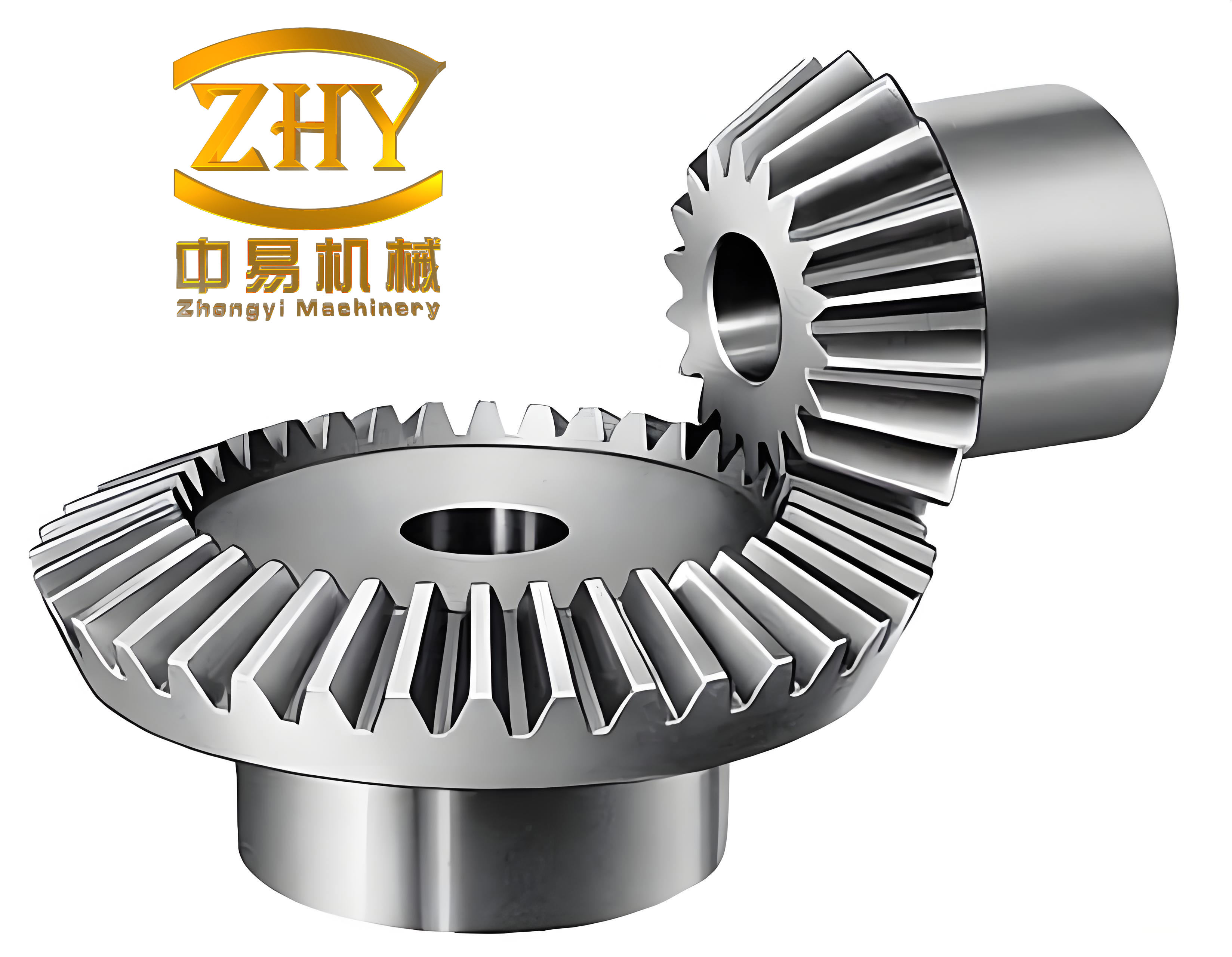
With the tooth profiles defined, I move on to constructing the gear body of the straight bevel gear. I select the XOY plane as the base and create a sketch of the gear’s cross-sectional outline, which includes the rim, web, and hub features. This sketch is then revolved around the gear’s central axis to form a solid 3D model. The revolution operation ensures that the body conforms to the conical shape typical of straight bevel gears, with parameters like the pitch angle \( \delta_1 \) governing the taper. This step lays the groundwork for adding the teeth and other details to the straight bevel gear.
Creating individual teeth for the straight bevel gear involves using a sweep operation. I use the large-end and small-end tooth profiles as section curves and the pitch cone line as a guide curve to generate a single tooth surface. This swept surface is then converted into a solid entity through extraction, resulting in a precise tooth form that matches the involute geometry. The sweep path is critical for maintaining the correct orientation and taper of the tooth in straight bevel gears, ensuring that the tooth thickness decreases appropriately from the large end to the small end. The mathematical basis for this can be described using the concept of equivalent spur gears, where the tooth profile is scaled based on the cone distance. For example, the tooth thickness \( s \) at any section of a straight bevel gear can be calculated as: $$ s = s_{\text{max}} \frac{R – y}{R} $$ where \( s_{\text{max}} \) is the thickness at the large end, \( R \) is the cone distance, and \( y \) is the distance from the apex. This formula ensures uniform tooth strength in straight bevel gears.
After forming a single tooth, I array it around the gear axis to complete the full set of teeth. Using a rotational pattern feature, I specify the number of teeth \( z_1 \) and the angle increment \( \frac{360}{z_1} \) to duplicate the tooth entity. This creates a symmetrical gear model with all teeth evenly spaced, which is essential for the smooth operation of straight bevel gears. Following this, I add finishing touches such as fillets, chamfers, and other cosmetic features to enhance the realism and functionality of the straight bevel gear. Fillets at the tooth roots help reduce stress concentrations, a key advantage of equal-dedendum straight bevel gears.
To validate the model, I also create a mating gear (e.g., gear Z2) using the same parametric approach. The parameters for the mating straight bevel gear are adjusted based on the gear ratio and mounting conditions. Once both gears are modeled, I assemble them in a virtual environment to check for proper meshing and clearance. The assembly demonstrates the equal-dedendum characteristic, where the tip clearance remains constant along the tooth length. By sectioning the assembly through the plane defined by the gear axes, I can inspect the meshing teeth and verify that the clearance is uniform, as shown in detailed views. This confirmation underscores the reliability of straight bevel gears in transmission systems.
In summary, the parametric modeling of equal-dedendum straight bevel gears involves a systematic process of defining parameters, creating basic geometries, generating involute tooth profiles, and assembling the components. The use of parametric equations allows for easy customization and optimization of straight bevel gears for various applications. This method not only improves design efficiency but also ensures high accuracy and performance. Straight bevel gears, with their unique equal-dedendum feature, offer superior mechanical properties compared to traditional designs, making them ideal for high-load scenarios. As technology advances, further refinements in parametric modeling will continue to enhance the design and manufacturing of straight bevel gears.
To further illustrate the parametric relationships, consider the following table that outlines additional formulas used in straight bevel gear design:
| Parameter | Formula | Application in Straight Bevel Gears |
|---|---|---|
| Cone Distance | $$ R = \frac{d}{2 \sin(\delta)} $$ | Determines the lateral distance from apex to pitch circle in straight bevel gears |
| Tooth Depth | $$ h = h_a + h_f $$ | Total tooth depth, where \( h_a \) is addendum and \( h_f \) is dedendum for straight bevel gears |
| Tip Angle | $$ \theta_a = \tan^{-1}\left(\frac{h_a}{R}\right) $$ | Angle defining the tip cone in straight bevel gears |
| Root Angle | $$ \theta_f = \tan^{-1}\left(\frac{h_f}{R}\right) $$ | Angle defining the root cone in straight bevel gears |
These formulas are integral to the parametric modeling process and help ensure that the straight bevel gears meet design specifications. For example, the cone distance \( R \) is used to scale the tooth profiles at different sections, maintaining the proper taper. In equal-dedendum straight bevel gears, the tip and root angles are balanced between mating gears, which is achieved by setting \( \theta_{a1} = \theta_{f2} \) and \( \theta_{a2} = \theta_{f1} \). This interdependence is a hallmark of straight bevel gears and is easily managed through parametric controls.
In conclusion, the parametric modeling technique for straight bevel gears provides a robust framework for designing complex gear systems. By leveraging mathematical equations and CAD tools, I can efficiently create and modify straight bevel gear models that adhere to the equal-dedendum principle. This approach not only streamlines the design process but also enhances the performance and reliability of straight bevel gears in practical applications. As I continue to explore advancements in gear technology, the focus on straight bevel gears will remain pivotal for achieving optimal mechanical solutions.