
In the field of gear manufacturing, the need for high-precision straight bevel gears after heat treatment has driven the development of specialized grinding equipment. However, dedicated straight bevel gear grinding machines are often expensive and scarce, particularly in domestic markets. To address this challenge, I have explored the transformation of a standard Y7132 gear grinding machine into a CNC-based machine capable of grinding straight bevel gears using the generating method. This approach leverages the principles of flat-top gear shaping, adapted for grinding operations, to achieve precise tooth profiles. The transformation involves retrofitting the machine with servo motors, ball screws, and CNC controls to enable complex multi-axis movements required for generating straight bevel gear teeth. In this paper, I will detail the theoretical foundations, mechanical modifications, and practical implementation of this method, supported by formulas, tables, and a case study to illustrate the process.
The core of this transformation lies in the generating method derived from flat-top gear shaping principles. A flat-top gear is a bevel gear with a 90-degree apex angle, where the pitch cone becomes a conical surface. In traditional shaping, pairs of cutting tools simulate a tooth of the flat-top gear to generate the tooth profile of the straight bevel gear through relative motion. For grinding, I replace the cutting tools with grinding wheels, where the wheel’s conical surface acts as the generating surface. The key relationship involves the roll ratio, which governs the relative motion between the workpiece and the generating surface. The roll ratio \( i_c \) is defined as:
$$ i_c = \frac{\cos \theta_f}{\sin \delta} $$
or alternatively,
$$ i_c = \frac{z_c \cos \theta_f}{z} $$
where \( \theta_f \) is the root angle of the straight bevel gear, \( \delta \) is the pitch angle, \( z \) is the number of teeth of the straight bevel gear, and \( z_c \) is the number of teeth of the flat-top gear. This ratio ensures that the grinding wheel and the straight bevel gear maintain proper meshing conditions during the generating process.
Another critical parameter is the tool post spacing angle \( \lambda \), which affects tooth thickness and contact patterns. It is approximated by:
$$ \lambda \approx \frac{180}{\pi R} \left( \frac{s}{2} + h_f \tan \alpha \right) $$
where \( R \) is the cone distance at the large end, \( s \) is the arc tooth thickness at the large end, \( h_f \) is the root height at the large end, and \( \alpha \) is the pressure angle. This angle aligns the grinding wheel’s path with the gear’s tooth flank during operation.
To implement this on the Y7132 machine, I modified its structure to incorporate CNC controls for synchronized movements. The original machine was equipped with a grinding wheel spindle driven by a standard three-phase induction motor, but I replaced the drives for the worktable, rotary table, and sliding sleeve with servo motors and ball screws for precise positioning. The grinding wheel, mounted on the sliding sleeve, performs linear reciprocating motions, simulating the fixed generating surface of the flat-top gear. The workpiece, mounted on a rotary table, undergoes both rotation about its own axis (self-rotation) and revolution around the machine’s center (public rotation), as well as horizontal translations, to achieve the generating motion. The CNC system coordinates these axes in a three-axis联动 to grind each tooth flank incrementally.
The setup involves adjusting the root angle of the straight bevel gear to parallel the sliding sleeve’s motion path. The gear’s axis must align with the symmetric center plane of the grinding wheel’s conical surfaces. A key distance \( r \) is defined as the projection of the apex distance on the horizontal plane, which influences the horizontal translations during grinding. For instance, in a specific case, \( r = 178.2773 \, \text{mm} \), derived from the gear’s geometry and fixture dimensions.
During the grinding process, the generating motions are executed step by step. Starting from an initial position, the straight bevel gear is revolved by the tool post spacing angle \( \lambda \), then translated horizontally to engage the grinding wheel. As the gear self-rotates by a small angle (e.g., 0.5 degrees), it simultaneously revolves by a corresponding angle based on the roll ratio, and the worktable moves horizontally to maintain contact between the gear tooth and the grinding wheel. This cycle repeats until the entire tooth flank is ground. The horizontal movement distance is calculated using absolute coordinates to avoid cumulative errors, and it depends on \( r \) and the revolution angle. For example, if the gear self-rotates by 10 degrees, the public rotation is \( 10 / i_c \) degrees, and the horizontal shift is determined via geometric relations in a 2D software like CAXA.
To illustrate, consider a Gleason straight bevel gear with the following parameters:
| Parameter | Value |
|---|---|
| Module at large end (m) | 11.467 mm |
| Pressure angle (α) | 22.5° |
| Number of teeth (z) | 18 |
| Addendum coefficient (ha*) | 0.8 |
| Dedendum coefficient (c*) | 0.188 |
| Tangential shift coefficient (xt) | 0.038 |
| Cone distance (R) | Calculated based on geometry |
| Tool post spacing angle (λ) | 5.95° |
| Roll ratio (ic) | 1.2959 |
Using these values, the generating motions are programmed into the CNC system. The self-rotation angle must be carefully determined to avoid under-grinding or damaging adjacent teeth. Literature suggests formulas for this, but practical trials are effective for optimization. Additionally, the grinding wheel’s tip is rounded to prevent interference with the root fillet of the straight bevel gear.
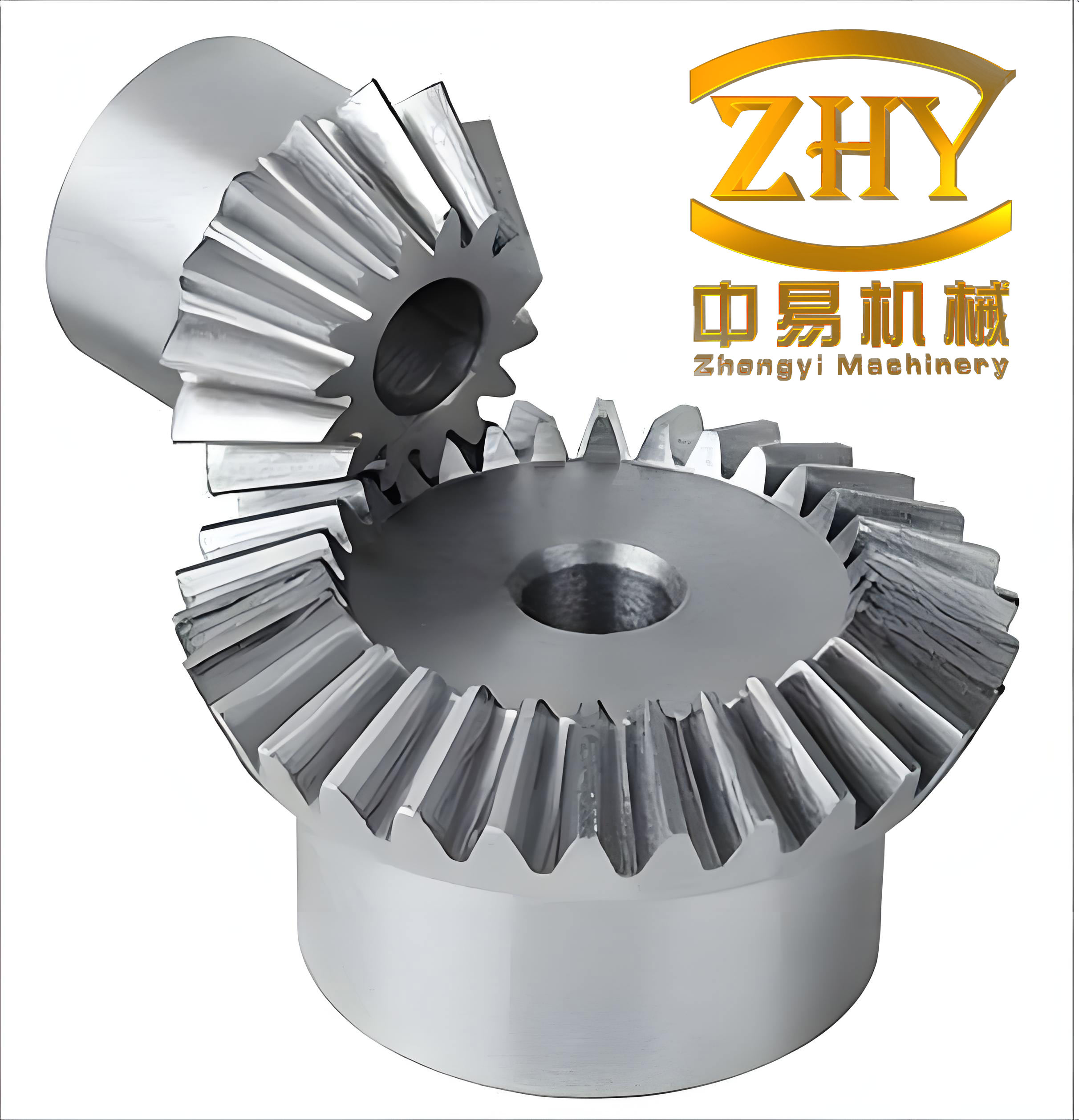
The grinding wheel dressing is performed using the original Y7132 dresser or by mounting a diamond tool on the worktable and using the vertical and horizontal axes联动 for compensation. This ensures the wheel maintains its correct profile throughout the process. The transformed machine achieves high accuracy in grinding straight bevel gears, addressing heat treatment distortions and improving surface finish.
In conclusion, the CNC transformation of the Y7132 gear grinding machine for straight bevel gear grinding using the generating method is a cost-effective solution. It leverages established principles of gear generation, adapted through modern controls, to produce precise straight bevel gears. The integration of formulas for roll ratio and tool post spacing angle, along with synchronized multi-axis motions, enables efficient grinding of complex tooth profiles. This approach not only enhances the quality of straight bevel gears but also demonstrates the potential of retrofitting conventional machines for advanced applications. Future work could focus on optimizing the CNC algorithms and expanding the method to other gear types.