
In mechanical transmission systems, straight bevel gears play a critical role due to their ability to transmit motion and power between intersecting axes. As a researcher in gear manufacturing, I have focused on addressing the limitations of traditional machining methods for straight bevel gears, such as planing and form milling, which often result in poor accuracy, low efficiency, and linear tooth profiles that lead to suboptimal contact patterns. My investigation centers on high-precision CNC milling using advanced multi-axis machines, which enables tooth flank modifications like crowning to improve performance and consistency. This article details my approach to CNC milling of straight bevel gears, including the machining process, contact pattern optimization, and a standardized development workflow to ensure quality and interchangeability.
The foundation of my research is the use of a Phoenix II 275HC gear milling machine, a six-axis, five-coordinate CNC system capable of generating straight bevel gears with accuracies up to GB 11365-1989 grade 5 (equivalent to AGMA 2009 grade B5). This machine employs an intermittent generating method, where the tool and workpiece move in a synchronized manner to carve the tooth surfaces. Unlike conventional methods, this process introduces a controlled crowning along the tooth length, which prevents edge contact under load and enhances durability. The machining workflow involves several steps: parameter calculation using specialized software, tooth contact analysis (TCA), initial roughing, coordinate measuring machine (CMM) inspection, iterative corrections, and final rolling tests to validate contact patterns and backlash.
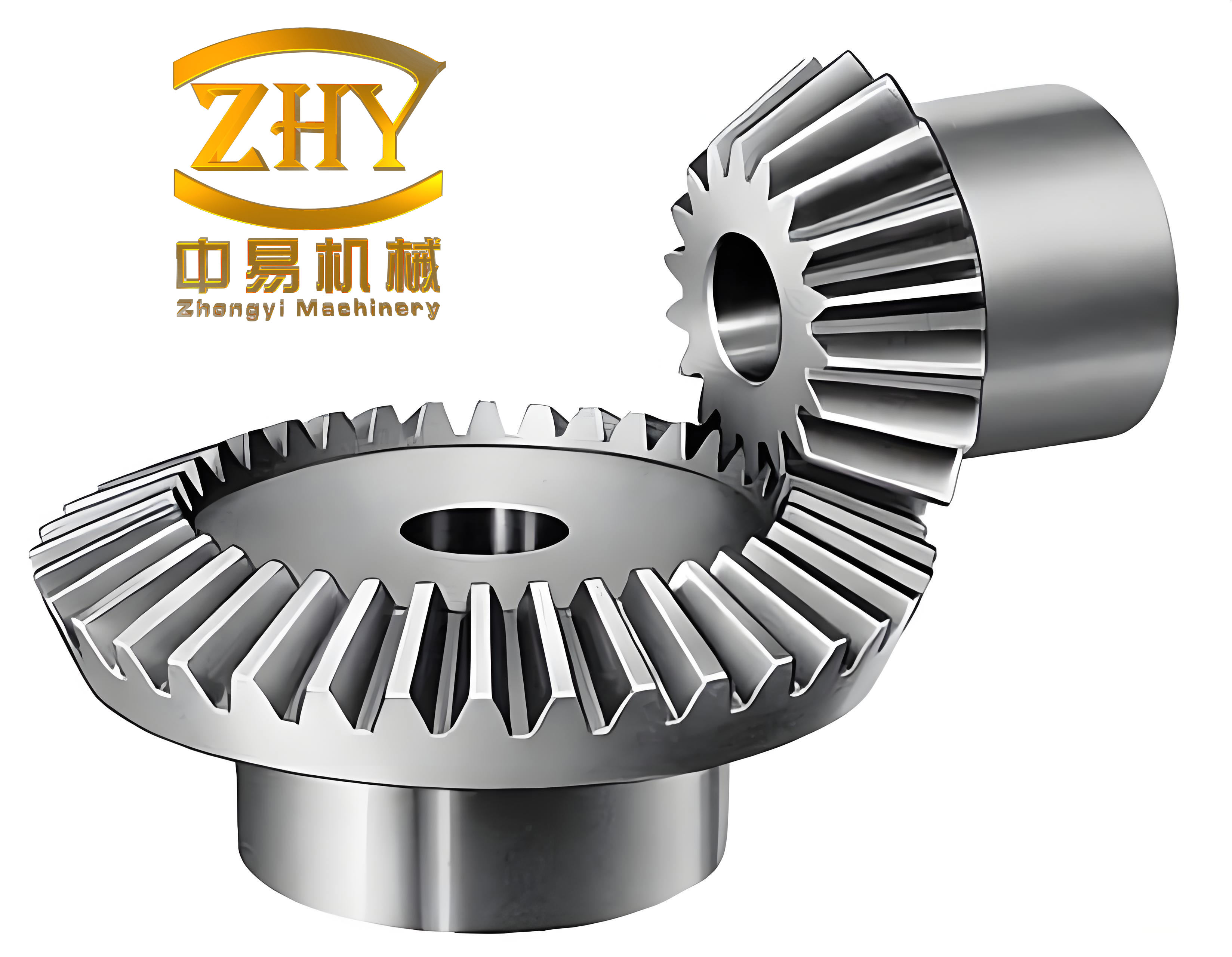
To achieve the desired tooth geometry, I utilize software tools like Straight Bevel for dimensional and tool parameter calculations and Unical for TCA simulations. The TCA helps predict contact patterns under theoretical conditions, and I perform first-order corrections by adjusting the spiral angle to shift the contact area toward the toe (small end) of the tooth. This is crucial because, after heat treatment and under load, the contact zone tends to expand toward the heel (large end). By pre-positioning the contact area, I ensure that the final assembly maintains an optimal pattern. The crowning amount, which defines the curvature along the tooth length, is influenced by tool diameter and dish angle. Since the machine uses a fixed 9-inch diameter tool, I modulate the dish angle to control the crowning and contact zone size. For instance, a larger dish angle increases crowning, resulting in a smaller contact area that mitigates stress concentration.
The generating motion on the 275HC machine involves complex coordinated movements. The tool, positioned above the workpiece, rotates about the C-axis and oscillates about the B-axis, while the workpiece rotates about the A-axis and translates along the X and Z axes. This generates the left flank of each tooth. After completing one flank, the tool retracts, the workpiece indexes, and the process repeats for all left flanks. Then, the tool moves below the workpiece to machine the right flanks. The mathematical representation of the tooth surface as a spherical involute can be described using parametric equations. For a straight bevel gear, the position vector of a point on the tooth flank in the gear coordinate system is given by:
$$ \vec{r}(u, \theta) = \begin{bmatrix} R \sin \alpha \cos \theta \\ R \sin \alpha \sin \theta \\ R \cos \alpha \end{bmatrix} $$
where \( R \) is the cone distance, \( \alpha \) is the pressure angle, and \( \theta \) is the rotational parameter. The crowning introduces a deviation from the ideal spherical surface, which I model as a parabolic modification along the tooth length. The crowning profile \( \delta(y) \) at a distance \( y \) from the midpoint is expressed as:
$$ \delta(y) = C \left(1 – \left(\frac{y}{L/2}\right)^2\right) $$
Here, \( C \) is the maximum crowning amount, and \( L \) is the face width. This modification ensures that under load, the contact area remains centered and avoids edge contact.
In my research, I have developed a comprehensive manufacturing workflow for straight bevel gears to ensure consistency across production batches. This involves the creation of master and control gears, which serve as references for quality assurance. The master control gear is the most accurate pair from the initial batch, used to digitize CMM inspection programs and validate other gears. Control gears, produced in the same batch, are employed to check contact patterns and backlash in rolling tests. The criteria for these gears are summarized in Table 1.
| Gear Type | Requirements |
|---|---|
| Master Control Gear | Must meet all drawing specifications; represents the most precise gear pair in the development batch; never used in rolling tests after designation; only one set exists as a master reference. |
| Control Gears | Manufactured based on the master control gear; must have correct backlash; contact patterns should match the master; tooth flank geometry must be within 50% of the CMM grid tolerance specified in the gear data sheet; typically, two sets are maintained for inspection. |
The development process begins with single-tooth cutting, followed by CMM inspection to measure parameters like chordal thickness at the midpoint, tooth depth, and flank geometry. I use a grid of 45 points on the tooth surface to compare actual measurements with theoretical values, allowing me to correct pressure angle and spiral angle errors. The chordal thickness \( s_c \) at the midpoint is calculated as:
$$ s_c = m \cdot \pi \cdot \cos \beta $$
where \( m \) is the module and \( \beta \) is the spiral angle. After geometric validation, the gears undergo rolling tests on a 360T machine under light load to assess contact patterns and backlash. The contact pattern should be elliptical or rectangular, centered between the toe and heel, and away from the edges. If deviations occur, I adjust the machining parameters using feedback from CMM data and TCA results.
Heat treatment and assembly in the actual gearbox can alter contact patterns due to deformations. Therefore, I conduct tests under various loads—light, normal, and maximum—to evaluate pattern shifts. The contact area \( A_c \) as a function of load \( F \) can be approximated by:
$$ A_c(F) = A_0 + k \cdot F $$
where \( A_0 \) is the initial contact area and \( k \) is a proportionality constant. Based on these tests, I refine the gear design and machining process to achieve stable contact patterns under operating conditions. This iterative approach ensures that the straight bevel gears meet performance requirements and are interchangeable across batches.
To illustrate the impact of crowning on contact patterns, I have analyzed the relationship between tool parameters and crowning. The crowning amount \( C \) is inversely related to tool diameter \( D_t \) and directly related to dish angle \( \gamma \):
$$ C \propto \frac{\tan \gamma}{D_t} $$
In practice, I select a dish angle that provides sufficient crowning without excessively reducing the contact area. For example, a dish angle of 20° to 30° is typical for straight bevel gears with moderate face widths. The contact pattern size \( L_c \) and position \( P_c \) are optimized using TCA simulations, where \( P_c \) is expressed as a percentage of the face width from the toe:
$$ P_c = \frac{d_t}{L} \times 100\% $$
Here, \( d_t \) is the distance from the toe to the pattern center. I aim for \( P_c \) between 40% and 60% in the unloaded state to account for load-induced shifts.
The use of master and control gears standardizes the inspection process. After digitizing the CMM program with the master control gear, I inspect production gears by comparing their flank geometries to the master. The tolerance for tooth flank deviations is set to 50% of the drawing specification to ensure tight control. This method has proven effective in maintaining consistency, as shown in the manufacturing data for a sample straight bevel gear pair in Table 2.
| Parameter | Value | Tolerance |
|---|---|---|
| Module | 4 mm | ±0.02 mm |
| Number of Teeth | 20 | N/A |
| Pressure Angle | 20° | ±0.1° |
| Face Width | 25 mm | ±0.1 mm |
| Crowning Amount | 0.02 mm | ±0.005 mm |
| Backlash | 0.1 mm | ±0.02 mm |
In conclusion, my research demonstrates that CNC milling of straight bevel gears with controlled crowning significantly enhances accuracy, efficiency, and performance. The integration of software simulations, CMM inspections, and standardized workflows ensures that gears are interchangeable and reliable. By repeatedly applying this methodology, I have achieved consistent results in batch production, reducing the need for selective assembly and improving overall quality. The straight bevel gear technology continues to evolve, and this approach provides a robust foundation for future advancements in gear manufacturing.