
In my research and industrial practice, I have often encountered the challenges associated with non-conjugate worm gear drive systems. These drives, where the worm and gear are not manufactured as a matched pair, are common in various mechanical applications due to their cost-effectiveness and flexibility. However, achieving optimal meshing performance in such non-conjugate worm gear drive setups is notoriously difficult. Traditionally, the evaluation of tooth contact in a non-conjugate worm gear drive relies on physical assembly tests. This involves applying a dye to the worm, assembling the drive, running it, and inspecting the contact patterns transferred onto the gear tooth surfaces. Poor contact necessitates re-machining the gear and repeating the entire process. This trial-and-error approach is not only time-consuming and labor-intensive but also leads to significant material waste and financial expenditure. The need for a more efficient methodology drove me to explore virtual simulation technology as a transformative solution for analyzing and optimizing the meshing characteristics of a non-conjugate worm gear drive.
Virtual simulation offers a powerful alternative, allowing me to create a digital twin of the entire manufacturing and assembly process. Within this virtual environment, I can observe, assess, and modify machining parameters and assembly conditions without the need for physical prototypes. This capability is invaluable for verifying the feasibility of machining schemes and predicting meshing behavior. The core of my approach is built upon the robust parametric modeling and mechanism simulation functionalities of the 3D design software Pro/ENGINEER Wildfire 4.0 (Pro/E4.0), extended through secondary development using VC++6.0 and its Pro/TOOLKIT toolkit. This integrated system effectively mimics the real-world factory process, translating physical machining and meshing tests into a completely computerized virtual factory. My primary goal is to study the tooth surface contact in a non-conjugate worm gear drive within this virtual space. By simulating the application of contact “spots” and generating cross-sectional profiles computationally, I can clearly visualize the meshing condition between the tooth surfaces. More importantly, I can iteratively adjust parameters to improve the contact pattern and strive for the optimal meshing state for the worm gear drive, thereby providing direct, actionable guidance for actual production.
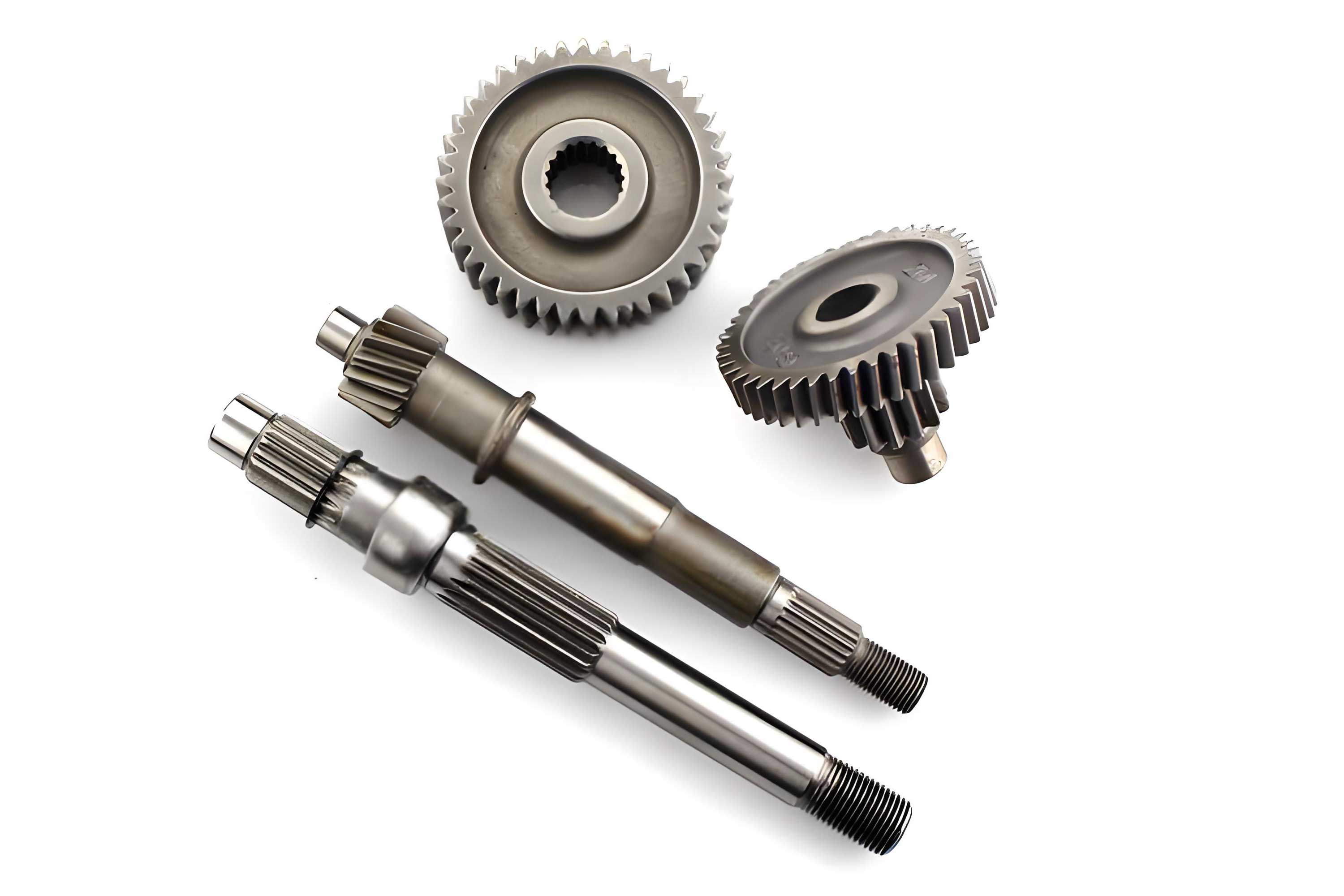
The fundamental principles governing the meshing of a non-conjugate worm gear drive are rooted in gear theory. For this specific industrial case study, the worm is a three-start conical enveloping worm, and the gear is a three-start worm gear generated by a single-start normal straight-sided worm gear hob. The known parameters for the working worm are as follows: it is a left-handed conical enveloping worm with a pitch diameter of 13.5 mm, an axial module of 1.25 mm, a lead angle at the pitch cylinder of 15°31′27″, and three starts. The pitch diameter of the worm gear hob is 20 mm. To ensure proper generation of the worm gear, the hob must be designed based on the conjugate relationship with a theoretical worm that would perfectly mate with the gear. However, since this is a non-conjugate worm gear drive, the hob is designed for a theoretical worm, but it is used to cut a gear that will mate with a different, non-conjugate worm. The key step is to determine the basic parameters of the hob such that the generated gear tooth surface will have a favorable meshing condition with the actual worm.
According to the principles of meshing, the lead angle of the worm gear hob, $\lambda_0$, is calculated from the geometry of the theoretical pairing. A fundamental relationship involves the axial module and diameters. For the hob design, we start with the following equation derived from the geometry of a cylindrical worm:
$$ \sin \lambda_0 = \frac{m \cdot z_0}{d_0} $$
However, a more specific relationship used in this context, considering the conjugate condition between the theoretical hob and the gear, is given by:
$$ \lambda_0 = \arcsin\left(\frac{m}{d_0} \cos \lambda_1\right) $$
Where $d_0$ is the pitch diameter of the worm gear hob, $\lambda_1$ is the lead angle of the actual worm, and $m$ is the axial module of the actual worm. The axial module of the hob, $m_0$, is then:
$$ m_0 = d_0 \cdot \tan \lambda_0 $$
The axial pressure angle of the hob, $\alpha_0$, must relate to the axial pressure angle of the actual worm, $\alpha_1$, through the lead angles to maintain the correct normal pressure angle. The relationship is:
$$ \tan \alpha_0 \cos \lambda_0 = \tan \alpha_1 \cos \lambda_1 $$
Using these equations with the known parameters, I calculated the basic design parameters for the single-start worm gear hob intended to generate the three-start worm gear. The calculated parameters form the foundation for designing a precision worm gear hob. When this hob is used to cut the gear, the theoretical machining inclination angle—the angle between the hob axis and the gear blank axis during generation—is given by the difference between the worm’s lead angle and the hob’s lead angle: $(\lambda_1 – \lambda_0)$. For an optimal non-conjugate worm gear drive, the tooth surfaces of the worm and gear should make contact in a manner that promotes the formation of a lubricant wedge. This is achieved when the contacting surfaces have a favorable relative curvature in the direction normal to the relative velocity vector at the point of contact. Essentially, the local geometry should encourage hydrodynamic lubrication, reducing friction and wear, which is a critical performance criterion for any worm gear drive. The following table summarizes the key parameters for this non-conjugate worm gear drive system, including both the actual components and the theoretical hob design.
| Component | Type/Property | Value |
|---|---|---|
| Worm (Actual) | Type | Conical Enveloping |
| Number of Starts | 3 | |
| Axial Module, $m$ (mm) | 1.25 | |
| Pitch Diameter, $d_1$ (mm) | 13.5 | |
| Tip Diameter (mm) | 16.0 | |
| Root Diameter (mm) | 10.375 | |
| Axial Pressure Angle, $\alpha_1$ | 20° | |
| Lead Angle at Pitch, $\lambda_1$ | 15°31′27″ | |
| Lead, $L$ (mm) | 11.781 | |
| Worm Gear Hob (Theoretical Design) | Type | Normal Straight-Sided |
| Number of Starts (Teeth) | 1 | |
| Normal Module, $m_{n0}$ (mm) | 1.217 | |
| Axial Module (Actual), $m_{0a}$ (mm) | 1.219 | |
| Axial Module (Theoretical), $m_{0a,th}$ (mm) | 1.207 | |
| Pitch Diameter, $d_0$ (mm) | 20.0 | |
| Tip Diameter (mm) | 23.2 | |
| Root Diameter (mm) | 16.4 | |
| Normal Pressure Angle, $\alpha_{n0}$ | 19.3046° | |
| Axial Pressure Angle, $\alpha_{0a}$ | 19.337781° | |
| Lead Angle, $\lambda_0$ | 3°29′19″ | |
| Worm Gear (Generated) | Number of Teeth | 36 |
| Tip Diameter (mm) | 47.5 | |
| Pitch Diameter (mm) | 45.0 | |
| Machining Parameters | Theoretical Machining Inclination Angle | 12.07° ($\lambda_1 – \lambda_0$) |
My virtual simulation methodology involves a multi-step process: parametric modeling of the worm, parametric modeling and virtual sharpening of the hob, virtual generation of the worm gear, and finally, assembly and motion simulation to analyze tooth contact. I implemented this within the Pro/E4.0 environment, leveraging its programmable features. For the three-start conical enveloping worm, I utilized the software’s `Program` functionality to define key input parameters such as number of starts, axial module, pressure angle, lead angle, grinding wheel radius, and pitch diameter. The worm blank was created via an extrusion operation. The crucial axial tooth profile and transition curves were constructed using Pro/E’s “Curve from Equation” feature. The equations for these curves are derived from the geometry of the conical grinding process. The axial profile for a single thread is then swept along a helical path with a constant section scan command, effectively translating and rotating it to form a solid helical tooth. This single thread is then patterned around the axis to complete the full three-start worm model. To streamline this process, I developed a Pro/TOOLKIT application using VC++6.0. This application presents a dialog box where I can input all the necessary parameters, and it automatically generates the 3D solid model of the worm through a series of programmed feature creations. This parametric approach is essential for rapidly exploring different design variations in the non-conjugate worm gear drive study.
The next stage focuses on the worm gear. I first created a parametric model of the single-start normal straight-sided worm gear hob using similar techniques. Its geometry is defined by parameters like normal module, normal pressure angle, lead angle, and pitch diameter. After modeling the hob body, its helical tooth form is generated. This virtual hob is then used in a simulated gear generation process. Pro/E’s advanced modeling capabilities, such as its “Cut” operation with a swept blend or using a family of tables to simulate hob movement, allow me to mimic the hobbing process. The gear blank is rotated while the virtual hob, set at the calculated theoretical machining inclination angle, performs a translational and rotational motion corresponding to the feed and indexing. This virtual machining operation progressively removes material from the gear blank, leaving behind the generated tooth spaces of the three-start worm gear. The result is a precise 3D model of the worm gear with geometry entirely defined by the hob parameters and the machining kinematics. This digitally manufactured gear is the counterpart for the non-conjugate worm in our virtual worm gear drive assembly.
With both components modeled, I proceed to the core analysis phase: tooth contact simulation. I assemble the worm and gear models in Pro/E with the appropriate center distance and axial alignment. The powerful `Mechanism` module is then employed to define a kinematic connection between them—typically a gear pair connection specifying the axis of rotation and the gear ratio (which is the ratio of the number of gear teeth to the number of worm starts, i.e., 36:3 or 12:1). I can then run a motion analysis, simulating the rotation of the worm and the driven rotation of the gear. To visualize contact, I employ a technique analogous to the physical dye test. While Pro/E’s Mechanism does not have a built-in “contact pattern” analyzer for complex surfaces in the standard sense, the effect can be achieved through interference detection or, more effectively, by post-processing the relative positions of the surfaces. For a more direct and clear visualization in my simulation framework, I calculate and display points on the gear tooth surface that come within a very small distance (a tolerance zone) from the worm tooth surface during motion. These points are visualized as a “contact pattern” or “spot” on the gear tooth. Furthermore, to deeply analyze the contact geometry, I section the assembled worm and gear pair through a plane that is normal to the relative velocity vector at a specific point of contact. The profiles of the two tooth surfaces in this section reveal their local conformity and curvature, indicating the potential for lubricant wedge formation. This combined approach of spotting and profiling provides a comprehensive view of the meshing quality in the simulated worm gear drive.
The critical investigation involves varying key machining parameters to observe their effect on the contact pattern. The most influential parameter for this non-conjugate worm gear drive is the actual machining inclination angle used during the virtual hobbing of the gear. While the theoretical value is 12.07°, real-world adjustments are often necessary to compensate for deflection, thermal effects, or to intentionally optimize contact. In my virtual factory, I can easily change this angle, re-generate the worm gear model, and re-run the contact simulation. I conducted a series of simulations by varying the machining inclination angle around the theoretical value. Below is a summary table of the observed contact characteristics for different angles, with a fixed center distance of 32.5 mm.
| Machining Inclination Angle | Observed Contact Pattern Location | Profile Conformity in Normal Section | Qualitative Assessment for Worm Gear Drive |
|---|---|---|---|
| 9.3° (Reduced) | Contact occurs near the tooth tip and/or root edges. Pattern is concentrated and localized at the boundaries. | The profiles show a distinct mismatch with a pointed or “edge” contact. The curvature difference is significant, creating a small, high-pressure contact area. | Poor. Edge contact leads to high stress concentration, poor lubrication, accelerated wear, and increased noise. Unfavorable for the worm gear drive longevity. |
| 12.07° (Theoretical) | Contact pattern is centered on the tooth flank, away from both tip and root. The pattern is oval-shaped and spreads across a moderate area of the flank. | The profiles exhibit good conformity. The curvatures are aligned such that a converging gap is formed in the direction of sliding, conducive to hydrodynamic oil film formation. | Good. Flank contact promotes better load distribution, allows lubricant entrainment to form a wedge, reduces friction and wear, leading to a smoother and more durable worm gear drive. |
| 12.5° (Increased) | Similar to the reduced angle case, contact shifts towards the opposite edge (e.g., the root or the other side of the flank), often showing a narrow band or corner contact. | The profile cross-section again reveals poor conformity, often with an opposite sense of mismatch compared to the reduced angle case. The contact geometry does not support an effective lubricant wedge. | Poor. Similar disadvantages as the reduced angle: high localized stress, inadequate lubrication, and potential for scuffing, compromising the worm gear drive performance. |
The mathematical rationale behind this behavior relates to the mismatch of the two surfaces. The tooth surface of the worm, $ \Sigma_1 $, is a conical enveloping surface. The tooth surface of the gear, $ \Sigma_2 $, is a screw surface generated by the hob. Their contact condition is governed by the equation of meshing, which for surfaces in line contact (as in generation) is given by the scalar product of the common normal vector and the relative velocity vector being zero at the point of contact: $ \mathbf{n} \cdot \mathbf{v}^{(12)} = 0 $. In a non-conjugate worm gear drive, the two surfaces are not fully conjugate, meaning this equation is not satisfied identically for a line but only at a point or a set of points under load. The local geometry is described by the principal curvatures and directions. For effective lubrication in a worm gear drive, the relative normal curvature, $ k_{\nu}^{(n)} $, in the direction of the relative velocity should be as large as possible to create a converging gap. This curvature can be approximated from the surface geometries. When the machining inclination angle deviates from the optimal, it alters the generated gear surface $ \Sigma_2 $, changing its curvature field relative to the worm surface $ \Sigma_1 $. This leads to a mismatch where the principal directions and curvatures are misaligned, resulting in edge contact instead of the desired flank contact. The optimal angle aims to align the surfaces such that in the critical contact zone, their relative normal curvature in the sliding direction is favorable.
Let me elaborate on the curvature analysis. Consider a point $ M $ on the potential contact line. The unit normal vector to both surfaces at $ M $ is $ \mathbf{n} $. The relative velocity of surface $ \Sigma_2 $ with respect to $ \Sigma_1 $ at $ M $ is $ \mathbf{v}^{(12)} $. The direction of sliding is given by the projection of $ \mathbf{v}^{(12)} $ onto the tangent plane. Let $ \mathbf{e}_t $ be a unit vector in this direction. The normal curvature of surface $ \Sigma_i $ in the direction $ \mathbf{e}_t $ is $ k_{t}^{(i)} $. An important indicator for lubrication is the parameter $ \Gamma $, sometimes called the lubricant entrapment factor, related to the difference in normal curvatures: $ \Delta k_t = k_{t}^{(1)} – k_{t}^{(2)} $. For a converging wedge, we desire $ \Delta k_t > 0 $ and sufficiently large. My simulation, by examining the cross-sectional profiles in the plane containing $ \mathbf{n} $ and $ \mathbf{e}_t $, effectively visualizes this curvature difference. At the optimal machining angle, the profiles show a harmonious, slightly convex-concave pairing with a consistent gap that narrows in the direction of sliding, corresponding to a positive $ \Delta k_t $. At non-optimal angles, the profiles cross or make contact at a sharp corner, indicating a very small or negative $ \Delta k_t $, which is detrimental for the worm gear drive’s tribological performance.
The virtual simulation system I developed goes beyond just observing contact patterns. It allows for a quantitative assessment. For instance, I can extract coordinate data of the points in the contact zone and calculate the approximate contact area, its centroid location, and its orientation on the tooth flank. Furthermore, by applying a simulated load (using finite element analysis integration or simplified spring-based contacts in Mechanism), I can observe how the contact pattern expands under load, which is crucial for the real-world performance of the worm gear drive. The ability to rapidly iterate through parameter changes—not just the machining inclination angle, but also hob profile modifications, center distance variations, and even worm geometry adjustments—is the core strength of this virtual approach. Each iteration in the physical world would require manufacturing a new gear, whereas in the virtual world, it involves merely changing a parameter and re-computing the model, a process that takes minutes or hours instead of days or weeks.
In conclusion, my work demonstrates the immense value of virtual simulation technology in the design and analysis of non-conjugate worm gear drive systems. By establishing a fully parametric digital workflow encompassing component modeling, virtual gear generation, and dynamic meshing simulation, I have created a powerful tool that can accurately predict tooth contact behavior. The key insight from this study is that for the specific case of a three-start conical enveloping worm mating with a gear generated by a single-start normal straight-sided hob, the theoretical machining inclination angle calculated from conjugate principles provides a very good starting point for optimal contact. Minor deviations from this angle, as shown through simulated contact patterns and profile analysis, lead to detrimental edge contact, while the theoretical angle promotes favorable flank contact conducive to lubrication. This virtual methodology eliminates the need for the costly and time-consuming cycle of physical trial-and-error manufacturing and assembly. It enables engineers to explore the design space thoroughly, optimize parameters for the best possible meshing performance in a worm gear drive, and achieve significant savings in resources, time, and cost before any metal is cut. The principles and tools described here are broadly applicable to the study and development of various types of non-conjugate gear drives, promising to enhance the efficiency and reliability of power transmission systems across industries.