
In modern mechanical engineering, the worm gear drive is a critical component due to its high transmission ratio, load-bearing capacity, low noise, and smooth operation. Among various types, the ZC1 worm gear drive, characterized by its circular arc tooth profile, offers enhanced meshing performance through convex-concave engagement and improved lubrication. This study focuses on analyzing the instantaneous contact lines on the worm gear tooth surface to optimize the meshing performance of the ZC1 worm gear drive used in applications like escalators. By investigating these contact lines, I aim to understand how design parameters influence lubrication and contact characteristics, which are vital for durability and efficiency in worm gear drive systems.
The meshing performance of a worm gear drive depends heavily on the distribution and shape of instantaneous contact lines. Poorly distributed contact lines can lead to localized heating, oil film breakdown, and accelerated fatigue, compromising the worm gear drive’s reliability. Previous research has explored areas like meshing zone calculation and numerical analysis for ZC1 worm gear drives, but a detailed examination of instantaneous contact lines remains underexplored. Therefore, I employ spatial meshing theory to develop mathematical models for the double-enveloping process, derive equations for instantaneous contact lines, and use computational tools to visualize their behavior under varying parameters. This approach allows me to identify key design variables for optimization, ensuring better performance in worm gear drive applications.
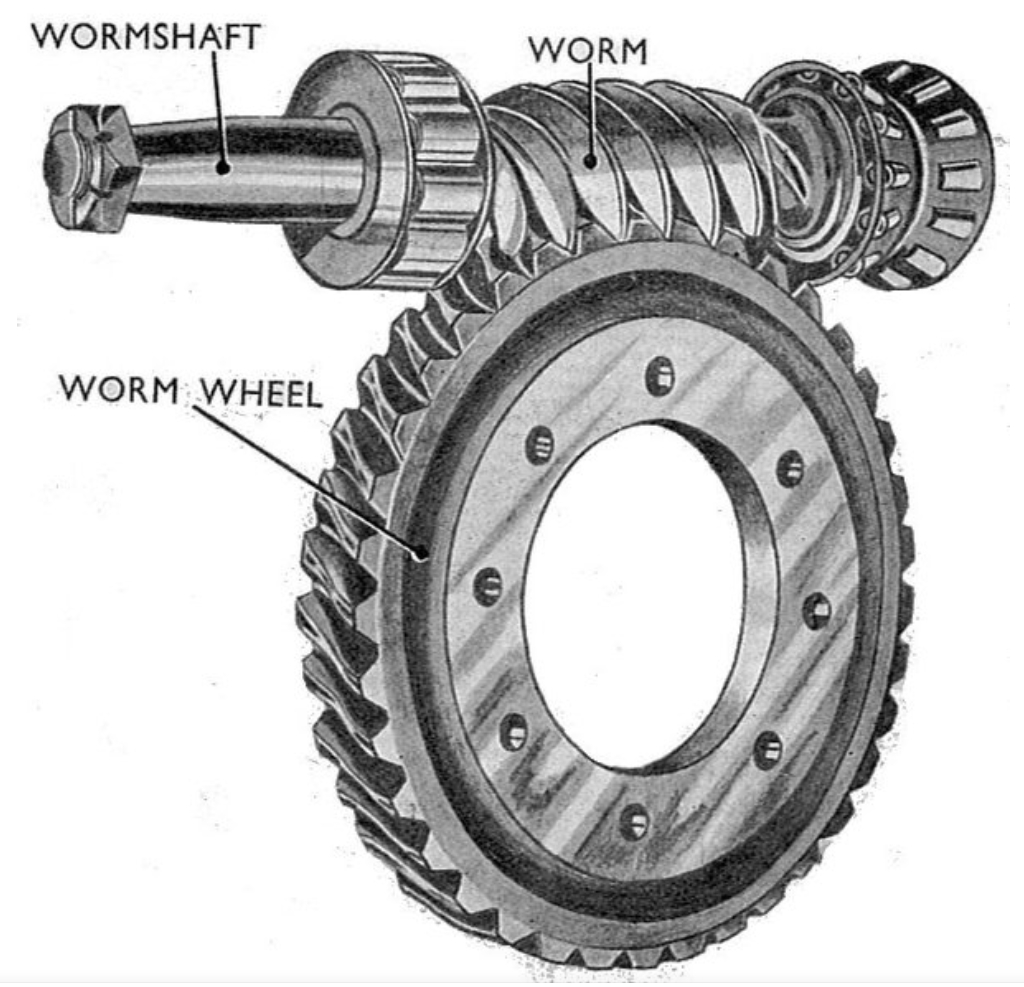
To analyze the ZC1 worm gear drive, I start with the first enveloping process, where the worm is generated by a grinding wheel. The coordinate systems are established as shown in mathematical models. Let \(S_1(O_1, i_1, j_1, k_1)\) be the moving coordinate system attached to the worm, with the worm axis aligned with \(k_1\), and \(S_\sigma(O_\sigma, i_\sigma, j_\sigma, k_\sigma)\) attached to the grinding wheel. The transformation matrix from \(S_\sigma\) to \(S_1\) is derived considering the lead angle \(\gamma\) and center distance \(A_\sigma\). The grinding wheel’s tooth profile is defined in its own coordinate system, and through transformations, the worm surface equation is obtained. The meshing condition ensures contact between the grinding wheel and worm, leading to the instantaneous contact line equations.
The grinding wheel surface equation in \(S_\sigma\) is given by:
$$r^{(\sigma)} = x_\sigma i_\sigma + y_\sigma j_\sigma + z_\sigma k_\sigma$$
where:
$$x_\sigma = -\rho \sin\theta \cos\beta – d \cos\beta$$
$$y_\sigma = \rho \sin\theta \sin\beta + d \sin\beta$$
$$z_\sigma = \rho \cos\theta – c$$
Here, \(\rho\) is the radius of the grinding wheel’s circular arc profile, \(\theta\) is the profile parameter, \(\beta\) is the rotation angle, and \(d\) and \(c\) are installation parameters. The unit normal vector \(n^{(\sigma)}\) at any point on the grinding wheel surface is:
$$n^{(\sigma)} = \sin\theta \cos\beta i_\sigma – \sin\theta \sin\beta j_\sigma – \cos\theta k_\sigma$$
The relative velocity between the grinding wheel and worm, \(v_{\sigma1}\), is derived from spatial kinematics. The meshing condition is:
$$\phi_{\sigma1} = n^{(\sigma)} \cdot v_{\sigma1} = 0$$
Simplifying this yields the meshing equation:
$$\tan\theta – \frac{A_\sigma – d \cos\beta – p \cot\gamma}{c \cos\beta + A_\sigma \sin\beta \cot\gamma + p \sin\beta} = 0$$
where \(p\) is the spiral parameter. The instantaneous contact line on the worm surface is then obtained by transforming coordinates using matrix \(M_{1\sigma}\). This forms the basis for the second enveloping process in the worm gear drive.
For the second enveloping, the worm surface acts as the tool to generate the worm gear tooth surface. Coordinate systems are set up with \(S_2(O_2, i_2, j_2, k_2)\) attached to the worm gear, and the axes are orthogonal for a typical worm gear drive. The transformation matrix from \(S_1\) to \(S_2\) accounts for rotation angles \(\phi_1\) and \(\phi_2\), with transmission ratio \(i_{12} = \omega_1 / \omega_2 = z_2 / z_1\). The meshing condition between the worm and worm gear is:
$$\phi_{12} = n^{(1)} \cdot v_{12} = 0$$
Here, \(n^{(1)}\) is the unit normal vector on the worm surface, derived from earlier equations, and \(v_{12}\) is the relative velocity. After substitutions, the meshing equation becomes:
$$\phi_{12} = W_1 \cos\phi_1 – W_2 \sin\phi_1 – W_3 = 0$$
where:
$$W_1 = i_{21}(x_1 n^{(1)}_z – z_1 n^{(1)}_x)$$
$$W_2 = -i_{21}(z_1 n^{(1)}_y – y_1 n^{(1)}_z)$$
$$W_3 = -(i_{21} a n^{(1)}_z – y_1 n^{(1)}_x + x_1 n^{(1)}_y)$$
The instantaneous contact line on the worm gear tooth surface is then expressed by combining these equations with coordinate transformations. This comprehensive model allows for analyzing the worm gear drive’s meshing performance through computational simulations.
Using MATLAB, I visualize the instantaneous contact lines on the worm gear tooth surface. The parameters are set based on typical ZC1 worm gear drive specifications: center distance \(a = 180 \, \text{mm}\), axial module \(m = 9.5 \, \text{mm}\), diameter factor \(q = 7.684\), pressure angle \(\alpha = 23^\circ\), grinding wheel radius \(\rho = 55 \, \text{mm}\), number of worm threads \(Z_1 = 5\), and number of worm gear teeth \(Z_2 = 29\). By varying key parameters, I assess their impact on contact line distribution, which directly affects lubrication and heat dissipation in the worm gear drive.
The center distance \(a\) significantly influences the instantaneous contact lines. As shown in simulations, decreasing \(a\) leads to sparser and shorter contact lines, with some交叉 regions that hinder heat dissipation. For instance, when \(a = 160 \, \text{mm}\), crossovers occur near the tooth tip, increasing the risk of oil film breakdown. This highlights the importance of selecting an appropriate center distance in worm gear drive design to ensure even contact distribution.
| Center Distance \(a\) (mm) | Contact Line Distribution | Observations |
|---|---|---|
| 160 | Sparse, with crossovers | Poor heat dissipation, increased wear |
| 170 | Moderate, minor crossovers | Acceptable but suboptimal |
| 180 | Uniform, no crossovers | Ideal for worm gear drive performance |
| 190 | Dense, some crowding | Good but may increase friction |
The grinding wheel radius \(\rho\) also plays a crucial role in the worm gear drive’s meshing behavior. Values of \(\rho = 50, 55, 60, 65 \, \text{mm}\) were tested. At \(\rho = 55 \, \text{mm}\), contact lines are均匀 distributed without crossovers, promoting effective lubrication. However, deviations cause crossovers near the tooth tip, as summarized below:
| Grinding Wheel Radius \(\rho\) (mm) | Contact Line Characteristics | Impact on Worm Gear Drive |
|---|---|---|
| 50 | Crossovers at tooth tip | Reduced lubrication efficiency |
| 55 | Uniform, no crossovers | Optimal for meshing performance |
| 60 | Crossovers present | Potential for localized heating |
| 65 | Severe crossovers | High risk of fatigue failure |
Lead angle \(\gamma\) is another critical parameter in worm gear drive design. Simulations with \(\gamma = 28^\circ, 33^\circ, 38^\circ, 40^\circ\) show that at \(\gamma = 33^\circ\), contact lines are evenly spaced without交叉, enhancing the worm gear drive’s durability. Smaller or larger angles lead to issues:
| Lead Angle \(\gamma\) (degrees) | Contact Line Distribution | Consequences for Worm Gear Drive |
|---|---|---|
| 28 | Short lines, no crossovers | Insufficient lubrication coverage |
| 33 | Uniform, no crossovers | Best meshing and lubrication performance |
| 38 | Crossovers at tooth tip | Heat accumulation, faster wear |
| 40 | Dense crossovers | Poor散热, oil film degradation |
These results emphasize that parameters like \(a\), \(\rho\), and \(\gamma\) must be carefully optimized to improve the worm gear drive’s meshing performance. The mathematical models provide a foundation for such optimization, enabling designers to predict contact line behavior and avoid pitfalls like交叉 regions that compromise lubrication.
Beyond instantaneous contact lines, other factors contribute to the overall performance of a worm gear drive. For example, the induced normal curvature and lubrication angle are key indicators of contact stress and oil film formation. However, in this analysis, I focus on contact line distribution as a primary metric because it directly influences heat dissipation and fatigue life in worm gear drive systems. By ensuring均匀 contact lines, the worm gear drive can maintain stable lubrication, reduce thermal effects, and extend service life, which is essential for demanding applications like escalators.
In practice, the worm gear drive’s efficiency depends on a balance between geometric parameters and operational conditions. The derived equations can be integrated into computer-aided design (CAD) tools for rapid prototyping and simulation. For instance, using MATLAB or similar software, engineers can automate the analysis of instantaneous contact lines for various design configurations, accelerating the development of high-performance worm gear drives. This approach aligns with modern trends in digital manufacturing and Industry 4.0, where data-driven design optimizes mechanical systems.
To further illustrate the mathematical framework, consider the coordinate transformation matrices used in the worm gear drive analysis. The matrix from \(S_\sigma\) to \(S_1\) is:
$$M_{1\sigma} = \begin{bmatrix}
\cos\delta & \sin\delta \cos\gamma & -\sin\delta \sin\gamma & A_\sigma \cos\delta \\
-\sin\delta & \cos\delta \cos\gamma & -\cos\delta \sin\gamma & -A_\sigma \sin\delta \\
0 & \sin\gamma & \cos\gamma & -p\delta \\
0 & 0 & 0 & 1
\end{bmatrix}$$
This matrix encapsulates the spatial relationship between the grinding wheel and worm during the first enveloping. Similarly, for the second enveloping in the worm gear drive, the matrix from \(S_1\) to \(S_2\) is:
$$M_{21} = \begin{bmatrix}
\cos\phi_1 \cos\phi_2 & -\sin\phi_1 \cos\phi_2 & -\sin\phi_2 & a \cos\phi_2 \\
-\cos\phi_1 \sin\phi_2 & \sin\phi_1 \sin\phi_2 & -\cos\phi_2 & -a \sin\phi_2 \\
\sin\phi_1 & \cos\phi_1 & 0 & 0 \\
0 & 0 & 0 & 1
\end{bmatrix}$$
These transformations are essential for deriving the worm gear tooth surface equation, which in turn defines the instantaneous contact lines. The comprehensive model allows for parametric studies, as shown in the tables above, to refine the worm gear drive design.
In conclusion, the analysis of instantaneous contact lines is vital for enhancing the meshing performance of the ZC1 worm gear drive. Through mathematical modeling and simulation, I demonstrate that center distance \(a\), grinding wheel radius \(\rho\), and lead angle \(\gamma\) significantly affect contact line distribution. Optimal values, such as \(a = 180 \, \text{mm}\), \(\rho = 55 \, \text{mm}\), and \(\gamma = 33^\circ\), promote均匀 contact lines without crossovers, improving lubrication and reducing wear in the worm gear drive. These parameters should be considered as key variables in future optimization efforts for worm gear drive systems. By integrating this analysis into design processes, engineers can develop more reliable and efficient worm gear drives for applications ranging from escalators to industrial machinery, ensuring long-term performance and sustainability.
The worm gear drive’s complexity requires continuous research, and this study lays groundwork for further investigations into areas like dynamic loading and thermal analysis. As technology advances, the integration of real-time monitoring and adaptive control could revolutionize worm gear drive maintenance, but that is beyond the current scope. For now, focusing on geometric optimization through instantaneous contact line analysis offers a practical path to better meshing performance in the ZC1 worm gear drive.