
This paper conducts a comprehensive analysis of the elastohydrodynamic lubrication (EHL) characteristics for a conjugate tooth pair within an inclined double-roller enveloping hourglass worm gear drive, explicitly accounting for the influence of surface roughness throughout the meshing cycle. The inherent complexity of surface interactions in precision gear drives necessitates a detailed understanding of lubrication performance. For the specific worm gear drive under investigation, the contact geometry and kinematics are derived from its unique meshing principles. Subsequently, a line-contact EHL model is established based on the theory for Newtonian fluids. The surface texture, a critical factor when film thickness is on the same order of magnitude as surface asperities, is integrated into the governing equations. The numerical solution is obtained using the efficient multi-grid method, enabling the calculation of pressure and film thickness distributions at various instants from mesh-in to mesh-out. Finally, the influences of key geometric parameters—roller radius, throat diameter coefficient, roller offset distance, and inclination angle—on the EHL performance are systematically evaluated. The results indicate that surface roughness induces pressure fluctuations and reduces the minimum film thickness, thereby adversely affecting lubrication. Furthermore, excessively large roller radii, offset distances, inclination angles, or an overly small throat diameter coefficient are detrimental to the formation of a protective fluid film, compromising the lubrication performance of the worm gear drive.
The inclined double-roller enveloping hourglass worm gear drive represents an advanced configuration designed to address limitations found in other roller-based worm drives, such as weak root sections or sensitivity to installation errors. In this design, the worm wheel comprises two components: a fixed wheel and a movable wheel. Multiple rollers are uniformly distributed around the circumference of both wheels, with their axes inclined at a specific angle relative to the radial direction of the wheel. These rollers are free to rotate about their own axes. The left and right flanks of the worm are generated by the enveloping action of the rollers on the fixed and movable wheels, respectively. This arrangement inherently provides operational backlash for individual roller rows, ensuring smooth operation and effective lubrication, while the staggered positioning of the two roller rows eliminates backlash for the overall drive, enhancing transmission accuracy.
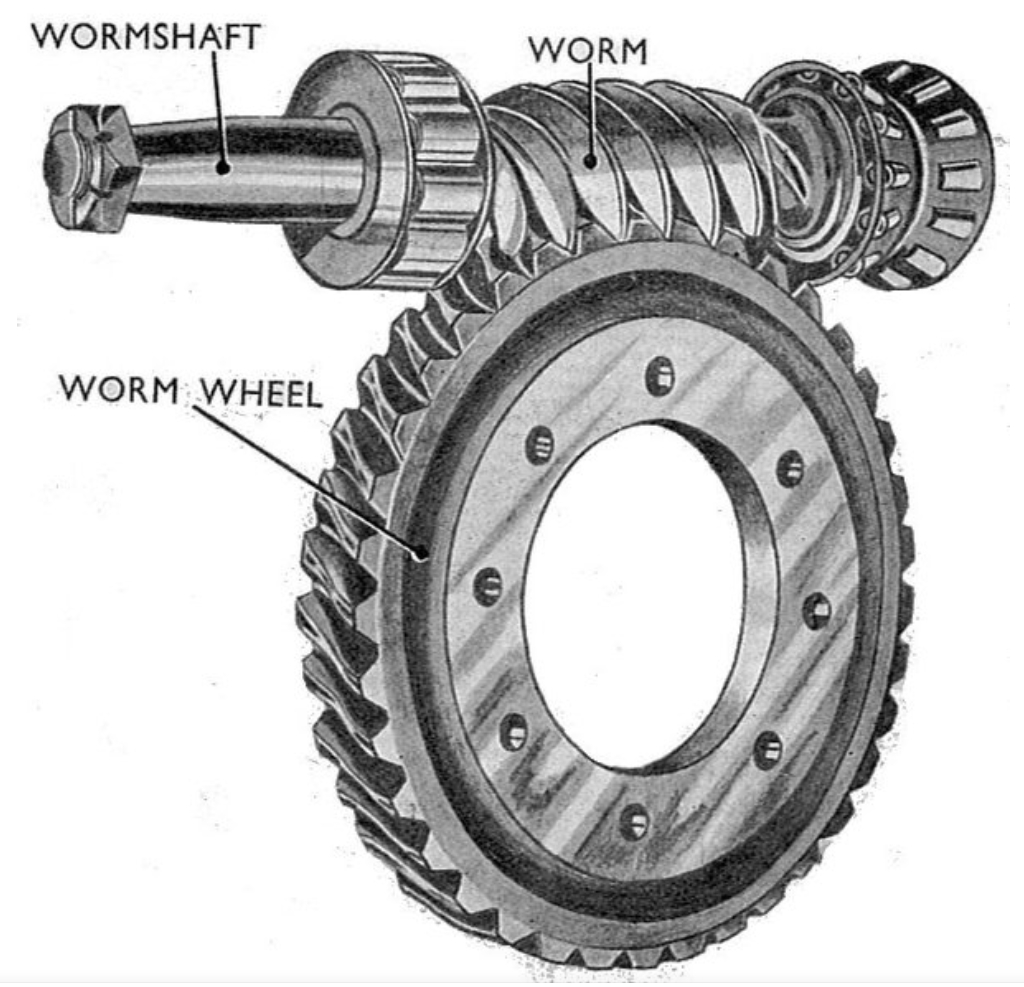
During operation, multiple tooth pairs are in contact simultaneously, with each conjugate pair having a single, spatially complex contact line. The curvature radius of the worm tooth surface varies continuously along the contact path, while the curvature radius of the wheel tooth surface (the roller surface) remains constant, equal to the roller radius $R_k$. The equivalent or reduced radius of curvature $R$ at any contact point, crucial for EHL analysis, is given by the reciprocal of the induced normal curvature $k_\sigma$:
$$
R = \frac{1}{k_\sigma}
$$
Assuming pure rolling at the contact for the lubrication model, the surface velocities of the worm wheel ($v_w$) and the worm ($v_g$) along the common normal at the meshing point are derived from kinematic analysis. The entrainment or rolling velocity $v_{jx}$, which governs the flow of lubricant into the contact conjunction, is the average of these two surface velocities:
$$
v_{jx} = \frac{v_w + v_g}{2}
$$
The load per unit contact length $w_i$ on the i-th meshing tooth pair is calculated from the input torque, considering the load distribution among simultaneously engaged pairs:
$$
w_i = \frac{F_{ni}}{L} = \frac{2 K_i T_1}{L d_1 \cos \alpha_n \cos \beta}
$$
where $K_i$ is the load-sharing factor, $L$ is the instantaneous contact line length, $\alpha_n$ is the normal pressure angle, $\beta$ is the lead angle, $T_1$ is the input torque, and $d_1$ is the worm pitch diameter. The variation of $R$, $v_{jx}$, and $w$ from mesh-in to mesh-out forms the fundamental dynamic input for the transient EHL analysis of the worm gear drive.
Based on elastohydrodynamic lubrication theory, the complex line contact between the worm flank and the roller in the worm gear drive can be effectively simplified to the classic model of an equivalent elastic cylinder contacting a rigid flat plane. This simplification is standard practice for analyzing gear contacts and provides a robust framework for numerical solution.
The mathematical model for isothermal line contact EHL consists of the following set of equations. For numerical stability and generality, these equations are presented in their dimensionless forms. The dimensionless parameters are defined as: $X = x/b$, $H = h/R$, $P = p/p_h$, $\eta^* = \eta/\eta_0$, $\rho^* = \rho/\rho_0$, $U = \eta_0 v_{jx} / (E’ R)$, $W = w / (E’ R)$, and $T = t v_{jx} / b$. Here, $b$ is the Hertzian contact half-width, $p_h$ is the maximum Hertzian pressure, $E’$ is the effective elastic modulus, and $\eta_0$ and $\rho_0$ are the ambient viscosity and density of the lubricant, respectively.
1. Reynolds Equation: This equation governs the pressure generation within the lubricant film. Its transient, dimensionless form is:
$$
\frac{d}{dX}\left( \epsilon \frac{dP}{dX} \right) = \frac{d(\rho^* H)}{dX} + \frac{d(\rho^* H)}{dT}
$$
where $\epsilon = \frac{\rho^* H^3}{\eta^* \lambda}$ and $\lambda = \frac{12 \eta_0 U R^2}{p_h b^2}$. The boundary conditions are $P(X_{in}) = 0$ at the inlet and $P(X_{out}) = dP(X_{out})/dX = 0$ at the outlet.
2. Film Thickness Equation (Including Roughness): The gap between the two surfaces includes the geometric separation, elastic deformation, and the contribution of surface asperities. Assuming transverse roughness textures on both the worm and wheel surfaces, the roughness functions can be modeled by cosine waves:
$$
\begin{aligned}
s_w(x,t) &= A_w \cos\left[ \frac{2\pi}{l_w} (x – v_w t) \right] \\
s_g(x,t) &= A_g \cos\left[ \frac{2\pi}{l_g} (x – v_g t) \right]
\end{aligned}
$$
where $A_w$, $A_g$ are roughness amplitudes and $l_w$, $l_g$ are roughness wavelengths. The dimensionless film thickness equation becomes:
$$
H(X) = H_0 + \frac{X^2}{2} – \frac{1}{\pi} \int_{X_{in}}^{X_{out}} \ln|X – X’| P(X’) dX’ – S(X)
$$
where $H_0$ is the dimensionless central rigid film thickness and $S(X)$ is the combined dimensionless roughness: $S(X) = A_w \cos\left[ \frac{2\pi}{l_w} (X – U_w T) \right] + A_g \cos\left[ \frac{2\pi}{l_g} (X – U_g T) \right]$.
3. Viscosity-Pressure Equation: The lubricant’s viscosity increases dramatically with pressure, described by the Roelands relationship:
$$
\eta^* = \exp\left\{ (\ln \eta_0 + 9.67) \left[ (1 + 5.1 \times 10^{-9} p_h P)^{z} – 1 \right] \right\}
$$
where $z = \alpha / [5.1 \times 10^{-9} (\ln \eta_0 + 9.67)]$ and $\alpha$ is the pressure-viscosity coefficient.
4. Density-Pressure Equation: The lubricant’s compressibility is accounted for by:
$$
\rho^* = \frac{1 + 0.6 \times 10^{-9} p_h P}{1 + 1.7 \times 10^{-9} p_h P}
$$
5. Load Balance Equation: The integrated pressure must support the applied external load:
$$
\int_{X_{in}}^{X_{out}} P(X) dX = \frac{\pi}{2}
$$
The numerical solution of this coupled system of integro-differential equations is achieved using the multi-grid method. The pressure field is solved iteratively on a hierarchy of grids, while the elastic deformation integral in the film thickness equation is efficiently calculated using the multi-grid integration technique. The discrete forms of the Reynolds equation and the load balance equation are solved simultaneously, with the central film thickness $H_0$ being adjusted in each iteration cycle to satisfy the load balance. The process employs a W-cycle for robust convergence, with Gauss-Seidel iteration used on each grid level. The solution from a previous time step serves as the initial guess for the next, facilitating the transient analysis. Convergence is deemed achieved when the relative errors in pressure and load fall below specified tolerances (e.g., $10^{-3}$).
The analysis is performed for a worm gear drive with the design parameters and lubricant properties listed in the table below.
| Parameter | Symbol | Value |
|---|---|---|
| Number of Worm Threads | $Z_1$ | 1 |
| Number of Wheel Teeth | $Z_2$ | 25 |
| Center Distance | $A$ | 125 mm |
| Roller Radius | $R_k$ | 6.5 mm |
| Roller Offset | $c_2$ | 7 mm |
| Throat Diameter Coefficient | $k_1$ | 0.4 |
| Inclination Angle | $\gamma$ | 6° |
| Input Power | $P$ | 5 kW |
| Input Speed | $n_1$ | 1450 rpm |
| Lubricant Property | Symbol | Value |
|---|---|---|
| Ambient Viscosity | $\eta_0$ | 0.028 Pa·s |
| Ambient Density | $\rho_0$ | 870 kg/m³ |
| Pressure-Viscosity Coefficient | $\alpha$ | $2.2 \times 10^{-8}$ m²/N |
| Effective Elastic Modulus | $E’$ | $\frac{E}{2(1-\nu^2)} \approx 115.4$ GPa |
The roughness parameters for both surfaces are set as $A_w = A_g = 0.06 \mu m$ and $l_w = l_g = 12 \mu m$. The meshing cycle of a single tooth pair is discretized into 100 time steps for analysis. The pressure and film thickness distributions are calculated for both smooth and rough surfaces at representative instants corresponding to single, double, triple, and quadruple tooth pair engagement.
The results clearly demonstrate the significant impact of surface roughness on the lubrication of the worm gear drive. For the smooth surface solution, the pressure profile exhibits the classical EHL shape with a sharp pressure spike near the outlet. The film thickness shows a central constriction. As the tooth pair moves from mesh-in to mesh-out, the peak Hertzian pressure first increases and then decreases, while the minimum film thickness follows an opposite trend, being thinnest near the worm’s throat region where the load per unit length is highest.
When surface roughness is introduced, the pressure and film thickness profiles exhibit pronounced perturbations. Each asperity passing through the high-pressure contact zone generates a local pressure peak. This effect is most severe during the middle stages of meshing (e.g., triple-pair engagement) where the contact pressure is highest. The minimum film thickness for the rough surface case is consistently lower than that for the smooth case. Crucially, the maximum pressure peak can be substantially higher due to these asperity interactions. This demonstrates that surface roughness is detrimental to the performance of the worm gear drive, as it leads to more severe pressure concentrations (increasing the risk of surface fatigue) and reduces the thickness of the protective lubricant film (increasing the risk of wear and asperity contact).
The influence of key geometric design parameters on the EHL performance was investigated at a critical meshing instant (triple-pair engagement). The following trends were observed:
1. Roller Radius ($R_k$): Increasing the roller radius leads to a larger equivalent radius of curvature $R$. While a larger $R$ generally promotes thicker films, in the context of this worm gear drive’s specific geometry and loading, the net effect observed is an increase in the maximum contact pressure and a decrease in the minimum film thickness with increasing $R_k$. The pressure fluctuations due to roughness also become more severe.
2. Throat Diameter Coefficient ($k_1$): This parameter significantly affects the worm’s profile. A smaller $k_1$ results in a more concave worm, altering the contact geometry and kinematics detrimentally. The analysis shows that a smaller throat diameter coefficient causes a marked increase in the maximum pressure peak and a decrease in film thickness, while also amplifying roughness-induced pressure fluctuations. It has the most pronounced effect among the parameters studied.
3. Roller Offset Distance ($c_2$): The offset distance influences the positioning of the roller’s generating surface. An excessively large offset distance adversely affects lubrication, leading to higher maximum pressure and thinner films with more severe roughness perturbations.
4. Inclination Angle ($\gamma$): The inclination angle defines the skew of the roller axis. Although its effect is less dramatic than that of $k_1$ or $R_k$, a larger inclination angle also tends to reduce the minimum film thickness and increase pressure, making the contact conditions less favorable for the worm gear drive.
The table below summarizes the qualitative influence of increasing each parameter on the EHL performance.
| Design Parameter | Effect on Max Pressure | Effect on Min Film Thickness | Effect on Roughness Perturbation |
|---|---|---|---|
| Roller Radius ($R_k \uparrow$) | Increases | Decreases | Amplifies |
| Throat Coeff. ($k_1 \downarrow$) | Significantly Increases | Significantly Decreases | Strongly Amplifies |
| Offset Distance ($c_2 \uparrow$) | Increases | Decreases | Amplifies |
| Inclination Angle ($\gamma \uparrow$) | Increases | Decreases | Amplifies |
In conclusion, this analysis provides a detailed investigation into the elastohydrodynamic lubrication of an inclined double-roller enveloping hourglass worm gear drive, incorporating the critical effect of surface roughness. A transient, isothermal line-contact EHL model was successfully implemented and solved numerically. The results establish that surface roughness induces significant fluctuations in pressure and diminishes the minimum film thickness, confirming its adverse role in the tribological performance of the drive. Furthermore, the study identifies that careful selection of geometric parameters is essential for optimizing lubrication. Specifically, excessively large roller radii, roller offset distances, or inclination angles, as well as an overly small throat diameter coefficient, are detrimental to the formation of a robust elastohydrodynamic film. Therefore, to ensure reliable and efficient operation of this advanced worm gear drive, manufacturing processes should aim for the finest feasible surface finish, and design optimization should avoid the extremes of the aforementioned parameters to maintain favorable lubrication conditions throughout the meshing cycle.