
In modern mechanical transmission systems, the worm gear drive plays a critical role due to its compact design, high reduction ratios, and self-locking capabilities. Among various types, the roller enveloping toroidal worm gear drive has garnered significant attention for its superior performance. This mechanism replaces the sliding friction in conventional worm gears with rolling friction, leading to enhanced transmission efficiency, improved lubrication, reduced wear, and extended service life. These advantages make it ideal for high-precision applications such as CNC machine tools, robotics, and aerospace systems. In this article, we delve into the contact characteristics of the roller enveloping worm gear drive, focusing on the influence of design parameters and assembly errors. By establishing mathematical models and three-dimensional precise models, we analyze how variations in key parameters affect stress distribution and meshing backlash, providing insights for optimizing the worm gear drive in industrial applications.
The roller enveloping worm gear drive consists of a roller worm wheel and a toroidal worm that meshes with it. The unique geometry transforms traditional sliding contact into rolling contact, which minimizes energy losses and increases durability. Understanding the contact behavior is essential for ensuring reliable operation and longevity. Previous studies have explored aspects like meshing backlash, contact stress, and the impact of assembly errors, but a comprehensive analysis of design parameters and their interplay with errors remains limited. Our work aims to fill this gap by systematically examining the effects of the worm throat minimum diameter and roller diameter on contact stress, as well as evaluating how assembly errors such as center distance deviation, axial misalignments, and shaft angle errors influence meshing clearance. Through this investigation, we seek to contribute to the advancement of high-performance worm gear drive technologies.
To begin, we establish a mathematical model for the roller enveloping worm gear drive. Define coordinate systems as follows: let $\sigma_m (o_m – x_m, y_m, z_m)$ and $\sigma_n (o_n – x_n, y_n, z_n)$ be frames fixed to the roller worm wheel and the worm, respectively. The moving frames $\sigma_1 (o_1 – x_1, y_1, z_1)$ and $\sigma_2 (o_2 – x_2, y_2, z_2)$ are attached to the worm wheel and worm, with angular velocities $\omega_1$ and $\omega_2$, and angular displacements $\phi_1$ and $\phi_2$. The transmission ratio is $i_{12} = \phi_1 / \phi_2 = \omega_1 / \omega_2 = Z_2 / Z_1$, where $Z_1$ and $Z_2$ are the number of worm threads and wheel teeth, respectively. The center distance is denoted as $a$.
The tooth surface equation for the roller worm wheel can be expressed as:
$$
\mathbf{r}_1 = x_1 \mathbf{i} + y_1 \mathbf{j} + z_1 \mathbf{k}, \quad \text{where} \quad x_1 = 0, \quad y_1 = r \cos \theta, \quad z_1 = r \sin \theta.
$$
Here, $r$ is the roller radius, and $\theta$ is a parameter defining the roller surface. For the toroidal worm, the tooth surface is derived using the envelope condition. The equation is:
$$
\begin{aligned}
\mathbf{r}_2 &= \mathbf{r}_1 + a \mathbf{i}, \\
x_2 &= x_1 \cos \phi + y_1 \sin \phi – a, \\
y_2 &= -x_1 \sin \phi + y_1 \cos \phi, \\
z_2 &= z_1,
\end{aligned}
$$
with the envelope condition given by:
$$
\frac{\partial \mathbf{r}_2}{\partial \theta} \cdot \left( \frac{\partial \mathbf{r}_2}{\partial \phi} \times \mathbf{n} \right) = 0,
$$
where $\mathbf{n}$ is the normal vector. Solving these equations yields the worm tooth surface as a function of parameters $u$ and $\theta$:
$$
\mathbf{r}_2(u, \theta) = \begin{bmatrix} x_2(u, \theta) \\ y_2(u, \theta) \\ z_2(u, \theta) \end{bmatrix}.
$$
This mathematical foundation allows us to generate precise tooth profiles for further analysis. The worm gear drive’s performance heavily depends on these geometric relationships, which we exploit in our modeling.
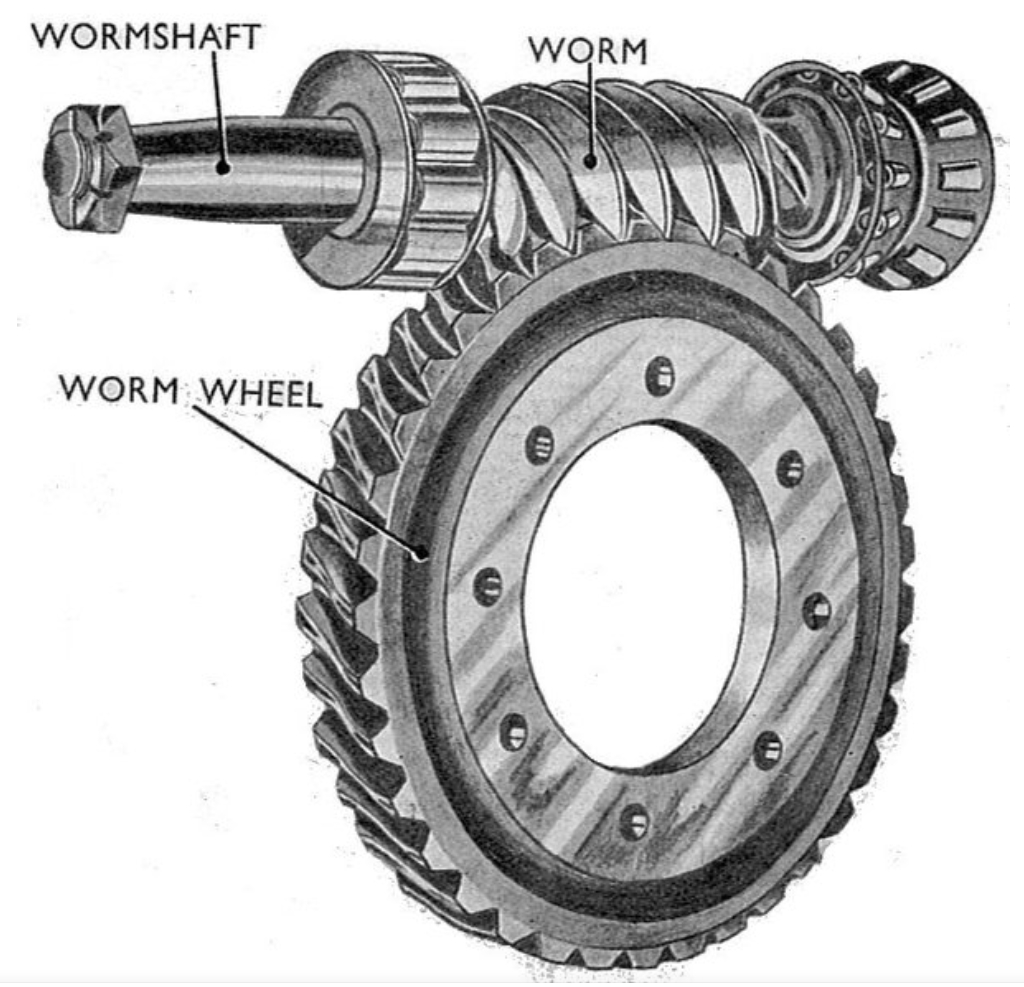
Using the mathematical model, we construct a three-dimensional precise solid model of the roller enveloping worm gear drive. By calculating discrete data points from the tooth surface equations and applying multi-order spline curves, we fit instantaneous contact lines. Smooth surface fitting of these lines produces the worm tooth surface, which is then combined with the worm body through Boolean operations to form the complete 3D model. This process ensures high accuracy in representing the worm gear drive’s geometry. The model reveals that the contact between the worm and wheel is line contact, which is typical for this type of worm gear drive. This line contact contributes to the efficient load distribution and reduced stress concentrations, key advantages of the roller enveloping design.
With the 3D model, we can simulate meshing behavior under various conditions. For instance, we examine the contact patterns and stress distributions using finite element analysis (FEA). The worm gear drive’s contact characteristics are sensitive to design parameters, which we explore next. The primary parameters of interest are the worm throat minimum diameter $d_{\text{min}}$ and the roller diameter $d_g$. In practical applications, the transmission ratio $i_{12}$ and center distance $a$ are often predetermined, so optimizing $d_{\text{min}}$ and $d_g$ is crucial for enhancing the worm gear drive’s performance.
We first analyze the effect of the worm throat minimum diameter on contact stress. Assuming $i_{12} = 20$ and $a = 100 \, \text{mm}$, we vary $d_{\text{min}}$ from 20 mm to 40 mm. The maximum equivalent stress and safety factor are computed through FEA simulations. The results are summarized in Table 1.
| $d_{\text{min}}$ (mm) | Maximum Equivalent Stress (MPa) | Safety Factor |
|---|---|---|
| 20 | 950 | 0.85 |
| 25 | 880 | 0.92 |
| 30 | 820 | 1.05 |
| 35 | 860 | 0.98 |
| 40 | 900 | 0.90 |
The data shows that the maximum equivalent stress follows a “V”-shaped trend with respect to $d_{\text{min}}$, reaching a minimum at $d_{\text{min}} = 30 \, \text{mm}$. Conversely, the safety factor peaks at this diameter. This indicates that $d_{\text{min}} = 30 \, \text{mm}$ is the optimal value for this worm gear drive configuration, balancing stress and safety. The stress variation can be attributed to changes in tooth thickness and bending stiffness. A smaller diameter reduces material but increases stress, while a larger diameter may lead to geometric constraints that also elevate stress. Thus, proper selection of the worm throat minimum diameter is vital for the worm gear drive’s durability.
Next, we investigate the influence of roller diameter $d_g$ on the worm gear drive’s contact characteristics. Keeping $i_{12} = 20$ and $a = 100 \, \text{mm}$, we set $d_g$ to 16 mm, 18 mm, and 20 mm. The results are presented in Table 2.
| $d_g$ (mm) | Maximum Equivalent Stress (MPa) | Minimum Safety Factor |
|---|---|---|
| 16 | 1050 | 0.75 |
| 18 | 1150 | 0.65 |
| 20 | 1250 | 0.55 |
As $d_g$ increases, the maximum equivalent stress rises, and the safety factor declines. This suggests that smaller rollers are beneficial for reducing stress in this worm gear drive. However, rollers must be large enough to withstand loads without excessive deformation. For $d_g = 16 \, \text{mm}$, the stress is lowest, making it the preferable choice among the tested values. The relationship between roller diameter and stress can be expressed empirically as:
$$
\sigma_{\text{max}} = k_1 d_g + k_2,
$$
where $k_1$ and $k_2$ are constants derived from regression analysis. This linear trend highlights the importance of optimizing roller size in worm gear drive design.
Beyond design parameters, assembly errors significantly impact the worm gear drive’s meshing performance. We consider four types of errors: center distance error $\Delta a$, worm axial error $\Delta l_1$, worm wheel axial error $\Delta l_2$, and shaft intersection angle error $\Delta \gamma$. These errors can introduce unwanted clearance or interference, affecting the worm gear drive’s accuracy and longevity.
First, center distance error $\Delta a$ is defined as positive when the distance increases and negative when it decreases. The effect on meshing clearance is shown in Table 3.
| $\Delta a$ (mm) | Clearance for First Tooth Pair (mm) | Clearance for Second Tooth Pair (mm) |
|---|---|---|
| -0.10 | -0.06 (interference) | -0.09 (interference) |
| -0.05 | -0.03 | -0.04 |
| 0.00 | 0.00 | 0.00 |
| +0.05 | +0.02 | +0.03 |
| +0.10 | +0.05 | +0.06 |
Negative errors increase interference (negative clearance), while positive errors create clearance. The second tooth pair is more sensitive to $\Delta a$. To maintain zero-backlash meshing in the worm gear drive, $\Delta a$ should be confined within $\pm 0.05 \, \text{mm}$.
Second, worm axial error $\Delta l_1$ causes asymmetric changes in clearance. Due to symmetry, we analyze only one direction. The results are in Table 4.
| $\Delta l_1$ (mm) | Clearance on Left Side (mm) | Clearance on Right Side (mm) |
|---|---|---|
| 0.00 | 0.00 | 0.00 |
| 0.02 | -0.02 | +0.02 |
| 0.05 | -0.05 | +0.05 |
A shift of $0.05 \, \text{mm}$ alters clearance by about $0.04$ to $0.05 \, \text{mm}$, with one side experiencing increased interference and the other decreased interference. For precise worm gear drive operation, $\Delta l_1$ should be less than $\pm 0.03 \, \text{mm}$.
Third, worm wheel axial error $\Delta l_2$ has minimal impact on the meshing zone but affects clearance distribution. As shown in Table 5, the worm gear drive exhibits local contact near the worm tooth tip when disengaging.
| $\Delta l_2$ (mm) | Clearance on Left Side (mm) | Clearance on Right Side (mm) |
|---|---|---|
| 0.00 | 0.00 | 0.00 |
| 0.10 | -0.03 | +0.03 |
| 0.20 | -0.06 | +0.06 |
Similar to worm axial error, $\Delta l_2$ causes one side to have increased interference and the other decreased. To avoid significant deviations, $\Delta l_2$ should be kept within $\pm 0.2 \, \text{mm}$ for this worm gear drive.
Fourth, shaft intersection angle error $\Delta \gamma$ is defined positive for clockwise rotation and negative for counterclockwise. The effect on clearance is summarized in Table 6.
| $\Delta \gamma$ (degrees) | Clearance for First Tooth Pair (mm) | Clearance for Second Tooth Pair (mm) |
|---|---|---|
| -0.5 | -0.04 | -0.05 |
| -0.3 | -0.02 | -0.03 |
| 0.0 | 0.00 | 0.00 |
| +0.3 | +0.02 | +0.03 |
| +0.5 | +0.04 | +0.05 |
Positive $\Delta \gamma$ increases interference, while negative $\Delta \gamma$ reduces it. The clearance change is approximately linear, with a variation of $0.07 \, \text{mm}$ over the range $-0.5^\circ$ to $+0.5^\circ$. For optimal worm gear drive performance, $\Delta \gamma$ should not exceed $\pm 0.4^\circ$.
To generalize, the relationship between assembly errors and meshing clearance can be modeled as:
$$
\delta = c_1 \Delta a + c_2 \Delta l_1 + c_3 \Delta l_2 + c_4 \Delta \gamma,
$$
where $\delta$ is the total clearance change, and $c_1, c_2, c_3, c_4$ are sensitivity coefficients derived from our data. This equation aids in tolerance allocation for worm gear drive assemblies.
In conclusion, our analysis of the roller enveloping worm gear drive reveals several key insights. The worm throat minimum diameter significantly influences contact stress, with an optimal value that minimizes stress and maximizes safety. The roller diameter also affects stress, where smaller diameters tend to reduce equivalent stress. Regarding assembly errors, center distance and worm axial errors directly cause meshing clearance or interference, while worm wheel axial and shaft angle errors primarily alter clearance distribution asymmetrically. To ensure zero-backlash operation and high efficiency in the worm gear drive, it is essential to control these errors within specified limits. Future work could explore dynamic effects, thermal considerations, and advanced materials to further enhance the worm gear drive’s performance. This study provides a foundation for designing and assembling robust roller enveloping worm gear drives in demanding applications.