
In mechanical transmission systems, the presence of gear backlash due to manufacturing errors, assembly inaccuracies, elastic deformation of teeth, and thermal expansion from friction can significantly impact precision, especially in applications like CNC machine tools, industrial robots, and radar systems. To address this, I have developed a novel inclined double-roller enveloping hourglass worm gear drive, which aims to eliminate backlash and compensate for wear. This worm gear drive utilizes a split worm wheel with inclined rollers as teeth, allowing for adjustable clearance. In this article, I will detail the meshing performance analysis, machining process, and performance testing of this innovative worm gear drive, emphasizing its advantages through extensive use of formulas and tables.
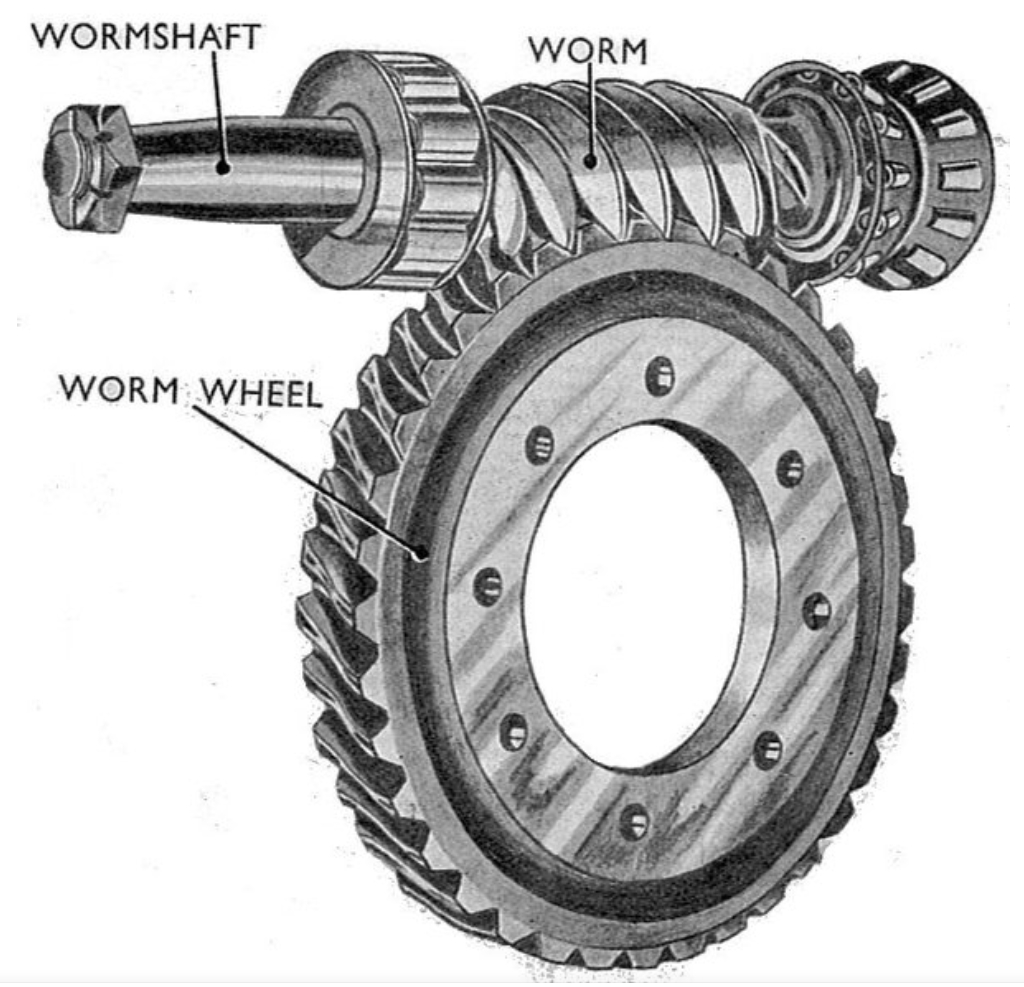
The inclined double-roller enveloping hourglass worm gear drive is designed to enhance precision in high-demand applications. This worm gear drive consists of a globoid worm and a worm wheel split into two halves: a fixed half and a movable half. Each half features a series of rollers inclined at an angle to the radial direction, serving as the teeth. This configuration allows for backlash adjustment through a clearance elimination mechanism. The worm gear drive operates on the principle of enveloping contact, where the worm surface is generated by the rolling motion of the rollers. To understand the performance of this worm gear drive, I first conducted a meshing geometry analysis.
For the meshing performance analysis, I established coordinate systems to model the worm gear drive. Let $S_1′(O_1′; i_1′, j_1′, k_1′)$ be the static coordinate system of the worm, and $S_2′(O_2′; i_2′, j_2′, k_2′)$ be the static coordinate system of the worm wheel. The moving coordinate systems are $S_1(O_1; i_1, j_1, k_1)$ for the worm and $S_2(O_2; i_2, j_2, k_2)$ for the worm wheel. Additionally, a coordinate system $S_0(O_0; i_0, j_0, k_0)$ is fixed at the center of the roller top, with the roller axis inclined at an angle $\gamma$ to the radial direction. The position of $O_0$ in $S_2$ is given by $(a_2, b_2, c_2)$. Here, $A$ is the center distance, $\alpha$ is the tooth circumferential angle, $c_2$ is the roller offset, and $\phi_1$ and $\phi_2$ are the rotation angles of the worm and worm wheel, respectively.
The roller surface, representing the worm wheel tooth, can be expressed in $S_0$ as:
$$ \mathbf{r}_0(\theta, u) = R\cos\theta \mathbf{i}_0 + R\sin\theta \mathbf{j}_0 + u \mathbf{k}_0 $$
where $R$ is the roller radius, and $\theta$ and $u$ are parameters of the roller generatrix. Based on gear meshing theory, the meshing equation for this worm gear drive is derived as:
$$ u = f(\theta, \phi_2) = \frac{P_1}{P_2} $$
with:
$$ P_1 = (-c_2 D_2 \sin\theta + a_2 \cos\theta) \cos\phi_2 + (c_2 D_1 \sin\theta – b_2 \cos\theta) \sin\phi_2 + i_{21}(b_2 D_2 – a_2 D_1) \sin\theta – A \cos\theta $$
$$ P_2 = (D_1 \cos\phi_2 + D_2 \sin\phi_2) \cos\theta – i_{21} \sin\theta $$
where $D_1 = \cos\alpha \cos\gamma – \sin\alpha \sin\gamma$, $D_2 = -\sin\alpha \cos\gamma – \cos\alpha \sin\gamma$, and $i_{21}$ is the gear ratio. The instantaneous contact line equation is given by:
$$ \mathbf{r}_0 = R\cos\theta \mathbf{i}_0 + R\sin\theta \mathbf{j}_0 + u \mathbf{k}_0, \quad u = f(\theta, \phi_2), \quad \phi_2 \neq 0 $$
To evaluate the contact characteristics, I calculated the induced normal curvature $k_\sigma$ in the direction of the contact line normal:
$$ k_\sigma = -\frac{(v_{12}^{(1)} / R – \omega_{12}^{(2)})^2 + (\omega_{12}^{(1)})^2}{\Psi} $$
where $v_{12}^{(1)} = B_1 D_2 \cos\theta + B_2 D_1 \cos\theta – B_3 \sin\theta$, $\omega_{12}^{(1)} = i_{21} \sin\theta – (D_2 \sin\phi_2 + D_1 \cos\phi_2) \cos\theta$, $\omega_{12}^{(2)} = D_1 \sin\phi_2 – D_2 \cos\phi_2$, and $B_1$, $B_2$, $B_3$ are functions of the coordinates and parameters. The lubrication angle $\mu$, which affects the oil film formation, is:
$$ \mu = \arcsin\left( \frac{v_{12}^{(1)} (v_{12}^{(1)} / R – \omega_{12}^{(2)}) + v_{12}^{(2)} \omega_{12}^{(1)}}{\sqrt{(v_{12}^{(1)} / R – \omega_{12}^{(2)})^2 + (\omega_{12}^{(1)})^2} \sqrt{(v_{12}^{(1)})^2 + (v_{12}^{(2)})^2}} \right) $$
and the self-rotation angle $\mu_z$ is:
$$ \mu_z = \arccos\left( \frac{v_{12}^{(2)}}{\sqrt{(v_{12}^{(1)})^2 + (v_{12}^{(2)})^2}} \right) $$
Using these formulas, I analyzed the meshing performance for a specific set of parameters, as summarized in the table below. This worm gear drive demonstrates multiple-tooth contact, with up to three pairs of teeth engaging simultaneously, ensuring load distribution and stability.
| Parameter | Value | Parameter | Value |
|---|---|---|---|
| Center Distance $A$ (mm) | 125 | Number of Worm Threads $z_1$ | 1 |
| Worm Throat Diameter Coefficient $k_1$ | 0.4 | Worm Handedness | Right |
| Worm Wheel Tooth Number $z_2$ | 25 | Roller Outer Diameter $R$ (mm) | 6.5 |
| Roller Offset $c_2$ (mm) | 7.5 | Tooth Circumferential Angle $\alpha$ (°) | 1 |
| Roller Inclination Angle $\gamma$ (°) | 6 | Addendum Coefficient $h_a^*$ | 1 |
| Clearance Coefficient $c^*$ | 0.25 | Center Distance Error (μm) | -0.001 to 0.001 |
The results show that the contact lines are evenly distributed along the tooth height, from entry to exit. The induced normal curvature decreases along the tooth height in the entry zone but increases in the exit zone, with higher values in the entry zone. The lubrication angle exceeds 80° in the entry zone, indicating favorable conditions for elastohydrodynamic lubrication. The self-rotation angle varies, reaching a minimum near the throat. These characteristics confirm that this worm gear drive has excellent meshing performance, reducing wear and improving efficiency.
Moving to the machining process, the globoid worm in this worm gear drive has a variable tooth thickness, being thinner in the middle and thicker at the ends. Conventional forming methods are unsuitable, so I employed a generating process using a modified gear hobbing machine. The worm blank, made of 40Cr alloy steel, was mounted on the machine tool holder, while a motorized spindle with a cutting tool was placed on the worktable. Through coordinated motion between the holder and table, the tool enveloped the worm surface according to the relative motion of the worm gear drive. The process involved rough turning, heat treatment, gear hobbing for slotting, milling, grinding, and nitriding to achieve a surface hardness of HV 1000 and roughness of 0.8 μm. The machining setup ensured precise tooth profiles essential for the worm gear drive’s performance.
The worm wheel consists of two halves: a fixed half and a movable half, each with rollers as teeth. The rollers are deep-groove ball bearings (model 686ZZ) mounted on pins made of 40CrNiMoA. The pins are press-fitted into the wheel halves, which are made of 3Cr13 stainless steel. The inclination angle $\gamma$ is machined accurately to ensure proper meshing. The pitch error of the rollers on the worm wheel pitch circle was controlled within ±0.005 mm to prevent interference. The assembly includes a backlash adjustment mechanism, allowing for precise clearance elimination in the worm gear drive.
After manufacturing, I assembled the prototype of the inclined double-roller enveloping hourglass worm gear drive into a reducer for performance testing. The tests were conducted on a magnetic powder loading mechanical transmission test bed, consisting of a three-phase AC motor with a frequency converter, a magnetic powder loader, torque-speed sensors, and data acquisition systems. The worm gear drive reducer was lubricated with CKE-320 worm gear oil. Prior to testing, I performed run-in trials at no-load and under light loads to ensure proper break-in.
The performance tests focused on transmission efficiency, oil sump temperature, and noise under various operating conditions. The input speed was varied at 400 rpm, 700 rpm, and 1000 rpm, with load torque increased gradually up to 20 N·m. The transmission efficiency $\eta$ was calculated as:
$$ \eta = \frac{T_2 \omega_2}{T_1 \omega_1} \times 100\% $$
where $T_1$ and $T_2$ are the input and output torques, and $\omega_1$ and $\omega_2$ are the input and output angular velocities. The results, presented in the table below, show that efficiency increases with load and stabilizes, reaching a maximum of 75.8%. This efficiency range of 70.5% to 75.8% is competitive for worm gear drives, attributed to the rolling contact of the rollers reducing friction.
| Input Speed (rpm) | Load Torque (N·m) | Efficiency (%) |
|---|---|---|
| 400 | 5 | 70.5 |
| 10 | 72.3 | |
| 20 | 73.8 | |
| 700 | 5 | 71.2 |
| 10 | 73.5 | |
| 20 | 75.1 | |
| 1000 | 5 | 72.0 |
| 10 | 74.4 | |
| 20 | 75.8 |
The oil sump temperature was monitored over time at a constant load of 20 N·m. The temperature rise $\Delta T$ can be modeled using the heat balance equation:
$$ \Delta T = \frac{Q}{c m} $$
where $Q$ is the heat generated from power losses, $c$ is the specific heat of oil, and $m$ is the oil mass. As shown in the table below, the temperature stabilized after 120 minutes, with a maximum equilibrium temperature of 49.5°C and a maximum rise of 34.5°C. These values are lower than those in conventional worm gear drives, due to reduced sliding friction in this worm gear drive.
| Input Speed (rpm) | Equilibrium Temperature (°C) | Temperature Rise (°C) | Noise Level (dB) |
|---|---|---|---|
| 400 | 42.3 | 27.3 | 70-85 |
| 700 | 46.1 | 31.1 | 75-92 |
| 1000 | 49.5 | 34.5 | 80-100 |
Noise levels were measured using a sound level meter, ranging from 70 dB to 100 dB, increasing with speed. The noise is primarily due to meshing impacts and vibration, but the multiple-tooth contact in this worm gear drive helps dampen vibrations. Compared to standard worm gear drives, this design offers quieter operation, making it suitable for precision applications.
In conclusion, the inclined double-roller enveloping hourglass worm gear drive presents a significant advancement in backlash elimination and performance. The meshing analysis confirms favorable contact patterns, with high lubrication angles and controlled curvature. The machining process, though complex, yields precise components that enhance the worm gear drive’s reliability. Performance tests demonstrate efficiencies up to 75.8%, low oil temperatures below 50°C, and moderate noise levels. These attributes make this worm gear drive ideal for high-precision systems requiring minimal backlash and wear compensation. Future work could focus on optimizing the inclination angle $\gamma$ for specific applications or exploring advanced materials to further improve the worm gear drive’s lifespan and efficiency.
Throughout this study, the term “worm gear drive” has been emphasized to highlight its central role in transmission systems. The innovative use of rollers as teeth transforms the traditional sliding contact into rolling contact, reducing friction and heat generation. This worm gear drive not only addresses backlash issues but also offers a robust solution for demanding mechanical environments. By integrating geometric analysis with practical machining and testing, I have validated the viability of this worm gear drive for industrial adoption. The tables and formulas provided herein summarize key data, aiding in the understanding and replication of this worm gear drive technology.