
In the realm of precision and heavy-duty transmission systems, the enveloping torus worm gear drive stands out for its theoretical advantages, including compact meshing, high load-carrying capacity, superior transmission efficiency, and extended service life. These attributes make it highly suitable for applications in precision machine tools, rail transportation, and metallurgical industries. However, the practical exploitation of these benefits in engineering contexts is often hindered by the stringent requirements for geometric accuracy and meshing quality of the tooth profiles. The performance of a worm gear drive is critically dependent on the precise matching of envelope lines according to established relationships; even minor deviations in the tooth surface can lead to significant meshing errors and a drastic reduction in load-bearing performance. Consequently, the development of accurate digital models for such complex geometries is paramount. This work addresses the challenge of precisely characterizing the intricate meshing surface of the cone-generated enveloping torus worm gear drive. I propose a comprehensive digital modeling methodology, deriving the mathematical models through differential geometry, kinematics, envelope theory, and spatial coordinate transformations. The focus is on establishing an exact digital foundation for the worm’s working tooth profile, which directly influences the application performance of the worm gear drive.
The core of the modeling effort lies in the forming principle of the worm. The cone-generated enveloping torus worm is produced by enveloping a rotating worm blank with a tilted conical grinding wheel. This wheel is mounted on a separate conical cutter head. The relative motion between the cutter head and the worm blank, governed by a specific speed ratio, generates the complex working surfaces through a double-enveloping process—one for the right-side tooth flank and another for the left-side. The complete worm profile consists of these two working flanks, along with the addendum and root toroidal surfaces. To mathematically capture this process, a multi-coordinate system framework is established. The primary systems include the grinding wheel coordinate system $S_1(O_1-x_1y_1z_1)$, the worm static coordinate system $S_2(O_2-x_2y_2z_2)$, the worm moving coordinate system $S_{2i}(O_2-x_{2i}y_{2i}z_{2i})$, the cutter head static system $S_3(O_3-x_3y_3z_3)$, and the cutter head moving system $S_{3i}(O_3-x_{3i}y_{3i}z_{3i})$. The spatial relationships and transformations between these systems are crucial for the derivation.
The conical grinding wheel surface is parameterized in its own coordinate system. For a point $M$ on the wheel surface, its coordinates are given by:
$$
\vec{r_1} = \begin{bmatrix} x_1 \\ y_1 \\ z_1 \end{bmatrix} = \begin{bmatrix} -r_1 \cos \beta_1 \\ r_1 \sin \beta_1 \\ R_1 \tan \alpha_1 – r_1 \tan \alpha_1 \end{bmatrix}
$$
where $R_1$ is the base radius of the wheel, $\alpha_1$ is the cone angle, and $\beta_1$ and $r_1$ are the angular and radial parameters on any cross-section, respectively. The normal vector $\vec{n}$ at point $M$ is derived using differential geometry:
$$
\vec{n} = \begin{vmatrix} \vec{i} & \vec{j} & \vec{k} \\
\frac{\partial x_1}{\partial \beta_1} & \frac{\partial y_1}{\partial \beta_1} & \frac{\partial z_1}{\partial \beta_1} \\
\frac{\partial x_1}{\partial r_1} & \frac{\partial y_1}{\partial r_1} & \frac{\partial z_1}{\partial r_1} \end{vmatrix} = \begin{bmatrix} -\cos \beta_1 \tan \alpha_1 \\ \sin \beta_1 \tan \alpha_1 \\ 1 \end{bmatrix}
$$
The fundamental condition for the envelope surface, based on the theory of gearing, is that the relative velocity vector between the tool and the workpiece must be orthogonal to the common normal vector at the point of contact. This is expressed by the meshing equation $\vec{n} \cdot \vec{v}_{12} = 0$, where $\vec{v}_{12}$ is the relative velocity. After transforming the normal vector and velocity into a common coordinate system (the moving cutter head system $S_{3i}$), the meshing equation for the right-side flank is obtained as a complex implicit function:
$$
f(r_1, \beta_1, \varphi_3) = 0
$$
Here, $\varphi_3$ is the rotation angle of the cutter head. For each instantaneous value of $\varphi_3$, this equation defines a set of parameters $(r_1, \beta_1)$ that satisfy the contact condition, forming an instantaneous contact line on the grinding wheel. The ensemble of all such lines constitutes the envelope surface. By applying a series of coordinate transformations, the points on these contact lines are mapped to the worm’s moving coordinate system $S_{2i}$, yielding the digital model for the right-side working tooth profile of the worm gear drive. The transformation chain is:
$$
\vec{r_{3i}} = \mathbf{Rot}_x(\beta-\pi) \mathbf{Rot}_z(\pi) \, \vec{r_1} + \mathbf{Tra}_x(h) + \mathbf{Tra}_y(-r_b)
$$
$$
\vec{r_{2i}} = \mathbf{Rot}_z(\varphi_2) \left[ \mathbf{Rot}_z(-\varphi_3) \mathbf{Rot}_x(\frac{\pi}{2}) \mathbf{Rot}_z(\pi) \, \vec{r_{3i}} + \mathbf{Tra}_x(-a) \right]
$$
where $\mathbf{Rot}$ and $\mathbf{Tra}$ denote rotation and translation matrices, $a$ is the center distance, $h$ and $r_b$ are setup parameters, and $\varphi_2 = i_{12} \varphi_3$ with $i_{12}$ being the transmission ratio of the worm gear drive.
The model for the left-side working flank is derived similarly, accounting for a different initial angular position $\varepsilon_0$ of the grinding wheel relative to the process for the right flank. The complete mathematical model for the worm gear drive’s worm tooth profile is thus a set of parametric equations coupled with the meshing condition. However, these models are subject to boundary constraints that define the viable region of the tooth surface. The constraints arise from the physical limits of the grinding wheel and the worm blank geometry:
| Constraint Source | Mathematical Expression |
|---|---|
| Grinding Wheel Radial Limit | $R_1 – h_1 / \tan \alpha_1 \leq r_1 \leq R_1$ |
| Grinding Wheel Height Limit | $0 \leq z_1 \leq h_1$ |
| Worm Blank Radial Boundary | $\sqrt{R_{a1}^2 – r_b^2} \leq y_1 \leq \sqrt{R_{f1}^2 – r_b^2}$ |
| Worm Working Length | $-L/2 \leq z_{2i} \leq L/2$ |
| Enveloping Angle Range | $\alpha \leq \varphi_3 \leq \alpha + 2\varphi_0$ |
In addition to the complex working flanks, the worm profile includes the addendum and root toroidal surfaces. These are generated by revolving circular arcs around the worm axis. Their generatrix equations are simpler. For the addendum torus:
$$
\begin{cases}
0 \leq \varepsilon \leq 2\pi \\
x = a – R_{a1} \cos \varepsilon \\
z = R_{a1} \sin \varepsilon \\
-L/2 \leq Z \leq L/2
\end{cases}
$$
and for the root torus:
$$
\begin{cases}
0 \leq \varepsilon \leq 2\pi \\
x = a – R_{f1} \cos \varepsilon \\
z = R_{f1} \sin \varepsilon \\
-L/2 \leq Z \leq L/2
\end{cases}
$$
where $R_{a1}$ and $R_{f1}$ are the addendum and root arc radii, and $\varepsilon$ is the revolution parameter.
The combined mathematical model for the cone-generated enveloping torus worm gear drive’s worm is a constrained, multi-variable, nonlinear system. To solve it and obtain the discrete point cloud representing the tooth surface, a specialized algorithm is designed. The algorithm leverages the forming principle where each fixed enveloping angle $\varphi_3$ corresponds to one instantaneous contact line. The core steps are as follows:
- Calculate all geometric parameters and the feasible ranges for $\varphi_3$, $\beta_1$, and $r_1$.
- Discretize the enveloping angle $\varphi_3$ into $n$ equal intervals over its feasible range, resulting in values $\varphi_3^{(1)}, \varphi_3^{(2)}, …, \varphi_3^{(n)}$.
- Discretize the grinding wheel angular parameter $\beta_1$ into $k$ equal intervals over its range, yielding $\beta_1^{(1)}, \beta_1^{(2)}, …, \beta_1^{(k)}$.
- For each fixed $\varphi_3^{(i)}$, iterate through all $\beta_1^{(j)}$. For each pair $(\varphi_3^{(i)}, \beta_1^{(j)})$, solve the meshing equation $f(r_1, \beta_1^{(j)}, \varphi_3^{(i)})=0$ for the corresponding $r_1$ value. This yields a set of contact points $(\beta_1^{(j)}, r_1^{(j)})$ on the grinding wheel for that instant.
- Transform these contact points from the grinding wheel coordinates to the worm moving coordinate system $S_{2i}$ using the established transformation equations.
- Apply the boundary constraint conditions to filter out points that lie outside the valid worm tooth region (e.g., points beyond the working length or outside the radial boundaries). The remaining points form the discrete representation of the contact line for angle $\varphi_3^{(i)}$.
- Repeat steps 4-6 for all $n$ discrete values of $\varphi_3$ to compute the entire cluster of contact lines and the complete point cloud for the worm working flank.
- The same algorithm is applied separately for the right and left flanks, adjusting the initial condition parameter $\varepsilon_0$ for the left flank.
This algorithm effectively handles the complexity of the model and enables the generation of a high-precision point cloud. The accuracy of the resulting digital model for the worm gear drive can be verified by a reverse-envelope check. For each computed contact point, one can back-calculate the corresponding enveloping parameters and then evaluate the orthogonality condition $\vec{n} \cdot \vec{v}_{12}$. The deviation from zero represents the model error.
To demonstrate the practical application and validity of the proposed modeling method and algorithm, a detailed modeling instance is presented. The basic parameters for the cone-generated enveloping torus worm gear drive are selected as follows:
| Parameter Name | Symbol | Value |
|---|---|---|
| Center Distance | $a$ | 200 mm |
| Number of Worm Threads (Right-hand) | $z_1$ | 1 |
| Drive Ratio | $i_{12}$ | 40 |
| Module | $m$ | 4 mm |
| Grinding Wheel Base Radius | $R_1$ | 30 mm |
| Grinding Wheel Cone Angle | $\alpha_1$ | $\pi/4$ rad |
| Grinding Wheel Height | $h_1$ | 30 mm |
| Setup Distance | $h$ | 35 mm |
| Cutter Head Tilt Angle | $\beta$ | 10° |
From these, key modeling parameters are derived, such as the worm pitch diameter $d_1 = 64.5$ mm, cutter head base radius $r_b = 62.5$ mm, feasible enveloping angle range $\varphi_3 \in [0.1026, 0.6586]$ rad, addendum radius $R_{a1} = 173.2361$ mm, root radius $R_{f1} = 159.7126$ mm, and working length $L = 91.8263$ mm. The discretization numbers are set to $n=200$ for $\varphi_3$ and $k=6$ for $\beta_1$ per contact line for illustrative clarity.
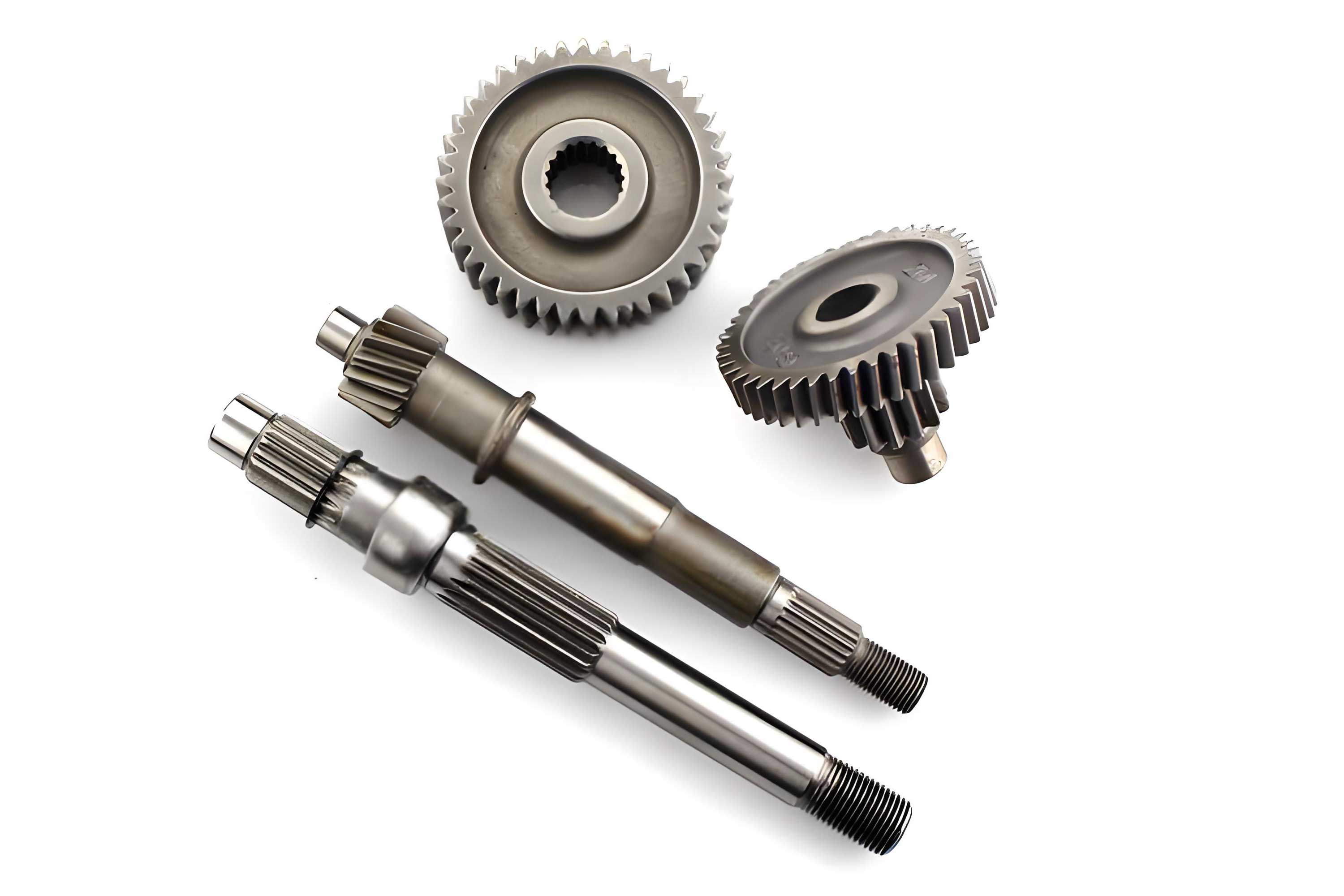
Executing the solving algorithm generates the complete set of instantaneous contact lines and the corresponding point cloud for the worm gear drive’s worm. The contact lines exhibit a non-linear nature in all coordinate systems, distinguishing this cone-generated type from other enveloping worm drives. For each discrete enveloping angle, a contact line composed of multiple points is obtained. The aggregate of all 200 contact lines for each flank forms a dense point cloud that accurately defines the three-dimensional working surface. The point clouds for the right and left flanks, as well as the combined model, can be visualized. Furthermore, the addendum and root generatrices are calculated separately and can be revolved to create their respective surfaces.
The precision of the digital model is a critical aspect for the worm gear drive. The error analysis performed via the reverse-envelope method on all 2400 calculated contact points (from both flanks) reveals an extremely high level of accuracy. The orthogonality error, calculated as $|\vec{n} \cdot \vec{v}_{12}|$, is on the order of $10^{-9}$ for all points. This minuscule error primarily stems from the finite numerical precision of the computational software (e.g., MATLAB) used to implement the algorithm. Theoretically, with sufficiently high numerical precision, this error can approach zero, confirming the exactness of the derived mathematical models and the effectiveness of the solving algorithm for the worm gear drive.
With the high-accuracy point cloud data for the working flanks and the definitions for the addendum and root tori, a complete three-dimensional digital solid model of the cone-generated enveloping torus worm can be constructed. This is achieved by importing the point data into CAD software (e.g., Pro/ENGINEER or similar) and employing curve and surface fitting techniques. The resulting solid model shows seamless integration between the complex enveloped working flanks and the simpler toroidal surfaces, validating the geometric consistency of the overall modeling approach for the worm component of the worm gear drive.
In conclusion, this work presents a rigorous and systematic digital modeling methodology for the cone-generated enveloping torus worm, a key component in a high-performance worm gear drive. By applying principles from differential geometry and kinematics, precise mathematical models for the working tooth flanks are derived. A robust numerical algorithm is designed to solve these complex nonlinear models, successfully generating the complete instantaneous contact line cluster and a high-fidelity point cloud representation of the worm surface. The modeling instance demonstrates the method’s capability to achieve exceptional geometric accuracy, with profile errors at the $10^{-9}$ level. This accurate digital model forms a crucial foundation for subsequent steps in the design and manufacturing chain for this type of worm gear drive. Specifically, it enables the precision digital manufacturing of the worm itself via CNC grinding and, most importantly, provides the essential geometric data required for the design and fabrication of the corresponding cone-generated double-enveloping worm wheel hob. The successful digital modeling paves the way for fully leveraging the theoretical advantages of the cone-generated enveloping torus worm gear drive in practical engineering applications, potentially enhancing performance in demanding transmission scenarios. Future work will naturally extend this modeling framework to the more complex secondary enveloping process required for the mating worm wheel, completing the digital twin for the entire worm gear drive assembly.