
In the field of engineering machinery, the worm gear drive is a critical component due to its high transmission ratio, substantial load-bearing capacity, and self-locking characteristics. As an engineer involved in mechanical transmission systems, I have often encountered the challenge of selecting the optimal worm gear drive type for specific applications, particularly when balancing performance, durability, and cost. This study focuses on a comparative analysis of the bearing capacity between cylindrical and hourglass (planar double-enveloping) worm gear drives, based on actual operational conditions from a construction machinery scenario. We aim to provide empirical data and insights that can guide the selection of worm gear drives in similar engineering contexts.
The operational requirements for the worm gear drive in this study include a center distance of 147 mm, a transmission ratio of 35, a maximum input speed of 719 rpm, a working torque of 9,600 N·m, an efficiency greater than 40%, and static self-locking capability with a torque of 20,000 N·m. These parameters set the foundation for our optimization and analysis. To achieve the highest possible bearing capacity, we established an optimization model with the objective function to maximize the module, as the module directly influences the strength and load distribution in a worm gear drive. The optimization variables are the worm pitch diameter and the lead angle, constrained by geometric, kinematic, and efficiency criteria.
The efficiency of a worm gear drive is a key performance metric, influenced by meshing losses, bearing and seal friction, and oil churning losses. The total efficiency $$\eta$$ is given by:
$$\eta = \eta_1 \eta_2 \eta_3$$
where $$\eta_2$$ accounts for oil churning losses (typically 0.99), $$\eta_3$$ for bearing and seal friction (typically 0.98), and $$\eta_1$$ is the meshing efficiency. For a worm-driven system, $$\eta_1$$ is expressed as:
$$\eta_1 = \frac{\tan \gamma}{\tan(\gamma + \rho_v)} \quad \text{(worm driving)}$$
$$\eta_1 = \frac{\tan(\gamma – \rho_s)}{\tan \gamma} \quad \text{(wheel driving)}$$
Here, $$\gamma$$ is the lead angle of the worm, and $$\rho_v$$ and $$\rho_s$$ are the equivalent friction angles, dependent on sliding velocity, material pairing, and manufacturing precision. To meet the efficiency target of over 40%, we have:
$$0.97 \frac{\tan \gamma}{\tan(\gamma + \rho_v)} > 0.40$$
For static self-locking with a 15% safety margin, the condition is:
$$-0.97 \frac{\tan(\gamma – \rho_s)}{\tan \gamma} – 0.15 > 0$$
The optimization problem is formulated as follows. The objective function is:
$$f = \max\{m\}$$
where $$m$$ is the module. The optimization variables are:
$$x = [d_1, \gamma]$$
with constraints including center distance limitation:
$$h_1 = d_1 + m i – 2a = 0$$
lead angle definition:
$$h_2 = \arctan\left(\frac{m}{d_1}\right) – \gamma = 0$$
sliding velocity constraint:
$$h_3 = v_s – \frac{\pi d_1 n_{in max}}{60 \times 1000 \cos \gamma} = 0$$
material pairing constraint:
$$g_1 = \rho_v(\rho_s) – f(v_s, \gamma) > 0$$
efficiency constraint:
$$g_2 = 0.97 \frac{\tan \gamma}{\tan(\gamma + \rho_v)} – 0.40 > 0$$
and self-locking constraint:
$$g_3 = -0.97 \frac{\tan(\gamma – \rho_s)}{\tan \gamma} – 0.15 > 0$$
Using MATLAB for numerical optimization, we obtained optimal parameters: $$m = 6.3392 \, \text{mm}$$, $$d_1 = 72.128 \, \text{mm}$$, and $$\gamma = 5.022^\circ$$, yielding an efficiency of 60.26% and static self-locking. For practical manufacturing, we adjusted the module to 6.35 mm, a standard value. The key geometric parameters for both cylindrical and hourglass worm gear drives are summarized in Table 1, ensuring a fair comparison under identical design conditions.
| Geometric Parameter | Value |
|---|---|
| Number of Worm Threads | 1 |
| Number of Worm Wheel Teeth | 35 |
| Wheel Transverse Module (m_t) [mm] | 6.35 |
| Worm Lead Angle (γ) [°] | 5.058 |
| Worm Pitch Diameter [mm] | 70 |
| Worm Wheel Pitch Diameter [mm] | 222.25 |
| Worm Effective Length [mm] | 80 |
| Worm Wheel Face Width [mm] | 56 |
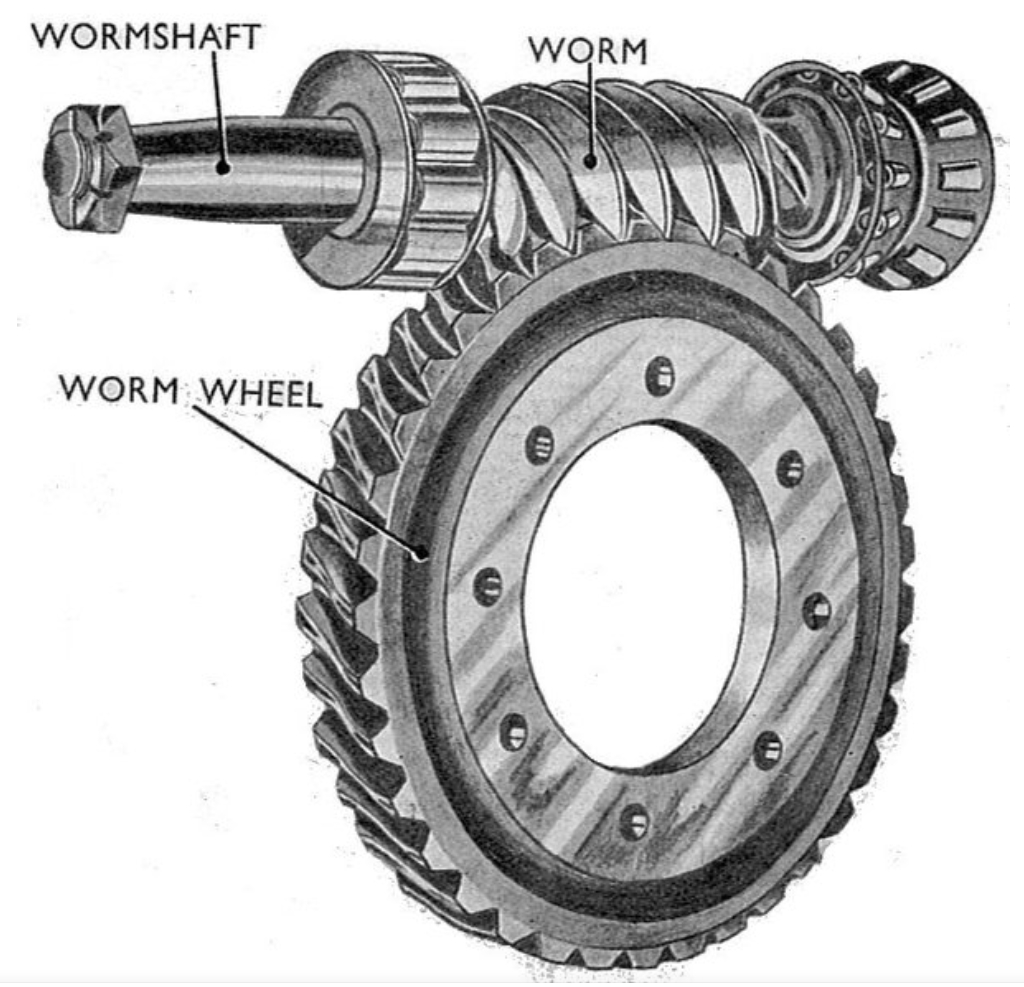
To assess the contact characteristics and bearing capacity, we performed finite element analysis (FEA) on both worm gear drive types. The material pairing was consistent: the worm wheel made of QT600-3 and the worm of 42CrMo with nitriding treatment to enhance wear resistance. This choice is based on previous experimental studies showing good performance for worm gear drives under high loads. We simplified the 3D models to reduce computational effort while maintaining accuracy, and meshed them uniformly for comparison. The FEA models for both worm gear drive types are shown conceptually, with the hourglass worm gear drive exhibiting a more complex contact pattern due to its double-enveloping nature.
The contact stress and strain distributions under working torque (9,600 N·m) and static self-locking torque (20,000 N·m) were analyzed. For the cylindrical worm gear drive, under working torque, the maximum equivalent stress on the worm and wheel tooth surfaces was 696 MPa and 695 MPa, respectively, with a maximum equivalent strain of 0.0046 and 0.0067. In contrast, the hourglass worm gear drive showed lower stresses: 518 MPa on the worm and 449 MPa on the wheel, with strains of 0.0032 and 0.0037. Under static self-locking torque, the cylindrical worm gear drive experienced stresses up to 1,207 MPa and 1,353 MPa, and strains of 0.0072 and 0.0131, while the hourglass worm gear drive had stresses of 740 MPa and 719 MPa, and strains of 0.0044 and 0.0058. These results indicate that the hourglass worm gear drive distributes loads more effectively, with lower stress concentrations and deformations, which is crucial for bearing capacity in worm gear drive applications.
A critical factor in bearing capacity is the number of simultaneously contacting tooth pairs. The FEA revealed that the hourglass worm gear drive had up to 5 contacting pairs, whereas the cylindrical worm gear drive had only 3. This difference significantly enhances the load-sharing capability of the hourglass worm gear drive, reducing per-tooth stress and improving overall durability. The contact patterns also differed: the hourglass worm gear drive exhibited a dual-line contact on the tooth surface, leading to a larger contact area and better alignment under load. These characteristics contribute to the superior performance of the hourglass worm gear drive in terms of bearing capacity.
To validate the FEA findings, we manufactured prototypes of both worm gear drive types based on the optimized parameters. The manufacturing processes were selected to ensure precision, with gear grinding for the worms and hobbing for the wheels, followed by run-in and selection for optimal mating. Initial contact pattern tests were conducted on a gear meshing instrument. The cylindrical worm gear drive showed a typical elliptical contact pattern, while the hourglass worm gear drive displayed two distinct contact zones, confirming the dual-line contact predicted by FEA. This preliminary test aligned with the simulation results, supporting the reliability of our analysis for worm gear drive behavior.
We then assembled the prototypes into test rigs for load-bearing experiments. The test setup included a drive motor, torque sensors, and a loading system to apply controlled torques. The worm gear drive prototypes were run under gradually increased loads to simulate actual operating conditions. Friction and wear tests were performed by running the worm gear drives until signs of scuffing or excessive wear appeared, such as increased noise or smoke. Both worm gear drive types were tested under identical conditions: same loading method, duration, step increments, and torque levels. After testing, the tooth surfaces were examined for wear.
The results were striking. The cylindrical worm gear drive exhibited severe wear on the worm wheel tooth surface, with a wear depth of approximately 0.5 mm. In contrast, the hourglass worm gear drive showed much lighter wear, around 0.2 mm. This direct experimental evidence confirms that the hourglass worm gear drive has a higher bearing capacity and better wear resistance under the same operational parameters. The reduced wear correlates with the lower stresses and strains observed in FEA, as well as the improved contact mechanics inherent to the hourglass design. This makes the hourglass worm gear drive a preferable choice for applications demanding high load-bearing performance and longevity.
Beyond the specific comparison, our study highlights several general principles for enhancing worm gear drive performance. The optimization of geometric parameters, such as module and lead angle, is essential for maximizing bearing capacity. The efficiency constraints must be carefully balanced with self-locking requirements, as seen in our mathematical model. For worm gear drives, the material pairing and surface treatments play a significant role in reducing friction and wear. In our case, the QT600-3 and nitrided 42CrMo combination proved effective, but other materials could be explored for different worm gear drive applications.
The advantages of the hourglass worm gear drive stem from its kinematic and geometric properties. The double-enveloping action allows for more teeth to be in contact at any given time, distributing the load over a larger area. This reduces the Hertzian contact stress, which is a key factor in pitting and fatigue failure in worm gear drives. The contact lines in an hourglass worm gear drive are also more favorable for lubricant entrainment, potentially improving elastohydrodynamic lubrication and further enhancing bearing capacity. These aspects are critical for worm gear drives used in heavy-duty machinery where reliability is paramount.
In terms of design implications, our findings suggest that for worm gear drives with center distances around 150 mm and transmission ratios near 35, the hourglass type offers a significant bearing capacity advantage. However, it is important to consider manufacturing complexity and cost. The hourglass worm gear drive requires more precise machining and alignment, which may increase production expenses. Therefore, in applications where cost is a major constraint but loads are moderate, a cylindrical worm gear drive might still be suitable if designed with adequate safety factors. Nevertheless, for high-torque, high-reliability scenarios, the hourglass worm gear drive is worth the investment.
To further quantify the bearing capacity, we can derive analytical expressions for the contact stress in worm gear drives. The maximum Hertzian contact stress $$\sigma_H$$ for a worm gear drive can be approximated by:
$$\sigma_H = \sqrt{\frac{F_n E^*}{\pi \rho_c}}$$
where $$F_n$$ is the normal load, $$E^*$$ is the equivalent modulus of elasticity, and $$\rho_c$$ is the equivalent radius of curvature. For a worm gear drive, $$\rho_c$$ varies along the tooth profile, and the hourglass design typically yields a larger $$\rho_c$$ due to its conformal contact, leading to lower $$\sigma_H$$. This aligns with our FEA results. Additionally, the bending stress $$\sigma_b$$ at the tooth root can be estimated using Lewis formula modifications for worm gear drives:
$$\sigma_b = \frac{F_t}{b m Y}$$
where $$F_t$$ is the tangential force, $$b$$ is the face width, $$m$$ is the module, and $$Y$$ is the form factor. The hourglass worm gear drive often has a more favorable form factor due to its tooth geometry, contributing to higher bending strength.
Table 2 summarizes the key performance metrics from our FEA and experimental tests, providing a direct comparison between the two worm gear drive types. This table encapsulates the bearing capacity indicators, emphasizing the superiority of the hourglass worm gear drive in this study.
| Metric | Cylindrical Worm Gear Drive | Hourglass Worm Gear Drive |
|---|---|---|
| Simultaneous Contact Pairs | 3 | 5 |
| Max Equivalent Stress (Working Torque) [MPa] | 696 (Worm), 695 (Wheel) | 518 (Worm), 449 (Wheel) |
| Max Equivalent Strain (Working Torque) | 0.0046 (Worm), 0.0067 (Wheel) | 0.0032 (Worm), 0.0037 (Wheel) |
| Max Equivalent Stress (Self-locking Torque) [MPa] | 1,207 (Worm), 1,353 (Wheel) | 740 (Worm), 719 (Wheel) |
| Max Equivalent Strain (Self-locking Torque) | 0.0072 (Worm), 0.0131 (Wheel) | 0.0044 (Worm), 0.0058 (Wheel) |
| Wear Depth After Testing [mm] | ~0.5 | ~0.2 |
| Contact Pattern Type | Single elliptical zone | Dual-line contact zones |
The experimental setup for worm gear drive testing involved careful calibration of alignment and clearance. The worm axial play was controlled within 0.05 mm, the worm wheel to sleeve clearance within 0.06 mm, and the sliding bearing clearance within 0.08 mm. These tolerances are typical for precision worm gear drives to minimize vibration and ensure smooth operation. During testing, we monitored temperature rise and noise levels, which are indirect indicators of bearing capacity and efficiency. The hourglass worm gear drive maintained lower temperatures and quieter operation under load, further confirming its robust design.
From a broader perspective, the bearing capacity of a worm gear drive is influenced by multiple factors, including lubrication conditions, operating speed, and assembly quality. In our tests, we used a standard mineral oil lubricant, but advanced synthetics could potentially improve performance. The sliding velocity $$v_s$$ in a worm gear drive is given by:
$$v_s = \frac{\pi d_1 n}{60 \times 1000 \cos \gamma}$$
where $$n$$ is the input speed. Higher $$v_s$$ can lead to increased friction and heat generation, affecting bearing capacity. The hourglass worm gear drive, with its better contact geometry, may mitigate some of these effects by promoting more efficient lubricant film formation.
In conclusion, our comprehensive analysis and experimental comparison demonstrate that the hourglass worm gear drive exhibits superior bearing capacity compared to the cylindrical worm gear drive under identical design parameters and loading conditions. The hourglass worm gear drive benefits from more simultaneous contacting tooth pairs, lower contact stresses and strains, and reduced wear, making it an excellent choice for high-load applications in engineering machinery. This study underscores the importance of geometric optimization and detailed analysis in selecting and designing worm gear drives. Future work could explore other worm gear drive variants or advanced materials to further push the boundaries of load-bearing performance. Ultimately, for engineers facing similar decisions, this research provides valuable data and methodology to guide the selection of worm gear drives based on bearing capacity requirements.
The implications extend beyond the specific case study. In industries such as construction, mining, and robotics, where worm gear drives are prevalent, understanding these differences can lead to more reliable and efficient machinery. We recommend that designers consider the hourglass worm gear drive for applications where maximum bearing capacity is critical, while weighing factors like cost and manufacturing complexity. Continuous improvement in simulation tools and testing protocols will further enhance our ability to predict and optimize worm gear drive performance, ensuring that these essential components meet the ever-growing demands of modern engineering.
To reiterate, the worm gear drive is a versatile and powerful transmission element, and its bearing capacity is a key determinant of system reliability. Through this study, we have shown that the hourglass configuration offers distinct advantages, validated by both finite element analysis and physical testing. As technology advances, we anticipate further innovations in worm gear drive design, but the fundamental principles of load distribution and contact mechanics will remain central to achieving high bearing capacity in worm gear drives.