
In the realm of power transmission and precision indexing, worm gear sets are indispensable components. Among them, double lead worm gear pairs stand out due to their unique capability for precise backlash adjustment. The primary challenge in their design and analysis lies in achieving an accurate three-dimensional digital model. Traditional modeling methods often rely on sweeping a predefined 2D tooth profile along a helical path. While this works for simpler cases like the Archimedean type, where the axial profile is a straight line, it fails to produce precise models for more complex tooth forms, such as the involute or extended involute helicoid, whose axial contours are complex curves not easily described by simple equations. This imprecision hinders subsequent finite element analysis, kinematic simulation, and CNC machining path generation. This article presents a novel, universal, and precise modeling methodology derived directly from the fundamental manufacturing process of worm gears. By simulating the actual spiral cutting motion of the tool’s cutting edge, we generate the exact helicoidal tooth surfaces for both leads of the worm. Subsequently, the conjugate worm wheel tooth form is derived through a Boolean operation based on the generated worm model. Implemented in Siemens NX software, this method is proven to be accurate, straightforward, and effective, providing a reliable digital foundation for the advanced engineering of worm gears.
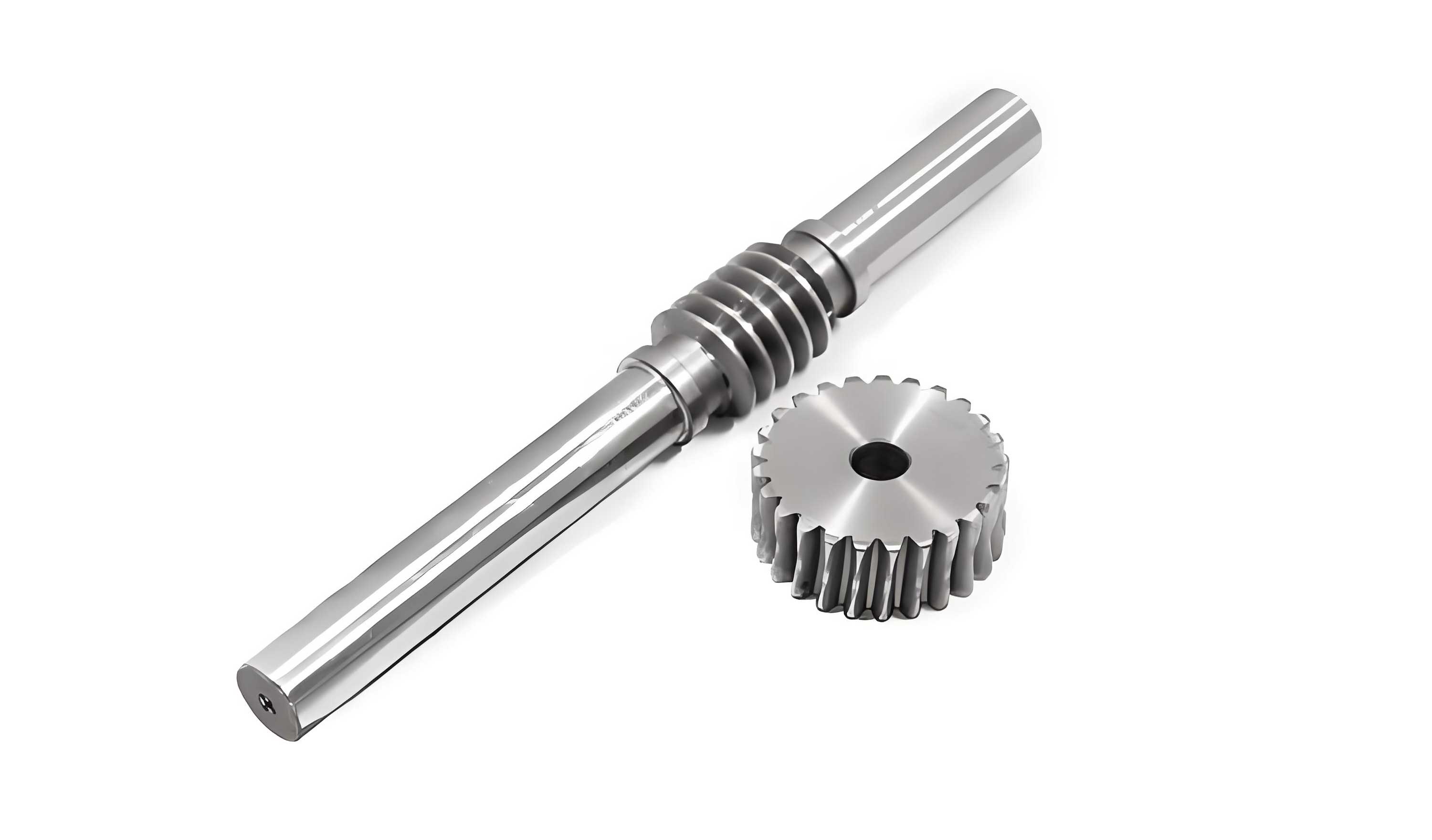
The defining feature of a double lead worm is that its left and right flanks possess different axial leads, while the lead on the same flank remains constant. This design results in the axial tooth thickness varying linearly along the worm’s length. When such a worm meshes with a standard worm wheel (with uniform tooth thickness), axial displacement of the worm changes the operational backlash without altering the center distance. This is superior to radial adjustment, which can reduce the contact area. The working principle in the axial plane is analogous to a rack and pinion, but with two different “rack” pitches. This effectively creates two distinct, simultaneous meshing conditions: one flank pair operates with positive modification (increased virtual center distance) and the other with negative modification. This precise control over meshing clearance is crucial for applications in high-precision rotary tables and servo-driven indexing heads where minimal, consistent backlash is paramount for accuracy and stiffness.
The key to precise modeling lies in accurately representing the generation of the worm’s helicoidal surfaces. Cylindrical worms are typically manufactured by turning with a straight-edged cutting tool. The orientation of this tool’s cutting edge relative to the worm blank determines the type of helicoid produced. By positioning the tool differently, we can generate the three main types: the Archimedean (ZA), the extended involute or normal straight-sided (ZN), and the involute (ZI) worm. This manufacturing insight forms the core of our modeling strategy. Instead of defining a complex 3D surface directly, we model the trajectory of the cutting edge’s contact line with the workpiece as it undergoes a combined rotational and translational (i.e., spiral) motion. This trajectory inherently defines the precise worm tooth flank.
The mathematical foundation for this approach is based on vector algebra describing helical motion. Consider a position vector $\mathbf{r}(x, y, z)$ in a coordinate system $O-ijk$. If this vector undergoes a rotation $\phi$ around an axis (e.g., the $k$-axis) combined with a linear translation $p\phi$ along that same axis, its new coordinates $\mathbf{r’}(x’, y’, z’)$ describe a helix. The parameter $p$ is the lead, with $p > 0$ for a right-hand helix. This transformation is given by:
$$
\begin{bmatrix} x’ \\ y’ \\ z’ \end{bmatrix} = \begin{bmatrix} \cos \phi & -\sin \phi & 0 \\ \sin \phi & \cos \phi & 0 \\ 0 & 0 & 1 \end{bmatrix} \begin{bmatrix} x \\ y \\ z \end{bmatrix} + \begin{bmatrix} 0 \\ 0 \\ p\phi \end{bmatrix}
$$
If the vector $\mathbf{r}$ represents a point on the cutting edge (a line segment defined by its endpoints), then applying this transformation for a continuum of $\phi$ values generates the helical path swept by that point. The surface traced by the entire cutting edge line during this motion is the exact helicoid of the worm’s tooth flank. Therefore, by calculating the helical paths for the endpoints defining the left and right cutting edges of the tool (which correspond to the left and right flanks of the worm tooth space), we can construct the boundaries of the tooth slot surface. This method is universally applicable to any worm type, as the cutting edge orientation (i.e., the coordinates of its endpoints) is the only variable.
Parametric Analysis and Calculation for an Extended Involute Double Lead Worm Set
To demonstrate the methodology, we analyze a specific case of an extended involute (ZN-type) double lead worm gear set from a CNC rotary table. The initial parameters are as follows:
Worm Data: Axial module $m = 1.5 \text{ mm}$, normal pressure angle $\alpha_{on} = 15^\circ$, number of starts $z_1 = 1$ (right-hand). Addendum coefficient $f_0 = 1$, dedendum coefficient $c_0 = 0.2$. Left flank axial pitch $t_z = 4.7686 \text{ mm}$, Right flank axial pitch $t_y = 4.6561 \text{ mm}$. Reference pitch diameter $d_{f1} = 32 \text{ mm}$.
Wheel Data: Number of teeth $z_2 = 80$, center distance $A = 76 \text{ mm}$.
From these, we calculate the essential geometrical and operational parameters necessary for modeling and defining the tool path.
| Parameter | Symbol | Formula | Value (mm or deg) |
|---|---|---|---|
| Nominal Axial Pitch | $t_0$ | $m\pi$ | 4.7124 |
| Pitch Difference | $\Delta t$ | $(t_z – t_y)/2$ | 0.05625 |
| Left Flank Module | $m_z$ | $t_z / \pi$ | 1.5179 |
| Right Flank Module | $m_y$ | $t_y / \pi$ | 1.4821 |
| Module Deviation | $\Delta m$ | $m_z – m = m – m_y$ | 0.0179 |
| Left Flank Working Pitch Diameter | $d_{1z}$ | $d_{f1} – \Delta m \cdot z_2$ | 30.568 |
| Right Flank Working Pitch Diameter | $d_{1y}$ | $d_{f1} + \Delta m \cdot z_2$ | 33.432 |
| Left Flank Lead Angle | $\lambda_z$ | $\arctan(m_z z_1 / d_{1z})$ | 2.8428° |
| Right Flank Lead Angle | $\lambda_y$ | $\arctan(m_y z_1 / d_{1y})$ | 2.5384° |
| Left Flank Axial Pressure Angle | $\alpha_{oaz}$ | $\arctan(\tan \alpha_{on} / \cos \lambda_z)$ | 15.0134° |
| Right Flank Axial Pressure Angle | $\alpha_{oay}$ | $\arctan(\tan \alpha_{on} / \cos \lambda_y)$ | 15.0117° |
| Parameter | Symbol | Formula | Value (mm) |
|---|---|---|---|
| Nominal Pitch Diameter | $d_{f2}$ | $m \cdot z_2$ | 120.0000 |
| Left Flank Working Pitch Diameter | $d_{f2z}$ | $m_z \cdot z_2$ | 121.4320 |
| Right Flank Working Pitch Diameter | $d_{f2y}$ | $m_y \cdot z_2$ | 118.5680 |
| Left Flank Base Circle Diameter | $d_{oz}$ | $d_{f2z} \cdot \cos \alpha_{oaz}$ | 117.2912 |
| Right Flank Base Circle Diameter | $d_{oy}$ | $d_{f2y} \cdot \cos \alpha_{oay}$ | 114.5248 |
A critical design parameter for double lead worm gears is the required worm thread length $L$. It must be sufficient to cover the active length of engagement $L_\alpha$, provide extra length for manufacturing $L_t$, and allow for the necessary axial adjustment $L_p$ to eliminate backlash. The active length is determined by the extreme points of contact on the worm wheel’s addendum circle for both flanks. Based on geometric relations in the axial plane, these lengths are calculated as follows:
For the right flank (positive modification):
$$ e_{y2} = \frac{\sqrt{d_{e2}^2 – d_{oy}^2} – \sqrt{d_{f2y}^2 – d_{oy}^2}}{2 \cos \alpha_{oay}} \approx 7.3341 \text{ mm} $$
$$ e_{y1} = \frac{(2f_0 m – \Delta m z_2) \tan \alpha_{oay}}{\sin 2\alpha_{oay}} \approx 3.1340 \text{ mm} $$
For the left flank (negative modification):
$$ e_{z1} = \frac{(2f_0 m + \Delta m z_2) \tan \alpha_{oaz}}{\sin 2\alpha_{oaz}} \approx 8.8569 \text{ mm} $$
$$ e_{z2} = \frac{\sqrt{d_{e2}^2 – d_{oz}^2} – \sqrt{d_{f2z}^2 – d_{oz}^2}}{2 \cos \alpha_{oaz}} \approx 2.8973 \text{ mm} $$
The active length is the sum of the larger value from each pair:
$$ L_\alpha = \max(e_{y2}, e_{z1}) + \max(e_{y1}, e_{z2}) = 8.8569 + 3.1340 \approx 11.9909 \text{ mm} $$
The axial adjustment length $L_p$ depends on the desired backlash adjustment $\Delta s$ (taken as 0.2 mm) and the tooth thickness increment coefficient $k_s = (t_z – t_y)/t_0$:
$$ L_p = \frac{\Delta s}{k_s} = \frac{0.2}{0.02387} \approx 9.0907 \text{ mm} $$
The manufacturing (thread run-out) length is typically:
$$ L_t = 2m\pi \approx 9.4248 \text{ mm} $$
Thus, the total required worm thread length is:
$$ L = L_\alpha + L_t + L_p \approx 30.5064 \text{ mm} $$
Additionally, the minimum axial width at the tooth top $S_a$ and the minimum axial width at the tooth root (slot) $b_{min}$ must be checked to ensure structural integrity after accounting for the varying tooth thickness. These are vital checks for the practicality of the worm gear design.
| Description | Symbol | Value (mm) |
|---|---|---|
| Active Contact Length | $L_\alpha$ | 11.9909 |
| Manufacturing/Thread Run-out Length | $L_t$ | 9.4248 |
| Axial Adjustment Length | $L_p$ | 9.0907 |
| Total Worm Thread Length | $L$ | 30.5064 |
| Distance from Ref. Plane to Thin End | $L_g$ | 7.8464 |
Implementation of Precise Modeling in Siemens NX
The modeling process for the double lead worm begins by defining the cutting edge geometry. For the ZN-type (normal straight-sided) worm, the cutting tool’s edge lies in the normal plane at the reference pitch cylinder. The endpoints of the left and right edges at a given axial reference section must be calculated. We establish a coordinate system with the Z-axis along the worm axis and the X-axis through the center of a reference tooth space at the nominal pitch diameter. The coordinates of the four endpoints (A, B for one side, C, D for the other) defining the tooth slot width at the outer diameter and root diameter are determined based on the module, pressure angles, and addendum/dedendum.
Let’s denote the coordinates of these endpoints in the X-Z plane as $A(X_1, Z_1)$, $B(X_2, Z_2)$, $C(X_3, Z_3)$, $D(X_4, Z_4)$, where $X$ is the radial distance and $Z$ is the axial position relative to the tooth space center. For the example worm, typical values might be: $A(17.5, -1.9031)$, $B(14.2, -1.0180)$, $C(17.5, 1.9031)$, $D(14.2, 1.0181)$.
The core of the modeling is generating the four helical paths traced by these points. In Siemens NX, this is achieved using the “Law Curve” function. We first define the laws of variation for X, Y, and Z coordinates as functions of a parameter $t$ (representing rotation angle $\phi$). For point A, which belongs to a left flank with lead $P_z = t_z \cdot z_1$, the parametric equations in the global coordinate system are:
$$ X_{A}(t) = X_1 \cdot \cos(\theta \cdot t) $$
$$ Y_{A}(t) = X_1 \cdot \sin(\theta \cdot t) $$
$$ Z_{A}(t) = Z_1 + \left( \frac{P_z \cdot t}{2\pi} \right) $$
where $\theta$ is the total angle of rotation (e.g., corresponding to the worm length $L$), and $t$ varies from 0 to 1. Similar expressions are created for points B, C, and D, with point C/D using the right flank lead $P_y = t_y \cdot z_1$ and their respective Z-offsets. The software’s “Expression” tool is used to define these laws and the constant parameters like $X_1$, $Z_1$, $P_z$, $P_y$, and $\theta$.
Executing the “Law Curve” command for each set of laws generates the four precise spatial helical curves. These curves represent the trajectories of the endpoints of the cutting edges. The next step is to create the ruled surfaces between corresponding helical curves (e.g., between helix A and helix B for one flank, and between helix C and helix D for the opposite flank) using the “Ruled Surface” or “Through Curve Mesh” commands. The ends of these surface strips are then capped with planar faces, and all surfaces are sewn together into a single solid body representing the precise tooth space (slot) of the worm gear.
This solid tooth space is then subtracted (Boolean subtract) from a cylindrical worm blank, resulting in one perfect thread of the double lead worm. This thread can be pattern-copied along the circumference (for multi-start worms) or simply extruded along the length if the thread is continuous. The resulting worm model is a mathematically exact representation of a manufactured part.
Modeling the worm wheel utilizes the principle of conjugate gear generation. The accurately modeled worm is virtually assembled with the worm wheel blank at the design center distance. Using the “Wave Geometry Linker” or an equivalent associative copy function in NX, the thread volume of the worm is copied as a “tool” body into the wheel blank part. A Boolean subtraction operation is then performed, subtracting the worm thread volume from the wheel blank. This directly generates the conjugate tooth space in the worm wheel. However, due to the double lead nature, the first subtraction might create a non-uniform space. To ensure a clean, periodic tooth form, one ideal tooth space (often the one at the meshing reference plane) is isolated, its surfaces are extracted, and it is patterned circularly around the wheel axis. This final patterned body is then used in a Boolean intersection with the wheel blank to create the final, precise worm wheel model with uniform teeth that correctly mate with the double lead worm.
Advantages and Conclusion
The proposed spiral cutting simulation method for modeling double lead worm gears offers significant advantages over traditional profile sweeping techniques. Its primary strength is universality and precision. Since it mimics the actual manufacturing process, it can accurately generate any type of cylindrical worm helicoid—Archimedean (ZA), extended involute (ZN), or involute (ZI)—simply by adjusting the initial coordinates of the cutting edge endpoints. This eliminates the need for complex, often approximate, mathematical descriptions of the axial tooth profile.
Secondly, the method inherently handles the dual-lead characteristic seamlessly. Each flank is generated independently based on its own lead parameter ($P_z$ or $P_y$), resulting in a model where the varying tooth thickness and differing flank geometries are perfectly integrated. This is crucial for accurate assembly simulation, load distribution analysis, and backlash calculation in virtual prototypes.
Furthermore, this approach provides a direct link to manufacturing. The defined cutting edge and its helical path can be readily adapted to define toolpaths for CNC turning or grinding of the actual worm. The model’s accuracy ensures that simulations for Finite Element Analysis (FEA) to assess stress, contact patterns, and thermal behavior are based on a faithful geometric representation, leading to more reliable results.
In conclusion, by shifting the modeling paradigm from geometric approximation to process simulation, we establish a robust, precise, and flexible framework for the digital design of double lead worm gear pairs. This method, successfully implemented in a mainstream CAD platform like Siemens NX, bridges the gap between design intent, manufacturing reality, and advanced engineering analysis, thereby enhancing the development cycle and performance assurance of these critical precision transmission components.