
In my extensive work with oilfield production equipment, I have consistently encountered a significant operational hazard associated with progressive cavity pump (PCP) systems: the uncontrolled reversal of the rod string following a shutdown. This reversal is driven by the release of torsional energy stored elastically in the rods and by the hydraulic head of the fluid column acting on the pump rotor. Left unchecked, this high-speed reverse rotation can lead to rod string back-off, bent polish rods, severe damage to the surface drive head, and poses a grave safety risk to personnel.
The conventional solution deployed in many horizontal PCP drive systems has been a ratchet-and-pawl brake mechanism. While functionally simple, this design has proven inadequate in my experience. Its safety factor is often insufficient for high-torque applications, and, critically, it does not allow for the automatic, controlled release of the trapped reverse torque. Releasing this energy requires manual intervention, which is not only labor-intensive but introduces a point of significant danger during field operations. The need for a more reliable and safer braking system led me to explore an alternative based on a fundamental mechanical principle: the self-locking capability of worm gears.
The core innovation I developed and applied involves the integration of a worm gears brake assembly with an overrunning clutch. The system is designed to be installed directly onto the main output shaft of the PCP drive head. Its operational logic is elegantly straightforward: it remains completely disengaged during normal pump operation but activates instantly and automatically to arrest any reverse rotation upon shutdown, subsequently enabling a controlled, motorized release of the stored energy.
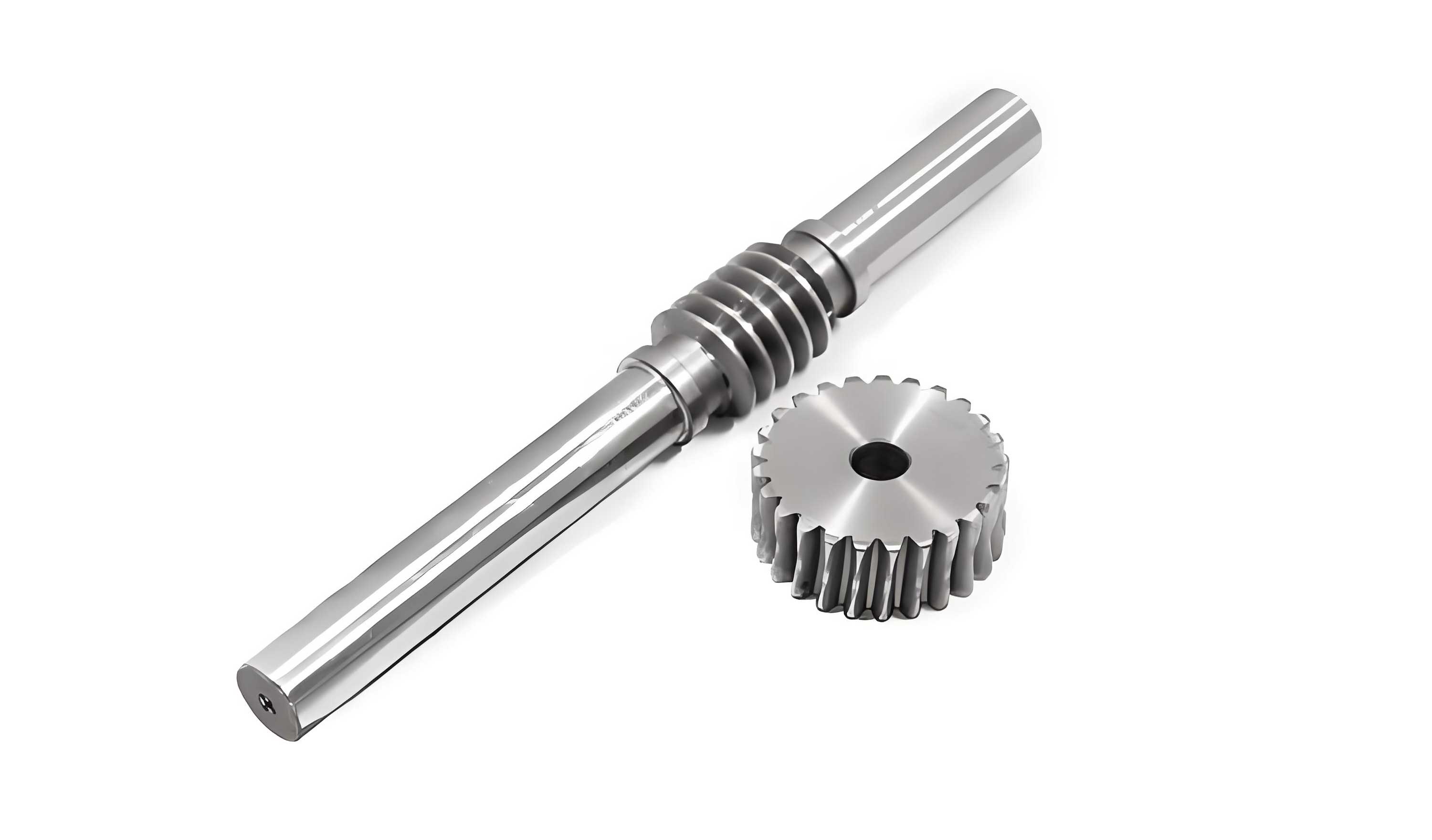
The fundamental architecture of this brake assembly is centered around the worm gears pair. The worm wheel is integrated into the outer race of an overrunning clutch. This entire assembly is housed within a dedicated gearbox that is bolted to the drive head’s main gearcase. The inner race of the overrunning clutch is connected to the drive head’s main output shaft via a key. The worm shaft is coupled to a small, auxiliary release motor through a secondary gear train or directly.
The working principle unfolds in two distinct phases:
1. Braking Phase: During normal pump operation, the main shaft (and thus the clutch inner race) rotates in the forward (pumping) direction. The overrunning clutch is in “overrun” or freewheel mode; the inner race does not drive the outer race. The integrated worm gears pair is therefore stationary and inactive. When the system is shut down and the main shaft begins to reverse, the direction of rotation relative to the clutch changes. The overrunning clutch engages, locking the inner race to the outer race. Consequently, the reverse torque from the rod string is transmitted to the worm wheel. Due to the self-locking property of the worm gears pair, the system seizes instantly, preventing any further reverse rotation and securely holding the rod string.
2. Reverse Energy Release Phase: With the system safely locked, the controlled release sequence initiates. The auxiliary release motor is energized, applying torque to the worm shaft. As the worm begins to turn, it drives the worm wheel slowly in the reverse direction. In this phase, the overrunning clutch is in a “disengaged” state for this relative motion; the outer race (worm wheel) can rotate independently of the inner race. However, because the inner race is under tension from the reversed rod string, it will also attempt to turn. The release motor’s speed is controlled so that the worm wheel’s rotation governs the pace at which the inner race (and hence the main shaft) is allowed to unwind, thereby smoothly and safely dissipating the stored elastic and hydraulic energy to zero.
The efficacy of this system hinges entirely on the self-locking behavior of the worm gears. A detailed force analysis is essential to define the conditions for self-locking and to size the release motor. Consider a right-handed worm gear pair where the worm wheel is the input member attempting to drive the worm, as is the case during the braking phase when reverse torque is applied.
Let $F_n$ be the normal force at the mesh point. This force can be resolved. The key component for self-locking is the relationship between the tangential force on the worm ($F_{t1}$) trying to turn it and the available frictional resistance. For the worm to remain stationary (locked), the frictional force must equal or exceed the driving tangential force.
The derivation leads to the fundamental self-locking criterion for worm gears:
$$
\mu’ \geq \tan(\gamma) \quad \text{or equivalently} \quad \Psi \geq \gamma
$$
where:
$\gamma$ is the lead angle of the worm,
$\mu’ = \frac{\mu}{\cos(\alpha_n)}$ is the equivalent coefficient of friction,
$\mu$ is the coefficient of friction between worm and wheel materials,
$\alpha_n$ is the normal pressure angle,
$\Psi = \arctan(\mu’)$ is the equivalent friction angle.
Therefore, to ensure reliable self-locking in our brake application, I must design the worm gears pair with a lead angle $\gamma$ smaller than the equivalent friction angle $\Psi$ for the expected operating conditions and material pairing (typically bronze wheel and hardened steel worm).
For the release phase, I need to calculate the torque required at the worm shaft ($T_1$) to back-drive the self-locked pair and release the torque on the wheel ($T_2$). The force balance analysis yields the following relationship:
$$
T_1 > T_2 \times \frac{(\tan\Psi – \tan\gamma) \times d_1}{(1 + \tan\Psi \tan\gamma) \times d_2}
$$
where $d_1$ and $d_2$ are the pitch diameters of the worm and worm wheel, respectively. For small lead angles and simplifying, the relationship can be approximated as:
$$
T_1 > T_2 \times K \quad \text{, where } K = \frac{(\tan\Psi – \tan\gamma) \times d_1}{(1 + \tan\Psi) \times d_2}
$$
This confirms a linear relationship between the release torque $T_1$ and the loaded braking torque $T_2$, a factor crucial for selecting the appropriate auxiliary motor. A higher coefficient of friction or a smaller lead angle increases the factor $K$, demanding a more powerful release motor.
To validate this theoretical model and the practical performance of the worm gears brake, I conducted comprehensive bench tests on a prototype. The system was subjected to increasing levels of simulated reverse torque $T_2$, and the corresponding minimum worm shaft torque $T_1$ required to initiate controlled release was measured. The results are summarized in the table below.
| Shaft Load Torque, $T_2$ (N·m) | Required Release Torque, $T_1$ (N·m) |
|---|---|
| 0 | 1.8 |
| 100 | 2.9 |
| 200 | 4.1 |
| 400 | 6.2 |
| 800 | 10.7 |
| 1500 | 18.5 |
| 2000 | 24.1 |
| 2500 | 29.6 |
| 3500 | 40.9 |
The data clearly demonstrates the linear correlation predicted by the theory. Plotting $T_1$ against $T_2$ yields a straight line, the slope of which corresponds to the experimental factor $K_{exp}$. This empirical validation was critical for fine-tuning the final design parameters and for specifying the reliable operational range of the auxiliary release motor and its control system.
The control logic for the auxiliary motor is designed for safety and autonomy. The motor circuit is powered through the normally-closed contact of the main drive motor’s contactor. When the main motor runs, power to the release circuit is cut. Upon main motor shutdown, the circuit is energized. A time-delay relay introduces a brief pause (e.g., 30 seconds) before initiating the release motor, allowing any immediate transients to settle. A current-sensing controller monitors the motor’s load. As the release proceeds and the reverse torque on the rod string diminishes to zero, the load on the auxiliary motor drops. Once the current falls below a preset threshold, indicating the energy release is complete, the controller opens the circuit, stopping the motor and illuminating a visual “safe-to-service” indicator. This automation removes personnel from the hazardous energy release process.
The advantages of employing worm gears in this braking context are substantial and multi-faceted:
1. Inherent Safety and Reliability: The self-locking property provides a purely mechanical, fail-safe brake that activates automatically without the need for sensors or actuators. Its reliability far surpasses that of spring-loaded pawls in traditional ratchets.
2. Controlled Energy Management: The system transforms a dangerous, rapid uncontrolled reversal into a slow, managed release. This protects all downstream components—rods, drive head, and seals—from shock loads.
3. Operational Efficiency and Safety: The automated release cycle eliminates strenuous and risky manual braking procedures, reducing worker exposure to hazards and lowering the physical demand of well servicing.
4. High Torque Capacity: Worm gears are inherently capable of providing high reduction ratios and can be designed to handle the very large reverse torques encountered in deep PCP applications.
In designing such a system, several practical considerations for the worm gears are paramount. Material selection is crucial; the worm wheel is typically made from a phosphor bronze or similar alloy to provide a good bearing surface and manage friction, while the worm is made from case-hardened steel for durability. Lubrication is critical not only for life but also for maintaining a consistent coefficient of friction, which directly impacts the self-locking behavior and the release torque factor $K$. The housing must be robustly sealed to prevent contamination from the harsh oilfield environment. Finally, thermal management must be considered, as the energy dissipated during the release phase is converted into heat within the worm gears housing.
The application scope of this worm gears brake assembly extends beyond the specific case of horizontal PCP drives. The principle is applicable to any rotary drive system where prevention of reverse rotation following a power loss is critical for safety and equipment integrity. This includes vertical PCP systems, certain conveyor drives, hoists, and winches. The table below summarizes the key comparison between the traditional and the worm gears-based brake system.
| Feature | Traditional Ratchet & Pawl Brake | Worm Gears & Clutch Brake |
|---|---|---|
| Activation | Automatic (but can fail under shock load) | Fully Automatic & Inherently Mechanical |
| Energy Release | Manual, Hazardous | Automatic, Motorized, Controlled |
| Safety for Personnel | Low (direct exposure during release) | High (automated process) |
| Reliability | Moderate (springs can fail, pawls can slip) | High (based on fundamental gear locking) |
| Handled Torque | Limited by pawl strength | Very High, scalable with gear design |
| Maintenance | Frequent checks on springs and pawl wear | Primarily lubrication and seal inspection |
In conclusion, the integration of a self-locking worm gears pair with an overrunning clutch represents a significant advancement in safety and reliability for progressive cavity pump drive systems. By leveraging the fundamental mechanical properties of worm gears—specifically their ability to transmit motion in one direction while locking against motion initiated from the other—I have developed a braking solution that automatically secures the drive train upon shutdown and subsequently provides a safe, automated method for dissipating dangerous reverse energies. The theoretical analysis, confirmed by experimental data, provides a clear framework for designing such systems, ensuring the self-locking condition $(\Psi \geq \gamma)$ is met and properly sizing the release mechanism. This approach effectively solves the chronic shortcomings of traditional braking methods, enhancing both operational safety and equipment longevity in demanding oilfield production environments. The principle stands as a robust testament to the enduring utility and innovative application of worm gears in modern mechanical engineering challenges.