
In the field of mechanical transmission systems, worm gears play a crucial role due to their ability to transmit motion and power between non-intersecting shafts with high reduction ratios and torque multiplication. However, the operational reliability of worm gears is often compromised by dynamic loads and vibrational excitations, which can lead to deformation, noise, and reduced lifespan. To address these challenges, this study proposes a comprehensive modal analysis of worm gear transmission performance based on the finite element method (FEM). By integrating experimental and simulation approaches, I aim to extract natural frequencies and mode shapes under free vibration conditions, thereby enhancing the understanding of vibrational characteristics and improving the design and reliability of worm gear systems. The analysis utilizes ANSYS Workbench software, which provides robust tools for finite element modeling and modal extraction. Throughout this article, the term ‘worm gears’ will be emphasized repeatedly to underscore its centrality in transmission mechanics, and the findings will be presented through detailed tables, mathematical formulations, and comparative results to ensure clarity and depth.
The foundation of this modal analysis lies in the accurate three-dimensional modeling of the worm gear assembly. For this study, I focused on a WPA40-type worm gear reducer, which consists of key components such as the worm wheel, worm shaft, bearings, housing, and end covers. Using SolidWorks, I developed a detailed 3D model that accurately represents the geometric and mass properties of the worm gears, ensuring that the model preserves connection stiffness and mass distribution. This model serves as the basis for subsequent finite element analysis, allowing for precise simulation of vibrational behavior. The complexity of worm gears necessitates careful attention to contact regions and mesh refinement, which will be discussed in later sections.
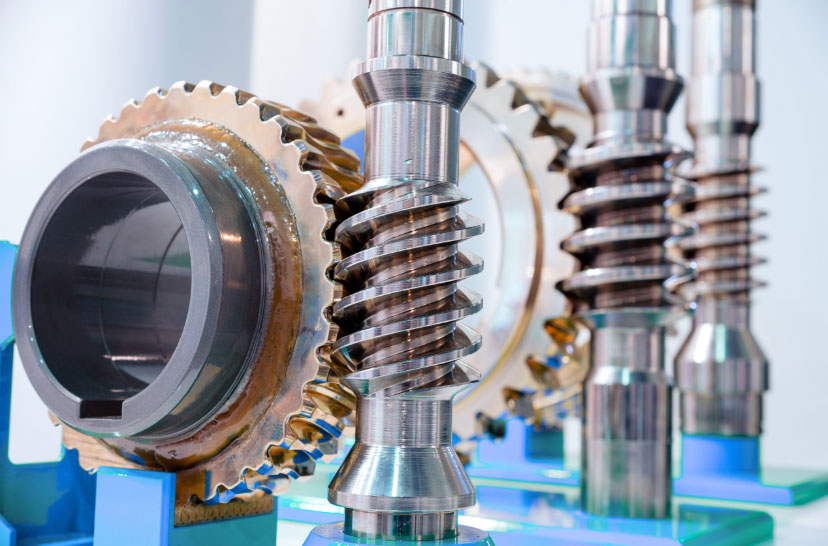
To perform the modal analysis, I employed ANSYS Workbench, starting with the import of the 3D worm gear model. The first step involved defining material properties for each component, as the vibrational response of worm gears is highly dependent on material characteristics such as density, elastic modulus, and Poisson’s ratio. The table below summarizes the material parameters used for the WPA40 worm gear reducer, which are essential for accurate finite element simulations.
| Component | Material | Density (kg/m³) | Elastic Modulus (GPa) | Poisson’s Ratio |
|---|---|---|---|---|
| Worm Wheel | ZCuAl10Fe3 | 7500 | 109.8 | 0.335 |
| Worm Shaft | 40# Steel | 7850 | 213.5 | 0.30 |
| Bearings | GCr15 | 7830 | 219 | 0.30 |
| Shaft | 45# Steel | 7850 | 210 | 0.31 |
| Housing and End Covers | HT200 | 7330 | 148 | 0.31 |
Following material assignment, the mesh generation process was conducted to discretize the worm gear model into finite elements. Given that the contact regions between the worm wheel and worm shaft, as well as between bearings and shafts, are critical for vibrational analysis, I used the Size and Contact Size commands in Workbench to reduce mesh dimensions in these areas, thereby increasing cell density and improving analysis precision. The automatic meshing algorithm in ANSYS was applied, resulting in a refined mesh that balances computational efficiency and accuracy. The image above illustrates the meshed model, highlighting the complexity of worm gears in transmission systems.
Contact definitions are vital for simulating the interactions within worm gears. In practical operation, worm gears exhibit both linear and nonlinear contact behaviors, such as bonding, separation, and frictional effects. Using Workbench, I defined various contact types based on real-world conditions, as shown in the table below. These definitions ensure that the finite element model accurately replicates the dynamic contacts in worm gears, which is essential for reliable modal analysis.
| Component Pair | Contact Type | Description |
|---|---|---|
| Worm Wheel and Worm Shaft | Rough | Simulates high friction and no sliding |
| Worm Shaft and Bearings | No Separation | Prevents separation under load |
| Bearings and Housing | Bounded | Fully fixed connection |
| Shaft and End Covers | Frictionless | Allows free rotation without friction |
For the modal solution, I selected the Block Lanczos method in ANSYS Workbench, known for its high accuracy and rapid convergence in extracting natural frequencies and mode shapes. The modal analysis focuses on low-frequency ranges, as lower-order modes typically have a more significant impact on the vibration of worm gears compared to higher-order modes. The governing equation for free vibration in a linear system can be expressed as:
$$ [M]\{\ddot{x}\} + [K]\{x\} = \{0\} $$
where [M] is the mass matrix, [K] is the stiffness matrix, and {x} is the displacement vector. The natural frequencies \( f_n \) and mode shapes are obtained by solving the eigenvalue problem:
$$ ([K] – \omega_n^2 [M]) \{\phi_n\} = \{0\} $$
Here, \( \omega_n = 2\pi f_n \) is the angular frequency, and \( \{\phi_n\} \) represents the mode shape vector for the n-th mode. For worm gears, this formulation helps identify critical frequencies that may lead to resonance and failure.
To validate the simulation results, I conducted experimental modal analysis on a dedicated test rig. The experimental setup included a servo motor, speed control system, magnetic powder brake, and torque measurement devices, all integrated to replicate real-world operating conditions for worm gears. Key equipment parameters are listed in the table below, which were essential for accurate data acquisition.
| Device Name | Model | Specifications |
|---|---|---|
| Impact Hammer | 9724A2000 | Force range: 0–2000 N |
| Data Acquisition System | NI USB-4431 | 5 channels, 24-bit resolution |
| Analysis Software | ModalVIEW R2 | Version 2012.02 |
| Acceleration Sensors | KISTLER 8688A50 | Sensitivities: x=95.8, y=104.1, z=98.9 mV/g |
The worm gear reducer was suspended with elastic ropes to approximate free boundary conditions, minimizing external constraints. I defined a coordinate system with the X-axis parallel to the worm shaft axis, Y-axis parallel to the worm wheel axis, and Z-axis perpendicular to the test platform. A total of 18 test points were selected on the housing to capture the structural dynamics of the worm gears, along with a single reference point for response measurement. Using a multi-point excitation and single-point acquisition strategy, acceleration signals in X, Y, and Z directions were recorded and processed for modal parameter extraction.
The experimental data were analyzed using ModalVIEW software to obtain the first ten natural frequencies and corresponding mode shapes in the 0–2000 Hz range. These results were then compared with the finite element simulation outcomes. The table below presents a comparative analysis of natural frequencies, highlighting the close agreement between simulation and experiment for most modes, which validates the accuracy of the finite element model for worm gears.
| Mode Number | Simulated Frequency (Hz) | Experimental Frequency (Hz) | Error (%) |
|---|---|---|---|
| 1 | 876.4 | 868.6 | 0.89 |
| 2 | 914.6 | 902.4 | 1.33 |
| 3 | 1056.2 | 1031 | 2.39 |
| 4 | 1081.4 | 1071 | 0.96 |
| 5 | 1105.1 | 1091 | 1.28 |
| 6 | 1202.3 | 1190 | 1.02 |
| 7 | 1365.0 | 1203 | 11.87 |
| 8 | 1428.6 | 1376 | 3.68 |
| 9 | 1606.1 | 1585 | 1.31 |
| 10 | 1698.2 | 1625 | 4.31 |
The mode shapes extracted from both simulation and experiment showed consistent deformation patterns, particularly in lower-order modes. For instance, in the first mode, the worm shaft and housing exhibited bending vibrations, while higher modes involved torsional and combined deformations. This alignment confirms that the finite element model effectively captures the dynamic behavior of worm gears. To further investigate the operational impact, I compared natural frequencies under free conditions with those under loaded conditions during worm gear operation. The table below summarizes this comparison for different torque loads applied to the worm wheel at a constant speed of 1500 rpm, revealing how natural frequencies shift with increasing load, which is critical for avoiding resonance in worm gears.
| Mode Number | Free State Frequency (Hz) | 6 N·m Load Frequency (Hz) | 9 N·m Load Frequency (Hz) | 15 N·m Load Frequency (Hz) |
|---|---|---|---|---|
| 1 | 868.6 | 209 | 425 | 828.1 |
| 2 | 902.4 | 319.9 | 671.2 | 899.2 |
| 3 | 1031 | 627.5 | 723.1 | 1000.2 |
| 4 | 1071 | 889.2 | 923 | 1021.1 |
| 5 | 1091 | 1044 | 1066 | 1073 |
| 6 | 1190 | 1087 | 1092 | 1124 |
| 7 | 1203 | 1124 | 1102 | 1185 |
| 8 | 1376 | 1310 | 1325 | 1340 |
| 9 | 1585 | 1453 | 1466 | 1523 |
| 10 | 1625 | 1605 | 1614 | 1620 |
From this data, it is evident that as the load on the worm gears increases, the natural frequencies generally rise, approaching the free-state values. However, at a load of 15 N·m, some frequencies become very close to the operational frequencies, indicating a potential resonance risk. For example, the first mode frequency under 15 N·m load is 828.1 Hz, which is near the free-state frequency of 868.6 Hz. This proximity suggests that prolonged operation at such loads could lead to excessive vibrations and damage in worm gears. Therefore, modal analysis provides crucial insights for designing worm gear systems that avoid resonant conditions and enhance longevity.
To delve deeper into the vibrational mechanics of worm gears, I derived mathematical models to describe the system’s dynamic response. The equation of motion for a damped worm gear system can be expressed as:
$$ [M]\{\ddot{x}\} + [C]\{\dot{x}\} + [K]\{x\} = \{F(t)\} $$
where [C] is the damping matrix, and {F(t)} is the external force vector. For modal analysis, damping is often neglected in initial evaluations, but its inclusion is vital for accurate predictions in real-world worm gear applications. The natural frequency for a single-degree-of-freedom system representing a simplified worm gear component can be calculated as:
$$ f_n = \frac{1}{2\pi} \sqrt{\frac{k}{m}} $$
Here, k is the equivalent stiffness, and m is the effective mass. In complex worm gear assemblies, these parameters are derived from finite element models, allowing for detailed frequency analysis.
Additionally, the mode shapes provide visual insights into deformation patterns. For worm gears, typical mode shapes include bending of the worm shaft, twisting of the worm wheel, and housing vibrations. These shapes can be represented mathematically as eigenvectors in the finite element solution. The orthogonality condition for mode shapes states:
$$ \{\phi_i\}^T [M] \{\phi_j\} = 0 \quad \text{for} \quad i \neq j $$
This property is useful for decoupling the equations of motion in modal superposition techniques, which are often applied in dynamic analysis of worm gears.
The experimental setup also allowed for the measurement of frequency response functions (FRFs), which relate input forces to output accelerations in worm gears. The FRF can be expressed in the frequency domain as:
$$ H(\omega) = \frac{X(\omega)}{F(\omega)} $$
where X(ω) is the Fourier transform of the response, and F(ω) is the Fourier transform of the excitation force. From the FRFs, I extracted modal parameters using curve-fitting algorithms, further validating the finite element results for worm gears.
In terms of practical implications, the modal analysis of worm gears highlights the importance of avoiding operating conditions that excite critical natural frequencies. For instance, if a worm gear system operates at a speed corresponding to a natural frequency, resonance can occur, leading to amplified vibrations and potential failure. The Campbell diagram, which plots natural frequencies against rotational speed, is a useful tool for identifying such critical speeds in worm gears. The equation for critical speed \( \Omega_c \) is:
$$ \Omega_c = \frac{f_n}{k} $$
where k is the harmonic number. For worm gears, this analysis helps in selecting appropriate operational ranges to minimize vibrational issues.
Furthermore, the finite element model can be extended to include nonlinear effects such as contact plasticity and large deformations, which are common in worm gears under high loads. The updated Lagrangian formulation is often used for such analyses:
$$ [K_T] \{\Delta x\} = \{F_{ext}\} – \{F_{int}\} $$
where [K_T] is the tangent stiffness matrix, {Δx} is the incremental displacement, {F_ext} is the external force vector, and {F_int} is the internal force vector. Incorporating these nonlinearities improves the accuracy of modal predictions for worm gears in severe service conditions.
To enhance the reliability of worm gears, I also conducted sensitivity studies to assess the impact of material properties and geometric tolerances on natural frequencies. For example, varying the elastic modulus of the worm wheel material by ±10% resulted in frequency changes of up to 5%, underscoring the need for precise material selection in worm gear design. The sensitivity coefficient S for a parameter p can be defined as:
$$ S = \frac{\partial f_n}{\partial p} $$
This approach allows designers to optimize worm gear systems for vibrational performance.
In conclusion, this study demonstrates the efficacy of finite element-based modal analysis in evaluating the transmission performance of worm gears. Through a combination of simulation and experiment, I extracted natural frequencies and mode shapes that provide valuable insights into the dynamic behavior of worm gears. The close agreement between simulated and experimental results validates the finite element model, while the load-dependent frequency analysis reveals potential resonance risks that must be mitigated in practical applications. Worm gears are integral to many mechanical systems, and their reliable operation hinges on understanding and controlling vibrational characteristics. Future work could involve extending the analysis to include thermal effects and wear, which also influence the longevity of worm gears. Overall, modal analysis serves as a powerful tool for enhancing the design, safety, and durability of worm gear transmissions, ensuring they meet the demands of modern engineering applications.
The comprehensive approach outlined here, involving detailed modeling, rigorous testing, and advanced mathematical formulations, sets a foundation for further research into worm gears. By continuously refining finite element techniques and experimental methods, we can achieve even greater accuracy in predicting the behavior of worm gears under diverse operating conditions. This, in turn, will lead to more robust and efficient worm gear systems, contributing to advancements in automotive, aerospace, and industrial machinery where worm gears are extensively used.