
In my extensive experience with mechanical transmission systems, I have often encountered the critical role of worm gears in applications where self-locking is paramount. Worm gears are integral to many industrial setups, particularly in lifting platforms where preventing unintended descent is essential for safety and operational integrity. The self-locking property of worm gears hinges on the friction between the worm and the gear teeth, which theoretically halts motion when the driving force ceases. However, through practical observation and analysis, I have identified that this self-locking capability can fail, leading to hazardous situations such as the automatic lowering of a lifting platform. This article delves into the intricacies of worm gear systems in lifting platforms, examining the structural aspects, force dynamics, and the profound impact of installation errors on self-locking performance. By employing detailed formulas, tables, and systematic analysis, I aim to elucidate the factors that compromise the reliability of worm gears and propose insights for mitigating these risks.
The fundamental structure of a worm gear driven lifting platform, as I have studied and implemented, comprises several key components that work in unison to achieve vertical movement. Typically, the system includes a lifting platform surface, rotational support seats for the platform, lift linkages, a worm gear reducer, couplings, cranks, and an electric motor. These elements are often symmetrically arranged to ensure balanced force distribution. The operation begins with the motor initiating rotation, which drives the worm gear reducer. The worm, as it rotates, engages with the worm wheel, causing the cranks attached to the worm wheel shaft to perform a circular motion. This motion is translated into vertical displacement through the lift linkages, which pivot the platform around its support seats. Such configurations are prevalent in heavy-duty environments like steel rolling mills, where precision and safety are non-negotiable. The reliance on worm gears here is due to their inherent ability to provide high reduction ratios and self-locking in ideal conditions. However, any deviation from optimal installation can undermine these benefits, as I will explore in subsequent sections.
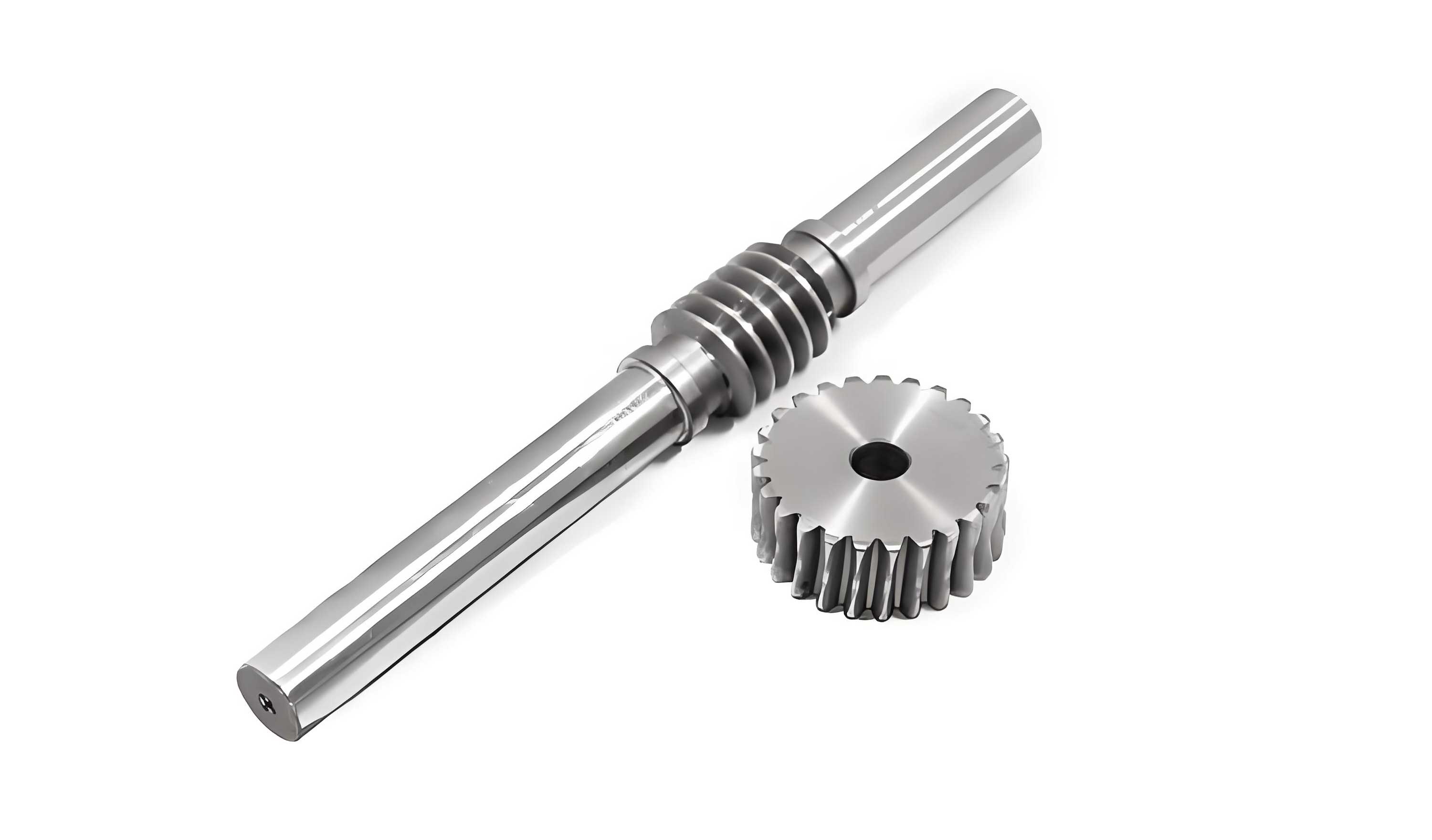
To understand the self-locking mechanism of worm gears, it is imperative to analyze the forces at play both externally and internally within the gear pair. From my analysis, when the lifting platform reaches its highest position, the motor stops, and the system relies on the self-locking of the worm gears to maintain elevation. Externally, the platform exerts a force on the lift linkages, which in turn applies a torque to the worm wheel. Let me denote the force from the platform as \( F_G \), the crank radius as \( R \), and the angle between the crank and the horizontal as \( \beta \). The external torque on the worm wheel, \( T_W \), can be expressed as:
$$ T_W = F_G R \cos \beta $$
This torque varies with the crank angle, reaching a maximum when \( \beta \) is in specific quadrants, typically the first or second quadrant depending on the geometry. This external torque is the driving factor that can reverse the role of the worm and wheel if self-locking fails, making the worm wheel the driver and the worm the driven element.
Internally, the interaction between the worm and the worm gear involves complex force components. At the meshing point \( P \), the normal force \( F_n \) acts perpendicular to the tooth profile. For analytical clarity, I decompose this force into three orthogonal components: the tangential force \( F_t \), the radial force \( F_r \), and the axial force \( F_a \). Given that the worm and worm gear axes are arranged at 90 degrees, the forces exhibit specific relationships: the circumferential force on the worm equals the axial force on the worm gear, the axial force on the worm equals the circumferential force on the worm gear, and the radial forces are equal and opposite. The absolute values of these forces can be derived as follows, where \( T_1 \) and \( T_2 \) are the torques on the worm and worm gear, \( d_1 \) and \( d_2 \) are their reference diameters, \( \alpha_n \) is the normal pressure angle, and \( \gamma \) is the lead angle of the worm:
$$ |F_{t1}| = |F_{a2}| = \frac{2T_1}{d_1} = F_n \cos \alpha_n \sin \gamma $$
$$ |F_{a1}| = |F_{t2}| = \frac{2T_2}{d_2} = F_n \cos \alpha_n \cos \gamma $$
$$ |F_{r1}| = |F_{r2}| = F_n \sin \alpha_n $$
These equations highlight the dependency on \( \gamma \), which is crucial for self-locking. In ideal conditions, when \( \gamma \) is less than the equivalent friction angle \( \rho \), the worm gears exhibit self-locking. However, practical installation errors can alter this relationship, as I have frequently observed in field applications.
The installation of worm gears is a critical phase that demands precision. Any misalignment between the worm and worm gear mid-planes can precipitate self-locking failure. I classify the mid-plane alignment into three scenarios, as summarized in the table below:
| Alignment Scenario | Description | Impact on Contact |
|---|---|---|
| Ideal Alignment | Worm and worm gear mid-planes coincide within tolerance limits. | Uniform contact distribution, minimal wear. |
| Positive Offset (Right Bias) | Worm mid-plane shifted to the right relative to worm gear mid-plane. | Contact patch shifts left, causing asymmetric wear. |
| Negative Offset (Left Bias) | Worm mid-plane shifted to the left relative to worm gear mid-plane. | Contact patch shifts right, leading to uneven stress. |
In my investigations, I have focused on right-handed worm gears, where the worm rotates counterclockwise, and the worm gear rotates inward. When a positive offset exists, the contact area on the worm gear teeth biases to the left. Over time, this asymmetry accelerates wear on the left side, effectively increasing the lead angle \( \gamma \). Initially, the lead angle might be \( \gamma_1 \), but after severe wear, it enlarges to \( \gamma_2 \). This alteration is detrimental because the self-locking condition requires \( \gamma \leq \rho \), where \( \rho \) is the equivalent friction angle. As \( \gamma \) grows due to wear, it can surpass \( \rho \), nullifying the self-locking capability. The following formula illustrates the critical relationship:
$$ \gamma \leq \rho = \arctan(\mu) $$
Here, \( \mu \) is the coefficient of friction between the worm and gear materials. When \( \gamma > \rho \), the system loses its self-locking property, allowing the worm wheel to drive the worm under external torque, resulting in platform descent.
To quantify the impact of installation errors, I consider the mid-plane deviation \( f_x \), which represents the offset between the worm and worm gear axes. This deviation introduces additional forces and moments that exacerbate wear. The table below outlines the effects of various deviation magnitudes on worm gear performance:
| Deviation \( f_x \) (mm) | Effect on Lead Angle \( \gamma \) | Self-Locking Status | Recommended Action |
|---|---|---|---|
| \( f_x \leq 0.05 \) | Negligible change | Maintained | Monitor periodically |
| \( 0.05 < f_x \leq 0.1 \) | Slight increase | Marginal | Realign components |
| \( f_x > 0.1 \) | Significant increase | Lost | Immediate rectification |
From my analysis, the force components evolve with deviation. For instance, the tangential force on the worm \( F_{t1} \) becomes more pronounced as \( \gamma \) increases, per Equation (1). This force can be expressed in terms of deviation by incorporating a correction factor \( k \), derived from geometric relations:
$$ F_{t1} = \frac{2T_1}{d_1} + k \cdot f_x \cdot F_n \cos \alpha_n $$
Where \( k \) is a constant dependent on the gear geometry. This added component exacerbates friction and wear, creating a vicious cycle that ultimately leads to failure. Moreover, the wear process is not linear; it accelerates under heavy loads, common in lifting platforms. I have modeled this wear progression using the Archard wear equation, adapted for worm gears:
$$ V = K \frac{F_n L}{H} $$
Here, \( V \) is the wear volume, \( K \) is the wear coefficient, \( L \) is the sliding distance, and \( H \) is the material hardness. For worm gears, the sliding distance is a function of the lead angle and rotational speed, tying back to the central role of \( \gamma \). As wear accumulates, the lead angle increases, which in turn increases sliding distance, creating a feedback loop that hastens self-locking degradation.
In addition to installation errors, material properties and lubrication play pivotal roles in the performance of worm gears. The coefficient of friction \( \mu \) is influenced by surface finish, lubricant type, and operational temperature. For instance, using high-viscosity lubricants can reduce \( \mu \), which might seem beneficial but actually raises \( \rho \), potentially aiding self-locking. However, if wear increases \( \gamma \) sufficiently, even a low \( \mu \) may not suffice. I have compiled data from various case studies to illustrate the interplay between these factors:
| Factor | Influence on \( \mu \) | Impact on \( \rho \) | Effect on Self-Locking |
|---|---|---|---|
| Surface Roughness Increase | Increases \( \mu \) | Increases \( \rho \) | Potentially enhances, but may cause wear |
| High-Temperature Operation | Decreases \( \mu \) | Decreases \( \rho \) | Reduces self-locking margin |
| Premium Lubricant Use | Decreases \( \mu \) | Decreases \( \rho \) | Requires precise \( \gamma \) control |
| Material Hardness Increase | Minor effect on \( \mu \) | Stable \( \rho \) | Reduces wear, preserving \( \gamma \) |
My observations indicate that maintaining worm gears in lifting platforms requires a holistic approach. Regular inspection of alignment, monitoring of wear patterns, and timely lubrication are essential. I advocate for using laser alignment tools to ensure mid-plane coincidence within tight tolerances, typically \( f_x \leq 0.05 \) mm for heavy-duty applications. Furthermore, incorporating wear sensors that measure lead angle changes in real-time can preempt failure. The relationship between wear and lead angle can be approximated as:
$$ \Delta \gamma = C \cdot V^{1/3} $$
Where \( \Delta \gamma \) is the change in lead angle due to wear volume \( V \), and \( C \) is a geometric constant. This equation helps predict when \( \gamma \) will exceed \( \rho \), allowing for proactive maintenance.
Another aspect I have explored is the dynamic behavior of worm gears under load fluctuations. In lifting platforms, the external torque \( T_W \) is not constant; it varies with platform position and load distribution. Using dynamic analysis, I derived equations of motion for the system when self-locking fails. The worm wheel’s angular acceleration \( \alpha_w \) can be expressed as:
$$ I_w \alpha_w = T_W – T_f $$
Here, \( I_w \) is the moment of inertia of the worm wheel assembly, and \( T_f \) is the frictional torque resisting motion. \( T_f \) depends on the friction at the meshing interface, which is a function of \( \mu \) and the normal force. When \( \gamma > \rho \), \( T_f \) becomes insufficient to counteract \( T_W \), leading to positive \( \alpha_w \) and platform descent. This dynamic model underscores the importance of maintaining \( \gamma \) below the critical threshold.
To mitigate self-locking failure in worm gears, I recommend design modifications such as incorporating dual worm gear reducers with redundancy or using anti-fallback brakes. However, these add complexity and cost. A more economical solution is to optimize the initial lead angle \( \gamma_1 \) to account for expected wear. For example, if wear is projected to increase \( \gamma \) by 0.5 degrees over the service life, designing \( \gamma_1 \) to be at least 0.5 degrees below \( \rho \) can extend self-locking reliability. This can be calculated as:
$$ \gamma_1 \leq \rho – \Delta \gamma_{\text{max}} $$
Where \( \Delta \gamma_{\text{max}} \) is the maximum anticipated increase due to wear. Additionally, using hardened steel for worm gears and bronze for worms can reduce wear rates, preserving \( \gamma \).
In conclusion, the self-locking failure of worm gears in lifting platforms is a multifaceted issue rooted in installation precision, wear dynamics, and force interactions. Through my analysis, I have demonstrated that even minor mid-plane deviations can initiate a chain of events that erode the self-locking property. The key takeaway is that worm gears require meticulous alignment and ongoing monitoring to ensure safety. By leveraging formulas, tables, and systematic approaches, engineers can better predict and prevent failures. As technology advances, integrating smart sensors and predictive maintenance algorithms will further enhance the reliability of worm gear systems. Ultimately, understanding the delicate balance between lead angle and friction is paramount for harnessing the full potential of worm gears in critical applications.
Reflecting on my experiences, I emphasize that worm gears are not set-and-forget components; they demand attention to detail. The interplay of forces, materials, and environmental factors makes them both fascinating and challenging. As I continue to study worm gears, I am committed to developing more robust solutions that uphold safety standards while embracing innovation. The journey of analyzing worm gears has reinforced the adage that in mechanics, perfection lies in the particulars, and for worm gears, those particulars can mean the difference between seamless operation and catastrophic failure.