
In my extensive experience with power transmission systems, I have observed that worm gears represent one of the most fundamental and versatile gear types, finding critical applications across diverse industries such as metallurgy, mining, chemical processing, and defense. The unique ability of worm gears to transmit motion and power between non-parallel, non-intersecting shafts with high reduction ratios and compact design makes them indispensable. However, despite considerable theoretical and manufacturing research—encompassing areas like lubricant development, material science for worm gear pairs, and production techniques—significant gaps remain. This necessitates a deeper, more nuanced exploration into the optimization and refinement of worm gear systems, particularly focusing on their machining characteristics. In this article, I will delve into the types, measurement methodologies, and especially the machining processes for worm gears, with a special emphasis on the Archimedes cylindrical variant, aiming to provide a detailed technical resource.
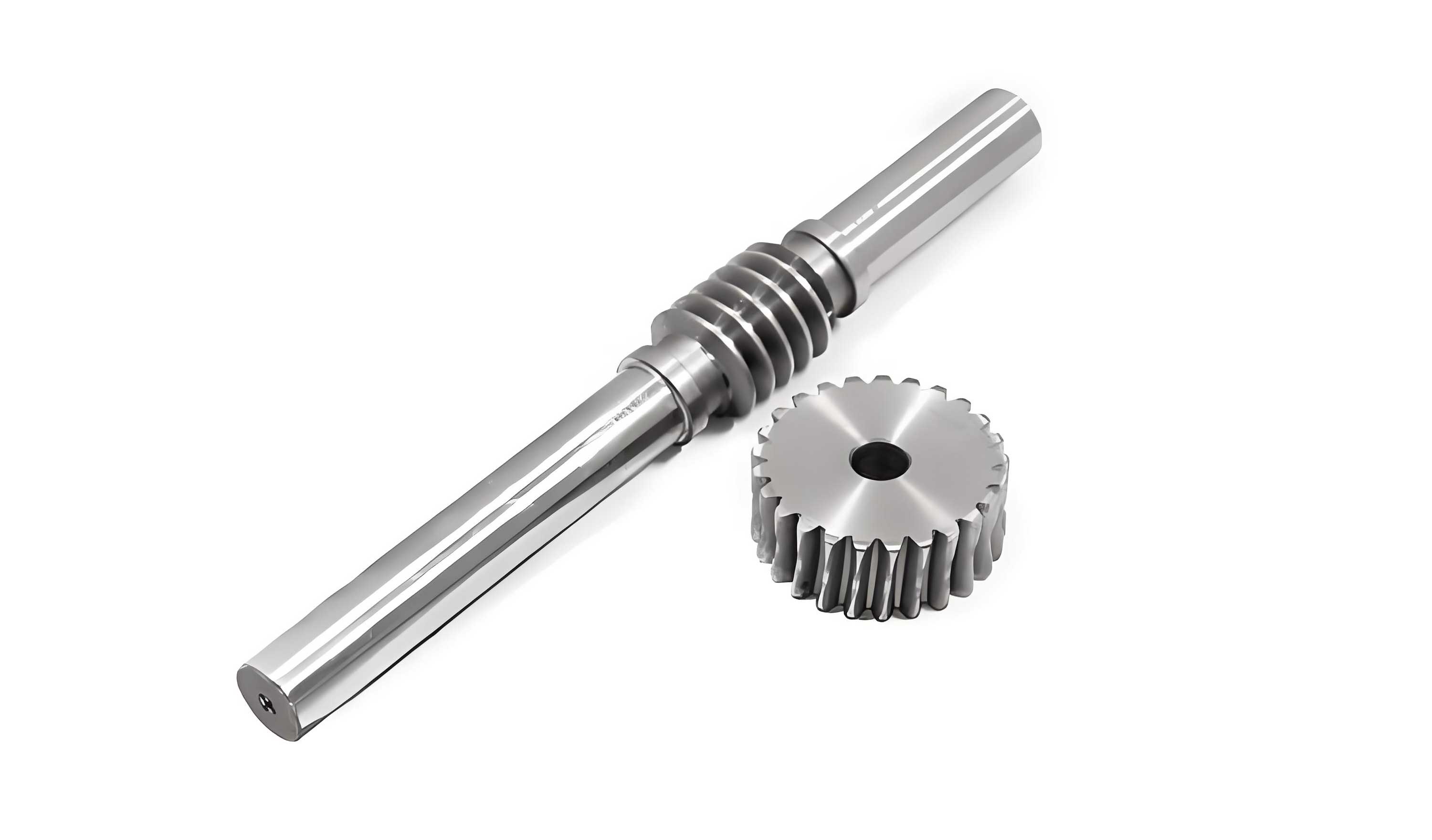
The design and performance of worm gears are profoundly influenced by their geometric configuration. Broadly, worm gears can be classified into several primary types, each with distinct characteristics that dictate their application, manufacturability, and measurement requirements. A thorough understanding of these types is essential for any engineer or machinist working with these components.
| Type | Defining Feature | Manufacturing Method | Key Advantages | Typical Applications |
|---|---|---|---|---|
| Archimedes Cylindrical Worm | Axial tooth profile is a straight line (involute in a plane perpendicular to the axis). | Single-point turning on a lathe with a straight-edged tool aligned with the worm axis. | Simple to produce, cost-effective for low to medium precision. | General machinery, conveyors, low-speed reducers. |
| Involute Helicoid Worm | Tooth surface is an involute helicoid; profile in the transverse section is an involute curve. | Turning with tool tangent to the base circle; can be ground for high precision. | Can be precision ground, suitable for high speeds and multiple-start worms. | High-speed drives, precision instrumentation, servo mechanisms. |
| Convolute (or Cone-Disc Enveloping) Worm | Non-linear tooth profile generated by a conical or disc-shaped tool. | Milling on a milling machine followed by grinding. | Good load distribution, improved contact conditions. | Heavy-duty industrial drives, mining equipment. |
| Circular Arc Cylindrical Worm | Concave worm tooth profile meshing with a convex worm wheel tooth profile. | Worm: machined with a convex circular cutting edge. Worm wheel: generated by a hob. | High contact ratio, superior load capacity due to convex-concave contact. | High-torque applications, cranes, hoists. |
| Double-Enveloping (Hourglass) Worm | Worm body is a globoidal shape, enveloping the worm wheel. | Complex generation using specialized hobbing machines. | Extremely high contact area and torque capacity. | Severe-duty applications, steel mill drives, military vehicles. |
| Conical Worm | Worm has a conical shape; resembles a spiral bevel gear arrangement. | Worm wheel is cut with a conical hob on a standard gear hobber. | High overlap ratio, easy assembly, good manufacturability. | Applications requiring large speed ratios in compact spaces. |
My focus often returns to the Archimedes cylindrical worm gears due to their widespread use and relatively straightforward, yet nuanced, machining process. The axial tooth profile being a straight line is the defining trait, but this simplicity in definition belies the precision required in its manufacture and inspection. The fundamental geometry of a standard Archimedes worm can be described by several key parameters. The axial pitch, $p_x$, is the distance between corresponding points on adjacent teeth measured parallel to the axis. The axial module, $m_x$, is a derived parameter fundamental to metric system design:
$$ m_x = \frac{p_x}{\pi} $$
where $p_x$ is measured in millimeters. The lead, $L$, for a multi-start worm is given by $L = z_1 \cdot p_x$, where $z_1$ is the number of starts or threads on the worm. The lead angle, $\gamma$, a critical parameter affecting efficiency and self-locking characteristics, is calculated from the pitch diameter of the worm, $d_1$, and the lead:
$$ \gamma = \arctan\left(\frac{L}{\pi d_1}\right) = \arctan\left(\frac{z_1 \cdot m_x}{d_1}\right) $$
For a standard setup with a 90° shaft angle, the helix angle of the worm wheel, $\beta$, is equal to the lead angle $\gamma$ of the worm. The center distance, $a$, between the worm and wheel axes is another vital dimension:
$$ a = \frac{d_1 + d_2}{2} $$
where $d_2$ is the pitch diameter of the worm wheel. Often, worm gear sets employ profile shift or modification to adjust the center distance or improve tooth strength. The profile shift coefficient, $x$, modifies the worm wheel’s geometry. If the measured center distance differs from the theoretical value calculated using standard module and tooth counts, it indicates a profile shift. The modified center distance $a’$ is related to the theoretical center distance $a$ and the profile shift coefficient by:
$$ a’ = a + m_x \cdot x $$
Accurate measurement of these parameters is the cornerstone of quality control for worm gears. For the worm, the first step is often to verify its type. As I practice, placing a precision straightedge or optical comparator along the axial profile of the worm tooth is a quick method to confirm an Archimedes profile—if the profile aligns perfectly with the straightedge, it is indeed an Archimedes worm. The axial pressure angle, $\alpha_x$, is typically 20° or, less commonly, 15°. It can be measured using an optical profile projector or a precision angle gauge. The module is determined by carefully measuring the axial pitch over several teeth using a pitch measuring machine or a precision micrometer with span wires, then applying the formula $m_x = p_x / \pi$. The lead angle can be measured indirectly via the lead using a lead testing instrument or calculated after determining the pitch diameter and number of starts.
| Component | Parameter | Symbol | Standard Value (Typical) | Measurement Technique |
|---|---|---|---|---|
| Worm | Axial Module | $m_x$ | 1, 1.25, 1.5, 2, 2.5, 3… mm | Measure axial pitch $p_x$ over N teeth: $m_x = (p_{x\_total} / N) / \pi$. |
| Pressure Angle (Axial) | $\alpha_x$ | 20° | Optical comparator, angle gauge, or coordinate measuring machine (CMM). | |
| Lead Angle | $\gamma$ | 3° to 25° (common) | Lead tester, or calculate from $\gamma = \arctan(m_x z_1 / d_1)$. | |
| Pitch Diameter | $d_1$ | Function of module and design | Measure over wires or balls, or using a precise micrometer. | |
| Worm Wheel | Center Distance | $a’$ | Design value | Measure on a metrology plate between mandrels supporting worm and wheel. |
| Profile Shift Coefficient | $x$ | 0, ±0.5, ±1.0… | Derived from measured $a’$, theoretical $a$, and module: $x = (a’ – a)/m_x$. | |
| Tooth Thickness | $s_2$ | Varies with module and shift | Measure with gear tooth calipers or span measurement, often at a specified reference circle. |
For the worm wheel, measurement is equally critical. The center distance check validates the entire assembly geometry. When the profile shift coefficient is significant, measuring tooth thickness at the theoretical pitch circle might be impractical as the caliper anvils might contact the root fillet. Therefore, I recommend measuring at a fixed reference height, often the mid-tooth depth. The chordal tooth thickness, $s_{c2}$, at a given chordal height, $h_{c2}$, can be calculated based on the wheel’s geometry. For a worm wheel with tooth number $z_2$, module $m_x$, and pressure angle $\alpha_x$, the calculations involve involute functions. However, for practical inspection, gear rolling testers or CMMs provide the most comprehensive data on tooth flank form and lead.
The heart of my analysis lies in the machining processes for these worm gears. While traditional methods like single-point turning on lathes for worms and hobbing for wheels are well-established, advanced methods aim for higher efficiency and precision. The use of旋风铣 (whirling) attachments on lathes is common for high-volume worm production. In this process, a rotating cutter head with multiple inserts whirls around the slowly rotating workpiece, generating the thread form in a continuous, semi-synchronous motion. The cutting geometry is complex, and any misalignment can lead to errors in the lead angle or tooth profile. The relationship between the cutter axis angle, $\Sigma$, and the worm’s lead angle, $\gamma$, must be precisely set to generate the correct flank. The fundamental kinematic equation for setting the whirling machine is:
$$ \text{Cutter Tilt Angle} \approx \gamma \pm \delta $$
where $\delta$ is a small correction factor depending on the cutter diameter and worm geometry. Despite its speed, whirling can introduce deviations, especially for large lead angles.
An alternative, highly efficient cold-forming process I have extensively worked with is thread rolling using a滚丝机 (thread rolling machine). This method is particularly attractive for mass-producing certain types of worms, especially those with symmetrical profiles and suitable material properties. The thread rolling process for worm gears involves pressing a hardened, precision ground滚丝轮 (flat die or cylindrical die) into the surface of a cylindrical blank, causing plastic deformation to form the teeth. This is a cold-working process that enhances surface finish, work-hardens the surface layer, and creates continuous grain flow, thereby improving fatigue strength. The process is governed by the principle of volume constancy and plastic flow. The required blank diameter, $d_b$, for a worm with major diameter $d_a$ and root diameter $d_f$ is critical and must be calculated accurately to avoid defects. An approximate formula based on the pitch diameter $d_1$ and the tooth depth $h$ is:
$$ d_b \approx d_1 + k \cdot h $$
where $k$ is an empirical factor (typically between 0.8 and 1.0) dependent on material ductility and the specific tooth form. The rolling force, $F_r$, can be estimated by:
$$ F_r \approx A_p \cdot \sigma_y \cdot C $$
where $A_p$ is the projected contact area between the die and workpiece during deformation, $\sigma_y$ is the yield strength of the workpiece material, and $C$ is a factor accounting for work hardening and friction. The success of rolling worm gears hinges on meticulous machine setup and process parameters.
| Setup Element | Parameter | Adjustment Principle | Effect of Incorrect Setting |
|---|---|---|---|
| Roller Dies | Axial Alignment | Dies must be coplanar and parallel. Shims are used behind bearings to prevent axial play. | Uneven tooth form, tapered lead, excessive die wear. |
| Die Width | Should be slightly greater than worm thread length (e.g., +1-2 mm). | Too wide: material flow at ends damages die teeth. Too narrow: incomplete thread formation. | |
| Die Tooth Profile | Must be the exact conjugate form of the desired worm space, considering elastic springback. | Incorrect worm tooth profile, improper meshing with worm wheel. | |
| Workpiece Support | Support Height | For mild steel: center ~0.25mm below roll center. For high-strength steel: center slightly above. | Improper support leads to deflection, poor form accuracy, or even workpiece buckling. |
| Support Material | Hardened and ground steel or carbide pads to minimize wear and friction. | Rapid wear, scoring on workpiece surface, inconsistent quality. | |
| Workpiece Preparation | Blank Diameter | Calculated precisely based on final worm dimensions and material flow. Surface must be free of scale and cracks. | Oversize: excessive rolling force, die damage. Undersize: incomplete tooth fill. |
| Blank Hardness | Should be below 37 HRC for most steels to allow plastic deformation without cracking. | Too hard: causes die chipping or catastrophic failure. Too soft: excessive material flow. | |
| Chamfering | Both ends of the blank must be chamfered significantly (angle ~30°, depth ~1.5 x tooth depth). | Without chamfer, material extrudes axially, forming burrs and causing severe die entry shock and damage. | |
| Machine Settings | Center Distance & Phase | Precisely adjusted to achieve the final major diameter and correct tooth engagement between dies. | Incorrect diameter, double-flanking, or mismatched pitch. |
The design of the滚丝轮 (roller dies) themselves is a reverse-engineering process from the desired worm. For an Archimedes worm with axial pressure angle $\alpha_x$ and module $m_x$, the die tooth profile in the axial section must be the exact negative of the worm’s tooth space, often with a slight modification to account for elastic recovery of the workpiece after rolling. This recovery, or springback, $\Delta s$, must be empirically determined for each material and affects the final tooth thickness. The die profile pressure angle, $\alpha_{die}$, might be slightly larger than $\alpha_x$:
$$ \alpha_{die} \approx \alpha_x + \Delta \alpha $$
where $\Delta \alpha$ is the springback angle correction, often in the range of 0.1° to 0.5°. The wear resistance of the dies is paramount; they are typically made from premium tool steels like D2 or M2, through-hardened to 60-64 HRC, and often coated with TiN or similar PVD coatings to extend life. The economic justification for rolling worm gears comes from high production rates, material savings (no chips), and improved part strength, but it is only suitable for ductile materials with sufficient elongation (typically >10-12%) and tensile strength below about 1000 MPa.
Once the worm is produced, the corresponding worm wheel must be generated using a hob that is a precise conjugate of the worm. The design of this hob is critical. For an Archimedes worm, the hob’s axial tooth profile is identical to the worm’s space. However, in practice, the hob is often designed with a slight topping or protuberance to generate a root relief on the worm wheel tooth, improving clearance. The hob’s lead must match the worm’s lead exactly. The hobbing process involves synchronizing the rotation of the hob ($N_h$) and the blank ($N_w$):
$$ \frac{N_h}{N_w} = \frac{z_2}{K} $$
where $z_2$ is the number of teeth on the worm wheel and $K$ is the number of starts on the hob (usually 1). The radial infeed, $f_r$, determines the tooth depth and is performed in passes. For finishing, a tangential feed might be used to improve surface finish on the flanks. The setup must also account for the hob axis tilt angle, which is set to the worm’s lead angle $\gamma$ plus the hob’s own rake angle if present.
Throughout my work, I have found that the interplay between design, measurement, and manufacturing is most evident when troubleshooting. For instance, premature wear in a worm gear set might trace back to an undetected error in the worm’s lead angle caused by an incorrect whirling machine setup. Or, noise and vibration could stem from an improperly calculated profile shift coefficient, leading to an incorrect contact pattern. Advanced metrology tools like 3D scanning and computer-aided inspection software now allow for a comprehensive comparison of the manufactured worm gear against its digital nominal model, calculating form errors, lead deviations, and pitch errors automatically.
Looking forward, the optimization of worm gears continues with trends like the integration of finite element analysis (FEA) to simulate the rolling process, predicting stresses and optimizing die life. Additive manufacturing is also beginning to play a role in producing prototype hobs or even complex worm wheel geometries in small batches. The core principles, however, remain rooted in a deep understanding of the geometry and mechanics I have outlined. The humble worm gear, in all its variants, will continue to be a cornerstone of mechanical power transmission, and mastering its machining characteristics—from the classic Archimedes form to more complex types—remains a rewarding and essential engineering pursuit. The continuous refinement of processes like thread rolling for worm gears promises even greater efficiency and reliability for these indispensable components in demanding industrial applications.