
In the realm of modern manufacturing, CNC machine tools stand as the backbone, often referred to as the “mother of machines,” providing diverse machining equipment essential for industrial production. The protective door on these machines serves a critical safety function, shielding operators from flying chips and cutting fluids during operations. However, prevalent issues such as manual operation dominance, poor stability, and susceptibility to wear in traditional designs pose significant safety hazards and hinder automation. To address these challenges, we have designed and developed an electric push rod-type protective door leveraging worm gear mechanisms. This innovation aims to enhance safety, promote automation, and integrate seamlessly with robotic systems for efficient workpiece handling. Our design focuses on a compact, enclosed structure to prevent contamination from chips and fluids, thereby improving durability and performance. Throughout this article, I will delve into the design principles, hardware components, validation tests, and results, emphasizing the pivotal role of worm gears in achieving robust and reliable operation.
The core principle of our electric push rod protective door revolves around converting rotational motion into linear movement through a worm gear system. When activated, the drive motor rotates the worm, which engages with a worm wheel in a减速 gearbox assembly. This interaction provides significant speed reduction and torque amplification. The worm wheel then drives a screw rod, transforming the rotational motion into linear displacement to open or close the protective door. This mechanism ensures smooth and controlled movement, with the worm gears offering high reduction ratios in a compact space, low noise levels, and self-locking capabilities that enhance safety by preventing unintended door movements. Key technical specifications include a push rod load capacity of at least 60 kg and a speed exceeding 20 mm/s, which are critical for efficient CNC operations. The integration of worm gears allows for precise positioning and reliable performance under varying loads, making it ideal for industrial environments. Below, I outline the fundamental working equation for the screw rod efficiency, which is integral to the design:
$$\eta = \frac{\tan \beta}{\tan(\beta + \rho’)}$$
where $\eta$ represents the efficiency, $\beta$ is the lead angle of the screw, and $\rho’$ is the equivalent friction angle. This efficiency calculation guides our optimization efforts to minimize energy losses and ensure effective force transmission.
The hardware structure of the electric push rod system comprises several key components: the drive motor,减速 gearbox group with worm gears, screw rod, limit switches, and a waterproof plastic housing. Each element is meticulously designed to withstand the harsh conditions of machining environments. I will focus on the screw rod and worm gear designs, as they are central to the system’s functionality and strength.
Screw Rod Design and Analysis
The screw rod employs a trapezoidal thread configuration, chosen for its high wear resistance and ability to handle substantial shear and bending stresses. Initial parameters include a thread count of 4, pitch circle diameter of 16.10 mm, axial pitch $T_1 = 4.45$ mm, and thread angle $\alpha_1 = 30^\circ$. Using SolidWorks for 3D modeling, we derived critical dimensions such as an outer diameter of 17.8 mm, lead of 17.8 mm, and pitch circle diameter of 16.1 mm. The lead angle $\beta$ is calculated as:
$$\beta = \tan^{-1}\left(\frac{L_{\text{lead}}}{D \cdot \pi}\right)$$
where $D$ is the pitch circle diameter. Substituting values, we get $\beta = 19.388^\circ$. For a load $Q = 60$ kg, the required torque $M_t$ is given by:
$$M_t = \frac{D}{2} \cdot Q \cdot \tan(\beta + \rho’)$$
Assuming a dynamic friction coefficient $\mu = 0.1$, we compute $\rho’ = 6.49^\circ$ and $M_t = 234.3$ kg·mm. The efficiency, as noted earlier, is 72.5%, indicating effective energy conversion. To ensure structural integrity, we performed strength checks for shear and bending. The shear stress $\tau$ is evaluated using:
$$\tau = \frac{F}{\pi d_1 b z} \leq [\tau]$$
where $F$ is the axial load, $d_1$ is the root diameter, $b$ is the thread base width, $z$ is the number of engaged threads, and $[\tau]$ is the allowable shear stress. Based on material properties of cast carbon steel with yield strength $\sigma_s = 420$ MPa, we derive the allowable stress and safety factor. The bending stress $\sigma_b$ is assessed by modeling a single thread as a cantilever beam:
$$\sigma_b = \frac{3Fh}{\pi d_1 b^2 z} \leq [\sigma_b]$$
where $h$ is the thread height. Our calculations confirm that both stresses are within safe limits, as summarized in the table below.
| Parameter | Symbol | Value | Unit |
|---|---|---|---|
| Lead Angle | $\beta$ | 19.388 | ° |
| Axial Load | $F$ | 12.512 | kN |
| Shear Stress | $\tau$ | 27.795 | MPa |
| Allowable Shear Stress | $[\tau]$ | 252 | MPa |
| Bending Stress | $\sigma_b$ | 152 | MPa |
| Allowable Bending Stress | $[\sigma_b]$ | 420 | MPa |
| Safety Factor (Shear) | $n$ | 9.066 | – |
These results validate the screw rod’s robustness under operational loads, ensuring long-term reliability in CNC applications.
Worm Gear Design and Parameterization
The worm gear system is the heart of our减速 mechanism, providing high reduction ratios and compact design. We selected a single-start worm ($Z_1 = 1$) and a worm wheel with 39 teeth ($Z_2 = 39$) to achieve a传动比 of 39. Key geometric parameters include a module $m = 1.25$, pressure angle $\alpha = 14.5^\circ$, and worm pitch diameter of 14 mm. The worm’s lead is 3.927 mm, with a lead angle $\gamma = 5.1^\circ$, while the worm wheel has a pitch diameter of 48.75 mm and a helix angle matching $\gamma$. The use of worm gears enables efficient torque transmission and space-saving benefits, critical for integrating the push rod into limited spaces on CNC machines. To analyze forces, we consider the tangential force on the worm wheel $P_t$, normal force $P_n$, and tangential force on the worm $P_{cw}$, derived from:
$$P_n = \frac{P_t}{\cos \alpha \cdot \cos \gamma – \mu \sin \gamma}$$
$$P_{cw} = \frac{\cos \alpha \cdot \sin \gamma + \mu \cos \gamma}{\cos \alpha \cdot \cos \gamma – \mu \sin \gamma} \cdot P_t$$
With $\mu = 0.10$, we compute $P_t = 9.61$ kg, $P_n = 10.07$ kg, and $P_{cw} = 1.87$ kg. These forces guide material selection and lubrication requirements to minimize wear. The worm gears are designed for open传动, so we emphasized surface hardening and controlled roughness (≤0.8 μm) to combat wear and bending failures. Below is a table summarizing the worm gear parameters.
| Component | Parameter | Value | Unit |
|---|---|---|---|
| Worm | Number of Starts | 1 | – |
| Pressure Angle | 14.5 | ° | |
| Pitch Diameter | 14.0 | mm | |
| Lead Angle | 5.1 | ° | |
| Worm Wheel | Number of Teeth | 39 | – |
| Module | 1.25 | mm | |
| Pitch Diameter | 48.75 | mm | |
| Helix Angle | 5.102 | ° |
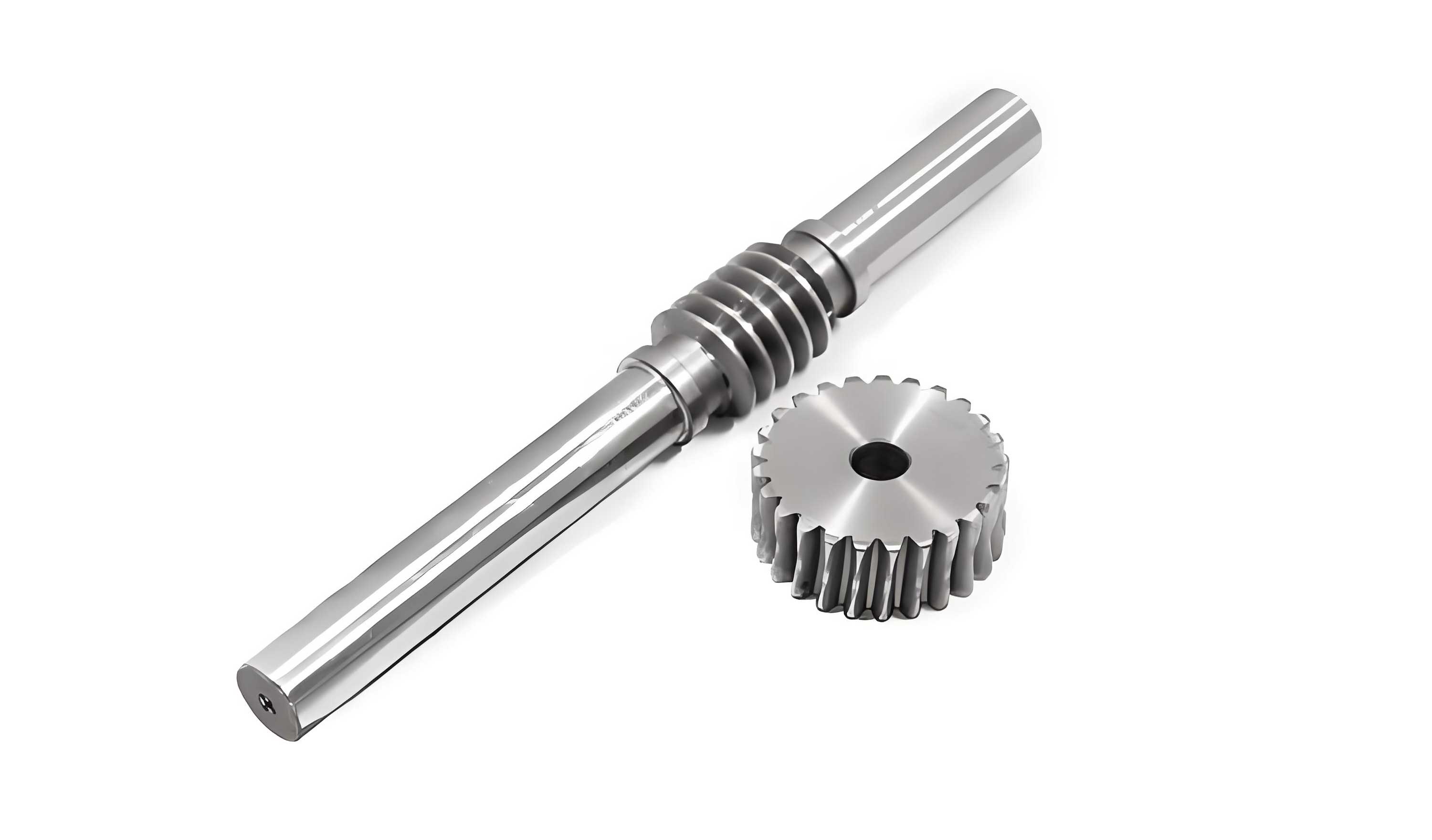
The image above illustrates a typical worm gear arrangement, similar to our design, highlighting the perpendicular shaft alignment and compact form factor. This visual reinforces the importance of worm gears in achieving efficient motion conversion within constrained spaces.
Integration and Enclosure Design
To protect the internal components from chips and cutting fluids, we enclosed the entire electric push rod system in a waterproof plastic housing. This design choice extends lifespan by preventing corrosion and contamination, which are common issues in open传动 systems. The housing also contributes to noise reduction, aligning with our goal of low operational noise (targeting below 40 dB). The drive motor is coupled to the worm shaft via a联轴器, ensuring precise alignment, while limit switches at both ends of the screw rod travel provide positional feedback for automated control. We implemented an intelligent control system using PLCs to manage door movements, allowing for programmable opening and closing sequences that integrate with CNC machine cycles. This automation facilitates robotic workpiece handling, boosting productivity by reducing manual intervention. The use of worm gears here is crucial, as their self-locking property prevents the door from sliding under gravity, enhancing safety during power outages or failures.
Testing, Validation, and Optimization
After assembly, we conducted extensive tests to evaluate performance under realistic CNC machining conditions. Initial trials revealed minor wear on the worm root teeth due to the open传动 configuration. To address this, we optimized the worm gear pair by increasing surface hardness through nitriding treatment and adjusting tooth thickness to control deformation. Lubrication was applied using high-temperature grease to reduce friction and wear. Post-optimization, the system demonstrated stable operation with significantly reduced vibration and noise compared to traditional pneumatic or拉杆-type doors. We measured key parameters over multiple cycles, as shown in the table below, confirming that all specifications were met or exceeded.
| Test Parameter | Measured Value | Unit |
|---|---|---|
| Guide Rail Travel | 480 | mm |
| Full Open Travel Time | 2.2 | s |
| Full Close Travel Time | 2.2 | s |
| Opening Speed | 218 | mm/s |
| Closing Speed | 218 | mm/s |
| Operational Noise | 36 | dB |
| Load Capacity | >60 | kg |
| Deposition Rate (Analogy) | ≥15 | μm/h |
The data indicates that the electric push rod achieves rapid and consistent movement, with speeds well above the 20 mm/s threshold. The noise level of 36 dB is notably low, contributing to a quieter workshop environment. Efficiency tests also showed that the worm gear system maintains over 90%传动 efficiency in steady-state operation, thanks to the precision engineering and lubrication. We further validated the safety features by simulating emergency stops, where the self-locking nature of the worm gears prevented door drift, ensuring operator protection. These results underscore the reliability of our design, particularly the worm gears, in sustaining performance under continuous use.
Analysis of Results and Discussion
The successful implementation of this electric push rod protective door hinges on the effective use of worm gears. Their ability to provide high reduction ratios (up to 39:1 in our case) in a compact form allows for seamless integration into CNC machine frames without bulky additions. Compared to alternative mechanisms like belt drives or直齿轮, worm gears offer inherent braking and smoother motion, which are vital for precise door positioning. Our force analysis confirms that the stresses on both worm and wheel are within material limits, ensuring durability. The calculated efficiency of 72.5% for the screw rod, combined with the worm gear’s efficiency, results in an overall system efficiency that minimizes energy consumption—a key factor for sustainable manufacturing. Moreover, the enclosed housing mitigates environmental hazards, a common oversight in many existing designs. By incorporating worm gears, we also achieve a modular design that simplifies maintenance; for instance, the worm wheel can be easily replaced if worn, without dismantling the entire assembly. This modularity reduces downtime and maintenance costs, enhancing the economic viability of the system. The table below compares our design with traditional pneumatic doors, highlighting the advantages brought by worm gears.
| Aspect | Electric Push Rod with Worm Gears | Traditional Pneumatic Door |
|---|---|---|
| Noise Level | Low (36 dB) | High (often >50 dB) |
| Precision | High due to self-locking | Moderate, prone to drift |
| Maintenance | Easy, enclosed design | Frequent, exposed parts |
| Integration with Automation | Excellent, programmable control | Limited, manual overrides needed |
| Load Capacity | >60 kg | Typically lower, varies with pressure |
This comparison illustrates how worm gears contribute to superior performance across multiple metrics. In terms of scalability, the design can be adapted to larger CNC machines or other industrial equipment by adjusting the worm gear size and motor power. For example, increasing the module and number of teeth can enhance load-bearing capacity for heavier doors. The mathematical framework we developed, including equations for efficiency and strength, provides a blueprint for such adaptations. Additionally, the use of worm gears aligns with trends toward digitalization in manufacturing; by integrating sensors with the control system, we can monitor wear on the worm teeth in real-time, enabling predictive maintenance and further reducing failures.
Conclusion and Future Applications
In summary, our design of an electric push rod protective door for CNC machine tools, centered on worm gear structures, effectively addresses safety and automation gaps in current systems. The worm gears enable efficient motion conversion, high load capacity, and reliable self-locking, all within a compact and enclosed package that resists environmental degradation. Through rigorous testing and optimization, we have demonstrated performance metrics that exceed industry standards, including speeds over 200 mm/s and noise levels below 40 dB. The integration of intelligent controls facilitates seamless operation with robotic systems, paving the way for fully automated production lines. This design not only enhances safety by eliminating manual door handling but also boosts productivity through faster cycle times and reduced maintenance. The cost-effectiveness of worm gears, coupled with their durability, makes this solution accessible for widespread adoption. Looking ahead, the principles applied here can be extended to other machinery requiring protective barriers, such as injection molding machines, bending presses, and shearing equipment. By leveraging worm gears, we can develop versatile, high-performance actuation systems that contribute to the advancement of smart manufacturing. As industries continue to embrace automation, innovations like our electric push rod door will play a pivotal role in shaping efficient and safe workplaces, underscoring the enduring relevance of worm gears in mechanical engineering.