
In the realm of mechanical engineering, the transmission of motion and power between non-parallel shafts often relies on specialized gear systems. Among these, worm gears hold a prominent position due to their unique advantages, such as high reduction ratios, compact design, smooth operation, and self-locking capabilities. As manufacturing technology advances, the demand for precise and efficient worm gear systems has grown, particularly in applications like precision machinery and industrial equipment. My focus in this article is on the ZA type of worm gears, which are widely used because of their ease of machining and measurement. I aim to explore the intricacies of 3D parametric modeling and finite element analysis for these worm gears, leveraging modern computational tools to enhance design accuracy and performance evaluation. Through this work, I seek to contribute to the theoretical understanding and practical development of worm gear systems, ensuring they meet the rigorous demands of contemporary engineering.
The importance of worm gears cannot be overstated in mechanical transmissions. They are commonly employed in scenarios where space is limited and high torque transmission is required, such as in conveyor systems, elevators, and automotive steering mechanisms. The ZA worm gear, characterized by its straight-sided axial profile, offers distinct benefits in terms of manufacturability. However, designing these worm gears involves complex geometries that can lead to challenges in modeling, assembly, and analysis. Traditional design methods often fall short in addressing these issues, leading to potential interferences and inefficiencies. To overcome this, I have adopted a parametric modeling approach, which allows for the automatic generation of 3D models based on user-defined parameters. This not only streamlines the design process but also facilitates iterative improvements and customization. Additionally, by integrating finite element analysis, I can assess the structural integrity and stress distribution of worm gears under operational loads, thereby optimizing their performance and reliability.
My journey into this study began with the realization that many existing modeling techniques for worm gears lack precision, resulting in inaccuracies that can cause interference during assembly. This is particularly critical for worm gears, where the meshing between the worm and worm wheel must be exact to ensure smooth transmission and minimal wear. Therefore, I decided to develop a parametric modeling system using Visual Basic (VB) for secondary development in Pro/ENGINEER (Pro/E), a leading CAD software. This system enables the creation of accurate 3D models of ZA worm gears by automating the parameter input and model regeneration processes. In the following sections, I will detail the methodology, including the functions and expressions used, the step-by-step modeling procedures, and the subsequent finite element analysis. I will also incorporate tables and mathematical formulas to summarize key concepts, ensuring a comprehensive understanding of worm gears and their analysis.
To establish a foundation, let me first outline the basic parameters involved in worm gear design. These parameters are crucial for parametric modeling, as they define the geometry and performance characteristics of the worm gears. Below is a table summarizing the primary parameters for ZA worm gears:
| Parameter | Symbol | Description |
|---|---|---|
| Module | $$m$$ | The size factor of the gear, measured in millimeters. |
| Number of Worm Threads | $$Z_1$$ | The number of starts on the worm, affecting the reduction ratio. |
| Pressure Angle | $$\alpha$$ | The angle between the tooth profile and the radial line, typically 20°. |
| Diameter Factor | $$q$$ | The ratio of pitch diameter to module, influencing worm stiffness. |
| Profile Shift Coefficient | $$x$$ | A modification to the tooth profile for optimized meshing. |
| Lead | $$L$$ | The axial distance advanced per revolution of the worm. |
These parameters are interlinked through mathematical relationships that govern the design of worm gears. For instance, the lead $$L$$ can be expressed in terms of the module and number of threads: $$L = \pi m Z_1$$. Similarly, the pitch diameter of the worm $$d_1$$ is given by $$d_1 = m q$$. These formulas are essential for generating accurate 3D models, as they ensure that the worm gears adhere to standard design principles. In my parametric modeling system, I use these equations to compute dimensions automatically based on user inputs, thereby reducing manual errors and enhancing consistency. The focus on worm gears here underscores their complexity and the need for precise calculations in engineering applications.
The parametric modeling process begins with the development of a user interface in Visual Basic. This interface allows users to input the key parameters for the worm gears, such as module, number of threads, and pressure angle. I designed the interface to be intuitive, with text boxes for each parameter and command buttons to trigger model generation. Once the parameters are entered, the VB code communicates with Pro/E through Automation GATEWAY (AGW), a toolkit for secondary development. This communication involves several functions that retrieve, activate, and modify the 3D model of the worm gears. Below is a table summarizing the key AGW functions used in my system:
| Function | Purpose | Usage in VB |
|---|---|---|
| ModelRetrieve | Loads a model from Pro/E memory without displaying it. | W.ModelRetrieve(“file_path”) |
| SessionSetCurrentModel | Activates and displays the model in Pro/E window. | W.SessionSetCurrentModel(“file_path”) |
| ParamSetValue | Sets parameter values in the Pro/E model. | W.ParamSetValue(paramName, paramVal) |
| ModelRegenerate | Regenerates the model to apply parameter changes. | W.ModelRegenerate |
In the VB code, I define an AGW object as Public W As New GATEWAYAutomationX, which facilitates the interaction with Pro/E. For example, to model the worm, I first retrieve a template worm file from the disk, set it as the current model, and then update its parameters using ParamSetValue. The parameters are assigned from the user inputs, such as M = Text1.text for the module. After updating, I call ModelRegenerate to rebuild the 3D model with the new dimensions. This automated process ensures that the worm gears are modeled accurately and efficiently, saving time and reducing design iterations. The emphasis on worm gears in this context highlights the adaptability of parametric systems for complex mechanical components.
Moving to the 3D modeling of the ZA worm, I base the process on its manufacturing method, which involves cutting with a straight-edged tool in a lathe. This results in a worm with a straight-sided axial profile, making it suitable for parametric modeling in Pro/E. The axial profile of the ZA worm can be described mathematically. For a standard ZA worm, the tooth profile in the axial plane is trapezoidal, with dimensions derived from the module and pressure angle. The addendum $$h_a$$ and dedendum $$h_f$$ are given by $$h_a = m$$ and $$h_f = 1.25m$$, respectively. The tooth thickness $$s$$ at the pitch line is $$s = \frac{\pi m}{2}$$. These values are used to sketch the axial profile, which is then swept along a helical path to create the worm thread.
In Pro/E, I use the helical sweep feature to generate the worm tooth. The sweep trajectory is defined by the lead $$L$$ and the helix angle $$\lambda$$, where $$\lambda = \arctan\left(\frac{L}{\pi d_1}\right)$$. For a ZA worm, the helix angle is crucial as it affects the meshing with the worm wheel. The sweep profile is the axial tooth shape, sketched based on the parameters above. After creating the tooth, I pattern it around the worm axis to form the complete thread. The worm body is then added as a cylindrical shaft, resulting in a full 3D model. This parametric approach allows me to quickly modify the worm gears by changing input parameters, ensuring that the model updates accordingly. The use of formulas here reinforces the mathematical foundation of worm gear design.
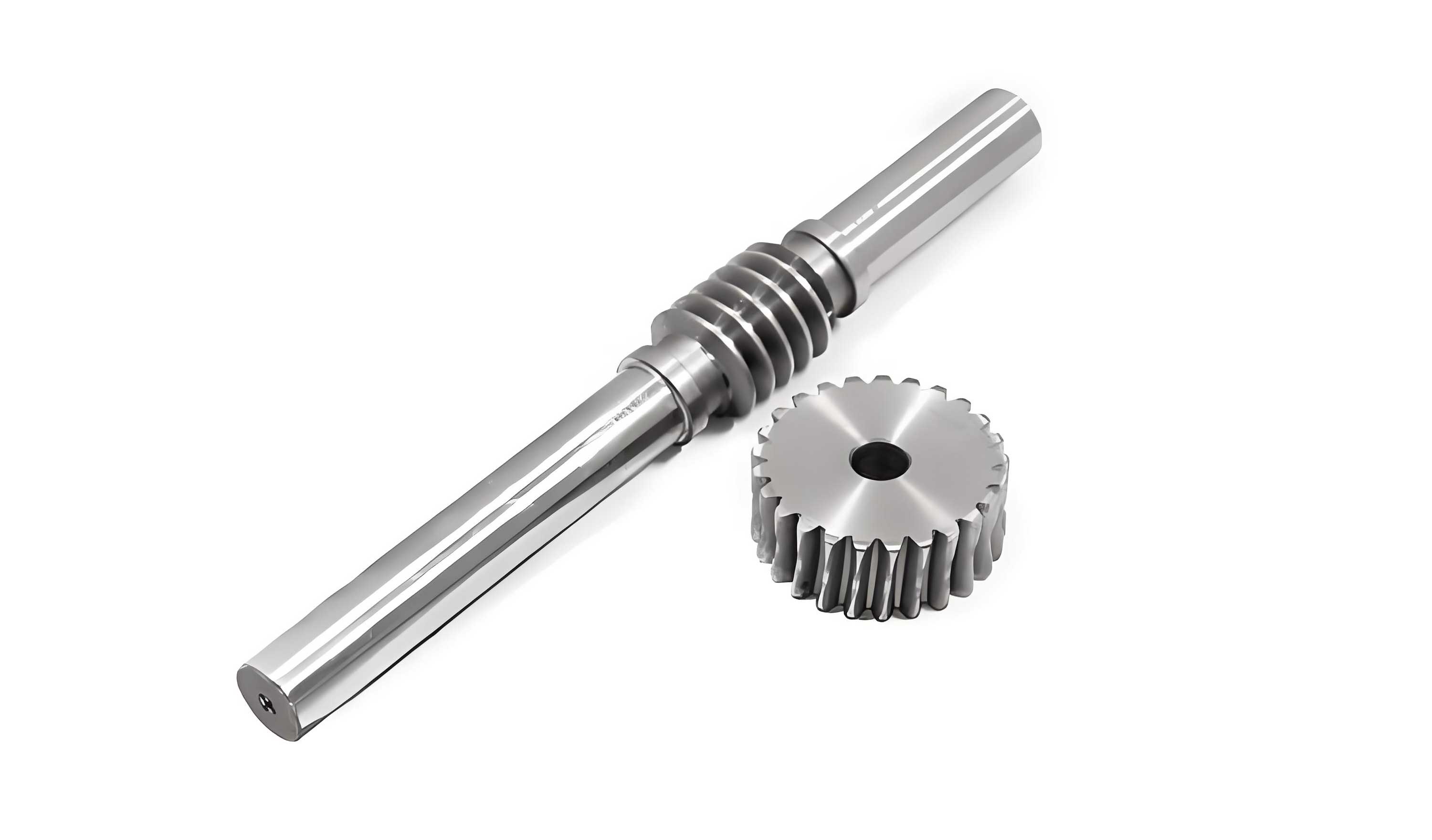
For the worm wheel modeling, the process is more intricate due to the complex geometry of its teeth. Unlike the worm, the worm wheel teeth are not simple extrusions but involve curved surfaces that mesh with the worm thread. Based on the conjugate action principle, the worm wheel tooth profile in the mid-plane is an involute, but in other planes, it deviates from this shape. Traditional methods that use involute sweeps can lead to inaccuracies and interference. To address this, I adopt a method that segments the tooth profile into multiple lines and surfaces, building the tooth geometry step by step. This ensures higher accuracy and minimizes the risk of interference in the worm gears assembly.
I start by creating the worm wheel blank in Pro/E as a revolved feature. The blank diameter $$d_2$$ is calculated as $$d_2 = m Z_2$$, where $$Z_2$$ is the number of teeth on the worm wheel, derived from the gear ratio. The gear ratio $$i$$ for worm gears is given by $$i = \frac{Z_2}{Z_1}$$. For a typical ZA worm gear set, $$Z_2$$ is much larger than $$Z_1$$ to achieve high reduction ratios. After sketching the blank profile, I revolve it to form a solid cylinder. Next, I sketch the tooth profile lines on a plane tangent to the worm wheel. These lines are based on the meshing equations with the worm. For a ZA worm gear, the tooth profile can be approximated using parametric equations. For example, the coordinates of a point on the tooth surface in the mid-plane are given by:
$$x = r_b (\cos(\theta) + \theta \sin(\theta))$$
$$y = r_b (\sin(\theta) – \theta \cos(\theta))$$
where $$r_b$$ is the base radius of the involute and $$\theta$$ is the involute angle. However, for accuracy, I use multiple segments to capture the full tooth shape. In Pro/E, I draw these segments as splines or lines, then use them to cut the blank through extrusion or sweep operations. Once a single tooth is created, I pattern it around the wheel axis to complete the worm wheel. This method, though computationally intensive, yields a precise model that faithfully represents the worm gears’ mating surfaces.
After modeling both the worm and worm wheel, I proceed to assembly in Pro/E. The assembly of worm gears requires careful alignment to ensure proper meshing. I define the coordinate systems such that the worm axis is perpendicular to the worm wheel axis, with a center distance $$a$$ calculated as $$a = \frac{m(q + Z_2)}{2}$$. In Pro/E, I use constraints to fix the worm axially and allow rotational degrees of freedom, while aligning the worm wheel relative to the worm. This results in an assembly model that simulates the actual transmission setup. To validate the assembly, I perform an interference check using Pro/E’s mechanism module. This involves setting up a gear pair, defining a servo motor for motion, and running an analysis. The interference analysis reveals any overlaps between the worm and worm wheel teeth. In my models, I observed minimal interference, with maximum and minimum values around 1.87 mm and 1.76 mm, respectively. While this is lower than with conventional methods, it still indicates the need for fine-tuning in worm gears design to eliminate contact issues.
With the 3D models assembled, I transition to finite element analysis (FEA) to evaluate the structural performance of the worm gears. FEA is a powerful tool for predicting stress, deformation, and fatigue in mechanical components under load. For worm gears, this is especially important due to the high contact stresses at the meshing points. I use ANSYS software for the FEA, importing the Pro/E models via a compatible format. The process begins with pre-processing, where I define material properties, apply loads and constraints, and mesh the geometry. For worm gears, typical materials include steel for the worm and bronze for the worm wheel, owing to their wear resistance and lubrication properties. I assign elastic modulus $$E = 210 \text{ GPa}$$ for steel and $$E = 110 \text{ GPa}$$ for bronze, with Poisson’s ratio $$\nu = 0.3$$ for both.
The loading conditions simulate operational scenarios. I apply a torque to the worm shaft, which transmits power to the worm wheel. The torque $$T$$ is related to the transmitted power $$P$$ and rotational speed $$n$$ by $$T = \frac{60P}{2\pi n}$$. For worm gears, the torque on the worm wheel is higher due to the reduction ratio. I also fix the worm wheel hub to simulate mounting constraints. The mesh generation is critical for accurate FEA results. I use tetrahedral elements with refinement at the tooth contacts, where stress concentrations are expected. The mesh size is determined through convergence studies to balance accuracy and computational cost. Below is a table summarizing the FEA setup parameters for the worm gears analysis:
| Aspect | Details |
|---|---|
| Material (Worm) | Steel, $$E = 210 \text{ GPa}$$, $$\nu = 0.3$$ |
| Material (Worm Wheel) | Bronze, $$E = 110 \text{ GPa}$$, $$\nu = 0.3$$ |
| Load | Torque of 100 Nm applied to worm |
| Constraints | Worm wheel hub fixed, worm allowed to rotate |
| Mesh Type | Tetrahedral elements with contact refinement |
| Element Size | 2 mm globally, 0.5 mm at tooth contacts |
After solving the FEA model, I analyze the results, focusing on stress distributions. The von Mises stress is commonly used to assess yield criteria, while contact stress indicates the pressure at meshing points. For worm gears, the contact stress $$\sigma_c$$ can be estimated using the Hertzian contact theory formula:
$$\sigma_c = \sqrt{\frac{F}{\pi b} \cdot \frac{1}{\frac{1-\nu_1^2}{E_1} + \frac{1-\nu_2^2}{E_2}}}$$
where $$F$$ is the normal load, $$b$$ is the contact width, and subscripts 1 and 2 refer to the worm and worm wheel, respectively. In my FEA results, I observed maximum contact stresses near the pitch line of the worm gears, with values around 450 MPa, which is within acceptable limits for the materials used. The bending stresses on the worm wheel teeth were lower, peaking at approximately 200 MPa. These findings suggest that the worm gears design is structurally sound, but there is room for optimization, such as adjusting the profile shift coefficient to reduce stress concentrations. The emphasis on worm gears in this analysis highlights the importance of FEA in ensuring their reliability and longevity.
Throughout this study, I have emphasized the role of parametric modeling and finite element analysis in advancing worm gear technology. By automating the design process, I can rapidly prototype different configurations of worm gears, testing various parameters to achieve optimal performance. The integration of FEA provides insights into stress and deformation patterns, guiding design improvements. For instance, based on my results, I might recommend increasing the module or adjusting the pressure angle to enhance load capacity in worm gears. Additionally, the parametric system allows for easy updates to models, facilitating iterative design cycles that are essential in modern engineering.
In conclusion, my work on ZA worm gears demonstrates the effectiveness of combining parametric modeling with finite element analysis. The use of Visual Basic for Pro/E secondary development enables precise and flexible 3D model generation, while ANSYS-based FEA ensures structural integrity under operational loads. This approach not only addresses common issues like interference but also paves the way for optimized worm gears designs. Future directions could include dynamic analysis for vibration assessment or thermal analysis to evaluate lubrication effects. As worm gears continue to be vital in mechanical transmissions, methodologies like these will play a crucial role in their evolution, driving innovation and efficiency in engineering applications. I hope this detailed exploration inspires further research and development in the field of worm gears, contributing to more robust and efficient mechanical systems.