
In the demanding environment of modern drilling operations, the mud circulation system is a critical circulatory network, and the mud agitator serves as its essential heart. My primary objective in this work is to design a robust and efficient agitator capable of ensuring the homogeneous mixing of drilling fluids and the uniform suspension of solid additives like barite and bentonite. Prolonged, reliable operation under continuous duty cycles is paramount. The core of this design philosophy centers on the use of worm gears for power transmission, leveraging their inherent advantages for this specific application. The complete assembly, as conceptualized, consists of an explosion-proof motor, a worm gear reducer, a supporting base, and an impeller assembly.
The rationale for selecting a worm gear drive is multifaceted. Compared to traditional gear trains, worm gears offer a superior power-to-weight ratio and a more compact structural footprint, which is crucial for installation on mud tanks with space constraints. Their ability to provide high single-stage reduction ratios (targeted here at i=25) with minimal components directly translates to design simplicity and potential maintenance benefits. Furthermore, the smooth and quiet operation characteristic of well-designed worm gears is highly desirable for long-term field operation. The following table outlines the key design targets for the agitator system.
| Parameter | Value / Specification |
|---|---|
| Motor Power | 11 kW (YB2-160M-4-11 Explosion-proof Motor) |
| Target Speed Reduction Ratio | 25 |
| Operational Duty | Continuous, 8 hours/day |
| Design Life | 10 years |
| Agitated Tank Volume | 20 – 30 m³ |
| Primary Transmission | Worm Gear Reducer |
| Impeller Type | Disc Turbine with Inclined Blades |
Detailed Component Design and Calculation
1. Worm Gear Reducer Design
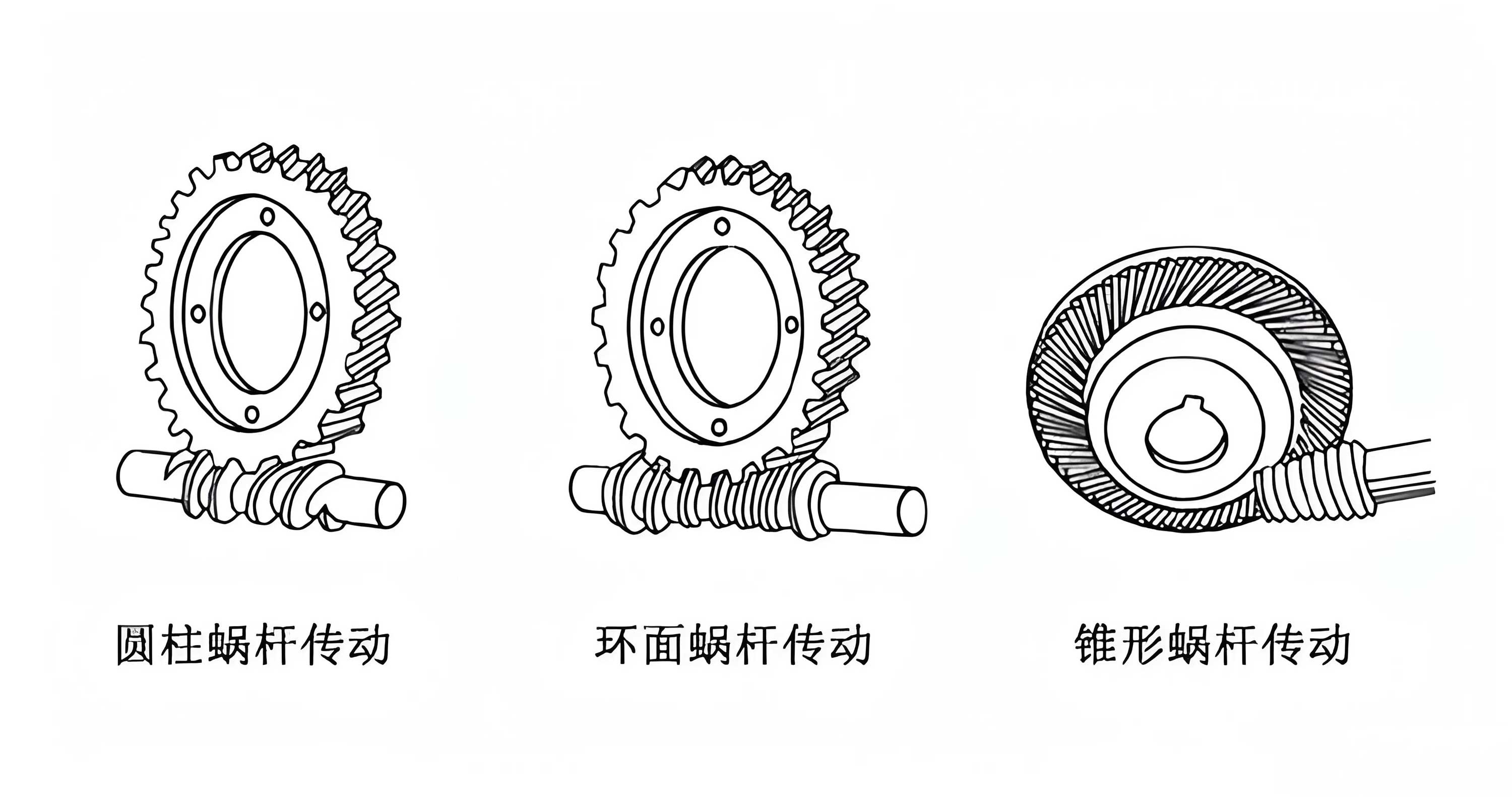
The reducer is the core transmission element. An Archimedean cylindrical worm gear set was designed. The worm shaft is manufactured from 45# steel for strength, while the worm wheel is cast from ZCuSn10P1 tin phosphor bronze, a material chosen for its excellent wear resistance and compatibility with the steel worm under sliding conditions. The initial geometric parameters were selected based on standard design procedures for worm gears.
The fundamental geometric relationships for the worm and worm wheel are defined by the module (m), the number of starts on the worm (z1), and the number of teeth on the worm wheel (z2). Key diameters are calculated as follows:
Worm Pitch Diameter (approximate for design): $$ d_1 \approx m \cdot q $$
where ‘q’ is the diameter factor.
Worm Tip Diameter: $$ d_{a1} = d_1 + 2m $$
Worm Root Diameter: $$ d_{f1} = d_1 – 2.4m $$
Worm Wheel Pitch Diameter: $$ d_2 = m \cdot z_2 $$
Worm Wheel Tip Diameter: $$ d_{a2} = m(z_2 + 2) $$
Worm Wheel Root Diameter: $$ d_{f2} = m(z_2 – 2.4) $$
Based on iterative design for strength, compactness, and standard module availability, the following parameters were finalized. The calculated dimensions for the worm and worm wheel are summarized in the tables below.
| Parameter | Symbol | Value |
|---|---|---|
| Module | m | 6.3 mm |
| Worm Starts | z1 | 2 |
| Worm Wheel Teeth | z2 | 50 |
| Speed Ratio | i | 25 |
| Center Distance | a | Approx. 189 mm |
| Parameter | Calculation | Value (mm) |
|---|---|---|
| Pitch Diameter, d1 | — | 63.00 |
| Tip Diameter, da1 | d1 + 2m | 75.60 |
| Root Diameter, df1 | d1 – 2.4m | 47.88 |
| Lead, s | π m z1 | 39.58 |
| Length of Threaded Portion | ≥ (12.5+0.09z2)m | 120 (selected) |
| Parameter | Calculation | Value (mm) |
|---|---|---|
| Pitch Diameter, d2 | m z2 | 315.00 |
| Tip Diameter, da2 | m(z2+2) | 327.60 |
| Root Diameter, df2 | m(z2-2.4) | 299.88 |
| Face Width, b2 | ≤ 0.67da1 | 50 (selected) |
Strength Verification of the Worm Gear: The bending stress at the root of the worm wheel teeth is a critical check. The formula used is:
$$ \sigma_{HF} = \frac{1.53 K T_2}{d_1 d_2 m} Y_{Fa2} Y_{\beta} \leq [\sigma_{HF}] $$
Where:
- K is the load factor (taken as 1.1 for a disc turbine impeller).
- T2 is the output torque on the worm wheel (N·mm).
- YFa2 is the form factor (3.95 for zv2 = z2/cos³γ ≈ 53).
- Yβ is the helix angle factor (1 – γ/140° = 0.91 for γ ≈ 11.3°).
- [\sigma_{HF}] is the allowable bending stress for the bronze (24.08 MPa).
Calculating with the design torque yields σHF ≈ 20.6 MPa, which is below the allowable limit, confirming the bending strength of the worm gears is satisfactory.
2. Impeller and Agitation System Design
The impeller is the component that directly imparts energy to the fluid. A disc turbine with four inclined blades (θ = 60°) was chosen. This design promotes strong radial and axial flow patterns, ensuring effective suspension of solids and homogenization throughout the tank volume, which is crucial for preventing barite sag.
Circulation Flow Rate: The pumping capacity of the impeller is vital. The circulating flow rate Qc is estimated using empirical relations for radial flow impellers:
$$ Q_c = N_{Qc} \cdot n \cdot d_j^3 $$
where:
- NQc is the dimensionless circulation flow number, dependent on impeller geometry and Reynolds number (Re).
- n is the rotational speed (58 rpm).
- dj is the impeller diameter (1.016 m).
The Reynolds number in the agitated tank is:
$$ Re = \frac{\rho n d_j^2}{\mu} $$
For typical mud (ρ=1900 kg/m³, μ=0.03 Pa·s), Re ≈ 0.63 × 10⁵, indicating turbulent flow. Using appropriate correlations, NQc was found to be approximately 0.469. This results in a circulating flow rate Qc ≈ 0.489 m³/s. For a 20 m³ tank, this corresponds to a tank turnover rate of about 1.54 times per minute, which is a key performance metric.
Impeller Geometry: Standard ratios guide the impeller dimensions relative to the tank (diameter D = 2.8 m, fluid height H = 3 m):
- dj/D ≈ 0.36 (within the typical 0.35-0.50 range for solids suspension).
- Blade width b = 200 mm, giving b/dj ≈ 0.20.
- Off-bottom clearance C is set to dj/3 ≈ 340 mm to effectively sweep the tank bottom.
Blade Thickness Calculation: The blade thickness (δ) is determined based on the transmitted power and material strength (QT600-3, Rm=600 MPa, safety factor Nb=8):
$$ \delta = 765 \sqrt[3]{\frac{P}{b n Z [\sigma] \sin \theta}} $$
where P=8.16 kW (power at impeller), Z=4 blades, [σ]=75 MPa. The calculation yields δ ≈ 8.7 mm; a thickness of 10 mm was selected for manufacturing robustness.
| Parameter | Symbol | Value |
|---|---|---|
| Type | — | Disc Turbine, 4 Inclined Blades |
| Diameter | dj | 1016 mm |
| Blade Width | b | 200 mm |
| Blade Thickness | δ | 10 mm |
| Blade Angle | θ | 60° |
| Design Speed | n | 58 rpm |
| Circulation Flow | Qc | ~0.49 m³/s |
3. Agitator Shaft Design
The agitator shaft transmits the torque from the worm gear reducer output to the impeller. It must withstand torsional stress and have sufficient stiffness to limit deflection. The minimum diameter based on torsional shear stress is given by:
$$ d \geq \sqrt[3]{\frac{9.55 \times 10^6 P}{0.2 [\tau] n}} $$
For 45# steel with [τ]=45 MPa, P=8.16 kW, n=58 rpm, the calculated d ≥ 63.6 mm. Accounting for a keyway and corrosion allowance, a nominal shaft diameter of 70 mm was initially chosen.
Stiffness Check: Excessive torsional deflection can cause vibration and alignment issues. The angle of twist per unit length φ must be limited (typically 0.5° to 1.0°/m). The diameter required for stiffness is:
$$ d \geq \sqrt[4]{\frac{9.55 \times 10^6 P}{0.38 G [\phi] n}} $$
where G is the shear modulus (8.1×10¹⁰ Pa). For [φ]=1°/m, d ≥ 62.0 mm. The selected 70 mm diameter satisfies both strength and stiffness criteria.
Finite Element Analysis for Structural Integrity
To validate the design beyond analytical calculations, Finite Element Analysis (FEA) was performed on critical components using ANSYS Mechanical.
1. Worm Wheel Shaft Analysis
The worm wheel shaft is subjected to combined torsion and bending from the meshing worm gears. Constraints were applied at the bearing locations and the coupling face. The full output torque and radial gear mesh load were applied at the worm wheel mounting location. The stress analysis showed a maximum von Mises stress of approximately 37.2 MPa, well below the yield strength of 45# steel (355 MPa). The maximum deformation was on the order of 1.65×10⁻⁴ mm, which is negligible for shaft operation. This confirms the worm wheel shaft designed in conjunction with the worm gears has a high safety factor.
2. Agitator Shaft Analysis
The long agitator shaft was analyzed under pure torsion corresponding to the full motor torque transmitted through the worm gear reducer. The results indicated a maximum shear stress of about 62.1 MPa, which is acceptable for the material. The torsional deformation pattern showed the expected distribution, with a maximum angular deflection within the specified allowable limit. The FEA validates that the 70 mm diameter shaft is adequately robust for the service conditions.
Computational Fluid Dynamics (CFD) Simulation of Mixing Performance
To evaluate the hydrodynamic performance and solid-suspending capability of the designed impeller, a transient multiphase CFD simulation was set up using the ANSYS Fluent software. A cylindrical tank model (D=3.0 m, H=2.5 m) was created. The impeller rotation was modeled using the Moving Reference Frame (MRF) approach. The drilling fluid was modeled as a liquid-solid mixture with a density of 1800 kg/m³ and a Newtonian viscosity of 30 mPa·s. An initial settled bed of solids (50 mm thick) was defined at the tank bottom.
The simulation solved the Reynolds-Averaged Navier-Stokes (RANS) equations with the standard k-ε turbulence model. The time-dependent calculation tracked the distribution of solid phase volume fraction. The key findings were:
- Flow Patterns: The inclined-blade disc turbine generated the intended dual circulation loops: a strong radial jet from the impeller disc and upward/downward axial flows along the tank wall and center, respectively. This is essential for full-tank mixing.
- Solid Suspension: The impeller effectively mobilized the initial settled solids. Within a short simulation time, solids were distributed throughout the tank volume. However, in the 20 m³ tank scenario, the simulation suggested a tendency for minor settling in the farthest corners from the impeller discharge, indicating the tank turnover rate, while acceptable, could be marginal for perfect homogeneity in this specific smaller volume.
- Velocity Field: High-velocity gradients were observed near the impeller blades, responsible for shear and breaking up agglomerates. Adequate velocities were maintained in the upper regions of the tank to prevent a stagnant zone.
The CFD results overall confirm the effectiveness of the impeller design. They also provide an important practical insight: while the agitator design is sound, selecting a tank volume at the upper end of the specified range (e.g., 30 m³) would improve the circulation time and further minimize any potential for local settling, ensuring more robust performance across a wider range of operational conditions.
Conclusion
This comprehensive design study has successfully detailed the development of a mud agitator centered on a worm gear drive system. The worm gears were meticulously designed, with parameters calculated and bending strength verified. The impeller was engineered based on established fluid mixing principles to provide the necessary circulation flow for solid suspension. The structural components, including the agitator shaft and the worm wheel shaft, were sized based on strength and stiffness criteria and subsequently validated via Finite Element Analysis, confirming their integrity under operational loads.
Furthermore, Computational Fluid Dynamics simulations were employed to visualize and assess the mixing performance, confirming that the designed impeller generates suitable flow patterns to suspend solids. The simulation also highlighted the relationship between agitator performance and tank volume, leading to the practical recommendation to use this agitator with tanks at the larger end of its capacity range for optimal results. In summary, the proposed design utilizing reliable worm gears for power transmission presents a viable and well-analyzed solution for demanding mud agitation applications in drilling fluid systems.