
In recent years, the market for electric hanging machines has experienced rapid growth in the household appliance sector. However, the development of the core technology—the power module composed of a motor and a gear train—has not kept pace, leading to frequent performance issues. The most critical problem is the inadequate self-locking capability of the worm gears within the power module. During endurance life testing, the phenomenon of “self-sliding” or “runaway” of the module occurs periodically, severely compromising the safety of the hanging machine. This article presents a systematic investigation into the self-locking mechanism of worm gears, proposing a novel concept termed the “self-locking extra torque.” We derive the corresponding calculation formula, validate it using Finite Element Analysis (FEA), and propose a straightforward yet highly effective design methodology for enhancing the self-locking performance of T-type power modules utilizing worm gears.
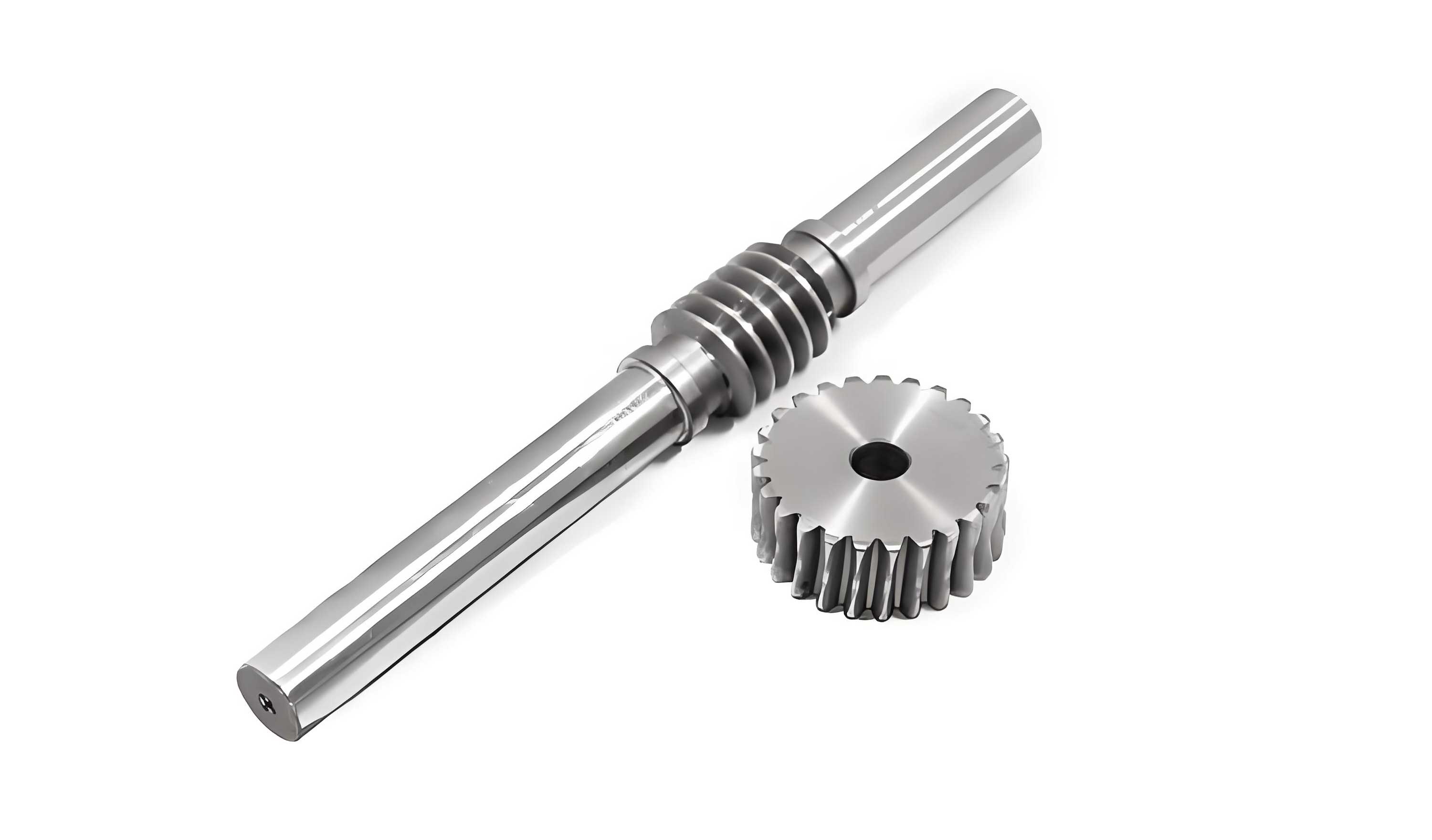
The current prevalent T-type power module for hanging machines typically features a single-stage transmission system. The motor shaft is often equipped with auxiliary braking components, such as friction brake discs and preload screws, to augment the locking torque. This design, as shown in the accompanying schematic, is necessitated by the inherent insufficiency of the worm gears‘ self-locking ability. Consequently, these additional components increase both complexity and cost. A fundamental question arises: Can the design be optimized to eliminate these auxiliary brakes by significantly strengthening the intrinsic self-locking property of the worm gears themselves, thereby achieving cost reduction and performance enhancement simultaneously?
To address this, a rigorous theoretical analysis of force transmission in worm gears under friction is essential. Standard mechanical design handbooks typically provide formulas for force transmission in worm gears neglecting friction. Therefore, we must derive the complete set of equations accounting for frictional forces to systematically analyze the self-locking condition.
Theoretical Derivation of Force Transmission in Worm Gears with Friction
1. Force on the Worm Wheel (F2)
The input force originates from the cable load, F2‘. This force acts on the winding drum, which is coaxial with the worm wheel. Analyzing the combined worm wheel and drum assembly, the moment equilibrium equation yields the circumferential force on the worm wheel’s pitch circle, F2:
$$ F_2 = F_2′ \cdot \frac{d_2′}{d_2} $$
where \( d_2′ \) is the diameter of the winding drum and \( d_2 \) is the pitch diameter of the worm wheel.
2. Lead Angle (γ) of the Worm
The direction of the normal contact force (Fn) between the worm and worm wheel is governed by the pressure angle (α, typically 20°) and the lead angle (γ). The lead angle is a critical design parameter. First, the module (m2) of the worm wheel is determined from its pitch diameter and number of teeth (Z2):
$$ m_2 = \frac{d_2}{Z_2} $$
The lead angle γ is then derived from the worm’s pitch diameter (d1) and the worm wheel module:
$$ \tan(\gamma) = \frac{Z_1 \cdot m_2}{d_1} $$
For a single-start worm, Z1 = 1, simplifying the formula to \( \tan(\gamma) = m_2 / d_1 \).
3. Forces During Motor Shutdown (Self-Sliding Condition)
The force distribution differs significantly between the motor-driven lifting phase and the static, power-off phase. When the motor is off, there is no electromagnetic torque. The worm has a tendency to rotate backward due to the load, a state we analyze as impending “self-sliding.” The forces on the worm gears during this condition are denoted with a subscript “sl” (slide).
The circumferential force on the worm during this state, F1,sl, is the difference between the tangential component of the contact force and the friction force opposing the sliding motion:
$$ F_{1,sl} = F_{n,sl} \cdot (\sin(\alpha_n) \cdot \cos(\gamma) – \mu \cdot \cos(\alpha_n) \cdot \cos(\gamma)) $$
The corresponding force on the worm wheel, F2,sl, is:
$$ F_{2,sl} = F_{n,sl} \cdot (\cos(\alpha_n) \cdot \sin(\gamma) + \mu \cdot \sin(\alpha_n) \cdot \sin(\gamma)) $$
Here, μ is the coefficient of friction between the worm and worm wheel materials, and αn is the normal pressure angle, approximately equal to α (20°).
Since the worm wheel force must balance the cable load regardless of the motor state, \( F_{2,sl} = F_2 \). Combining this with the equation for F2,sl, we can solve for the contact force during sliding:
$$ F_{n,sl} = \frac{F_2}{\cos(\alpha_n) \cdot \sin(\gamma) + \mu \cdot \sin(\alpha_n) \cdot \sin(\gamma)} $$
Substituting this back into the equation for F1,sl gives:
$$ F_{1,sl} = F_2 \cdot \frac{ \sin(\alpha_n) \cdot \cos(\gamma) – \mu \cdot \cos(\alpha_n) \cdot \cos(\gamma) }{ \cos(\alpha_n) \cdot \sin(\gamma) + \mu \cdot \sin(\alpha_n) \cdot \sin(\gamma) } $$
This simplifies to:
$$ F_{1,sl} = F_2 \cdot \frac{ \tan(\alpha_n) – \mu }{ 1 + \mu \cdot \tan(\alpha_n) } \cdot \cot(\gamma) $$
4. The Self-Locking Extra Torque (Tlock_extra)
To quantitatively assess the safety margin against self-sliding, we introduce the key concept of “Self-Locking Extra Torque,” Tlock_extra. This represents the external torque that must be applied to the worm shaft to initiate sliding when the system is in a self-locked state with friction at its maximum. A positive Tlock_extra indicates a secure lock with a safety margin; a value of zero represents the critical locking condition; a negative value implies the system will slide autonomously.
For a system with dual worm gears (common in T-modules for symmetric load distribution) and potential auxiliary brake discs, the total self-locking extra torque is the sum of contributions from both worm gears and the brakes, taken with a negative sign relative to the sliding direction torque on the worm shaft (Tworm).
$$ T_{lock\_extra} = -T_{worm} = -[ 2 \cdot (F_{1,sl} \cdot \frac{d_1}{2}) + T_{f\_brake\_load} + T_{f\_brake\_preload} ] $$
Substituting the expression for F1,sl and the relation \( F_2 = F_2′ \cdot (d_2′ / d_2) \), we arrive at the comprehensive formula:
$$ T_{lock\_extra} = – \left[ F_2′ \cdot \frac{d_2′}{d_2} \cdot d_1 \cdot \frac{ \tan(\alpha_n) – \mu }{ 1 + \mu \cdot \tan(\alpha_n) } \cdot \cot(\gamma) \right] – T_{f\_brake} $$
Where \( T_{f\_brake} = T_{f\_brake\_load} + T_{f\_brake\_preload} \). Furthermore, substituting \( \cot(\gamma) = d_1 / (Z_1 \cdot m_2) \) provides the formula in terms of fundamental design parameters:
$$ T_{lock\_extra} = – \left[ F_2′ \cdot \frac{d_2′}{d_2} \cdot \frac{d_1^2}{m_2} \cdot \frac{ \tan(\alpha_n) – \mu }{ 1 + \mu \cdot \tan(\alpha_n) } \right] – T_{f\_brake} $$
For the critical self-locking condition without brakes (Tf_brake=0, Tlock_extra=0), the equation reduces to the classical self-locking criterion: \( \mu \ge \tan(\gamma) \cdot \cos(\alpha_n) \), which for small αn approximates to \( \mu \ge \tan(\gamma) \). Our derived formula extends this binary condition into a quantifiable metric of locking strength.
Finite Element Analysis Validation
To validate the derived theoretical formula for Tlock_extra (specifically the contribution from the worm gears), a Finite Element Analysis (FEA) model was constructed. The model simulated a single tooth pair in contact between the worm and worm wheel. The worm wheel’s central axis was constrained, allowing only rotation, and was subjected to an input torque \( M_{input} = F_2′ \cdot d_2′ \). The worm shaft was subjected to an imposed angular displacement in the direction that would cause self-sliding. The FEA solver calculated the resulting reaction torque on the worm shaft required to induce this motion, denoted as Tworm\_sliding\_FEA. According to our definition, this calculated torque should be equal in magnitude but opposite in sign to the worm gears‘ contribution to Tlock_extra in the theoretical formula (i.e., the term inside the bracket before subtracting brake torque).
The materials were modeled with high stiffness to focus on kinematic and frictional constraints. A Coulomb friction model with μ=0.1 was applied at the tooth contact interface. The results of a representative calculation are summarized in the table below:
| Input Parameter | Symbol | Value |
|---|---|---|
| Cable Load | F2′ | 196.2 N |
| Winding Drum Diameter | d2′ | 44.8 mm |
| Worm Wheel Pitch Diameter | d2 | 54 mm |
| Worm Pitch Diameter | d1 | 7.5 mm |
| Pressure Angle | α | 20° |
| Friction Coefficient | μ | 0.1 |
| Comparison of Results | ||
| Theoretical Tlock_extra (Worm Gear Contribution) | – | 3.91 N·mm |
| FEA Result (Tworm_sliding_FEA) | – | 4.08 N·mm |
| Discrepancy | – | 4.66% |
The close agreement between the theoretical prediction and the FEA result, with a discrepancy of only 4.66%, strongly validates the correctness and reliability of the derived force transmission equations for worm gears under frictional self-locking analysis.
Design Optimization Strategies Based on the Theoretical Model
The validated formula for Tlock_extra provides a powerful tool for design optimization. To eliminate the auxiliary brake components, the intrinsic self-locking torque from the worm gears must be increased to match or exceed the total locking torque (worm gear + brake) of the original design. Analyzing the formula reveals four primary design parameters that directly influence Tlock_extra (for the worm gear portion):
- Winding Drum Diameter (d2′)
- Worm Wheel Pitch Diameter (d2)
- Worm Wheel Module (m2)
- Worm Pitch Diameter (d1)
We evaluated four distinct optimization strategies, each focusing on modifying one parameter while aiming to achieve the same target Tlock_extra as the original braked design. The feasibility of each strategy was assessed not only by the self-locking torque but also by its impact on the structural integrity and manufacturability of the worm gears.
| Design Parameter & Strategy | Original (with Brake) | Strategy 1: Increase d2′ | Strategy 2: Decrease d2 | Strategy 3: Decrease m2 | Strategy 4: Increase d1 |
|---|---|---|---|---|---|
| Winding Drum Diameter, d2′ (mm) | 44.8 | 211.5 | 44.8 | 44.8 | 44.8 |
| Worm Wheel Pitch Diameter, d2 (mm) | 54 | 54 | 11.4 | 54 | 54 |
| Worm Wheel Module, m2 (mm) | 0.75 | 0.75 | 0.75 | 0.569 | 0.75 |
| Worm Pitch Diameter, d1 (mm) | 7.5 | 7.5 | 7.5 | 7.5 | 9.2 |
| Calculated Worm Wheel Force, F2 (N) | 162.8 | 768.5 | 771.0 | 162.8 | 162.8 |
| Friction Coefficient, μ | 0.1 | 0.1 | 0.1 | 0.1 | 0.1 |
| Target Self-Locking Extra Torque, Tlock_extra (N·mm) | 18.5 | 18.5 | 18.5 | 18.5 | 18.5 |
| Feasibility & Rationale | Uses brake, high cost. | Not Feasible. Drastic increase in d2′ massively increases F2, leading to probable tooth shear/bending failure. | Not Feasible. Severe reduction in d2 drastically increases F2 and reduces space for teeth, causing strength and manufacturing issues. | Not Feasible. Reduction in m2 significantly weakens tooth bending strength (∝ m23), risking tooth fracture under load. | Feasible & Optimal. Modest increase in d1 (22.7%) achieves target. Maintains all other forces and strength parameters. Simplest manufacturing change. |
The analysis presented in the table leads to a clear conclusion. Strategies 1 and 2 are impractical because they require extreme changes that multiply the force on the worm gears‘ teeth (F2) by a factor of nearly five, inevitably causing structural failure. Strategy 3 critically weakens the tooth profile. In contrast, Strategy 4—increasing the worm pitch diameter (d1)—is the most effective and elegant solution. It leverages the quadratic relationship \( T_{lock\_extra} \propto d_1^2 \) in the formula. A relatively modest increase in d1 (from 7.5 mm to 9.2 mm in this case) yields the required boost in self-locking torque without adversely affecting the stress state on the worm gears‘ teeth, the overall gear ratio, or the basic geometry of the worm wheel. This change is also straightforward to implement in manufacturing.
Conclusion
This study provides a systematic and in-depth engineering analysis of self-locking performance in T-type power modules utilizing worm gears for electric hanging machines. By introducing the quantitative metric of “Self-Locking Extra Torque” and deriving its governing formula from first principles, we have moved beyond the traditional binary view of self-locking. The formula was successfully validated against Finite Element Analysis, confirming its accuracy for modeling the complex frictional interactions in worm gears.
The practical application of this theoretical model enabled a comparative evaluation of four potential design optimization paths. The analysis conclusively identified that increasing the worm pitch diameter (d1) is the most viable, effective, and efficient strategy to enhance the intrinsic self-locking capability of the worm gears. This approach allows for the elimination of auxiliary braking components like friction discs and preload screws, thereby reducing cost, simplifying assembly, and improving long-term reliability by removing wear-prone parts.
This work exemplifies the significant value of model-based forward design and simulation-driven development in the appliance industry. It demonstrates how transitioning from traditional trial-and-error methods to a foundation of solid engineering mechanics and computational verification can lead to optimized, robust, and cost-effective product solutions. The methodology and findings related to worm gears are widely applicable to other mechanical systems where reliable self-locking and compact power transmission are critical requirements.