
The relentless pursuit of higher accuracy in multi-axis CNC machine tools places stringent demands on their core functional components. Among these, the precision rotary table is paramount, as its operational accuracy and stability directly govern the machining precision of the entire machine. For worm gear-driven rotary tables, ubiquitous in high-precision applications, uncertainties in assembly parameters—such as center distance deviation, mid-plane offset, shaft intersection angle error, and variable loading conditions—can significantly degrade transmission accuracy. While existing research has applied multi-body system theory to model machine tools and rotary tables, a comprehensive quantitative analysis of error sources specific to the worm gear transmission chain within a rotary table, coupled with a systematic methodology for precision allocation, remains an area for deeper exploration. This article, therefore, presents a thorough investigation into the precision design of worm gear rotary tables. We will establish a complete mathematical framework for error propagation based on multi-body system theory, perform a detailed sensitivity analysis to identify the principal error contributors, and demonstrate a practical application of this methodology to achieve a targeted improvement in performance.
1. Introduction and Background
The performance of a precision worm gear rotary table is a symphony orchestrated by the interplay of numerous geometric and kinematic parameters. Traditional design approaches often rely on empirical rules or isolated analyses of components like the worm and worm wheel pair. However, the final positioning error of the table is the cumulative result of errors originating from every element in the kinematic chain: from the motor mount and the worm shaft bearings to the worm wheel itself, the connecting mechanism, and finally the worktable. To control and optimize this overall accuracy effectively, a holistic model that captures the spatial relationship and error transfer between all these bodies is essential.
Multi-body system (MBS) theory provides a powerful and generalized framework for this purpose. It allows any complex mechanical system to be abstracted into a collection of rigid or flexible bodies connected by joints, with the topological structure clearly defined by low-order body arrays. Prior research has successfully applied MBS theory to model the geometric errors of multi-axis machine tools and simulation turntables. Studies have focused on establishing volumetric error models for five-axis machines, analyzing the reliability of double-worm gear drives, and identifying key error sources in triaxial test platforms through sensitivity analysis. Others have proposed cost-accuracy optimization methods for direct-drive tables and error compensation strategies based on established models.
Despite these advances, a focused application of MBS theory to deconstruct the entire error propagation path within a worm gear-driven precision rotary table, leading to a quantifiable and sensitivity-driven precision design process, is less common. This study aims to bridge that gap. We begin by analyzing the specific transmission architecture of a horizontal machining center’s worm gear rotary table. Subsequently, a multi-body topological model is constructed, and the complete spatial error transfer model is derived mathematically. Using the function differential method, we conduct a comprehensive sensitivity analysis to pinpoint the error sources with the greatest influence on the table’s final positional inaccuracy. Finally, this methodology is applied to a real-world precision upgrade project, with the design calculations and experimental validation confirming the efficacy of the proposed approach.
2. Worm Gear Rotary Table Transmission System
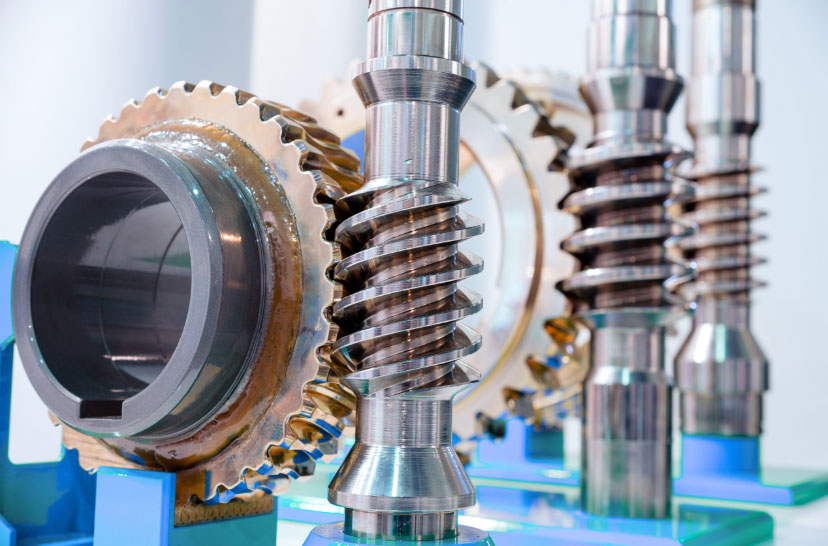
The core transmission system of the precision worm gear rotary table under investigation, typical for a horizontal machining center, consists of several key subsystems arranged in a serial kinematic chain. The primary power flow initiates from a servo motor rigidly fixed to a mounting sled or base. This motor is directly coupled to the worm shaft, forming the input drive. The worm engages with the worm wheel, which is mounted on a shaft that also carries an anti-backlash mechanism. This anti-backlash mechanism, in turn, engages with a face gear or a large-diameter internal gear connected directly to the rotary worktable.
For the purpose of error modeling, the system is logically partitioned into the following consecutive bodies or subsystems:
- Sled/Base System (Body K0): The fixed reference mounting platform for the motor.
- Worm Shaft System (Body K1): Includes the motor output flange, coupling, and the worm shaft with its supporting bearings. Its axis of rotation is defined.
- Worm Wheel System (Body K2): Comprises the worm wheel and the anti-backlash mechanism shaft. It rotates about an axis perpendicular to the worm shaft axis (in a standard configuration).
- Worktable System (Body K3): The rotary worktable itself, connected to the worm wheel system’s output.
- Payload (Body K4): The load or tooling mounted on the worktable.
The accuracy transmission path is therefore sequential: Sled System → Worm Shaft System → Worm Wheel System → Worktable System → Payload. Any geometric deviation or motion error in any of these bodies propagates along this chain, culminating in a positional error at the payload.
3. Multi-body Topological Model and Error Modeling
3.1 Topological Structure of the Precision Turntable
Based on multi-body system theory, the worm gear rotary table is abstracted as an open-chain system. A coordinate system is attached to each body in the sequence. Let \( K_n \) (where \( n = 0, 1, 2, 3, 4 \)) represent the coordinate systems attached to the Sled, Worm Shaft, Worm Wheel, Worktable, and Payload bodies, respectively. The origin of \( K_0 \) is considered the inertial reference frame. The topological structure is linear, as shown in the conceptual model, where each body moves relative to its predecessor.
The fundamental relationship in MBS describes how a point \( P \) defined in the coordinate system of body \( K_j \) is expressed in the coordinate system of body \( K_i \). The general transformation is given by:
$$ {^i\mathbf{P}} = \mathbf{T}_{i,j}^{P} \cdot \mathbf{T}_{i,j}^{PE} \cdot \mathbf{T}_{i,j}^{S} \cdot \mathbf{T}_{i,j}^{SE} \cdot {^j\mathbf{P}} $$
Where:
- \( \mathbf{T}_{i,j}^{P} \): Ideal relative position transformation matrix from \( K_j \) to \( K_i \).
- \( \mathbf{T}_{i,j}^{PE} \): Relative position error transformation matrix (static geometric errors like perpendicularity).
- \( \mathbf{T}_{i,j}^{S} \): Ideal relative motion transformation matrix (nominal rotation).
- \( \mathbf{T}_{i,j}^{SE} \): Relative motion error transformation matrix (errors like axis tilt and radial runout during motion).
For adjacent bodies whose relative positions are fixed by design, the ideal position matrix is typically a \( 3 \times 3 \) identity matrix \( \mathbf{I}_{3\times3} \) if origins are aligned, or a constant translation matrix.
3.2 Formulation of the Error Model for the Worm Gear Assembly
The errors are categorized based on their nature and the bodies they affect. The key error sources for the worm gear rotary table are summarized in the table below. The notation \( \varepsilon_{a}^{b}(c) \) represents a perpendicularity (squareness) error of axis \( b \) of the lower body with respect to axis \( a \) of the higher body, where \( c \) indicates the nominal axis of rotation for the lower body. The notation \( \delta_{a}(c) \) represents an angular motion error (tilt) of the rotating body around its nominal axis \( c \), projected onto the \( a \)-axis direction.
| Error Category | Error Sources |
|---|---|
| Perpendicularity (Squareness) Errors | \( \varepsilon_{x0}(y1),\ \varepsilon_{z0}(y1),\ \varepsilon_{x1}(z2),\ \varepsilon_{y1}(z2),\ \varepsilon_{x2}(z3),\ \varepsilon_{y2}(z3) \) |
| Angular Motion (Tilt) Errors | \( \delta_{x}(y1),\ \delta_{z}(y1),\ \delta_{x}(z2),\ \delta_{y}(z2),\ \delta_{y}(z3),\ \delta_{x}(z3) \) |
| Radial Motion (Position) Errors | \( \delta_{y}(y1),\ \delta_{z}(z2),\ \delta_{z}(z3) \) |
| Payload Mounting Errors | \( \sigma_{x}(x4),\ \sigma_{z}(z4),\ \sigma_{y}(y4) \) |
Using the small-angle approximation, the transformation matrices between adjacent bodies are developed. Let \( \alpha, \beta, \gamma \) represent the rotation angles of the Worm Shaft system (K1), Worm Wheel system (K2), and Worktable system (K3), respectively. The function \( \text{rot}(\mathbf{n}, \theta) \) denotes a rotation matrix about an axis \( \mathbf{n} \) by an angle \( \theta \).
Transformation from Sled (K0) to Worm Shaft (K1):
The Worm Shaft rotates nominally about the y-axis of K0. Its errors include perpendicularity of its axis and motion errors.
$$
\begin{aligned}
\mathbf{T}_{01}^{P} &= \mathbf{I}_{3\times3} \\
\mathbf{T}_{01}^{PE} &= \text{rot}(x_0, \varepsilon_{x0}(y1)) \cdot \text{rot}(z_0, \varepsilon_{z0}(y1)) \\
\mathbf{T}_{01}^{S} &= \text{rot}(y_0, \alpha) \\
\mathbf{T}_{01}^{SE} &= \text{rot}(x_0, \delta_{x}(y1)) \cdot \text{rot}(y_0, \delta_{y}(y1)) \cdot \text{rot}(z_0, \delta_{z}(y1))
\end{aligned}
$$
Transformation from Worm Shaft (K1) to Worm Wheel (K2):
The Worm Wheel rotates nominally about the z-axis of K1.
$$
\begin{aligned}
\mathbf{T}_{12}^{P} &= \mathbf{I}_{3\times3} \\
\mathbf{T}_{12}^{PE} &= \text{rot}(x_1, \varepsilon_{x1}(z2)) \cdot \text{rot}(y_1, \varepsilon_{y1}(z2)) \\
\mathbf{T}_{12}^{S} &= \text{rot}(z_1, \beta) \\
\mathbf{T}_{12}^{SE} &= \text{rot}(x_1, \delta_{x}(z2)) \cdot \text{rot}(y_1, \delta_{y}(z2)) \cdot \text{rot}(z_1, \delta_{z}(z2))
\end{aligned}
$$
Transformation from Worm Wheel (K2) to Worktable (K3):
The Worktable rotates nominally about the z-axis of K2.
$$
\begin{aligned}
\mathbf{T}_{23}^{P} &= \mathbf{I}_{3\times3} \\
\mathbf{T}_{23}^{PE} &= \text{rot}(x_2, \varepsilon_{x2}(z3)) \cdot \text{rot}(y_2, \varepsilon_{y2}(z3)) \\
\mathbf{T}_{23}^{S} &= \text{rot}(z_2, \gamma) \\
\mathbf{T}_{23}^{SE} &= \text{rot}(x_2, \delta_{x}(z3)) \cdot \text{rot}(y_2, \delta_{y}(z3)) \cdot \text{rot}(z_2, \delta_{z}(z3))
\end{aligned}
$$
Transformation from Worktable (K3) to Payload (K4):
The Payload is fixed to the worktable, so there is no nominal motion, but static mounting misalignments exist.
$$
\begin{aligned}
\mathbf{T}_{34}^{P} &= \mathbf{I}_{3\times3} \\
\mathbf{T}_{34}^{PE} &= \text{rot}(x_3, \sigma_{x}(x4)) \cdot \text{rot}(y_3, \sigma_{y}(y4)) \cdot \text{rot}(z_3, \sigma_{z}(z4)) \\
\mathbf{T}_{34}^{S} &= \mathbf{I}_{3\times3} \\
\mathbf{T}_{34}^{SE} &= \mathbf{I}_{3\times3}
\end{aligned}
$$
The overall ideal transformation from the inertial frame (K0) to the Payload frame (K4) is:
$$ \mathbf{T}_{ide} = \prod_{i=0}^{3} \left( \mathbf{T}_{i(i+1)}^{P} \cdot \mathbf{T}_{i(i+1)}^{S} \right) $$
The overall actual transformation, incorporating all errors, is:
$$ \mathbf{T}_{act} = \prod_{i=0}^{3} \left( \mathbf{T}_{i(i+1)}^{P} \cdot \mathbf{T}_{i(i+1)}^{PE} \cdot \mathbf{T}_{i(i+1)}^{S} \cdot \mathbf{T}_{i(i+1)}^{SE} \right) $$
To evaluate the positioning error, consider a point vector along the payload’s axis. In the payload coordinate system K4, let this axis vector be \( \mathbf{e} = [0, 0, 1]^T \). Its representation in the inertial frame K0 under ideal and actual conditions is:
$$
\begin{aligned}
\mathbf{P}_{ide} &= \mathbf{T}_{ide} \cdot \mathbf{e} \\
\mathbf{P}_{act} &= \mathbf{T}_{act} \cdot \mathbf{e}
\end{aligned}
$$
The error vector \( \boldsymbol{\mu} \), representing the deviation of the actual payload axis from its ideal position, is then:
$$ \boldsymbol{\mu} = \begin{bmatrix} \mu_x \\ \mu_y \\ \mu_z \end{bmatrix} = \mathbf{P}_{act} – \mathbf{P}_{ide} $$
where \( \mu_x, \mu_y, \mu_z \) are the error components along the X, Y, and Z axes of the inertial reference frame (K0). Substituting all the transformation matrices (Eqs. 2-8) into this equation yields the complete mathematical model for the transmission error of the worm gear precision rotary table as a function of all geometric and motion errors and the rotation angles \( \alpha, \beta, \gamma \).
4. Sensitivity Analysis of Error Sources and Precision Design Methodology
4.1 Sensitivity Analysis via the Function Differential Method
The derived error model \( \boldsymbol{\mu} = f(\theta_1, \theta_2, …, \theta_n) \) is a complex multivariate function, where \( \theta_i \) represents each of the individual error sources listed in Table 1. To allocate tolerances effectively and optimize the design for both precision and cost, it is crucial to understand the influence, or sensitivity, of each error source on the final output error \( \boldsymbol{\mu} \).
The function differential method is employed for this sensitivity analysis. Considering small variations, the total differential of the error function approximates the combined effect:
$$ \Delta \boldsymbol{\mu} \approx \sum_{i=1}^{n} \frac{\partial \boldsymbol{\mu}}{\partial \theta_i} \cdot \Delta \theta_i $$
The sensitivity coefficient \( \mathbf{S}_i \) for error source \( \theta_i \) is defined as its partial derivative, evaluated ideally when all other errors are zero:
$$ \mathbf{S}_i = \left. \frac{\partial \boldsymbol{\mu}}{\partial \theta_i} \right|_{\theta_j=0,\ \forall j \neq i} $$
This coefficient is a vector \( [S_{i,x}, S_{i,y}, S_{i,z}]^T \), indicating how strongly \( \theta_i \) affects each component of the final error. To compare the overall influence across different errors, a normalized sensitivity magnitude is calculated. First, the magnitude of each sensitivity vector’s effect over a full range of table motion (e.g., a cycle of \( \alpha, \beta, \gamma \)) is averaged. Then, a normalized sensitivity coefficient \( \lambda_i \) for a specific error component (e.g., \( \mu_x \)) is computed as:
$$ \lambda_{i, \mu_k} = \frac{ | \bar{S}_{i, \mu_k} | }{ \sum_{j=1}^{m} | \bar{S}_{j, \mu_k} | } \quad (k = x, y, z) $$
where \( \bar{S}_{i, \mu_k} \) is the average sensitivity magnitude for error \( \theta_i \) on component \( \mu_k \) over the operational cycle, and the sum is over all \( m \) error sources affecting that component.
Applying this analysis to the worm gear rotary table model yields the sensitivity coefficients. The table below summarizes the functional form of the sensitivity (partial derivative) for each error source. It is important to note that the influence of an error often depends on the rotational position (\( \alpha, \beta, \gamma \)).
| Error Source | Sensitivity on \( \mu_x \) | Sensitivity on \( \mu_y \) | Sensitivity on \( \mu_z \) |
|---|---|---|---|
| \( \varepsilon_{x0}(y1) \) | 0 | \( \sin\alpha\cos\beta \) | \( \sin\beta \) |
| \( \varepsilon_{z0}(y1) \) | \( -\sin\beta \) | \( -\cos\alpha\cos\beta \) | 0 |
| \( \varepsilon_{x1}(z2) \) | 0 | \( \cos\alpha\sin\beta \) | \( -\sin\alpha\sin\beta \) |
| \( \varepsilon_{y1}(z2) \) | 0 | \( \cos\alpha\cos\beta \) | \( -\sin\alpha\cos\beta \) |
| \( \varepsilon_{x2}(z3) \) | \( -\cos\alpha \) | \( -\sin\alpha\sin\beta \) | \( -\cos\alpha\sin\beta \) |
| \( \varepsilon_{y2}(z3) \) | 0 | \( \cos\alpha \) | \( -\sin\alpha \) |
| \( \delta_{x}(y1) \) | \( -\sin\alpha \) | \( \cos\alpha \) | 0 |
| \( \delta_{y}(y1) \) | 0 | 0 | 0 |
| \( \delta_{z}(y1) \) | 0 | \( -\sin\alpha\sin\beta \) | \( -\cos\beta \) |
| \( \delta_{x}(z2) \) | \( -\sin\alpha \) | \( \cos\alpha \) | 0 |
| \( \delta_{y}(z2) \) | \( \cos\beta \) | \( -\sin\alpha\sin\beta \) | \( -\cos\beta \) |
| \( \delta_{z}(z2) \) | 0 | 0 | 0 |
| \( \delta_{x}(z3) \) | \( \sin\alpha\sin\gamma + \cos\alpha\sin\beta\cos\gamma \) | \( \cos\alpha\sin\gamma + \sin\alpha\sin\beta\cos\gamma \) | \( \cos\beta\sin\gamma \) |
| \( \delta_{y}(z3) \) | \( -\sin\alpha\cos\gamma – \cos\alpha\sin\beta\sin\gamma \) | \( \cos\alpha\cos\gamma – \sin\alpha\sin\beta\sin\gamma \) | \( -\cos\beta\sin\gamma \) |
| \( \delta_{z}(z3) \) | 0 | 0 | 0 |
| \( \sigma_{x}(x4) \) | \( \sin\alpha\sin\gamma + \cos\alpha\sin\beta\cos\gamma \) | \( \cos\alpha\sin\gamma + \sin\alpha\sin\beta\cos\gamma \) | \( \cos\beta\sin\gamma \) |
| \( \sigma_{y}(y4) \) | \( -\sin\alpha\cos\gamma – \cos\alpha\sin\beta\sin\gamma \) | \( \cos\alpha\cos\gamma – \sin\alpha\sin\beta\sin\gamma \) | \( -\cos\beta\sin\gamma \) |
| \( \sigma_{z}(z4) \) | 0 | 0 | 0 |
By computing the average normalized sensitivity coefficients \( \lambda \) over a representative work cycle, the key error influencers are clearly identified. For instance, analysis shows that:
- For the X-direction error (\( \mu_x \)): The worktable tilt error \( \delta_{x}(z3) \) and the payload mounting error \( \sigma_{x}(x4) \) are dominant, collectively accounting for a very large percentage of the total sensitivity.
- For the Y-direction error (\( \mu_y \)): Multiple error sources have high sensitivity, including several perpendicularity errors (\( \varepsilon_{z0}(y1), \varepsilon_{y1}(z2), \varepsilon_{x2}(z3) \)) and angular motion errors (\( \delta_{z}(y1), \delta_{y}(z2), \delta_{y}(z3) \)), along with the payload mounting error \( \sigma_{y}(y4) \).
- For the Z-direction error (\( \mu_z \)): The perpendicularity errors \( \varepsilon_{x1}(z2) \) and \( \varepsilon_{y2}(z3) \), along with the motion errors \( \delta_{x}(z3) \) and \( \delta_{y}(z3) \), and the payload error \( \sigma_{x}(x4) \) are the principal contributors.
This sensitivity analysis provides a quantitative roadmap. It tells the designer which error parameters in the worm gear drive and associated systems must be controlled most rigorously to achieve a desired overall accuracy level.
4.2 Application to Precision Design: A Case Study
To validate the methodology, it was applied to upgrade an existing worm gear rotary table for a new, more stringent precision requirement. The key technical parameters and design targets are compared below.
| Parameter | Original Specification | New Design Target |
|---|---|---|
| Table Size (mm) | 630 × 630 | 630 × 630 |
| Shaft Perpendicularity Error (arcsec) | 5 | 3 |
| Rotary Error (axial/radial tilt) (arcsec) | 8 | 4 |
Using the error model and the insights from sensitivity analysis, the allowable values for each individual error source were calculated via an optimization process that ensured the final aggregated error met the new targets. The calculated (allocated) tolerances for critical error sources are listed below. These values were derived by working backwards from the system-level error budget, giving stricter tolerances to the high-sensitivity errors identified earlier.
| Error Item / Subsystem | Error Source | Calculated Allocation (arcsec) | Design Target Limit (arcsec) |
|---|---|---|---|
| Worm Shaft Perpendicularity | \( \varepsilon_{x0}(y1) \) | 2.9 | 3 |
| \( \varepsilon_{z0}(y1) \) | 0.1 | ||
| Worm Wheel Perpendicularity | \( \varepsilon_{x1}(z2) \) | 2.898 | 3 |
| \( \varepsilon_{y1}(z2) \) | 0.102 | ||
| Worktable Perpendicularity | \( \varepsilon_{x2}(z3) \) | 0.1 | 3 |
| \( \varepsilon_{y2}(z3) \) | 2.9 | ||
| Worm Shaft Rotary Error | \( \delta_{x}(y1) \) | 2.281 | 4 |
| \( \delta_{y}(y1) \) | 2.243 | ||
| \( \delta_{z}(y1) \) | 0.476 | ||
| Worm Wheel Rotary Error | \( \delta_{x}(z2) \) | 0.094 | 4 |
| \( \delta_{y}(z2) \) | 0.07 | ||
| \( \delta_{z}(z2) \) | 3.562 | ||
| Worktable Rotary Error | \( \delta_{x}(z3) \) | 0.11 | 4 |
| \( \delta_{y}(z3) \) | 0.11 | ||
| \( \delta_{z}(z3) \) | 3.78 |
The allocation clearly reflects the sensitivity analysis. For example, errors with lower sensitivity (like \( \varepsilon_{z0}(y1) \), \( \delta_{z}(z2) \)) are allowed to be larger (closer to the system target), while high-sensitivity errors (like \( \varepsilon_{x0}(y1) \), \( \varepsilon_{y2}(z3) \), \( \delta_{x}(y1) \)) are allocated much tighter portions of the total error budget. This intelligent distribution ensures the design goal is met without imposing unnecessarily strict and costly tolerances on every component.
4.3 Experimental Validation of the Precision Design
A prototype worm gear rotary table was manufactured and assembled according to the precision design specifications derived above. It was then installed on a horizontal machining center testbed for performance validation. The rotary accuracy—comprising positioning accuracy and repeatability—was measured using a high-precision laser interferometer system (e.g., Renishaw XM-60) with a wireless rotary axis calibrator (e.g., XR-20). The test involved commanding the table through a full 360-degree rotation, taking measurements at 30-degree intervals. Data was collected over multiple cycles to ensure statistical significance.
The results were processed and plotted. The polar plot of positioning accuracy showed a periodic pattern consistent with error harmonics from the worm gear meshing. The maximum recorded positioning error was 3.9 arcseconds, and the maximum repeatability error was 3.0 arcseconds. Both values were well within the design target of 4 arcseconds for rotary error, representing a performance improvement of over 40% compared to the original specification. This successful experimental outcome confirms the validity and practical utility of the multi-body system theory-based error modeling and sensitivity-driven precision design methodology for worm gear rotary tables.
5. Conclusion
This study has presented a systematic and quantitative framework for the precision design of worm gear-driven rotary tables. By leveraging multi-body system theory, a comprehensive mathematical model describing the spatial propagation of geometric and motion errors through the entire transmission chain—from the motor base to the payload—was developed. The subsequent application of the function differential method enabled a rigorous sensitivity analysis, which successfully identified the error sources with the greatest impact on the final table inaccuracy. This analysis moves beyond qualitative assessment, providing designers with a clear prioritization list for tolerance control.
The practical application of this methodology to a real-world precision upgrade project demonstrated its effectiveness. By allocating tolerances based on calculated sensitivity coefficients, a new set of component-level specifications was generated. The subsequent manufacture and testing of a prototype table confirmed that the system-level accuracy targets were met, with a significant improvement over the previous design. The integration of error modeling, sensitivity analysis, and precision allocation into a cohesive workflow provides a powerful theoretical foundation for optimizing the performance of worm gear rotary tables. This approach ensures a balanced design that achieves high accuracy without incurring excessive cost from universally tight tolerances. The principles and methods outlined here are not limited to worm gear tables and can serve as a valuable reference for the precision design of other complex mechanical transmission systems and robotic mechanisms.