
In the field of precision optical instrumentation, particularly for systems requiring accurate rotary scanning motions, the selection and design of transmission components are critical. Among these, worm gear drives are frequently employed due to their inherent advantages: compactness, high reduction ratios, smooth operation, and self-locking capability. However, traditional design approaches for worm gears often focus on single performance criteria, leading to compromises in other essential aspects. In practical engineering applications, such as in atmospheric monitoring spectrometers or other optical scanning devices, the transmission system must simultaneously meet multiple, often conflicting, requirements. These include minimizing the overall size and weight of the mechanism, maximizing transmission efficiency to reduce power consumption and heat generation, and ensuring high durability against failure modes like pitting and wear. The conventional iterative design process struggles to balance these objectives effectively. Therefore, a systematic multi-objective optimization framework is necessary to derive a design that represents the best possible compromise tailored to specific application priorities.
This article presents a comprehensive methodology for the multi-objective optimal design of worm gear pairs. I will establish a mathematical model that formalizes the design problem, define the critical performance objectives, and apply a weighted optimization strategy to find solutions. The core of the approach lies in translating engineering intuition—regarding which performance aspects are most vital for a given operating environment—into quantitative weight factors that guide the optimization algorithm. To demonstrate the method’s validity and flexibility, I will analyze optimization results for several distinct application scenarios. Furthermore, a detailed structural analysis of an optimized worm shaft will be conducted to verify that the proposed design satisfies all mechanical integrity requirements. Throughout this discussion, the term worm gears will be frequently referenced, underscoring their central role in this engineering challenge.
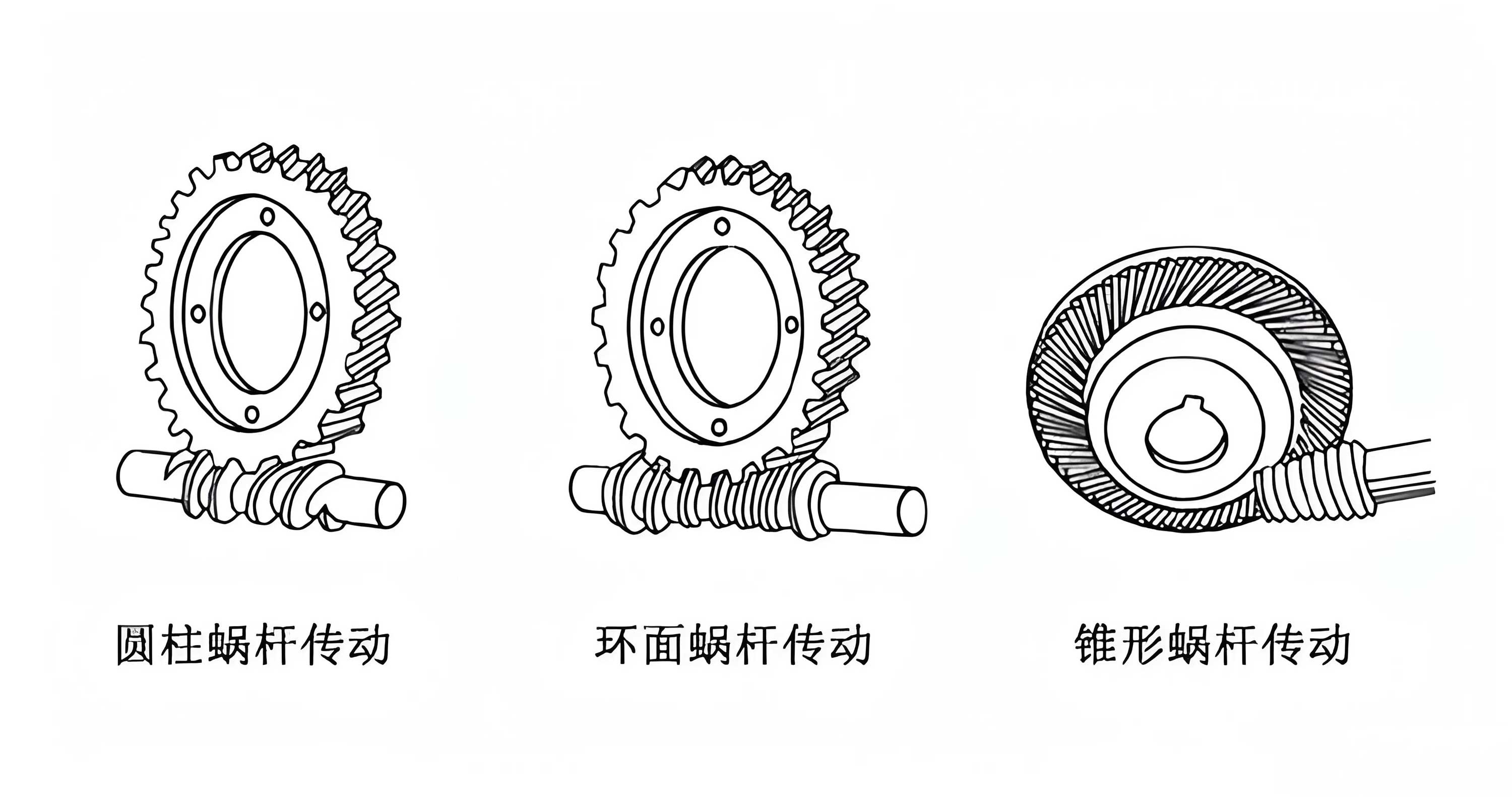
The fundamental geometry of a worm gear set is defined by several key parameters. For a standard cylindrical worm and gear pair, the primary design variables are the module (m), the number of worm threads or starts (z₁), the diametral quotient or diameter factor (q), and the face width of the worm gear (b). The center distance (a), a direct indicator of the drive’s spatial footprint, is a function of these variables: $$a = \frac{m}{2}(q + z_2) = \frac{m}{2}(q + u \cdot z_1)$$ where $z_2$ is the number of teeth on the worm gear and $u$ is the transmission ratio ($u = z_2 / z_1$). The choice of these parameters directly influences all performance metrics. For instance, a larger module generally increases strength but also size and weight. A higher number of worm starts can improve efficiency but may complicate manufacturing. The design of worm gears thus involves navigating this complex parameter space.
To frame this as an optimization problem, I define the vector of design variables as: $$\mathbf{X} = [x_1, x_2, x_3, x_4]^T = [m, z_1, q, b]^T$$ The next step is to formulate the objective functions that quantify the desired performance characteristics. Four key objectives are considered:
1. Minimization of Drive Volume (F₁): A compact design is crucial for instruments where space is limited. Minimizing the center distance serves as a effective proxy for minimizing the overall volume occupied by the worm gear set. Therefore, the first objective function is: $$F_1(\mathbf{X}) = a = 0.5m(q + u z_1)$$
2. Minimization of Total Mass (F₂): Reducing mass is important for portable devices, airborne platforms, and for minimizing inertial loads. The total mass can be approximated by summing the masses of the worm and the gear. The worm is often steel, while the gear is typically made from a bronze alloy for wear resistance. The objective function is: $$F_2(\mathbf{X}) = \frac{\pi}{4} \rho_1 m^2 (u z_1)^2 b + \frac{\pi}{4} \rho_2 m^2 q^2 l$$ where $\rho_1$ and $\rho_2$ are the densities of the gear and worm materials, respectively, and $l$ is the length of the worm’s threaded portion, approximated as $l \approx 2.5m\sqrt{z_2} = 2.5m\sqrt{u z_1}$.
3. Maximization of Transmission Efficiency (F₃): The efficiency of worm gears, especially when the worm is the driver, is largely determined by the friction in the gear mesh. The efficiency $\eta$ for a worm-driving scenario is given by: $$\eta = \frac{\tan \gamma}{\tan(\gamma + \varphi_v)}$$ where $\gamma$ is the lead angle ($\tan \gamma = z_1 / q$) and $\varphi_v$ is the equivalent friction angle ($\varphi_v = \arctan f_v$, with $f_v$ being the equivalent coefficient of friction). To convert the maximization of $\eta$ into a minimization problem, I use the inverse of the friction-related component as the objective function: $$F_3(\mathbf{X}) = \frac{\tan(\gamma + \varphi_v)}{0.955 \tan \gamma}$$ The constant 0.955 accounts for additional minor losses like bearing friction. A lower value of $F_3$ corresponds to higher efficiency.
4. Maximization of Resistance to Surface Pitting (F₄): For worm gears with bronze wheels, surface fatigue (pitting) is a common failure mode. The contact stress $\sigma_H$ at the mesh is calculated using a simplified Hertzian formula: $$\sigma_H = Z_E Z_\rho \sqrt{\frac{K T_2}{a^3}}$$ where $Z_E$ is the elastic coefficient of the materials, $Z_\rho$ is a contact geometry factor, $K$ is the load factor, and $T_2$ is the output torque on the worm gear. To maximize pitting resistance, we need to minimize the contact stress. Thus, the fourth objective function is simply the contact stress formula: $$F_4(\mathbf{X}) = Z_E Z_\rho \sqrt{\frac{K T_2}{a^3}}$$
Any viable design must also satisfy a set of constraints dictated by mechanical strength, geometry, and manufacturing considerations. These constraints are formulated as inequalities $G_j(\mathbf{X}) \le 0$:
Bending Strength Constraint: The bending stress in the worm gear tooth must be below the allowable limit $[\sigma_F]$. $$G_1(\mathbf{X}) = \frac{1.53 K T_2 Y_{Fa2} Y_\beta}{m^3 q z_2 [\sigma_F]} – 1 \le 0$$ Here, $Y_{Fa2}$ is the tooth form factor and $Y_\beta$ is the helix angle factor.
Contact Strength Constraint: The calculated contact stress must not exceed the allowable contact stress $[\sigma_H]$. $$G_2(\mathbf{X}) = \frac{\sigma_H}{[\sigma_H]} – 1 = \frac{Z_E Z_\rho}{[\sigma_H]} \sqrt{\frac{K T_2}{a^3}} – 1 \le 0$$
Parameter Range Constraints: These ensure practical and manufacturable designs.
$$G_3(\mathbf{X}) = m_{min} – m \le 0, \quad G_4(\mathbf{X}) = m – m_{max} \le 0 \quad \text{(Module bounds)}$$
$$G_5(\mathbf{X}) = q_{min} – q \le 0, \quad G_6(\mathbf{X}) = q – q_{max} \le 0 \quad \text{(Diametral quotient bounds)}$$
$$G_7(\mathbf{X}) = z_{1,min} – z_1 \le 0 \quad \text{(Minimum worm starts)}$$
$$G_8(\mathbf{X}) = 0.67m(q+2) – b \le 0, \quad G_9(\mathbf{X}) = b – 0.75m(q+2) \le 0 \quad \text{(Gear width bounds)}$$
$$G_{10}(\mathbf{X}) = \frac{z_1}{q} – \tan \gamma_{max} \le 0 \quad \text{(Maximum lead angle for manufacturability)}$$
With multiple objectives, a single solution that minimizes all functions simultaneously rarely exists. The set of optimal solutions is called the Pareto front. To find a single preferred solution for engineering implementation, I employ the linear weighted sum method. This method aggregates the multiple objectives into a single scalar evaluation function $U(\mathbf{X})$: $$U(\mathbf{X}) = \sum_{i=1}^{4} w_i \cdot \frac{F_i(\mathbf{X})}{F_i^*}$$ where $F_i^*$ is the ideal minimum value of the $i$-th objective function found by minimizing it individually (subject to constraints), and $w_i$ is the weight coefficient assigned to that objective, with $\sum w_i = 1$. Normalizing each objective by its ideal value $F_i^*$ removes the influence of differing units and scales, allowing for a fair summation. The weights $w_i$ are not arbitrary; they quantitatively reflect the relative importance of each performance objective for a specific application context.
The assignment of weight coefficients is a crucial step that links engineering judgment to mathematical optimization. For example, in a space-borne optical instrument (e.g., a satellite-mounted spectrometer), minimizing mass might be paramount due to extreme launch costs, while for a ground-based stationary monitor, durability and pitting resistance could be the primary concern. I define three illustrative application environments and assign qualitative importance scores (on a scale) to each objective, which are then normalized to obtain the weights $w_i$.
| Application Environment | Importance of Compactness (F₁) | Importance of Low Mass (F₂) | Importance of High Efficiency (F₃) | Importance of Pitting Resistance (F₄) |
|---|---|---|---|---|
| Ground-Based Station | 38 | 22 | 14 | 62 |
| Airborne Platform | 40 | 29 | 63 | 59 |
| Space-Borne Platform | 62 | 74 | 28 | 67 |
The normalized weight coefficients are calculated as $w_i = \lambda_i / \sum \lambda_i$, where $\lambda_i$ are the importance scores from the table above.
| Application Environment | $w_1$ (Volume) | $w_2$ (Mass) | $w_3$ (Efficiency) | $w_4$ (Pitting) |
|---|---|---|---|---|
| Ground-Based Station | 0.29 | 0.16 | 0.13 | 0.42 |
| Airborne Platform | 0.21 | 0.15 | 0.33 | 0.31 |
| Space-Borne Platform | 0.27 | 0.32 | 0.12 | 0.29 |
To solve the optimization problem numerically, I utilized scientific computing software capable of handling constrained nonlinear optimization. The input parameters for a generic case are: worm material is hardened steel, gear material is cast tin bronze (ZCuSn10P1), transmission ratio $u = 80$, worm speed $n_1 = 360$ rpm, and output torque $T_2 = 4200$ N·mm. The allowable stresses are determined from material handbooks. The optimization was run for each set of weight coefficients corresponding to the three environments. The results for the key design variables are presented below.
| Application Environment | Module, $m$ (mm) | Worm Starts, $z_1$ | Diametral Quotient, $q$ | Gear Width, $b$ (mm) | Center Distance, $a$ (mm) |
|---|---|---|---|---|---|
| Ground-Based Station | 1.02 | 1 | 11.36 | 9.14 | 50.5 |
| Airborne Platform | 0.91 | 1 | 16.00 | 10.92 | 61.7 |
| Space-Borne Platform | 0.85 | 1 | 11.65 | 7.79 | 44.6 |
The results clearly demonstrate how the priority weights shape the optimal design of the worm gears. For the space-borne platform, where mass reduction is heavily weighted ($w_2=0.32$), the optimizer selects the smallest module ($m=0.85$) and a relatively low gear width ($b=7.79$), leading to the smallest center distance and consequently lower mass. For the ground-based station, where pitting resistance is most critical ($w_4=0.42$), the module is slightly larger ($m=1.02$) to reduce contact stress, even at the cost of increased volume. The airborne platform, with a high emphasis on efficiency ($w_3=0.33$), pushes the design towards a larger diametral quotient ($q=16$), which, for a single-start worm, results in a smaller lead angle. While a smaller lead angle typically reduces efficiency, in this specific torque and friction context, the interplay with other constraints led to this result; a more detailed model for $f_v$ might refine this. In all cases, the optimizer converged to a single-start worm ($z_1=1$), which is common for high-ratio worm gears and is likely influenced by the lead angle constraint $G_{10}$.
To further illustrate the benefit of the multi-objective approach, let’s compare the optimized design for the ground-based scenario (after rounding practical values to $m=1$, $q=12$, $b=10$) with a baseline design obtained from a standard handbook procedure focusing mainly on strength. The performance improvement is significant.
| Performance Metric | Baseline Design | Multi-Objective Optimized Design | Improvement |
|---|---|---|---|
| Calculated Contact Stress $\sigma_H$ (MPa) | 152.3 | 114.4 | 24.9% reduction |
| Estimated Efficiency $\eta$ (%) | 68.5 | 72.4 | 5.7% increase |
| Center Distance $a$ (mm) | 52.0 | 50.0 | 3.8% reduction |
An optimal design on paper must be validated for structural integrity under load. The worm shaft, being a relatively slender component transmitting torque and承受 bending from mesh forces, requires checks for deflection (stiffness) and stress (strength). I will analyze the worst-case scenario, which is the worm shaft in the more heavily loaded position of a two-axis scanner system. For the ground-based optimized design ($m=1$ mm, $q=12$, $z_1=1$), the worm pitch diameter is $d_1 = m q = 12$ mm. The root diameter for stiffness calculations is slightly smaller. The tangential force $F_t$, radial force $F_r$, and axial force $F_a$ on the worm can be calculated from the output torque $T_2$ and geometry: $$F_t = \frac{2T_1}{d_1}, \quad F_a = \frac{2T_2}{d_2}, \quad F_r \approx F_a \tan \alpha$$ where $T_1$ is the input torque ($T_1 = T_2 / (u \eta)$), $d_2 = m z_2$ is the gear pitch diameter, and $\alpha$ is the pressure angle (typically 20°). For our case, $T_1 \approx 210$ N·mm, $d_2 = 1 \times 80 = 80$ mm. Calculating the forces: $$F_t = \frac{2 \times 210}{12} = 35 \text{ N}, \quad F_a = \frac{2 \times 4200}{80} = 105 \text{ N}, \quad F_r \approx 105 \times \tan 20^\circ \approx 38.2 \text{ N}$$ The resultant force $F$ acting on the worm shaft at the mesh point has radial and axial components. For stiffness analysis, we consider the bending due to the radial component and the torque. The worm shaft is modeled as a simply supported beam with the mesh force applied at the mid-span (distance between bearings $L$). The shaft diameter at the root of the thread is taken as $d_r = d_1 – 2.4m = 12 – 2.4 = 9.6$ mm for a standard worm profile. The moment of inertia $I$ and polar moment of inertia $J$ for this cross-section are: $$I = \frac{\pi d_r^4}{64}, \quad J = \frac{\pi d_r^4}{32}$$
Stiffness Analysis: Excessive deflection can cause misalignment and affect the precision of the worm gear mesh. The maximum deflection $y$ at mid-span and the slope $\theta$ at the bearings are calculated using standard beam formulas. The torsional deflection per unit length $\phi’$ is also checked.
Formulas and Results:
Bending Deflection: $$y = \frac{F_r L^3}{48 E I}$$ Assuming bearing span $L = 50$ mm and Young’s modulus for steel $E = 210$ GPa: $$I = \frac{\pi (0.0096)^4}{64} = 4.17 \times 10^{-10} \text{ m}^4$$ $$y = \frac{38.2 \times (0.05)^3}{48 \times 210 \times 10^9 \times 4.17 \times 10^{-10}} = 5.7 \times 10^{-6} \text{ m} = 5.7 \mu\text{m}$$
Slope at Bearing: $$\theta = \frac{F_r L^2}{16 E I} = \frac{38.2 \times (0.05)^2}{16 \times 210 \times 10^9 \times 4.17 \times 10^{-10}} = 3.4 \times 10^{-4} \text{ rad}$$
Torsional Deflection: $$\phi’ = \frac{T_1}{G J} \times \frac{180}{\pi} \quad \text{(in degrees per meter)}$$ with shear modulus $G = 80$ GPa. $$J = 2I = 8.34 \times 10^{-10} \text{ m}^4$$ $$\phi’ = \frac{0.210}{80 \times 10^9 \times 8.34 \times 10^{-10}} \times \frac{180}{\pi} = 0.018 ^\circ/\text{m}$$
These values are well within typical allowable limits for precision machinery (e.g., $y_{allow} < 20 \mu m$, $\theta_{allow} < 0.001$ rad, $\phi’_{allow} < 0.25 ^\circ/m$). Therefore, the worm shaft stiffness is satisfactory.
Strength Analysis: The worm shaft is subjected to combined bending and torsion. Using the maximum bending moment $M = F_r L / 4$ at the mid-span and the torque $T_1$, the equivalent stress according to the maximum distortion energy (von Mises) theory is calculated. The shaft is analyzed at the root diameter section.
Bending Moment: $$M = \frac{F_r L}{4} = \frac{38.2 \times 0.05}{4} = 0.4775 \text{ N·m}$$
Section Moduli: $$Z = \frac{\pi d_r^3}{32} = \frac{\pi (0.0096)^3}{32} = 8.68 \times 10^{-8} \text{ m}^3$$ $$Z_p = \frac{\pi d_r^3}{16} = 1.736 \times 10^{-7} \text{ m}^3$$
Bending Stress: $$\sigma_b = \frac{M}{Z} = \frac{0.4775}{8.68 \times 10^{-8}} = 5.5 \text{ MPa}$$
Torsional Shear Stress: $$\tau = \frac{T_1}{Z_p} = \frac{0.210}{1.736 \times 10^{-7}} = 1.21 \text{ MPa}$$
Von Mises Equivalent Stress: $$\sigma_{vm} = \sqrt{\sigma_b^2 + 3\tau^2} = \sqrt{(5.5)^2 + 3(1.21)^2} = \sqrt{30.25 + 4.39} = \sqrt{34.64} = 5.89 \text{ MPa}$$
This equivalent stress is extremely low compared to the yield strength of hardened steel (typically > 600 MPa), indicating a very high factor of safety. This is common in precision instruments where stiffness and wear, not ultimate strength, are the limiting factors. The shear stress from torsion is also negligible. Therefore, the worm shaft possesses ample strength.
The multi-objective optimization methodology for worm gear drives presented here provides a systematic and rational approach to design. By explicitly defining several key performance metrics—size, mass, efficiency, and durability—and incorporating their relative importance for a specific application through weighted coefficients, the method yields a design that is not merely feasible but optimally balanced. The case studies for ground-based, airborne, and space-borne environments vividly illustrate how shifting engineering priorities lead to distinct optimal geometries for the worm gears. The structural analysis confirms that the optimized designs are not just theoretical points but are mechanically sound, meeting all stiffness and strength requirements with significant margins.
The core insight is that the conventional design of worm gears, often reliant on handbook formulas and successive iterations, can be significantly enhanced by formal optimization techniques. The linear weighted sum method, while straightforward, is powerful when combined with a thoughtful determination of weights based on a clear understanding of operational needs. Future work could explore more advanced multi-objective algorithms that generate the entire Pareto front, allowing designers to visually navigate the trade-offs. Additionally, incorporating more detailed models for friction, thermal effects, and dynamic behavior could further refine the optimization results. Nevertheless, the current framework establishes a robust foundation for the intelligent design of worm gear sets in precision mechanical systems, ensuring that these critical components contribute effectively to the overall performance and reliability of sophisticated optical instruments.