
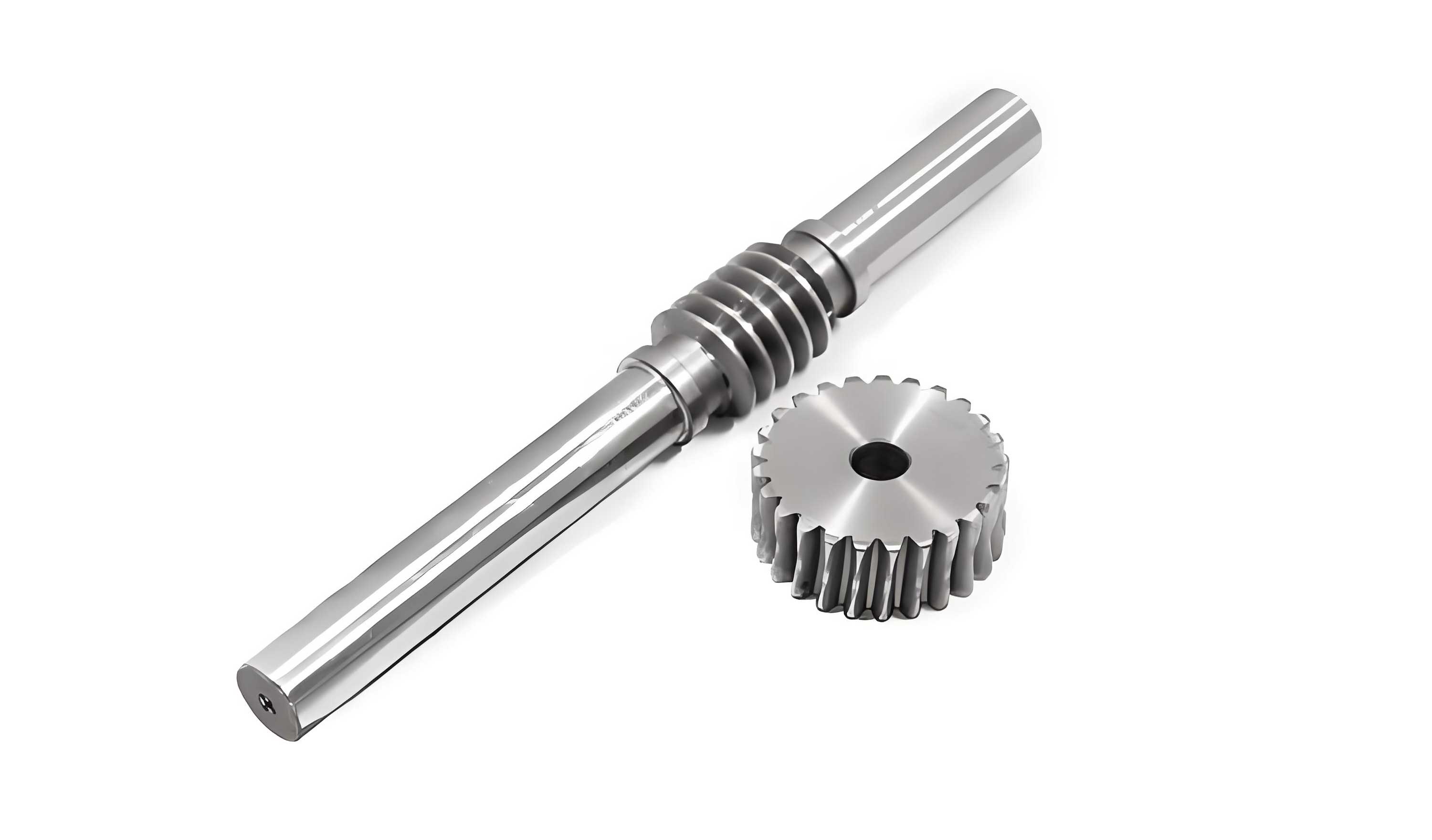
The reliable and efficient operation of worm gears is critical in numerous industrial applications where high reduction ratios and compact design are paramount. Characterized by their unique sliding contact motion between the worm and the wheel, worm gears exhibit distinct advantages in torque multiplication and quiet operation. However, this very sliding contact introduces significant challenges, primarily related to friction, heat generation, and wear, which directly impact transmission efficiency and operational lifespan. Therefore, rigorous performance testing under simulated real-world conditions is indispensable before their deployment in critical systems. This necessitates the development of sophisticated, automated test benches capable of applying precise mechanical inputs and loads while accurately measuring a multitude of response parameters. We designed and implemented a high-performance measurement and control system for a worm gear test rig, leveraging advanced motion control technology and graphical system design software to create a flexible and reliable platform for comprehensive worm gear evaluation.
The core mechanical structure of the test bench is designed to decouple and independently control the input and output sides of the worm gear pair under test. It consists of three primary modules. The first module is the input drive unit, comprising a high-dynamic permanent magnet synchronous motor (PMSM) coupled to the worm shaft via a torque sensor. This unit is responsible for precisely controlling the input rotational speed and angle. The second module is the loading unit, featuring an asynchronous servo motor acting as a programmable dynamic load on the worm wheel output shaft, also connected through a high-precision torque sensor. This setup allows for the application of controlled resisting torque, simulating various operational loads on the worm gears. The third module includes the rigid mechanical frame, bearing blocks, and couplings that ensure accurate alignment and transmission of forces. This configuration enables the simulation of complex working cycles where both the input kinematics and the output load can be independently varied according to predefined profiles.
Selecting the appropriate control architecture was fundamental to meeting the test bench’s demanding requirements for synchronized multi-axis motion, real-time data acquisition, and system flexibility. After evaluating several platforms, the Siemens SIMOTION D system was chosen as the core motion controller. SIMOTION D represents an integrated solution where the motion control CPU is embedded directly within the SINAMICS S120 multi-axis drive system. This tight integration offers significant advantages for our application, particularly in terms of compactness, deterministic performance, and simplified wiring through the high-speed Drive-CLiQ communication interface. The system’s ability to handle complex motion tasks, logic control, and technology functions within a single programming environment significantly streamlined the development process.
The table below summarizes a comparison of relevant control platforms, highlighting the rationale for selecting SIMOTION D.
| Control Platform Type | Typical Architecture | Advantages | Disadvantages for This Application |
|---|---|---|---|
| PLC + Separate Motion Controller | Decentralized control via fieldbus (e.g., PROFIBUS) | High flexibility in component selection | Complex integration, potential synchronization latency |
| PC-Based Control | Software controller running on industrial PC | Very powerful for data processing and UI | Potential real-time determinism concerns |
| Integrated Motion Control (SIMOTION D) | Controller integrated into drive system | Excellent determinism, compact design, simplified engineering | Vendor-specific hardware ecosystem |
The hardware configuration of our worm gear test control system is built around the SIMOTION D425 controller. The key components include:
- Control Module (D425): The central processing unit executing all motion control programs, logic, and closed-loop control algorithms.
- Smart Line Module (SLM): Converts three-phase AC mains power to a regulated DC bus voltage, supplying power to the drive modules and capable of regenerative braking.
- Motor Modules (Double Motor Module): These inverter units convert the DC bus voltage to controlled three-phase AC power for the servo motors. One module supplies the input-side PMSM, and another supplies the output-side loading motor.
- Servo Motors: A high-precision PMSM for the input side and a high-torque servo motor for the loading side.
- Torque/Speed Sensors: Non-contact, rotary torque sensors (e.g., from Kistler) are installed on both the input and output shafts to provide direct measurement of transmitted torque independent of the motor’s current-based torque estimation.
- Industrial PC (IPC): Acts as the supervisory HMI and data acquisition server, running the LabVIEW application.
The interconnection is remarkably streamlined. The D425 controller communicates with the SLM and Motor Modules via the proprietary Drive-CLiQ cable, which handles configuration, power electronics control, and high-speed data exchange for feedback signals (motor encoder data can be read directly through this link). The analog signals from the external torque sensors and any additional digital I/O are connected to the controller’s terminal board. The IPC communicates with the SIMOTION D425 over a standard Industrial Ethernet connection using the OPC (OLE for Process Control) protocol, ensuring reliable and secure data exchange for non-real-time commands and monitoring.
The software architecture is deliberately split between the high-level supervisory functions on the IPC and the real-time deterministic control on the SIMOTION D. This separation of concerns optimizes the performance and reliability of the entire worm gear test system.
1. Lower-Level Control (SIMOTION SCOUT):
The engineering and runtime software for SIMOTION is SCOUT. Within SCOUT, we configured two “Technology Objects” as axes: one for the input drive and one for the output load. A critical feature employed is the “Position-Controlled Axis with Torque Supervision” mode. This allows an axis to operate primarily in precise position control while continuously monitoring the actual torque via the physical sensor. Conversely, the loading axis can be configured in “Torque-Control Mode,” where it acts as a programmable brake, applying a defined torque profile regardless of the resulting position. The core of the test sequence control is the CAM (Electronic Cam) function. The kinematic relationship between the master (e.g., input axis position) and the slave (e.g., output axis torque) is defined by a non-linear CAM profile. This profile is designed programmatically or graphically to simulate the desired operational cycle for the worm gears. The profile could represent constant speed with step-load changes, sinusoidal load variations, or complex sequences derived from field data. The motion control program, written primarily in Motion Control Chart (MCC) and Structured Text (ST), handles the sequence: enabling drives, engaging the CAM synchronization, monitoring fault signals (from overloads or sensor limits), and executing safe shutdown procedures.
The closed-loop control structure within the drive for a torque-controlled axis can be conceptually represented. The torque command $$T_{cmd}$$ is compared with the feedback $$T_{fbk}$$ from the sensor. The error is processed by a torque controller (typically a PI controller), which outputs a current setpoint. This cascades into the inner current control loops of the drive. The relationship can be simplified as:
$$ T_{cmd}(t) = f_{CAM}(\theta_{master}(t)) $$
$$ I_{q,set}(t) = K_{p,T} \cdot e_T(t) + K_{i,T} \cdot \int e_T(t) dt $$
where $$e_T(t) = T_{cmd}(t) – T_{fbk}(t)$$, and $$I_{q,set}$$ is the quadrature current setpoint producing torque.
2. Upper-Level Supervision & Data Acquisition (LabVIEW):
The National Instruments LabVIEW environment is used to create the operator interface and manage high-speed data acquisition. Its graphical programming paradigm is ideal for rapid development of test sequencing, data visualization, and logging. The LabVIEW application performs several key functions:
- Test Profile Management: Allows the user to define, save, and load complex CAM profiles for input position and output torque. These profiles are then downloaded to the SIMOTION controller via OPC.
- System Monitoring & Control: Provides a dashboard showing real-time values of speed, torque (both command and feedback), position, motor temperature, and system status. It sends commands like “Start Test,” “Stop,” or “Emergency Halt” to the controller.
- Synchronized High-Speed Data Acquisition: While the SIMOTION handles real-time control, the analog signals from the two independent torque sensors and optional vibration or temperature sensors are acquired synchronously using a multifunction data acquisition card (e.g., NI PCI-6259). LabVIEW’s deterministic timing ensures that data from all these channels is sampled simultaneously, providing a coherent dataset for post-test analysis of worm gear performance.
- Data Logging and Analysis: All acquired data is timestamped and streamed to disk in a structured format (like TDMS). Built-in analysis routines can calculate derived parameters such as instantaneous efficiency of the worm gear pair in real-time:
$$ \eta(t) = \frac{P_{out}(t)}{P_{in}(t)} = \frac{T_{wheel}(t) \cdot \omega_{wheel}(t)}{T_{worm}(t) \cdot \omega_{worm}(t)} $$
where $$T$$ and $$\omega$$ represent torque and angular speed, respectively.
The following table outlines the primary software components and their respective tasks in the worm gear test system.
| Software Layer | Platform/Tool | Primary Functions |
|---|---|---|
| Real-Time Motion Control | Siemens SIMOTION SCOUT | Axis configuration, closed-loop control, CAM profile execution, safety logic, drive communication. |
| Supervisory HMI & DAQ | NI LabVIEW | User interface, test sequence management, high-speed synchronous analog acquisition, data visualization, logging, and analysis. |
| Communication Bridge | SIMATIC NET OPC Server | Provides standardized data exchange between LabVIEW (OPC Client) and the SIMOTION controller. |
To validate the functionality and performance of the designed measurement and control system, a series of tests were conducted on the worm gear test bench. A fundamental test involved running a synchronized position-torque profile. The input axis was commanded to follow a triangular position profile, moving back and forth between two angular limits at a constant velocity. Simultaneously, the output loading axis was commanded to apply a torque profile that was phase-shifted and of a different waveform (e.g., a sinusoidal load opposing the direction of motion).
The key parameters for a sample validation test are summarized below:
| Parameter | Input (Worm) Axis | Output (Wheel) Axis |
|---|---|---|
| Control Mode | Position Control with Torque Monitoring | Torque Control |
| Command Profile | Triangular wave: ±90° at 60 RPM equivalent | Sinusoidal wave: ±15 N·m at 1 Hz |
| Primary Feedback | Motor Encoder (for control) | Torque Sensor (for control) |
| Monitoring Signal | Torque Sensor | Motor Encoder (for speed/position calculation) |
The results demonstrated the system’s capabilities. The input axis accurately tracked the position command with minimal following error. The output axis applied the requested sinusoidal torque. The torque feedback signals acquired by the LabVIEW system showed clean, low-noise profiles that closely matched the commanded shapes. The ripple and noise in the measured torque were within ±2 N·m, which is attributed to minor mechanical resonances, sensor noise, and the inherent friction characteristics of the worm gears themselves. The synchronous data acquisition allowed for clear plotting of input angle vs. output torque over time, enabling direct observation of hysteresis effects in the worm gear transmission—a critical factor in understanding backlash and elastic deformation. The system successfully implemented automatic shutdown routines when simulated fault conditions (e.g., an artificially triggered over-torque signal) were introduced, confirming the robustness of the safety interlocks.
The integration of the SIMOTION D motion control system with a LabVIEW-based supervisory and data acquisition framework has resulted in a highly capable and flexible test platform for worm gear evaluation. The system successfully meets the core requirements: independent and precise control of input kinematics and output load, synchronized high-fidelity data measurement from multiple sensors, and safe, automated operation. The use of CAM profiles provides immense flexibility to simulate virtually any operational condition that worm gears might encounter in the field. This platform is not only suitable for endurance and fatigue testing but also for detailed characterization of transmission efficiency, dynamic behavior, thermal effects, and wear progression under controlled, repeatable conditions. The design exemplifies how modern integrated motion control and graphical system design software can be effectively combined to solve complex mechatronic testing challenges, providing a valuable tool for research and development aimed at improving the performance and durability of worm gear transmissions.