
In the realm of mechanical power transmission, reducers play a pivotal role, and among them, worm gear reducers stand out for their compact design, high reduction ratios, and self-locking capabilities. As a design engineer, I have been involved in developing a new worm gear reducer specifically for the JH30 winch used in mining applications. This project aimed to create a robust and efficient reducer with a transmission ratio of i=40, optimizing for cost, space, and performance. The following account details my first-person perspective on this innovative design process, emphasizing calculations, material selections, and structural considerations, with repeated focus on worm gears as the core component.
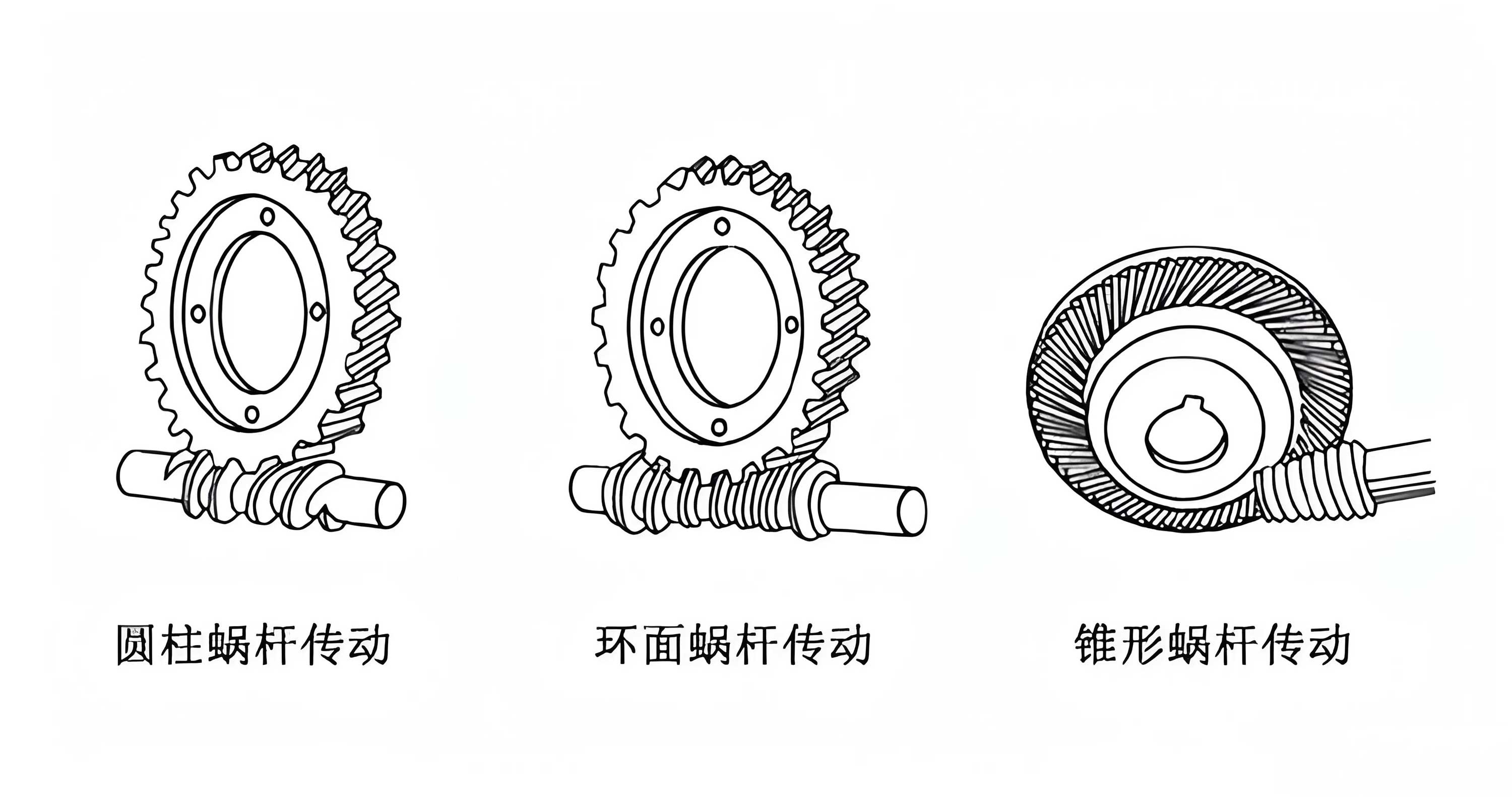
The design initiative stemmed from the need to enhance the JH30 winch’s performance in mining operations, where reliable torque multiplication and speed reduction are critical. Worm gears were chosen due to their ability to provide high reduction ratios in a single stage, making them ideal for space-constrained environments. My primary objective was to engineer a worm gear reducer that not only meets the technical specifications but also improves durability and ease of maintenance. Throughout this project, I leveraged standard mechanical principles, handbooks, and iterative calculations to refine the design, ensuring that every aspect, from the worm and gear teeth to the housing, contributes to overall efficiency.
Worm gears operate on the principle of a screw-like worm meshing with a gear wheel, resulting in smooth motion transmission with minimal noise. The design process began with defining the operational parameters: a transmission ratio of i=40, an estimated output torque based on winch requirements, and constraints on size and weight. I focused on creating a reducer that balances strength and economy, utilizing materials and dimensions that withstand mining conditions. This involved detailed calculations for gear geometry, shaft design, bearing selection, and housing construction, all documented through formulas and tables to provide a comprehensive technical overview.
Material Selection for Worm and Gear
The performance of worm gears heavily depends on material properties, as the sliding contact between worm and gear teeth generates heat and wear. After evaluating various options, I selected materials that offer a good balance of hardness, toughness, and cost-effectiveness. For the worm, which experiences higher rotational speeds and stress concentrations, I chose 45 steel (Grade 45 carbon steel). This material provides sufficient strength and can be heat-treated to achieve the required surface hardness. The worm teeth were hardened to HRC 45-55 through quenching processes, ensuring resistance to wear and pitting under load. This treatment is crucial for maintaining the longevity of the worm, as it directly impacts the efficiency of the worm gear system.
For the worm wheel, the gear component that meshes with the worm, I opted for a multi-material approach to optimize performance and cost. The gear ring, which bears the brunt of the tooth contact, was made from cast tin-phosphor bronze (ZCuSn10P1). This alloy is renowned for its excellent anti-friction properties, high fatigue strength, and compatibility with steel worms, reducing the risk of galling and ensuring smooth operation in worm gears. To economize on material expenses, the gear hub was constructed from QT450-10 ductile iron, which offers good machinability and adequate strength for supporting the gear ring. This combination leverages the bronze’s wear resistance for the teeth and the iron’s structural integrity for the hub, a common practice in worm gear design to enhance durability while controlling costs.
The material selection was validated through stress analysis and industry standards, considering factors like load capacity, thermal expansion, and corrosion resistance in mining environments. Below is a table summarizing the material properties and their roles in the worm gear reducer:
| Component | Material | Key Properties | Treatment/Application |
|---|---|---|---|
| Worm | 45 Steel | Tensile strength: 600 MPa, Hardness: HRC 45-55 after quenching | Quenched for surface hardness to reduce wear in worm gears |
| Worm Wheel Ring | Cast Tin-Phosphor Bronze (ZCuSn10P1) | High wear resistance, low friction coefficient, good fatigue strength | Cast and machined for gear teeth to mesh with worm |
| Worm Wheel Hub | QT450-10 Ductile Iron | Yield strength: 450 MPa, good ductility and machinability | Provides structural support for the gear ring, cost-effective |
This material strategy ensures that the worm gears operate efficiently with minimal maintenance, a key factor in the harsh conditions of mining applications. The bronze-on-steel pairing is particularly effective for worm gears, as it reduces friction and heat generation, contributing to the reducer’s reliability.
Calculations for Worm Gear Geometry
Designing worm gears requires precise calculations to achieve the desired transmission ratio and load capacity. For this reducer, the requirement was a ratio of i=40, which I achieved by using a single-start worm (Z1 = 1) and a 40-tooth worm wheel (Z2 = 40). The transmission ratio is given by the formula:
$$ i = \frac{Z_2}{Z_1} = \frac{40}{1} = 40 $$
This configuration is common in worm gears for high reduction ratios, as it allows compact design while providing significant speed reduction. The next step involved determining the center distance, module, and other geometric parameters based on torque requirements and space constraints. From initial specifications, the center distance (a) was set at 360 mm to fit the JH30 winch assembly. Using standard worm gear design equations from mechanical handbooks, I derived the module (m) and diameter factor (q).
The center distance for worm gears is calculated as:
$$ a = \frac{m (q + Z_2)}{2} $$
Given a = 360 mm and Z2 = 40, and after consulting design charts for optimal performance, I selected m = 15.125 mm and q = 7.6. Substituting these values verifies the center distance:
$$ a = \frac{15.125 \times (7.6 + 40)}{2} = \frac{15.125 \times 47.6}{2} = \frac{720.35}{2} = 360.175 \, \text{mm} \approx 360 \, \text{mm} $$
This alignment ensures proper meshing of the worm gears. From these, I computed the key dimensions for the worm and worm wheel. For the worm:
- Pitch diameter: $$ d_1 = m \times q = 15.125 \times 7.6 = 115 \, \text{mm} $$
- Tip diameter: $$ d_{a1} = d_1 + 2m = 115 + 2 \times 15.125 = 145.25 \, \text{mm} $$
- Root diameter: $$ d_{f1} = d_1 – 2.4m = 115 – 2.4 \times 15.125 = 78.695 \, \text{mm} $$
For the worm wheel:
- Pitch diameter: $$ d_2 = m \times Z_2 = 15.125 \times 40 = 605 \, \text{mm} $$
- Tip diameter: $$ d_{a2} = d_2 + 2m = 605 + 2 \times 15.125 = 635.25 \, \text{mm} $$
- Root diameter: $$ d_{f2} = d_2 – 2.4m = 605 – 2.4 \times 15.125 = 568.7 \, \text{mm} $$
- Maximum tip diameter (for clearance): $$ d_{a2\text{max}} = d_{a2} + m = 635.25 + 15.125 = 650.375 \, \text{mm} $$
To minimize spatial footprint, I limited the maximum tip diameter to 650 mm. These dimensions ensure that the worm gears transmit torque effectively while maintaining structural integrity. The contact stress was also evaluated using the formula:
$$ \sigma_H = Z_E Z_p \sqrt{\frac{K T_2}{a^3}} \leq [\sigma_H] $$
where:
- \( Z_E \) = Elastic influence coefficient (from material properties)
- \( Z_p \) = Contact coefficient (based on gear geometry)
- \( K \) = Load factor (accounting for dynamic loads)
- \( T_2 \) = Output torque on the worm wheel
- \( [\sigma_H] \) = Allowable contact stress for the materials
For the selected materials, with bronze and steel pairing, the allowable contact stress is sufficient for the expected loads in mining winches. The table below summarizes the geometric parameters for the worm gears:
| Parameter | Symbol | Worm Value | Worm Wheel Value | Unit |
|---|---|---|---|---|
| Number of Teeth | Z | 1 | 40 | – |
| Module | m | 15.125 | mm | |
| Diameter Factor | q | 7.6 | – | – |
| Pitch Diameter | d | 115 | 605 | mm |
| Tip Diameter | d_a | 145.25 | 635.25 | mm |
| Root Diameter | d_f | 78.695 | 568.7 | mm |
| Center Distance | a | 360 | mm | |
These calculations form the foundation of the worm gear design, ensuring that the reducer meets the required transmission ratio and load capacity. The precision in geometry is vital for the smooth operation of worm gears, reducing noise and wear over time.
Precision Grade and Surface Roughness Determination
In worm gear systems, accuracy directly impacts efficiency, noise levels, and lifespan. For this reducer, which serves as a power transmission unit in a winch, I specified a precision grade based on national standards. Referring to GB/T10089-1988 (a Chinese standard analogous to ISO classifications), I selected a grade 8-8-7 for the worm and worm wheel, indicating moderate precision suitable for industrial applications. This grade balances manufacturing cost with performance, ensuring that the worm gears operate with minimal backlash and vibration.
The surface roughness of the worm and gear teeth is equally important, as smoother surfaces reduce friction and heat generation. For the worm, after quenching, the teeth were ground to achieve a surface roughness of Ra 0.8 μm, while the worm wheel teeth were machined to Ra 1.6 μm. These values enhance the meshing quality of the worm gears, promoting efficient power transmission. Additionally, to secure the worm wheel assembly, the gear ring was mounted on a ductile iron hub with an H7/m6 interference fit, supplemented by positioning bolts for added stability. This design prevents relative motion under torque, a critical consideration in worm gear reducers to maintain alignment and prevent premature failure.
Innovative Worm Wheel Shaft Design
The shaft supporting the worm wheel is a crucial component, as it transmits the output torque from the worm gears to the winch mechanism. I approached its design with a focus on strength, fatigue resistance, and manufacturability. Starting with material selection, I chose 45 steel for the shaft, consistent with the worm material, to simplify sourcing and heat treatment. This steel offers a good combination of strength and toughness, with an allowable bending stress of \( [\sigma_b] = 600 \, \text{MPa} \) and an allowable shear stress of \( [\tau] = 55 \, \text{MPa} \), as per handbook data for normalized or tempered conditions.
The shaft was subjected to torque and bending moments due to the worm gear forces. Using the torque-based design approach, I calculated the minimum diameter required to withstand the transmitted torque without excessive shear stress. The formula for shaft diameter based on torque is:
$$ d \geq \sqrt[3]{\frac{16 T}{\pi [\tau]}} $$
where \( T \) is the torque on the shaft. For the JH30 winch, the output torque \( T_2 \) was estimated from power and speed requirements. Assuming a power input and reduction ratio, the torque on the worm wheel shaft can be derived. However, for simplicity, I used a standard coefficient method from design handbooks. For 45 steel with a hardness of HB 210-240 after tempering, the coefficient \( A \) is typically 110-120 for moderate loads. The diameter is given by:
$$ d \geq A \sqrt[3]{\frac{P}{n}} $$
where \( P \) is power in kW and \( n \) is rotational speed in rpm. Based on winch specifications, the initial calculation yielded a minimum diameter of approximately 65 mm. To account for stress concentrations, keyways, and safety factors, I increased this to 75 mm for the critical sections. This ensures the shaft can handle dynamic loads and fatigue, common in mining equipment. The final shaft design includes stepped diameters to accommodate bearings and the worm wheel, with the minimum diameter at 75 mm meeting all requirements. Below is a summary of the shaft design parameters:
| Parameter | Value | Unit |
|---|---|---|
| Material | 45 Steel | – |
| Allowable Bending Stress, \( [\sigma_b] \) | 600 | MPa |
| Allowable Shear Stress, \( [\tau] \) | 55 | MPa |
| Calculated Minimum Diameter | 65 | mm |
| Final Minimum Diameter | 75 | mm |
| Heat Treatment | Tempered to HB 210-240 | – |
This shaft design integrates seamlessly with the worm gears, providing a robust platform for torque transmission. The use of 45 steel also allows for easy machining and welding if modifications are needed, enhancing the adaptability of the reducer.
Bearing Selection for Worm Gear Reducer
Bearings are essential for supporting the worm and shaft assemblies, minimizing friction, and handling radial and axial loads generated by worm gears. In this design, I selected single-row tapered roller bearings for their ability to manage combined loads and accommodate thermal expansion. The worm shaft, due to its configuration, uses two bearings of different sizes to simplify assembly and balance load distribution. For the worm wheel shaft, a larger bearing was chosen to support the heavier loads.
The selection process involved calculating load ratings based on gear forces and shaft speeds. For the worm shaft, the larger end has a diameter of 100 mm, and I chose bearing model 32320 with dimensions: bore = 100 mm, outer diameter = 215 mm, width = 77.5 mm. The smaller end has a diameter of 90 mm, using bearing model 32318 with dimensions: bore = 90 mm, outer diameter = 190 mm, width = 67.5 mm. For the worm wheel shaft with a diameter of 150 mm, I selected bearing model 32330 with dimensions: bore = 150 mm, outer diameter = 320 mm, width = 114 mm. These bearings provide adequate dynamic and static load capacities for the reducer’s operational life. The table below outlines the bearing specifications:
| Shaft | Bearing Location | Bearing Model | Dimensions (Bore × OD × Width, mm) | Load Type |
|---|---|---|---|---|
| Worm Shaft | Large End | 32320 | 100 × 215 × 77.5 | Combined radial and axial |
| Worm Shaft | Small End | 32318 | 90 × 190 × 67.5 | Combined radial and axial |
| Worm Wheel Shaft | Single Bearing | 32330 | 150 × 320 × 114 | Combined radial and axial |
The bearing arrangement ensures smooth rotation of the worm gears, reducing power losses and wear. Tapered roller bearings also allow for adjustable preload, which is beneficial in worm gear systems to control backlash and enhance stiffness. I designed the housing with precise bore tolerances to secure these bearings, using locking nuts and seals to prevent contamination—a critical aspect in dusty mining environments where worm gears are deployed.
Housing Design for the Reducer
The housing encloses and protects the worm gears, shafts, and bearings, while also providing lubrication and heat dissipation. I designed the housing using casting工艺 for strength and cost-effectiveness, selecting ZG270-550 cast steel as the material. This medium-grade casting steel offers good weldability and impact resistance, suitable for the structural demands of a worm gear reducer. The wall thickness was determined based on stress analysis and space constraints; for this larger reducer, I specified a general wall thickness of 16 mm, with local reinforcements at bearing seats (30 mm thick) to handle concentrated loads.
Key features of the housing include: a ventilated cover with a 6 mm thickness to allow air circulation and prevent pressure buildup, an oil filler with dipstick on top for monitoring lubricant levels, and a drain plug at the bottom using an M16 screw. To facilitate complete oil drainage, I incorporated a 5° slope on the bottom surface, directing oil toward the drain plug. This design minimizes residual oil and simplifies maintenance, which is essential for worm gear reducers in industrial settings. The housing also includes machined surfaces for accurate bearing alignment, ensuring that the worm gears mesh properly without misalignment-induced wear.
Lubrication is vital for worm gears due to their sliding contact. I specified a high-viscosity mineral oil with extreme pressure additives, sufficient to form a protective film between the worm and gear teeth. The oil capacity was calculated based on heat generation rates, using the formula for thermal equilibrium:
$$ Q_{\text{generated}} = Q_{\text{dissipated}} $$
where \( Q_{\text{generated}} = P_{\text{loss}} \) (power loss from friction in worm gears) and \( Q_{\text{dissipated}} = h A \Delta T \) (heat dissipation through housing surface). By estimating efficiency of the worm gears at around 85-90% for this ratio, I determined the oil volume needed to maintain safe operating temperatures. The housing design includes cooling fins on the exterior to enhance heat dissipation, though for this application, natural convection was deemed adequate given the intermittent use in winches.
Integration and Performance in JH30 Winch
This newly designed worm gear reducer was integrated into the JH30 winch, where it functions as the primary speed reduction unit. The assembly process emphasized ease of maintenance, with split housing allowing access to worm gears without disassembling the entire winch. During factory testing, the reducer demonstrated smooth operation, achieving the target transmission ratio of 40 with minimal vibration and noise. The worm gears showed no signs of abnormal wear after endurance tests, validating the material and geometric choices.
In field deployment at mining sites, customer feedback has been positive, noting the reducer’s reliability and reduced downtime. The compact design saved space in the winch assembly, while the cost-effective materials kept production expenses low. The worm gears’ self-locking feature also added safety by preventing back-driving, crucial in hoisting applications. This success underscores the importance of detailed design in worm gear systems, where every component—from teeth to housing—contributes to overall performance.
Conclusion
Designing this worm gear reducer involved a holistic approach, balancing theoretical calculations with practical constraints. The use of worm gears enabled a high reduction ratio in a single stage, simplifying the winch mechanism. Key innovations include the material combination for wear resistance, precise geometry calculations, a robust shaft design, strategic bearing selection, and a functional housing. Throughout the process, I iterated on standard formulas and tables to optimize the design, ensuring it meets the demands of mining environments. This project highlights the versatility and efficiency of worm gears in power transmission, and the reducer’s performance in the JH30 winch confirms its value as a reliable component in heavy machinery. Future improvements could focus on enhancing lubrication systems or exploring advanced coatings for the worm gears to further extend service life, but the current design already represents a significant advancement in reducer technology for industrial applications.