
The development of Electric Power Steering (EPS) systems represents a cornerstone in the advancement of new energy vehicles, directly contributing to energy efficiency and enhanced driver experience. At the heart of both Pinion-type (P-EPS) and Column-type (C-EPS) systems lies a critical reduction mechanism: the worm gear set. This component is tasked with reducing the high-speed rotation of the assist motor while proportionally increasing its output torque, thereby providing the necessary steering force to aid the driver. The performance, durability, and NVH (Noise, Vibration, and Harshness) characteristics of the entire EPS system are profoundly influenced by the precision and reliability of these worm gears.
In contemporary industrial design, three-dimensional modeling of worm gears is often facilitated by specialized gear generator software like KiSSsoft or integrated toolboxes within CAD platforms such as Creo or SolidWorks. While efficient for generating standard geometries, these automated approaches frequently fall short when confronted with the unique, proprietary design features inherent to specific product lines. Engineers are then forced to undertake secondary modifications on the base model, a process that can introduce errors, compromise design intent, and significantly impede development efficiency. Consequently, there exists a pressing industrial need for a universal, parametric design methodology capable of automatically generating precise three-dimensional models of worm gears, complete with their distinctive technical features, within a flexible and powerful CAD environment.
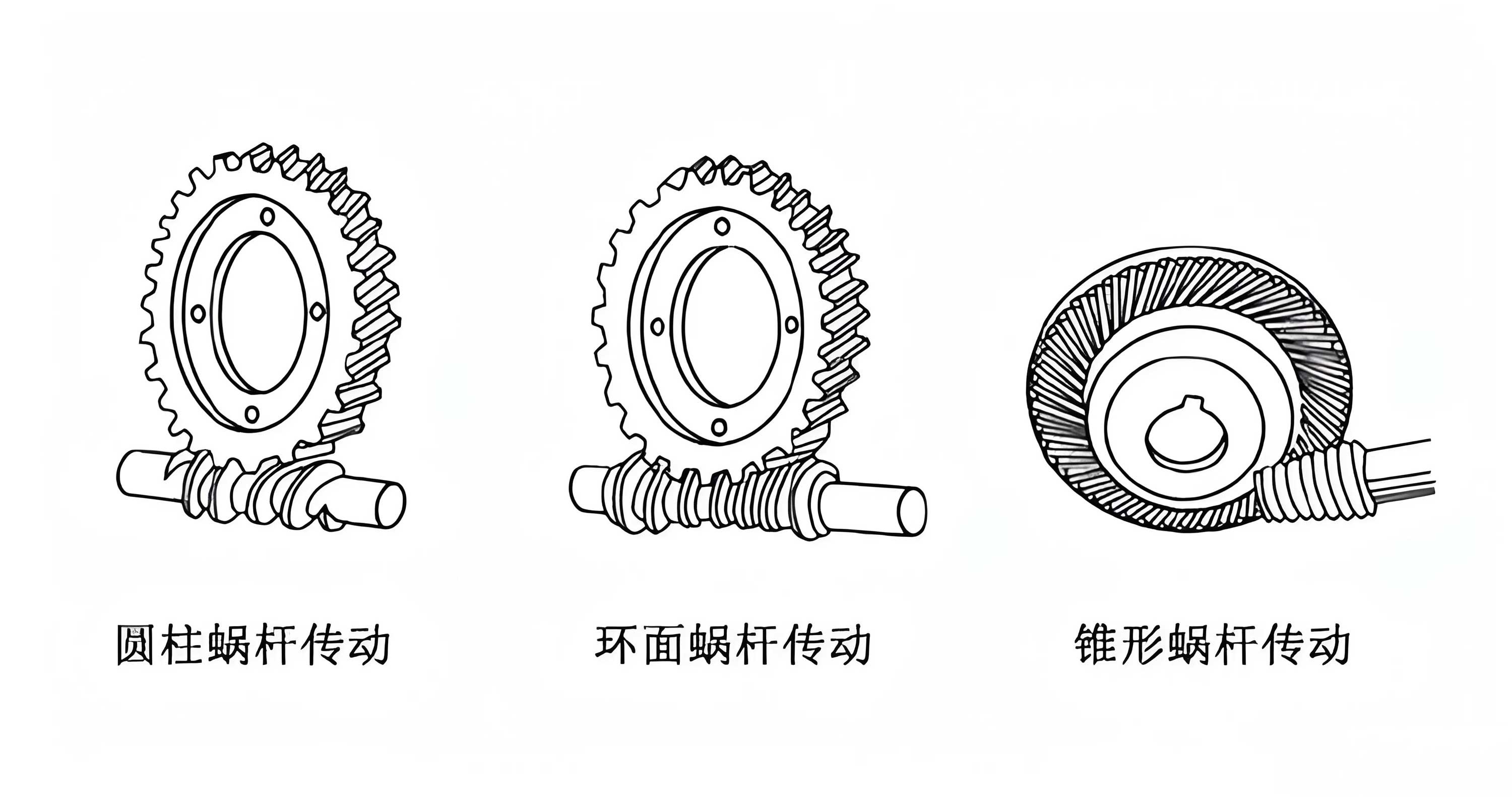
CATIA V5 R20, a premier CAD/CAE/CAM solution from Dassault Systèmes, offers an exceptional platform for such complex parametric modeling. Its robust capabilities in handling formulas, law curves, and advanced surface modeling make it ideal for generating the precise geometries of involute worm gears. This article details a comprehensive methodology for the parameterized design, assembly, and simulation of ZI-type (involute) worm gears, specifically tailored for EPS applications. The process leverages real-world design data to create fully editable, feature-accurate models, enabling rapid iteration, finite element analysis, and ultimately, a more efficient and cost-effective development cycle for these essential automotive components.
Fundamental Geometry of Involute Worm Gears
The ZI-type worm gear pair is characterized by an involute helicoid profile on the worm, which meshes with a gear whose tooth profile is also an involute in the plane normal to its axis. This geometry is analogous to that of a helical gear with a very high helix angle (the worm) engaging with a spur or helical gear (the worm wheel). The key design parameters and their interrelationships form the foundation of the parametric model. The primary parameters, typically derived from system requirements like torque, ratio, and package constraints, include:
- Number of worm starts, $Z_1$
- Number of worm gear teeth, $Z_2$
- Normal module, $m_n$
- Normal pressure angle, $\alpha_n$
- Lead angle of the worm at the reference cylinder, $\gamma$
- Center distance, $a$
- Profile shift coefficient, $x_2$
From these, all other critical dimensions are calculated. The axial module, $m_x$, is fundamental for diameter calculations and is derived from the normal module and the lead angle:
$$
m_x = \frac{m_n}{\cos(\gamma)}
$$
The pitch diameters for the worm ($d_1$) and the worm gear ($d_2$) are calculated as:
$$
d_1 = m_x \cdot q \quad \text{and} \quad d_2 = m_x \cdot Z_2
$$
where $q$ is the diameter factor. The theoretical center distance, $a’$, is $(d_1 + d_2)/2$. The actual center distance $a$ often necessitates a profile shift (or “modification”) in the worm gear, quantified by the coefficient $x_2$, calculated as:
$$
x_2 = \frac{a – a’}{m_x}
$$
This shift adjusts the tooth thickness and operating clearances. The tip and root diameters for both members are then determined using the addendum ($h_a^*$) and dedendum ($h_f^*$) coefficients:
$$
\begin{aligned}
d_{a1} &= d_1 + 2h_a = d_1 + 2 m_n h_a^* \\
d_{f1} &= d_1 – 2h_f = d_1 – 2 m_n (h_a^* + c^*) \\
d_{a2} &= d_2 + 2h_a + 2 x_2 m_x \\
d_{f2} &= d_2 – 2h_f + 2 x_2 m_x
\end{aligned}
$$
where $c^*$ is the bottom clearance coefficient. The geometry of the involute curve itself is central to the accurate modeling of the tooth flanks. An involute can be defined as the trajectory of a point on a straight line as it rolls without slipping on a base circle of diameter $d_b$. Its parametric equations in a plane are given by:
$$
\begin{aligned}
x(\phi) &= \frac{d_b}{2} (\cos \phi + \phi \sin \phi) \\
y(\phi) &= \frac{d_b}{2} (\sin \phi – \phi \cos \phi)
\end{aligned}
$$
Here, $\phi$ is the roll angle (or involute parameter) in radians. For the worm gear, the base circle diameter $d_{b2}$ is related to its pitch diameter and the transverse pressure angle $\alpha_t$, which itself depends on the normal pressure angle and the lead angle: $\alpha_t = \arctan(\tan \alpha_n / \cos \gamma)$. Therefore:
$$
d_{b2} = d_2 \cdot \cos(\alpha_t)
$$
This set of equations and relationships is encoded into the CAD system to drive the parametric model.
Parametric Modeling Workflow in CATIA
The modeling strategy employs a Boolean subtraction approach, mirroring the physical manufacturing process where material is removed from a blank to form the teeth. This method yields higher precision for finite element analysis compared to direct additive modeling of the teeth. The process is divided into distinct stages for the worm gear and the worm.
Worm Gear Modeling
The first step is to declare all design parameters and formulas within the CATIA “Formula” tool. A comprehensive table of parameters, including both input values and calculated ones, is established. This creates a single source of truth for the entire model.
| Parameter Name | Symbol | Formula / Value | Calculated Result |
|---|---|---|---|
| Normal Module | $m_n$ | Input | 2.0 mm |
| Number of Teeth | $Z_2$ | Input | 36 |
| Worm Lead Angle | $\gamma$ | Input | 17.73° |
| Axial Module | $m_x$ | $m_n / \cos(\gamma)$ | 2.0997 mm |
| Pitch Diameter | $d_2$ | $Z_2 \cdot m_x$ | 75.59 mm |
| Base Diameter | $d_{b2}$ | $d_2 \cdot \cos(\alpha_t)$ | 72.949 mm |
| Profile Shift Coeff. | $x_2$ | $(a – a’) / m_x$ | +0.181 |
| Tip Diameter | $d_{a2}$ | $d_2 + 2m_n h_a^* + 2 x_2 m_x$ | 80.352 mm |
| Root Diameter | $d_{f2}$ | $d_2 – 2m_n (h_a^*+c^*) + 2 x_2 m_x$ | 71.352 mm |
Next, the involute tooth profile is created. The parametric equations are implemented using CATIA’s “Law” feature. The variable $\phi$ is replaced by a normalized parameter $t$ ranging from 0 to 1, linked to a specific angular span (e.g., $0$ to $\pi$ radians for a full involute segment). The law for the X-coordinate is defined as:
$$
\text{Law}_X(t) = \frac{d_{b2}}{2} \cdot \cos(\pi \cdot t \cdot 1\text{rad}) + \frac{d_{b2}}{2} \cdot \pi \cdot t \cdot \sin(\pi \cdot t \cdot 1\text{rad})
$$
A parallel law defines the Y-coordinate. These laws are then used to create a planar “Spline” curve, representing one flank of the worm gear tooth space. This curve is mirrored and connected with root and tip arcs to form a closed profile of a single tooth space. Crucially, this profile is drawn on a plane and then offset radially by a distance equal to the profile shift $x_2 \cdot m_x$ to account for the center distance adjustment.
This shifted 2D profile becomes the cross-section. It is swept along a circular path (the throat radius of the worm gear) using the “Sweep” surface command to generate a helical, volumetric representation of the tooth space. Concurrently, a separate sketch defining the outer contour of the worm gear blank (including the hub, web, and rim) is revolved around the central axis to create the solid blank. Finally, the swept tooth space volume is circularly patterned $Z_2$ times around the axis. A Boolean “Remove” operation between the blank body and the patterned tooth space bodies yields the final, precise solid model of the worm gear. All features remain fully parametric and editable via the initial formulas.
Worm Modeling
The modeling philosophy for the worm is similar, but its geometry is that of an involute helicoid. Interestingly, the generating profile for the worm’s tooth space is derived not from the worm’s own base cylinder but from the mating worm gear’s geometry to ensure correct conjugate action. Therefore, the same involute law curve based on the worm gear’s base diameter $d_{b2}$ is used.
| Parameter Name | Symbol | Formula | Calculated Result |
|---|---|---|---|
| Number of Starts | $Z_1$ | Input | 2 |
| Pitch Diameter | $d_1$ | $m_x \cdot q$ | 13.648 mm |
| Axial Pitch | $p_x$ | $\pi m_x$ | 6.597 mm |
| Lead | $p_z$ | $Z_1 \cdot p_x$ | 13.193 mm |
| Tip Diameter | $d_{a1}$ | $d_1 + 2 m_n h_a^*$ | 17.648 mm |
A 2D tooth space profile is created using the involute law. This profile is then swept along a helical path defined by the worm’s lead $p_z$ over its active length. The resulting helical solid body represents one tooth space of the worm. A cylindrical worm blank is created based on the tip diameter $d_{a1}$ and length $b_1$. The helical tooth space body is patterned along the worm’s helix (for a multi-start worm) and then subtracted from the blank via Boolean operation. Special features like lead-in chamfers or undercuts at the ends of the worm threads can be incorporated into the sweep guide curve or as separate machining operations on the blank, showcasing the flexibility of this parametric method in adding proprietary features.
Assembly, Interference Check, and Motion Simulation
Once the individual components are modeled, they are brought into the CATIA “Assembly Design” workbench. The assembly constraints are applied to position the worm and worm gear correctly: their axes are set at the specified center distance $a$ and oriented at 90 degrees, and a surface contact constraint aligns them axially to the correct meshing position.
A critical step is the interference analysis. Using the “Clash” command, the software checks for static overlaps between the two components. A correct design should show the status as “Contact” or “Clearance,” not “Clash.” Furthermore, the “Measure Between” tool can be used to quantify the minimum clearance at various points along the meshing zone, ensuring it aligns with design specifications for backlash. For the modeled worm gears, the analysis confirmed proper contact with no interference and a functional backlash value.
To validate the kinematic functionality, the assembly is transferred to the “DMU Kinematics” workbench. A “Revolute Joint” is defined for the worm’s rotation about its axis, and a second “Revolute Joint” is defined for the worm gear. These two joints are then connected via a “Gear Coupling” joint, where the gear ratio is defined as $Z_1 / Z_2$. A “Angle Driven” command is applied to the worm’s joint. Activating the simulation with sensors for collision detection allows the virtual mechanism to rotate through several cycles. The absence of detected collisions during motion confirms that the modeled worm gears are kinematically sound and do not incur unexpected dynamic interference, validating the geometric accuracy of the parameterized model.
Finite Element Analysis for Strength Validation
The primary advantage of a precise parametric model is its direct utility in engineering analysis. The assembled worm gear pair was exported for Finite Element Analysis (FEA) in ANSYS Workbench to evaluate stress and strain under load, a critical step in verifying the design’s mechanical integrity.
Model Setup and Meshing: The geometry was imported into a Static Structural analysis system. Materials were assigned: a high-strength alloy steel (e.g., 40Cr) for the worm, and a glass-fiber reinforced engineering plastic (e.g., PA46-GF15) for the worm gear, reflecting common EPS material choices. A frictional contact was defined between all tooth flanks with a coefficient of 0.13. The mesh was generated using a tetrahedral element formulation, with local sizing controls to refine the element size in the critical contact region around the teeth to approximately 1.6-1.9 mm, ensuring solution accuracy.
Boundary Conditions and Loading: The simulation aimed to replicate a high-torque static loading condition. The worm shaft ends were fixed (representing bearing supports). A remote torque of 80 N·m—simulating a high assist load—was applied to the inner hub surface of the worm gear. The hub was bonded to the worm gear’s inner bore. This configuration allows the worm gear to rotate under load while the worm is restrained, inducing significant contact and bending stresses in the teeth.
Results and Discussion: The solved model provided detailed stress and strain contours. The analysis revealed distinct behaviors for the two components due to their dissimilar materials.
| Component | Max. Equivalent (von-Mises) Stress | Location | Material Yield Strength | Safety Check |
|---|---|---|---|---|
| Worm (Steel) | 549.4 MPa | Root fillet of loaded teeth | 785 MPa | Acceptable |
| Worm Gear (PA46-GF15) | 76.3 MPa | Root fillet of loaded teeth | 97 MPa | Acceptable |
The worm, made of high-strength steel, exhibited its highest stress concentration in the root fillet region of the most heavily loaded threads, a typical failure initiation point. The maximum value of approximately 549 MPa remained well below the material’s yield strength, indicating a safe design with a factor of safety. The plastic worm gear showed a much lower maximum stress (~76 MPa), also located at the tooth root, which is below its yield point. However, the strain (deformation) observed in the plastic gear was orders of magnitude larger than in the steel worm, highlighting the compliance of the polymer material. This underscores the importance of the geometric design, particularly adequate tooth thickness and root fillet optimization, to manage deflection and ensure proper meshing under load. The fact that the maximum contact and bending stresses for both members of the worm gear set are within their respective material limits confirms that the selected parameters create a viable design from a strength perspective. This integrated workflow—from parametric modeling in CATIA directly to FEA in ANSYS—enables rapid virtual prototyping and validation, drastically reducing the need for physical testing in the early design phases.
Conclusion
This article has presented a detailed methodology for the parametric design and analysis of involute worm gears specifically for Electric Power Steering systems using CATIA V5. The process moves beyond generic gear generation by establishing a fully parameterized model where all critical dimensions are driven by a central set of formulas and laws, including the precise involute tooth geometry. The Boolean-based modeling approach faithfully replicates the manufacturing process and yields models suitable for high-fidelity simulation.
The key advantages of this method are multifold. First, it generates fully editable feature trees, unlike “dumb geometry” from some generators, preserving design intent and allowing easy modifications. Second, changing a fundamental parameter (e.g., module, number of teeth) automatically updates the entire geometry and its dependent assemblies, dramatically accelerating design iterations. Third, the use of law curves enables the modeling of complex, high-precision surfaces essential for optimal worm gear performance. Finally, the seamless transition of the accurate model into Finite Element Analysis software validates the design under operational loads, providing critical insights into stress distribution and safety factors before physical prototyping.
This integrated parametric approach significantly enhances design efficiency, reduces development costs and time, and improves the reliability of the final product. It empowers engineers to rapidly explore the design space for worm gears, optimize proprietary features, and confidently validate performance, thereby contributing directly to the development of more efficient and robust Electric Power Steering systems for the next generation of vehicles.