
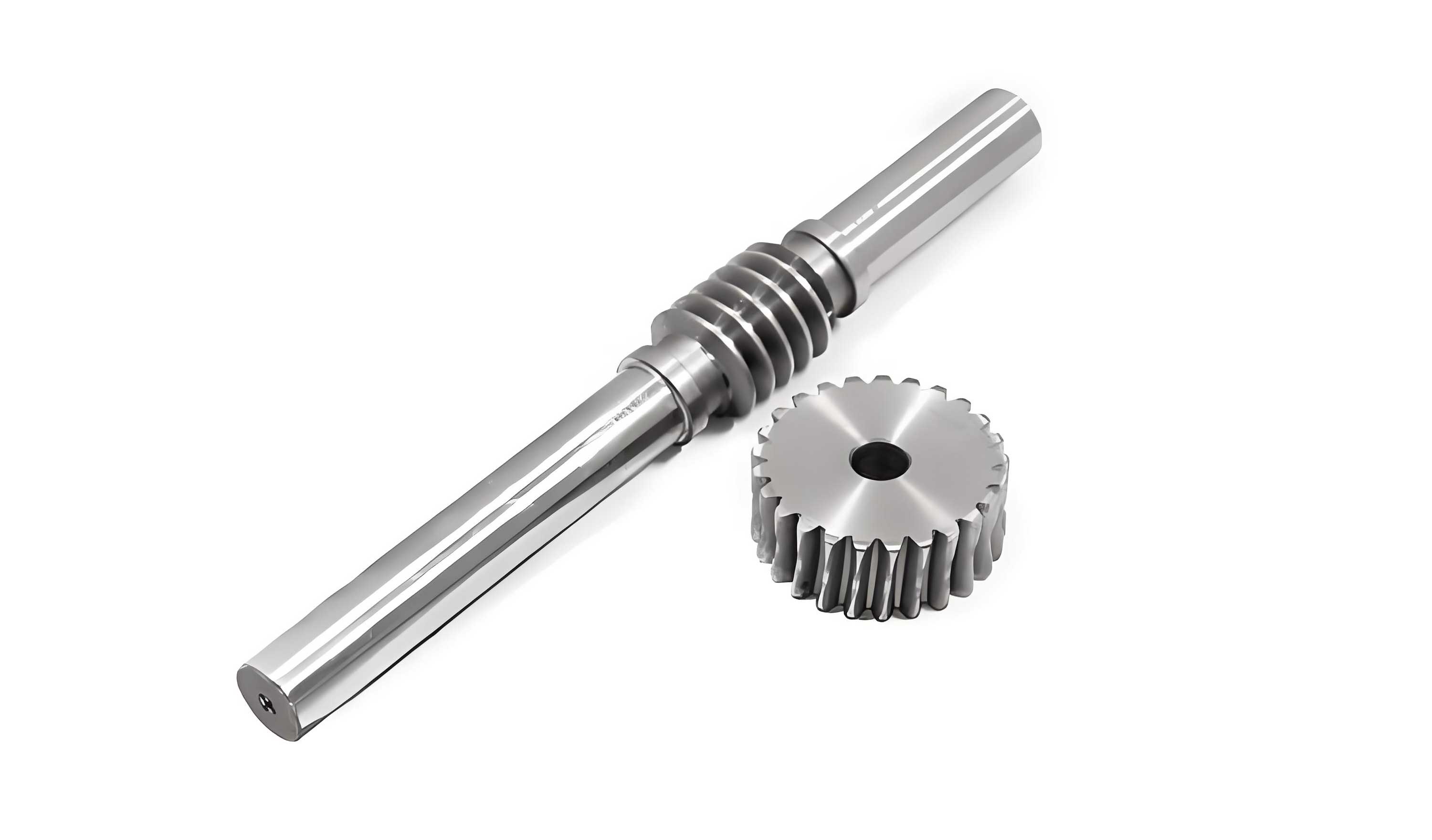
The study of power transmission components, particularly high-performance gear sets, is fundamental to advancing mechanical engineering. Among these, planar double-enveloping worm gear sets, often referred to as hourglass or globoid worm gears, represent a significant area of research due to their superior characteristics. These worm gear systems are renowned for their exceptional load-carrying capacity, high efficiency in certain configurations, compact design, and smooth, quiet operation. The unique geometry, where the worm partially wraps around the worm wheel, results in multiple teeth being in contact simultaneously. This leads to a larger contact area compared to cylindrical worm gears, distributing the load more effectively and enhancing durability. Consequently, these worm gears are extensively employed in demanding applications such as heavy-duty lifting equipment, rolling mills in metallurgy, construction machinery, and precision positioning systems where high torque and reliability are paramount.
The core advantage of planar double-enveloping worm gear sets stems from their complex conjugate action. The worm thread surface is generated by a planar grinding wheel or hob, which itself undergoes a defined motion relative to the worm blank. This process, essentially a double-enveloping generation, creates a localized contact pattern that can be optimized for load distribution. Analyzing the stress state and contact mechanics within these worm gear pairs under operational loads is crucial for predicting their performance, life, and failure modes. However, the intricate geometry of the worm and wheel teeth presents a significant challenge for traditional analytical methods. This is where computational techniques, specifically the Finite Element Method (FEM), become indispensable. FEM allows for a detailed, three-dimensional investigation of stress fields, deformation, and, most critically, the distribution of load among the contacting teeth and along the contact lines.
This article presents a comprehensive static structural analysis of a planar double-enveloping worm gear set using ANSYS Workbench 14.0. The primary objectives are to construct a valid three-dimensional digital model, perform finite element contact analysis under a specified torque, and critically examine the resulting load and stress distribution. Special attention is paid to verifying the consistency of load sharing between different meshing positions—a key indicator of smooth operation and modeling accuracy. The insights gained are vital for validating digital prototyping workflows and for the optimal design of robust worm gear drives.
Digital Modeling of Double-Enveloping Worm Gears
Creating an accurate three-dimensional digital model is the foundational step for any meaningful finite element analysis of worm gears. The complex, spatially curved surfaces of double-enveloping worm gears are not defined by simple geometric primitives. Several methodological approaches have been developed in the literature to tackle this challenge, each with its own merits and limitations. A summary and comparison of the primary methods are presented below.
| Modeling Method | Core Principle | Advantages | Challenges/Limitations |
|---|---|---|---|
| Point-by-Point Calculation & Surface Fitting | Solves the meshing equation system to compute discrete coordinate points on the tooth flanks. These points are then used to fit a continuous surface (e.g., NURBS). | Potentially high precision if enough points are calculated. Directly based on gear theory. | Computationally intensive for complex surfaces. Accuracy depends on point density and fitting algorithm. May result in “noisy” surfaces. |
| Virtual Manufacturing (Boolean Simulation) | Digitally replicates the physical generation process. Involves assembling virtual tools (hob/grinding wheel) and blanks, defining their kinematic relationship, and performing a Boolean subtraction. | Intuitively mirrors real-world production. Naturally generates conjugate surfaces. | Extremely computationally expensive for FEA preparation. Resulting geometry often has minute irregularities requiring extensive cleanup. Model is tied to specific tool geometry. |
| Parametric Curve-Driven Modeling | Derives parametric equations for key feature lines (e.g., contact lines, spiral curves on the worm thread). These curves are used as trajectories or guides to create sweeps, lofts, or fills to build the solid tooth. | Offers a good balance between accuracy and computational efficiency. Creates “clean”, watertight CAD geometry suitable for FEA. Enables parametric control. | Requires deep understanding of the gear’s differential geometry. The final surface is an approximation based on the guiding curves. |
For this analysis, the parametric curve-driven approach is adopted, as referenced in prior work. The fundamental process begins with the establishment of the meshing coordinate systems and the derivation of the family of contact lines on the worm thread surface. A key curve, such as the middle contact line or a characteristic spiral, is expressed parametrically. In a CAD environment like Pro/ENGINEER or SolidWorks, this curve can be defined using equation-driven curve features. The solid model of the worm thread is then generated by performing a sweep or a variable-section sweep along this trajectory, with the cross-section defined according to the axial profile of the generating plane. The worm wheel model is typically created using a similar principle or, more commonly, by performing a Boolean intersection operation between the generated worm and a wheel blank in the assembled meshing position, simulating one full engagement cycle. This method yields the three-dimensional models of the worm and wheel, as illustrated in the accompanying figure. The specific parameters for the model analyzed here are a center distance of 250 mm, with a worm reference circle diameter of 82 mm and a worm gear pitch diameter of 418 mm.
Theoretical Foundation for Contact in Worm Gears
Understanding the contact mechanics theoretically provides a benchmark for the finite element results. The load distribution in worm gears is not uniform. For a planar double-enveloping set, the instantaneous contact under ideal conditions typically consists of several distinct lines. The total transmitted load $F_t$ is distributed across these $n$ simultaneous contact lines. If we consider the load sharing among $k$ pairs of teeth in contact, the force on an individual tooth pair $i$ can be expressed as a fraction of the total tangential force:
$$ F_{t,i} = \zeta_i \cdot F_t $$
where $\sum_{i=1}^{k} \zeta_i = 1$. The factors $\zeta_i$ depend on the relative stiffness of the tooth pairs and the precise alignment, which is a function of the manufacturing quality and assembly.
Furthermore, along a single contact line $j$ on tooth pair $i$, the load per unit length $q_j(s)$ varies. In a simplified linear elastic model for a Hertzian-type line contact, the pressure distribution can be related to the deformation compatibility. The fundamental relationship for the normal approach $\delta$ between two bodies in contact is governed by an integral equation. For a worm gear contact, a highly simplified indicative form considering bending and contact deformation can be conceptualized. The contact stress $\sigma_c$ at any point is related to the load intensity and the relative radii of curvature $\rho_{1}, \rho_{2}$ at that point. The equivalent radius of curvature $\rho_{eq}$ is given by:
$$ \frac{1}{\rho_{eq}} = \frac{1}{\rho_{1}} \pm \frac{1}{\rho_{2}} $$
where the sign depends on whether the surfaces are convex or concave. The maximum contact pressure $p_0$ for a line contact, following Hertzian theory, is:
$$ p_0 = \sqrt{\frac{F_n E_{eq}}{\pi \rho_{eq} L}} $$
Here, $F_n$ is the normal load per unit length, $L$ is the effective length of contact, and $E_{eq}$ is the equivalent elastic modulus:
$$ \frac{1}{E_{eq}} = \frac{1-\nu_1^2}{E_1} + \frac{1-\nu_2^2}{E_2} $$
where $E_1, E_2$ and $\nu_1, \nu_2$ are the Young’s moduli and Poisson’s ratios of the worm and wheel materials, respectively. In reality, the contact in double-enveloping worm gears is far more complex than a simple line contact, but these equations provide a foundational understanding of the parameters influencing stress.
Finite Element Analysis Setup and Procedure
The three-dimensional CAD assembly of the worm gear set is imported into ANSYS Workbench for static structural analysis. The process involves defining material properties, generating a finite element mesh, establishing contact conditions, applying boundary conditions and loads, and finally solving and post-processing.
Material Properties and Contact Definition
Material properties must be assigned to accurately reflect the physical behavior of the worm gears under load. The worm, typically subjected to higher stresses and requiring high strength and wear resistance, is assigned the properties of alloy steel 40Cr. The worm wheel, often made from a bronze alloy to reduce friction and wear in the sliding contact, is assigned the properties of a cast copper-aluminum alloy. The properties are summarized in the table below.
| Component | Material | Young’s Modulus, $E$ (GPa) | Poisson’s Ratio, $\nu$ |
|---|---|---|---|
| Worm | 40Cr Steel | 206 | 0.28 |
| Worm Wheel | ZCuAl8Mn3Fe3Ni2 | 124 | 0.34 |
The interaction between the worm threads and the wheel teeth is the most critical aspect of the simulation. In ANSYS Workbench, a “Frictional” contact type is defined between the suspected contacting surfaces. A coefficient of friction, $\mu$, is specified (a value of 0.1 is a common starting point for lubricated steel-bronze pairs). The contact formulation is set to “Augmented Lagrange” for its robustness in handling moderate penetrations. The behavior is set to “Asymmetric,” meaning the worm thread surface is designated as the “Contact” side and the wheel tooth flank as the “Target” side, which is generally more efficient for this geometry.
Meshing Strategy
A high-quality mesh is essential for capturing stress gradients, especially in the contact regions. A tetrahedral mesh is often used for the complex geometry of worm gears. To ensure accuracy in the contact zone, local mesh refinement is applied to the surfaces of the worm threads and the corresponding wheel teeth. The global mesh size is controlled to balance computational cost and result fidelity. The relevance center is set to “Fine,” and the span angle center is set to “Coarse” to produce a reasonable number of elements. The final mesh for the assembly consists of several hundred thousand nodes and elements. The contact regions are automatically detected and handled by the solver. Key mesh statistics are shown below.
| Metric | Value |
|---|---|
| Number of Nodes | ~450,000 |
| Number of Elements | ~280,000 |
| Element Type | SOLID187 (10-node tetrahedron) |
| Contact Refinement | 2 levels of local sizing on contact surfaces |
Boundary Conditions and Loading
To simulate a static torque transmission scenario, appropriate constraints are applied. The inner cylindrical surface of the worm wheel hub is fixed with a “Cylindrical Support.” This support constrains radial and axial displacements but allows rotation about the wheel axis. A “Fixed Support” is applied to one end of the worm shaft to prevent all rigid body motion. The driving torque is applied to the worm shaft. In ANSYS Workbench, this is achieved by applying a “Moment” load of 208 N·m to the cylindrical surface of the worm shaft. This simulates the input driving condition. To prevent over-constraint, the rotation about the worm axis is not explicitly constrained elsewhere, allowing the system to find its equilibrium under the applied moment and contact forces. Two distinct, randomly chosen rotational positions of the worm relative to the wheel are analyzed (Position 1 and Position 2) to investigate the consistency of the load distribution.
| Analysis Case | Worm Constraint | Wheel Constraint | Applied Load |
|---|---|---|---|
| Meshing Position 1 | Fixed Support on one end-face | Cylindrical Support on bore (free rotation) | Moment = 208 N·m on worm shaft |
| Meshing Position 2 | Fixed Support on one end-face | Cylindrical Support on bore (free rotation) | Moment = 208 N·m on worm shaft |
Results and Discussion: Load and Stress Distribution in Worm Gears
The solution provides detailed contour plots of stress, deformation, contact pressure, and other quantities. The primary focus is on the von Mises equivalent stress, as it is a key criterion for predicting yield initiation in ductile materials like the steel worm and bronze wheel.
Stress Contours and Load Sharing Analysis
For Meshing Position 1, the von Mises stress distribution on the worm shows localized high-stress regions along the active flanks of the threads that are in contact. The stress is not uniform along the wrap-around contact arc, which is expected due to the varying radius of curvature and load intensity. The maximum stress value is observed at a specific point, often near the root or the engaging side of the thread. The worm wheel exhibits a complementary stress pattern on its teeth, with the highest stresses appearing on the contacting flanks. The number of teeth carrying significant load is visibly more than one, demonstrating the multi-tooth contact characteristic of double-enveloping worm gears.
For Meshing Position 2, a similar analysis is performed. The resulting von Mises stress contours, while different in their exact spatial pattern due to the change in meshing phase, exhibit comparable qualitative features. The magnitude of the maximum stress is of the same order, and the number of teeth actively sharing the load remains consistent. This similarity across different engagement positions is a critical validation point. It indicates that the digital model of the worm gear set possesses the fundamental kinematic and geometric correctness expected from a conjugate pair. An inconsistent or vastly different stress pattern between positions would suggest modeling inaccuracies, such as incorrect tooth flank geometry or misalignment, which could lead to vibration, noise, and premature failure in a real worm gear drive.
Quantitative Comparison and Model Validation
To move beyond qualitative comparison, key quantitative metrics can be extracted from the two analysis cases. The table below summarizes these results, focusing on maximum stress, approximate contact area, and a qualitative assessment of load-sharing teeth.
| Result Metric | Meshing Position 1 | Meshing Position 2 | Observation/Conclusion |
|---|---|---|---|
| Max. Von Mises Stress on Worm (MPa) | ~345 | ~332 | Values are very close (~4% difference), indicating consistent peak loading. |
| Max. Von Mises Stress on Wheel (MPa) | ~218 | ~205 | Values are very close (~6% difference). Stress in bronze wheel is lower, as expected. |
| Approx. Number of Loaded Teeth | 3-4 | 3-4 | Consistent multi-tooth contact is observed, a hallmark of double-enveloping worm gears. |
| Nature of Stress Distribution | Localized along predicted contact zones | Localized along predicted contact zones | The pattern follows the theoretical contact lines for planar double-enveloping worm gears. |
The close agreement in maximum stress values and the consistent observation of multi-tooth contact between the two independent meshing positions strongly support the validity of the parametric modeling approach used. The finite element analysis acts as a virtual test, confirming that the generated tooth flanks interact in a stable, repeatable manner characteristic of a properly conjugated worm gear pair. Furthermore, the stress patterns visually align with the expected elongated contact areas typical for this class of worm gears, rather than point contacts or erratic patterns.
Examination of Load Distribution Along Contact Lines
A more advanced post-processing step involves probing the contact pressure distribution along specific paths on the contact surface. While the full mapping is complex, the principle can be discussed. For a given contacting tooth pair, the contact pressure $p(x, y)$ on the surface is output by the solver. By defining a path along the approximate center of the contact patch (which aligns with the theoretical instantaneous contact line), the pressure variation can be plotted. The plot would typically show a non-uniform distribution, often peaking in the middle of the contact band and tapering towards the ends due to edge effects and flank modifications. The integral of this pressure over the contact area for a given tooth equals the share of the total normal force carried by that tooth pair. The consistency of these integrated forces across the engaged teeth in both analyzed positions further validates the model’s ability to simulate correct load-sharing behavior among the teeth of the worm gear set.
Conclusion
This detailed finite element analysis successfully demonstrates the process and value of using computational tools for the evaluation of planar double-enveloping worm gear sets. The parametric modeling method proved effective in generating a three-dimensional digital model that accurately reflects the conjugate geometry of these complex components. The static structural analysis in ANSYS Workbench, under an applied torque of 208 N·m, revealed critical insights into the operational behavior of the worm gear drive. The von Mises stress distributions showed that multiple teeth share the load simultaneously, a key design advantage of this worm gear topology. Most importantly, the analysis of two distinct, randomly chosen meshing positions yielded highly consistent results in terms of maximum stress magnitude and load-sharing characteristics. This consistency is a robust indirect validation of the geometric accuracy of the digital worm gear models. Any significant deviation would have indicated flaws in the tooth flank generation process.
The study underscores that finite element analysis is not merely a tool for stress calculation but a powerful means for verifying digital prototypes and understanding nuanced mechanical behavior, such as inter-tooth load distribution, which is difficult to assess experimentally. The methodology outlined—from parametric modeling based on gear theory to detailed contact simulation—provides a reliable framework for the design, analysis, and optimization of high-performance worm gear drives. Future work could extend this analysis to dynamic conditions, investigate the effects of misalignment, optimize tooth flank modifications for even load distribution, or explore different materials and lubricated contact conditions to more fully characterize the performance envelope of these essential power transmission components.