
In the evolution of robotic systems, the development of advanced wrist actuators has been pivotal for enhancing dexterity and functionality in industrial applications such as spray painting and welding. Among various designs, the flexible wrist based on spherical gear transmission stands out due to its simplicity, compactness, and large motion range. This wrist can achieve up to 260 degrees of pitch and yaw motions, along with continuous bidirectional roll rotation. In this article, I will delve into the moving principles and kinematic analysis of this innovative wrist actuator, focusing on the unique properties of spherical gear mechanisms. The content is structured to provide a comprehensive understanding, using mathematical formulations, tables, and detailed explanations to meet the depth required for such a system.
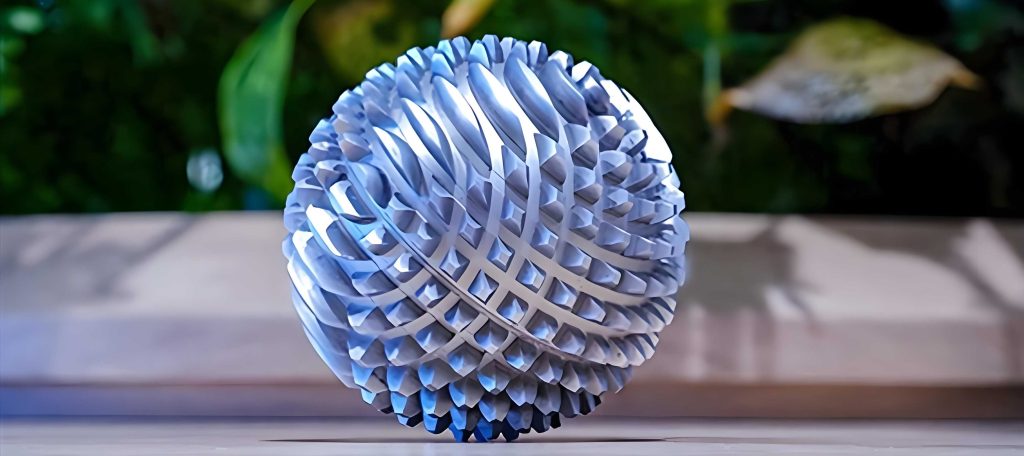
The concept of spherical gear transmission is fundamental to this wrist design. A spherical gear is essentially a gear formed by rotating a planar gear around its polar axis, which results in a spherical surface with concentric tooth rings. When two spherical gears mesh, they behave like two spheres rolling purely against each other, with their centers fixed. This allows for omnidirectional tilting of the polar axes relative to each other. To facilitate this motion, the spherical gear must be mounted on a two-degree-of-freedom cross-joint frame, enabling rotations about the X and Y axes in a Cartesian coordinate system. The meshing principle of spherical gears ensures smooth torque transmission and precise angular displacements, which are critical for robotic wrist applications. The key advantage of using spherical gears lies in their manufacturability; they can be produced using methods similar to those for standard cylindrical gears, unlike more complex alternatives like convex-concave gear pairs. This makes the wrist not only efficient but also cost-effective.
The flexible wrist actuator based on spherical gear transmission comprises four cross-joint frames coupled through three pairs of spherical gears. These gears sequentially transmit motion from one frame to the next, enabling complex spatial movements. The wrist is driven by two DC torque motors that actuate push-pull rods, which in turn move a thrust ring to induce pitch and yaw motions in the first frame. Simultaneously, another motor rotates a drive rod, imparting roll motion to the entire cross-joint assembly. Since the thrust ring can rotate relative to the frames, the roll motion does not interfere with the pitch and yaw actions, allowing for independent three-degree-of-freedom control. The structural arrangement ensures that a small input angle at the first stage is amplified through the gear train to produce a larger output angle at the wrist end, enhancing the wrist’s agility and range. This design leverages the spherical gear’s ability to maintain continuous contact during tilting, which is essential for smooth and reliable operation in dynamic environments.
To analyze the kinematics of the wrist, I define a coordinate system where the initial position aligns the polar axes of all spherical gears with the Z-axis. The X-axis and Y-axis correspond to the vertical and horizontal axes of the first cross-joint frame, respectively. The wrist’s motion can be decomposed into pitch-yaw movements and roll rotations, each requiring separate kinematic models. For pitch and yaw, the input is an angular displacement at the first frame, and the output is the total orientation and position of the wrist endpoint. For roll, the input is a rotation of the drive rod, and the output is the cumulative rotation of the wrist end. The following sections provide detailed derivations for both motion types, including forward and inverse solutions, using vector analysis and trigonometric relationships.
The pitch-yaw motion of the wrist is governed by the meshing of three spherical gear pairs. Let the input angle at the first frame be denoted as $\theta_1$. Due to the gear ratios, the subsequent angles are determined by the base circle radii of the spherical gears. Denote the base radii as $r_1, r_2, r_3, r_4, r_5, r_6$ for the six spherical gears involved. The angular relationships are derived from the gear meshing conditions:
$$ \frac{\theta_2}{\theta_1} = \frac{r_1}{r_2}, \quad \frac{\theta_4}{\theta_3} = \frac{r_3}{r_4}, \quad \frac{\theta_6}{\theta_5} = \frac{r_5}{r_6} $$
From the geometry of the wrist, we have $\theta_2 = \theta_3$ and $\theta_4 = \theta_5$. Thus, the angles can be expressed recursively:
$$ \theta_2 = \frac{r_1}{r_2} \theta_1, \quad \theta_4 = \frac{r_3}{r_4} \theta_2 = \frac{r_3 r_1}{r_4 r_2} \theta_1, \quad \theta_6 = \frac{r_5}{r_6} \theta_4 = \frac{r_5 r_3 r_1}{r_6 r_4 r_2} \theta_1 $$
The total output angle $U$ for the wrist end is the sum of all angular displacements:
$$ U = \theta_1 + \theta_2 + \theta_4 + \theta_6 = \theta_1 \left(1 + \frac{r_1}{r_2} + \frac{r_3 r_1}{r_4 r_2} + \frac{r_5 r_3 r_1}{r_6 r_4 r_2}\right) $$
This can be simplified to:
$$ U = \frac{(r_6 r_4 r_2 + r_6 r_4 r_1 + r_6 r_3 r_1 + r_5 r_3 r_1)}{r_6 r_4 r_2} \theta_1 $$
To determine the position of the wrist endpoint $E$, I use vector analysis. Let $\mathbf{O}_1\mathbf{O}_2$, $\mathbf{O}_2\mathbf{O}_3$, $\mathbf{O}_3\mathbf{O}_4$, and $\mathbf{O}_4\mathbf{E}$ be vectors representing the links between joint centers. Their magnitudes are determined by the sum of adjacent spherical gear radii, and their orientations depend on the angles $\theta_1, \theta_2, \theta_4, \theta_6$ and the direction of tilt in the X-Y plane, denoted by an angle $\phi$. The vector from the base to the endpoint is:
$$ \mathbf{O}_1\mathbf{E} = \mathbf{O}_1\mathbf{O}_2 + \mathbf{O}_2\mathbf{O}_3 + \mathbf{O}_3\mathbf{O}_4 + \mathbf{O}_4\mathbf{E} $$
Expressing this in Cartesian coordinates, with $\phi$ as the projection angle on the X-Y plane:
$$ \begin{aligned}
\mathbf{O}_1\mathbf{E} = & \mathbf{i} \cos\phi \left[ (r_1 + r_2) \sin\theta_1 + (r_3 + r_4) \sin(\theta_1 + \theta_2) + (r_5 + r_6) \sin(\theta_1 + \theta_2 + \theta_4) + L_e \sin(\theta_1 + \theta_2 + \theta_4 + \theta_6) \right] \\
+ & \mathbf{j} \sin\phi \left[ (r_1 + r_2) \sin\theta_1 + (r_3 + r_4) \sin(\theta_1 + \theta_2) + (r_5 + r_6) \sin(\theta_1 + \theta_2 + \theta_4) + L_e \sin(\theta_1 + \theta_2 + \theta_4 + \theta_6) \right] \\
+ & \mathbf{k} \left[ (r_1 + r_2) \cos\theta_1 + (r_3 + r_4) \cos(\theta_1 + \theta_2) + (r_5 + r_6) \cos(\theta_1 + \theta_2 + \theta_4) + L_e \cos(\theta_1 + \theta_2 + \theta_4 + \theta_6) \right]
\end{aligned} $$
Here, $L_e$ is the distance from the last joint center to the wrist endpoint. Thus, the coordinates of point $E$ are:
$$ \begin{aligned}
X_e &= \cos\phi \left[ (r_1 + r_2) \sin\theta_1 + (r_3 + r_4) \sin(\theta_1 + \theta_2) + (r_5 + r_6) \sin(\theta_1 + \theta_2 + \theta_4) + L_e \sin(\theta_1 + \theta_2 + \theta_4 + \theta_6) \right] \\
Y_e &= \sin\phi \left[ (r_1 + r_2) \sin\theta_1 + (r_3 + r_4) \sin(\theta_1 + \theta_2) + (r_5 + r_6) \sin(\theta_1 + \theta_2 + \theta_4) + L_e \sin(\theta_1 + \theta_2 + \theta_4 + \theta_6) \right] \\
Z_e &= (r_1 + r_2) \cos\theta_1 + (r_3 + r_4) \cos(\theta_1 + \theta_2) + (r_5 + r_6) \cos(\theta_1 + \theta_2 + \theta_4) + L_e \cos(\theta_1 + \theta_2 + \theta_4 + \theta_6)
\end{aligned} $$
These equations constitute the forward kinematic solution for pitch-yaw motion. For the inverse solution, given a desired endpoint position $(X_e, Y_e, Z_e)$ or orientation $U$, we can solve for $\theta_1$ and $\phi$. From the expression for $U$, we have:
$$ \theta_1 = \frac{r_6 r_4 r_2}{r_6 r_4 r_2 + r_6 r_4 r_1 + r_6 r_3 r_1 + r_5 r_3 r_1} U $$
Since all polar axes remain in a common plane during tilting, $\phi$ can be derived from the ratios of $X_e$ and $Y_e$:
$$ \phi = \arctan\left(\frac{Y_e}{X_e}\right) $$
However, this assumes $X_e \neq 0$; otherwise, $\phi$ is determined by quadrant analysis. The inverse kinematics may require iterative methods if full position control is needed, but for orientation control, the above suffice. The spherical gear transmission ensures that these relationships are linear in terms of angular ratios, simplifying computation.
To summarize the pitch-yaw kinematic parameters, I present the following table, which lists the key variables and their descriptions. This table helps in understanding the geometric dependencies of the spherical gear system.
| Symbol | Description | Units |
|---|---|---|
| $\theta_1$ | Input angle at the first cross-joint frame | radians |
| $\theta_2, \theta_4, \theta_6$ | Angular displacements at subsequent spherical gear pairs | radians |
| $r_1, r_2, r_3, r_4, r_5, r_6$ | Base circle radii of the spherical gears | meters |
| $U$ | Total output angle at the wrist end | radians |
| $\phi$ | Projection angle of tilt direction in the X-Y plane | radians |
| $L_e$ | Distance from the last joint to the endpoint | meters |
| $X_e, Y_e, Z_e$ | Cartesian coordinates of the wrist endpoint | meters |
Now, let’s turn to the roll motion of the wrist. This involves the rotation of the entire cross-joint assembly driven by the spherical gear transmission. Each cross-joint frame acts like a universal joint, where the input and output shafts are connected via spherical gears. For a single cross-joint frame, let the angle between the input and output shafts be $\beta$, and let the initial orientation of the input shaft relative to the plane containing both shafts be $\alpha$. If the input shaft rotates by an angle $\psi_1$, the output shaft rotates by an angle $\psi_3$, and their relationship is given by:
$$ \tan(\psi_1 + \alpha) = \tan(\psi_3 + \alpha’) \cos\beta $$
where $\alpha’$ is the initial output angle derived from $\alpha$:
$$ \tan\alpha’ = \frac{\tan\alpha}{\cos\beta} $$
Solving for $\psi_1$ in terms of $\psi_3$, we get:
$$ \tan\psi_1 = \frac{(\cos^2\beta + \tan^2\alpha) \tan\psi_3}{(1 + \tan^2\alpha) \cos\beta – (1 – \cos^2\beta) \tan\psi_3 \tan\alpha} $$
Similarly, for $\psi_3$ in terms of $\psi_1$:
$$ \tan\psi_3 = \frac{(1 + \tan^2\alpha) \tan\psi_1 \cos\beta}{\cos^2\beta (1 – \tan\psi_1 \tan\alpha) + \tan\alpha (\tan\psi_1 + \tan\alpha)} $$
In the wrist actuator, there are four cross-joint frames in series. Denote the input roll angle from the drive rod as $\psi_1$, and the output roll angles at each frame as $\psi_2, \psi_3, \psi_4, \psi_E$, where $\psi_E$ is the final wrist end rotation. The initial orientations $\alpha_i$ for each frame depend on the tilt direction $\phi$. From the geometry, we have $\alpha_1 = \phi$, $\alpha_2 = \phi + 90^\circ$, $\alpha_3 = \phi$, $\alpha_4 = \phi + 90^\circ$. The shaft angles $\beta_i$ correspond to the angular displacements from the pitch-yaw motion: $\beta_1 = \theta_1$, $\beta_2 = \theta_3$, $\beta_3 = \theta_5$, $\beta_4 = \theta_6$. Applying the universal joint equations recursively, we derive the forward kinematics for roll motion:
$$ \begin{aligned}
\tan\psi_2 &= f_2(\tan\psi_1, \tan\phi, \cos\theta_1) \\
\tan\psi_3 &= f_2(\tan\psi_2, \tan(\phi + 90^\circ), \cos\theta_3) \\
\tan\psi_4 &= f_2(\tan\psi_3, \tan\phi, \cos\theta_5) \\
\tan\psi_E &= f_2(\tan\psi_4, \tan(\phi + 90^\circ), \cos\theta_6)
\end{aligned} $$
where $f_2$ is the function defined above for $\psi_3$ in terms of $\psi_1$. The inverse kinematics can be obtained by reversing these equations:
$$ \begin{aligned}
\tan\psi_4 &= f_1(\tan\psi_E, \tan(\phi + 90^\circ), \cos\theta_6) \\
\tan\psi_3 &= f_1(\tan\psi_4, \tan\phi, \cos\theta_5) \\
\tan\psi_2 &= f_1(\tan\psi_3, \tan(\phi + 90^\circ), \cos\theta_3) \\
\tan\psi_1 &= f_1(\tan\psi_2, \tan\phi, \cos\theta_1)
\end{aligned} $$
with $f_1$ being the function for $\psi_1$ in terms of $\psi_3$. These equations allow for precise control of the roll orientation, independent of the pitch-yaw motions, thanks to the decoupling provided by the spherical gear transmission. The use of spherical gears ensures that the roll motion is transmitted smoothly even during tilting, which is a key advantage over traditional wrist designs.
To illustrate the roll motion parameters, I provide another table that encapsulates the variables involved. This highlights the interplay between the spherical gear angles and the cross-joint orientations.
| Symbol | Description | Units |
|---|---|---|
| $\psi_1$ | Input roll angle from the drive rod | radians |
| $\psi_2, \psi_3, \psi_4, \psi_E$ | Roll angles at successive cross-joint frames | radians |
| $\alpha_1, \alpha_2, \alpha_3, \alpha_4$ | Initial orientations of input shafts relative to joint planes | radians |
| $\beta_1, \beta_2, \beta_3, \beta_4$ | Angles between input and output shafts (from pitch-yaw motion) | radians |
| $\phi$ | Tilt direction angle in the X-Y plane | radians |
The integration of pitch-yaw and roll motions in the spherical gear-based wrist enables full spatial dexterity. For instance, in a spray painting application, the wrist can orient the nozzle arbitrarily while maintaining a continuous roll to avoid wrist singularities. The kinematic models derived above facilitate real-time control algorithms, such as inverse kinematics solvers for trajectory planning. Moreover, the linear relationships in the pitch-yaw domain simplify the computation, reducing the computational load on the robot controller. The spherical gear design also minimizes backlash and wear, as the tooth engagement is distributed over a spherical surface, ensuring consistent performance over time.
In terms of advantages, the spherical gear transmission offers several benefits. First, the manufacturability of spherical gears using conventional gear-cutting techniques lowers production costs. Second, the compactness of the wrist design allows for integration into confined spaces, which is crucial for industrial robots working in dense environments. Third, the large motion range—up to 260 degrees in pitch and yaw—exceeds that of many conventional wrists, providing greater flexibility. Fourth, the continuous bidirectional roll capability enables complex maneuvers without resetting, enhancing efficiency in tasks like welding, where continuous rotation is often required. These advantages make the spherical gear-based wrist a compelling choice for next-generation robotic systems.
To further explore the kinematic behavior, I can discuss the Jacobian matrix for velocity analysis. The Jacobian relates the joint velocities to the endpoint linear and angular velocities. For the pitch-yaw motion, the joint variables are $\theta_1$ and $\phi$, while for roll, it is $\psi_1$. Differentiating the position equations with respect to time yields the linear velocity components. For example, the linear velocity of point $E$ is:
$$ \begin{aligned}
\dot{X}_e &= -\sin\phi \dot{\phi} \left[ \sum \text{terms} \right] + \cos\phi \left[ \sum (r_i + r_j) \cos(\cdot) \dot{\theta}_k \right] \\
\dot{Y}_e &= \cos\phi \dot{\phi} \left[ \sum \text{terms} \right] + \sin\phi \left[ \sum (r_i + r_j) \cos(\cdot) \dot{\theta}_k \right] \\
\dot{Z}_e &= -\left[ \sum (r_i + r_j) \sin(\cdot) \dot{\theta}_k \right]
\end{aligned} $$
where the summations are over the link contributions. Similarly, the angular velocity can be derived from the roll motion equations. This velocity analysis is essential for dynamic control and path planning, ensuring smooth and accurate movements. The spherical gear transmission contributes to a well-behaved Jacobian, as the gear ratios provide mechanical advantage and reduce sensitivity to input errors.
In conclusion, the spherical gear-based flexible wrist actuator represents a significant advancement in robotic wrist technology. Its design leverages the unique properties of spherical gears to achieve omnidirectional motion with simplicity and reliability. The kinematic analysis presented here provides a foundation for control system development, enabling precise manipulation in industrial applications. Future work could focus on optimizing the spherical gear tooth profiles for improved efficiency or integrating sensors for force feedback. As robotics continues to evolve, such innovative mechanisms will play a crucial role in enhancing robot capabilities, and the spherical gear approach offers a promising pathway forward.
Throughout this discussion, I have emphasized the importance of spherical gear transmission in enabling the wrist’s functionality. The repeated mention of spherical gears underscores their centrality to the design, from the basic meshing principle to the complex kinematic equations. By using tables and formulas, I have summarized the key relationships, making the analysis accessible for engineers and researchers. This comprehensive treatment should aid in the adoption and further development of spherical gear-based wrists in various robotic systems, pushing the boundaries of what is possible in automation and manipulation.