
My research focuses on an advanced form of gearing fundamentally different from conventional types. While traditional gear pairs—cylindrical, bevel, and non-cylindrical—transmit rotation between axes with fixed relative positions (parallel, intersecting, or skew), they possess only a single degree of freedom. I have been deeply involved in the study of a mechanism capable of transmitting two-dimensional rotational motion: the spherical gear pair. This unique capability, allowing for omnidirectional deflection of the output axis relative to the input axis, is essential for applications like biomimetic spherical joints, high-performance robot flexible wrists, and humanoid hip or shoulder joints. The motion is analogous to the pure rolling of one sphere upon another. Investigating spherical gear transmission is thus valuable both for enriching mechanism theory and for meeting pressing engineering needs.
Early work on spherical gear concepts, often termed “spherical crown gears,” emerged from research into robot flexible wrists. These initial designs typically featured a discrete set of pits on one spherical segment mating with conical pins on another. While enabling omnidirectional motion, they suffered from significant transmission error at larger deflection angles due to fundamental flaws in engagement principle—discrete tooth distribution and non-conjugate tooth profiles. This limited their application to tasks with low precision requirements. Subsequent attempts to improve performance included modifying the tooth count, employing specialized fixtures, or replacing the gear pair with sphere-pin pairs. However, a comprehensive solution required addressing the root causes: the need for a conjugate tooth profile and a continuous tooth distribution on the spherical surface.
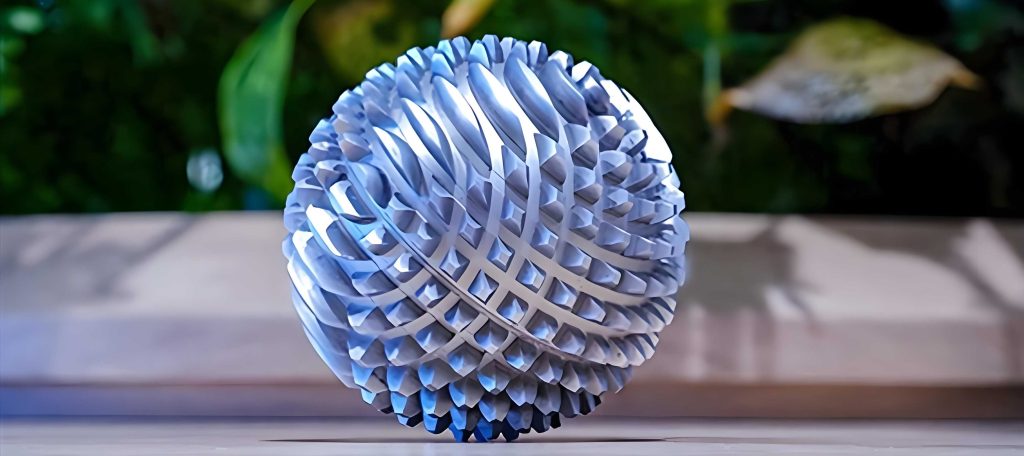
In my research, I propose a novel spherical gear mechanism based on a toroidal involute surface. This design fundamentally overcomes the inherent problems of earlier discrete-tooth spherical gears. The core of my work involves a deep investigation into its transmission theory and the construction method for its computer model.
Fundamental Study of Spherical Gear Transmission
To systematically develop the theory for the toroidal involute spherical gear, it is essential to first define key terminology, as illustrated in the conceptual model of a spherical gear pair. The following table summarizes these critical terms.
| Term | Definition |
|---|---|
| Polar Axis | The line passing through the sphere’s center and perpendicular to the plane of the gear ring. It is also the rotation axis during manufacturing. |
| Gear Ring | The toroidal body generated by revolving a planar tooth profile 360° around the polar axis. |
| Convex Gear | A spherical gear whose teeth at the polar axis end form a columnar revolving body. |
| Concave Gear | A spherical gear featuring a recessed pit at the polar axis end. |
| Tip Sphere | The sphere generated by revolving the addendum circle of the planar gear around the polar axis. |
| Root Sphere | The sphere generated by revolving the dedendum circle of the planar gear around the polar axis. |
| Pitch Sphere | The sphere generated by revolving the pitch circle of the planar gear around the polar axis. |
| Base Sphere | The sphere generated by revolving the base circle of the planar gear around the polar axis. |
| Mesh Cone | The conical surface that is the locus of all contact points during meshing. |
Tooth Surface Generation Principle
The tooth profile of my proposed spherical gear is generated from a standard planar involute gear. Consider a pair of mating planar spur gears. If this planar pair is conceptually rotated 360° around the line connecting their centers (which becomes the polar axis), it transforms into a pair of spherical gears. Consequently, all circles in the planar gear (pitch, base, addendum, dedendum) evolve into corresponding spheres in the spherical gear.
The mathematical generation of the toroidal involute surface can be described as follows. Let line segment $\overline{AB}$ be the generating line, lying in a plane $P$ that contains the polar axis $\overline{O_1O_2}$. Points $C$ and $D$ are the intersections of the base circle (within plane $P$) with the polar axis. As the generating line $\overline{AB}$ rolls without slip on the base circle within plane $P$, the plane $P$ itself simultaneously rotates about the polar axis $\overline{O_1O_2}$. The trajectory of any point on the generating line during this compound motion forms the tooth flank of the spherical gear. The locus of all points on the base circle constitutes the base sphere.
The surface generated is a ring-shaped surface. Crucially, the profile in any cross-section containing the polar axis is a standard involute curve. Therefore, the complete tooth flank is a toroidal involute surface, defined parametrically. If we consider a point on the generating line at a distance $r_b$ (the base radius) from the base circle’s center in the rotating plane, its path can be expressed. Let $\theta$ be the roll angle on the base circle in plane $P$, and $\phi$ be the rotation angle of plane $P$ about the polar axis (z-axis). The coordinates of a point on the surface are given by:
$$ x = (r_b \cos\theta + r_b \theta \sin\theta) \cos\phi $$
$$ y = (r_b \cos\theta + r_b \theta \sin\theta) \sin\phi $$
$$ z = r_b \sin\theta – r_b \theta \cos\theta $$
where $\theta$ varies over the active profile, and $\phi$ from $0$ to $2\pi$.
Meshing Characteristics
When a pair of conjugate spherical gears mesh, their pitch spheres roll purely on one another. This results in point contact between the tooth flanks throughout the motion, except at the singular configuration where the two polar axes are aligned. In that aligned position, the gear ring planes are parallel, and contact occurs along a full circular line.
Since the profile in any polar cross-section is identical to the transverse tooth profile of a spur gear, the two spherical gears can engage along any direction centered on the polar axis. This enables the pitch spheres to roll purely in any arbitrary direction, allowing for omnidirectional relative摆动 between the polar axes. The line connecting the sphere centers and the two polar axes always lie in a common plane, which is also the common normal plane of the tooth surfaces at the contact point. The contact point moves along the line of action within this plane. Consequently, the locus of all contact points forms a double-napped cone—the mesh cone.
Correct Meshing Conditions
The planar spur gear from which the spherical gear is derived is called its “equivalent” or “virtual” gear. The meshing of spherical gears occurs effectively in this normal plane. Therefore, the conditions for correct meshing are identical to those for standard spur gears, but applied to their normal plane parameters:
1. The normal module must be equal: $m_{n1} = m_{n2} = m_n$ (standard value).
2. The normal pressure angle must be equal: $\alpha_{n1} = \alpha_{n2} = \alpha_n$ (standard value).
Additionally, there is a specific pairing requirement unique to spherical gears:
3. For a mating pair, the polar axis of one gear (the concave gear) must pass through the center of the tooth space, while the polar axis of the other gear (the convex gear) must pass through the center of the tooth tip.
Contact Ratio
The contact ratio for a pair of spherical gears is calculated in the same manner as for spur gears, using the parameters of their equivalent gears. The formula is:
$$ \epsilon = \frac{1}{2\pi} [z_1 (\tan \alpha_{a1} – \tan \alpha’) + z_2 (\tan \alpha_{a2} – \tan \alpha’)] $$
where:
- $\epsilon$ is the contact ratio.
- $z_1, z_2$ are the numbers of teeth on the equivalent gears (virtual tooth counts).
- $\alpha_{a1}, \alpha_{a2}$ are the tip pressure angles of the equivalent gears.
- $\alpha’$ is the operating pressure angle (which equals the standard pressure angle $\alpha_n$ for non-modified gears).
Profile Shift (Modification)
The generation process for spherical gears via a cutting or grinding tool is analogous to that for spur gears, with the added rotation of the gear blank about its polar axis. Consequently, the phenomenon of undercutting can occur if the equivalent gear has too few teeth. To prevent undercutting, profile shift (or addendum modification) is applied by altering the relative position between the gear blank and the tool. All concepts related to profile-shifted spur gears, such as the minimum number of teeth to avoid undercutting $z_{min}$ and the minimum profile shift coefficient $x_{min}$, are directly applicable to spherical gears. The minimum tooth count to avoid undercutting without shift is given by $z_{min} = \frac{2 h_a^*}{\sin^2 \alpha}$, where $h_a^*$ is the addendum coefficient. The required profile shift coefficient $x$ to avoid undercutting for a gear with $z$ teeth is: $x \ge h_a^* \frac{z_{min} – z}{z_{min}}$.
3D Modeling of Spherical Gears via the Rotation-Sweep Method
In the course of my research on spherical gears, numerous tasks such as shape analysis, meshing simulation, multi-stage transmission study, and offline programming require an accurate computer model. Constructing this digital model is a foundational step. The rotation-sweep modeling technique is ideally suited for this purpose due to the axi-symmetric nature of the spherical gear tooth surface generation. This method involves revolving a 2D planar profile (the “generatrix” or “base entity”) around a defined axis to create a 3D solid.
The generatrix for a spherical gear model is the involute tooth profile from its equivalent gear. My algorithm for constructing the spherical gear model using the rotation-sweep method involves several key steps, as outlined in the table below:
| Step | Process Description | Key Data Structure/Operation |
|---|---|---|
| 1 | Define and discretize the base entity (involute curve). | Generate a sequence of closely-spaced points $(x_i, z_i)$ defining one flank of the 2D tooth profile in a plane containing the polar axis (z-axis). |
| 2 | Arrange discretized points into an ordered point chain. | Create a linked list or array $P = \{p_1, p_2, …, p_n\}$. |
| 3 | Specify position and orientation of the rotation axis. | Typically the z-axis: $\text{Axis} = (0,0,k)$, where $k$ is the direction vector. |
| 4 | For each point $p_i$ in chain $P$, generate a circle of revolved points. | For a given $p_i=(x_i, 0, z_i)$ and rotation step $\Delta\phi$, generate points $p_{i,j} = (x_i \cos(j\Delta\phi), x_i \sin(j\Delta\phi), z_i)$ for $j=0$ to $m-1$, where $m=2\pi/\Delta\phi$. Store as vertex ring $V_i$. |
| 5 | Connect adjacent vertex rings to form quadrilateral facets. | For rings $V_i$ and $V_{i+1}$, create facets defined by vertices $(v_{i,j}, v_{i,j+1}, v_{i+1,j+1}, v_{i+1,j})$ for all $j$. |
| 6 | Assemble all facets to form the complete tooth surface. | Maintain consistent vertex order (e.g., counter-clockwise for outward normal) for all facets. Store as a face list. |
| 7 | Apply surface smoothing/shading. | Use Phong shading or normal interpolation to create a realistic visual appearance of the curved surface. |
| 8 | Replicate for full gear ring and add core geometry. | Pattern the single tooth model around the axis to create the full gear ring. Boolean union with a spherical or toroidal core body. |
| 9 | Final visualization and export. | Render the complete 3D solid model of the spherical gear for analysis or simulation. |
The implementation of this algorithm relies on established concepts in solid modeling and data structures. Special attention must be paid to the orientation of generated faces; typically, a right-hand rule is used to define the outward surface normal by ordering vertices counter-clockwise as viewed from the exterior. The resulting digital model, as constructed through this process, enables precise computational analysis and dynamic simulation of the spherical gear mechanism’s behavior.
Conclusions and Future Perspectives
The spherical gear represents a significant frontier in gear transmission technology. My work on the toroidal involute spherical gear provides a fundamental theoretical and modeling framework that addresses core limitations of earlier designs. By establishing correct meshing conditions, defining the tooth surface generation mathematically, and developing a robust 3D modeling algorithm, this research lays a foundation for practical application. The unique two-degree-of-freedom motion of the spherical gear pair makes it a compelling solution for advanced mechanical systems requiring precise omnidirectional orientation control.
However, the study of spherical gears is still in a relatively nascent stage. Numerous theoretical and technical challenges remain open for further investigation. Future research must delve into areas such as:
- Strength Design and Durability: Developing specific formulas for bending and contact stress calculation for the complex toroidal involute tooth flank under multi-axis loading conditions.
- Efficiency and Friction Analysis: Studying power loss mechanisms in point-contact rolling-sliding conditions, potentially modeled with traction formulas like $ \mu = f(S, \ldots) $, where $S$ is the slide-to-roll ratio.
- Advanced Meshing Theory: Exploring loaded tooth contact analysis (LTCA) and the influence of misalignment or elastic deformations on transmission error.
- Manufacturing and Metrology: Developing practical, high-precision machining methods (e.g., multi-axis CNC grinding) and corresponding inspection techniques for the spherical gear surface.
- Backlash and Precision Control: Analyzing the effect of tooth clearance on positioning accuracy in closed-loop servo applications and devising compensation strategies.
The potential application domains for spherical gears are extensive and growing. Beyond robotic flexible wrists, they are promising for biomimetic compound-motion joints, hyper-flexible manipulator arms, advanced prosthetics in rehabilitation engineering, spatial orientation simulation platforms, and precision actuators for antenna or sensor pointing systems. In principle, any system requiring accurate spatial orientation control of an output shaft relative to an input shaft could benefit from the intrinsic capabilities of the spherical gear mechanism. Therefore, continued research and development in this field are likely to yield substantial technological rewards, making the spherical gear a key component in the next generation of sophisticated mechanical systems.