
In the field of robotics, snake-like robots have garnered significant attention due to their exceptional adaptability in complex environments such as narrow pipelines, uneven terrains, and disaster zones. Traditional designs often rely on single-degree-of-freedom joints串联 with multiple motors, leading to control complexities, increased负载, and reduced传动精度. To address these limitations, I propose a novel snake-like robot model that leverages 3D-printed involute spherical gears. This design aims to enhance flexibility, reduce weight, and improve real-time controllability of joint movements. Throughout this article, I will delve into the structural design, working principles, motion analysis, and validation through simulations and experiments. The core innovation lies in the use of spherical gears, which enable multi-directional偏摆 with high precision, making the robot more efficient and versatile.
The inspiration for this work stems from the need for more agile and lightweight robotic systems. Existing snake-like robots, while functional, often suffer from limitations in joint articulation and energy consumption. By incorporating spherical gears, I aim to create a robot that mimics biological蛇运动 more accurately. The spherical gear design allows for arbitrary directional偏摆 in space, which is crucial for achieving natural locomotion patterns. In this article, I will first introduce the overall architecture of the robot, followed by a detailed examination of the spherical gear components. Then, I will explain the design of individual bone joints, analyze the robot’s kinematics, and present simulation and experimental results. All discussions will emphasize the advantages of using spherical gears in such applications.
Introduction to Snake-like Robots and Spherical Gears
Snake-like robots are a class of hyper-redundant robots that mimic the locomotion of biological snakes. Their ability to traverse challenging environments makes them ideal for search-and-rescue missions, industrial inspection, and军事侦察. However, many existing designs utilize simple joint mechanisms, such as gear-based or ball-socket connections, which can limit movement range and precision. For instance, gear joints often involve complex assemblies with high传动误差, while ball-socket joints lack real-time angle control. To overcome these issues, I have developed a new approach using involute spherical gears. These spherical gears are 3D-printed with materials like ABS, offering a balance of strength, lightness, and durability. The spherical gear design enables smooth啮合 across multiple axes, allowing for controlled偏摆 angles and positions. This innovation not only simplifies the robot’s mechanics but also enhances its overall performance. In the following sections, I will explore the specifics of this design, starting with the spherical gear itself.
Design and Characteristics of 3D-Printed Involute Spherical Gears
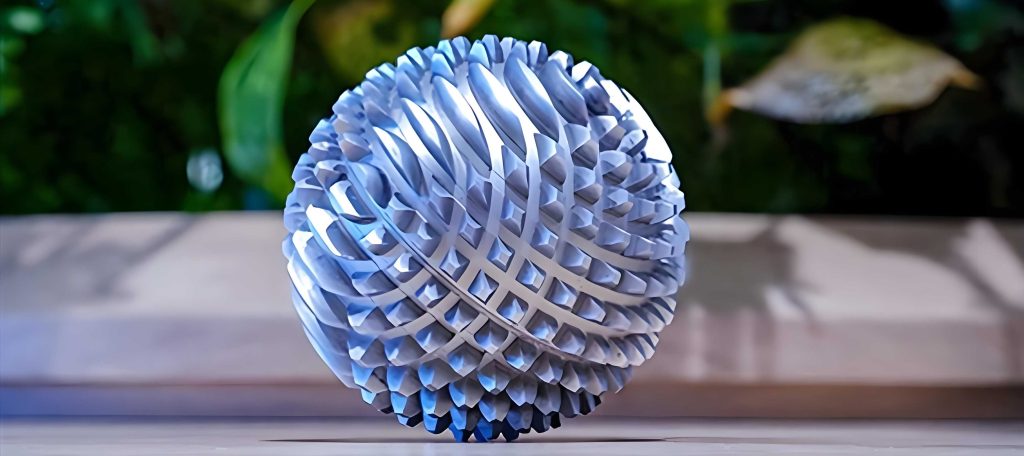
The heart of my snake-like robot is the involute spherical gear. Unlike conventional gears, spherical gears feature teeth arranged on a spherical surface, enabling啮合 at various orientations. This property allows for multi-degree-of-freedom movement in a compact form. I designed these spherical gears using computer-aided modeling, focusing on渐开线 tooth profiles to ensure smooth and precise engagement. The gears are fabricated via 3D printing, which facilitates rapid prototyping and customization. The use of ABS material reduces weight while maintaining sufficient strength for robotic applications. Key parameters of the spherical gears are summarized in the table below, which details their几何特征 based on啮合 rings.
| Ring Number | Axis Angle (degrees) | Module | Number of Teeth | Cone Angle (degrees) | Pitch Circle Diameter (mm) |
|---|---|---|---|---|---|
| First Ring | 180 | 6 | 4 | 26 | 16 |
| Second Ring | 152 | 6 | 44 | 27 | |
| Third Ring | 122 | 6 | 60 | 26 | |
| Fourth Ring | 116 | 10 | 77 | 45 |
The selection of four啮合 rings was made to balance偏摆 angle and传动误差. Each ring corresponds to a specific轴线夹角 when gears are fully engaged, as shown in the table. The spherical gear pair consists of convex and concave gears that mesh together, forming a传动副. The啮合 characteristics can be described mathematically. For a spherical gear, the tooth profile follows an involute curve on a spherical surface. The position of a point on the tooth can be expressed using spherical coordinates. Let $R$ be the radius of the spherical gear, $\theta$ the azimuthal angle, and $\phi$ the polar angle. The parametric equations for the involute profile are derived from standard gear theory, adapted for spherical geometry. The contact condition between two spherical gears ensures continuous motion transmission. The传动比 between two meshing spherical gears depends on their tooth numbers and the angle between their axes. For a pair of spherical gears with tooth numbers $z_1$ and $z_2$, and an axis angle $\alpha$, the angular velocity ratio is given by:
$$ \frac{\omega_1}{\omega_2} = \frac{z_2}{z_1} \cdot \frac{\sin(\beta_2)}{\sin(\beta_1)} $$
where $\beta_1$ and $\beta_2$ are the cone angles of the gears. This relationship allows for precise control of joint movements. The spherical gear design enables偏摆 in any direction, which is crucial for the snake-like robot’s adaptability. By using multiple spherical gears in series, I can achieve larger偏摆 angles while maintaining controllability. The 3D printing process ensures that each spherical gear is lightweight and accurate, contributing to the robot’s overall efficiency.
Single Bone Joint Design: Yaw Unit and Driving Unit
Each bone joint in the robot comprises two main parts: a yaw unit for movement articulation and a driving unit for actuation. I designed these units to work in tandem, enabling real-time control of偏摆 angles and positions. The yaw unit consists of three pairs of spherical gears connected via系杆保持架,十字节, and十字节万向联轴器. This arrangement allows for multi-stage偏摆, mimicking the flexibility of a biological joint. The driving unit includes微型伺服 motors that convert rotational motion into linear displacement via lead screws, which then actuate the yaw unit. Below, I detail each component’s structure and function.
Yaw Unit Structure
The yaw unit is built around three pairs of spherical gears, labeled as pairs 1-2, 3-4, and 5-6. Each pair is mounted on系杆保持架 that provide support and maintain偏摆 angles.十字节 connect the gears to the系杆保持架, while十字节万向联轴器 link the gears within each pair. The kinematic chain starts with a thrust rod connected to a一级系杆, which is fixed to spherical gear 3. As the thrust rod moves, it causes spherical gear 3 to偏摆. This motion is transmitted through十字节万向联轴器 to spherical gear 2, which rotates around spherical gear 1, inducing偏摆 in the二级系杆. Subsequently, spherical gear 5, attached to the二级系杆,偏摆 and drives spherical gear 4 via another十字节万向联轴器, resulting in偏摆 of the三级系杆. This cascading effect allows the joint to achieve complex movements in space. The geometry of the yaw unit can be modeled using连杆 lengths and angles. Let $L_i$ represent the length of each偏摆 section, where $i=1,2,3$. These lengths are derived from the基圆半径 of the spherical gears and adjustment factors for系杆保持架 and十字节. Mathematically:
$$ L_i = A_i \sqrt{r_{i,1}^2 + r_{i,2}^2} $$
Here, $A_i$ is a length coefficient accounting for additional components, and $r_{i,1}$ and $r_{i,2}$ are the base circle radii of the gears in pair $i$. The偏摆 angles $\phi_i$ of each section relative to the vertical axis depend on the input rotation $\theta_1$ from the driving unit. Based on gear啮合 ratios, we have:
$$ \theta_2 = \frac{r_1}{r_2} \theta_1, \quad \theta_4 = \frac{r_3}{r_4} \theta_3, \quad \theta_6 = \frac{r_5}{r_6} \theta_5 $$
where $\theta_j$ denotes the rotation angle of gear $j$. The cumulative偏摆 angle $\phi_i$ is given by:
$$ \phi_i = \sum_{k=1}^{i} \theta_{2k-1} – \theta_{2k} $$
This formulation enables precise calculation of joint configuration for any input.
Driving Unit Mechanism
The driving unit features two thrust rods oriented 90 degrees apart on a cylindrical surface. Each rod is driven by a微型伺服 motor through a lead screw mechanism. The motor rotates a screw, causing a nut to move linearly along the screw axis. This linear motion is transferred to the thrust rod, which connects to the一级系杆 of the yaw unit. By controlling the motors, I can extend or retract the thrust rods independently or synchronously, producing various joint movements. Specifically:
- If the right thrust rod extends while the left retracts, the joint偏摆 to the left.
- If the left thrust rod extends while the right retracts, the joint偏摆 to the right.
- If both rods extend simultaneously, the joint仰起.
- If both rods retract simultaneously, the joint俯下.
The control system uses a main controller that sends指令信号 to each joint’s driving unit via wireless communication. A local controller within each driving unit processes these signals and adjusts the motors accordingly. Angle feedback from sensors ensures accurate position control. This setup minimizes the number of motors required per joint, reducing overall负载 and complexity. The use of spherical gears in the yaw unit enhances传动精度, making the movements smooth and predictable.
Kinematic Analysis of the Snake-like Robot
To achieve effective locomotion, I performed a kinematic analysis of both individual bone joints and the entire robot. The robot is composed of five identical bone joints connected in series via万向铰链. Each joint’s movement is defined by偏摆 angles in space, which are controlled through the driving units. I derived mathematical models to describe the position and orientation of each joint, enabling motion planning and simulation.
Single Bone Joint Kinematics
For a single bone joint, consider its偏摆 in a specific direction. Let $\alpha$ be the angle between the projection of the joint on the $xOy$ plane and the $x$-axis. The joint’s shape is determined by the input angle $\theta_1$ and the projection angle $\alpha$. The coordinates of any point along the joint relative to its base can be calculated using the偏摆 angles $\phi_i$ and the lengths $L_i$. Denote the base point as $O(0,0,0)$. The coordinates of the end of the $i$-th section are given by:
$$ x_i = \left( \sum_{k=1}^{i} L_k \sin \phi_k \right) \cos \beta $$
$$ y_i = \left( \sum_{k=1}^{i} L_k \sin \phi_k \right) \sin \beta $$
$$ z_i = \sum_{k=1}^{i} L_k \cos \phi_k $$
Here, $\beta$ is the azimuthal angle of偏摆 direction in the horizontal plane. By varying $\theta_1$ and $\beta$, the joint can assume different positions in space. This flexibility is key to the robot’s adaptability. The spherical gears play a crucial role here, as their啮合 properties ensure that $\phi_i$ changes smoothly with $\theta_1$.
Overall Robot Kinematics
The robot consists of $n=5$ bone joints. Each joint has three偏摆 sections, so the total number of连杆 is $3n$. Let $\theta_{i,j}$ denote the relative rotation angle between连杆 in joint $i$, section $j$. The control variables are the input angles $\theta_{1,i}$ for each joint and the projection angles $\beta_i$ for each joint’s偏摆 direction. From the gear啮合 relationships, I derived expressions for the连杆 angles $\phi_{i,j}$ for joint $i$, section $j$. For the $i$-th joint, the angles are:
$$ \phi_{i,1} = \sum_{q=1}^{i} \theta_{2q-1,1} $$
$$ \phi_{i,2} = -\sum_{q=1}^{i} \theta_{2q-1,2} + \sum_{k=1}^{3} \beta_{2i-1,k} $$
$$ \phi_{i,3} = \sum_{q=1}^{i} \theta_{2q-1,3} + \sum_{k=1}^{3} \beta_{2i-1,k} – \beta_{2i-1,2} $$
These formulas account for the cumulative effects of preceding joints. The coordinates of the end of each连杆 can be computed recursively. For连杆 $(i,j)$, its coordinates relative to the robot’s base are:
$$ x_{i,j} = \sum_{p=1}^{j} L_{i,p} \sin \phi_{i,p} \cos \beta_i + \sum_{k=1}^{i-1} \sum_{p=1}^{3} L_{k,p} \sin \phi_{k,p} \cos \beta_k $$
$$ y_{i,j} = \sum_{p=1}^{j} L_{i,p} \sin \phi_{i,p} \sin \beta_i + \sum_{k=1}^{i-1} \sum_{p=1}^{3} L_{k,p} \sin \phi_{k,p} \sin \beta_k $$
$$ z_{i,j} = \sum_{p=1}^{j} L_{i,p} \cos \phi_{i,p} + \sum_{k=1}^{i-1} \sum_{p=1}^{3} L_{k,p} \cos \phi_{k,p} $$
This kinematic model allows for the规划 of robot trajectories for various gaits, such as蠕动 or抬头运动. The use of spherical gears ensures that the关节 angles are precisely controllable, enhancing the accuracy of these movements.
Simulation and Experimental Validation
To verify the design’s feasibility, I conducted simulations using MATLAB and built a physical prototype for experimental testing. The simulations focused on analyzing the motion curves of single bone joints and the entire robot under different input conditions. The experiments involved a fabricated single bone joint to measure its actual performance compared to theoretical values.
Simulation Analysis
I simulated the single bone joint and the five-joint robot for蠕动运动, where $\beta_i = 0$ (movement in the $xOz$ plane). The parameters used were: length coefficients $A_1=1.5$, $A_2=3$, $A_3=1.5$, module $m=6$, tooth number $z=4$ for all spherical gears, and equal relative rotation angles $\theta_{i,j}$. Two cases were considered: input angle $\theta_1 = \pi/7$ and $\theta_1 = \pi/6$. The resulting curves for a single joint are shown in the table below, which summarizes key points along the curve.
| Input Angle $\theta_1$ | Section | $\phi$ (degrees) | $x$ (mm) | $z$ (mm) |
|---|---|---|---|---|
| $\pi/7$ | 1 | 26 | 16 | 32 |
| 2 | 51 | 72 | 78 | |
| 3 | 77 | 107 | 86 | |
| $\pi/6$ | 1 | 30 | 18 | 31 |
| 2 | 60 | 80 | 67 | |
| 3 | 90 | 116 | 67 |
The curves demonstrate that larger input angles yield greater偏摆, as expected. For the full robot, the simulations produced serpentine shapes resembling biological蛇蠕动. The overall形态 changes with $\theta_1$, confirming that the robot can achieve natural locomotion patterns. Additionally, I simulated抬头运动 by setting $\beta = \pi/4$ and $\pi/3$ with $\theta_1 = \pi/7$ and $\pi/6$. The 3D curves showed that the joint can偏摆 to different spatial positions, highlighting the versatility enabled by spherical gears.
Physical Prototype and Experiment
I constructed a single bone joint using 3D-printed spherical gears,系杆保持架,十字节, and the driving unit. The joint was tested for left-right偏摆 and俯仰 movements. The experimental setup confirmed that the driving unit could accurately control the thrust rods, producing the desired motions. To quantify accuracy, I measured the joint’s angles and coordinates using a contact-type三坐标测量仪. With $\beta=0$, I took measurements for $\theta_1 = \pi/7$ and $\pi/6$, comparing them to theoretical values. The results are summarized below.
| Parameter | Theoretical Value ($\theta_1=\pi/7$) | Experimental Value ($\theta_1=\pi/7$) | Theoretical Value ($\theta_1=\pi/6$) | Experimental Value ($\theta_1=\pi/6$) |
|---|---|---|---|---|
| $\phi_1$ (degrees) | 26 | 27 | 30 | 32 |
| $x_1$ (mm) | 16 | 18 | 18 | 19 |
| $z_1$ (mm) | 32 | 35 | 31 | 30 |
| $\phi_2$ (degrees) | 51 | 54 | 60 | 63 |
| $x_2$ (mm) | 72 | 74 | 80 | 85 |
| $z_2$ (mm) | 78 | 75 | 67 | 63 |
| $\phi_3$ (degrees) | 77 | 80 | 90 | 87 |
| $x_3$ (mm) | 107 | 114 | 116 | 125 |
| $z_3$ (mm) | 86 | 82 | 67 | 65 |
The maximum errors observed were 3 degrees in angle, 9 mm in $x$-coordinate, and 4 mm in $z$-coordinate. These discrepancies are within acceptable limits, considering measurement uncertainties and fabrication tolerances. The experiments validate that the spherical gear-based joint operates as intended, with precise control over偏摆 angles and positions.
Conclusion
In this article, I have presented a novel design for a snake-like robot utilizing 3D-printed involute spherical gears. The spherical gear mechanism addresses common limitations in traditional snake-like robots, such as high负载, control complexity, and limited传动精度. By incorporating spherical gears into the bone joints, I achieved multi-directional偏摆 with real-time controllability. The kinematic analysis provided mathematical models for both single joints and the overall robot, enabling accurate motion planning. Simulations in MATLAB demonstrated that the robot can emulate biological蛇运动, such as蠕动 and抬头运动, by adjusting input angles and projection angles. Physical experiments on a single bone joint confirmed the design’s feasibility, with measured performance closely matching theoretical predictions. The use of spherical gears not only reduces the number of motors required but also enhances the robot’s agility and precision. Future work may involve optimizing the spherical gear parameters for different materials, scaling the design for larger robots, and implementing advanced control algorithms for autonomous navigation. This research contributes to the field of柔性机器人 by offering a new approach to joint design, paving the way for more efficient and adaptable snake-like robots.