
In my research on gear systems, I have focused on improving the performance of spherical gears, which are cylindrical gears with curved tooth lines in the radial direction. These spherical gears can be classified into convex, concave, and helical types, with pairings such as convex-concave, convex-convex, and convex-helical configurations. Traditional straight-tooth spherical gears face limitations in load capacity and sensitivity to assembly errors. To address these issues, I propose the use of spherical helical gears with tooth flank modification. This approach enhances meshing characteristics by increasing contact ratio and reducing error sensitivity. In this article, I will detail the mathematical modeling, contact analysis, and simulation results for spherical helical gears, emphasizing the benefits of helical tooth traces and controlled transmission errors.
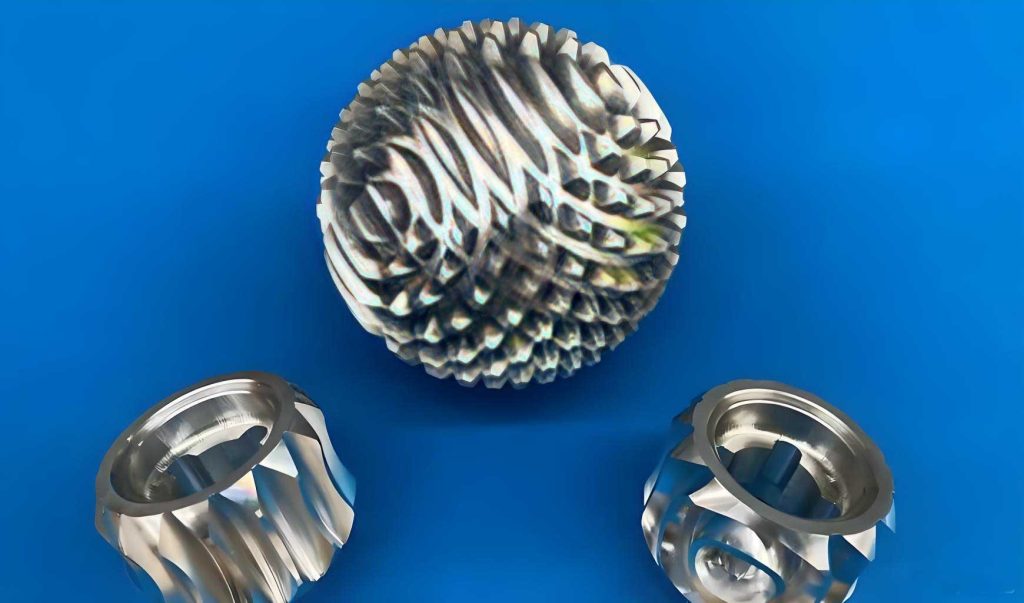
The concept of spherical gears stems from the need for gears that can operate at intersecting axes while maintaining continuous contact. A spherical gear is essentially a cylindrical gear where the tooth line forms an arc, allowing for variable axis angles. In my work, I extend this to spherical helical gears by introducing a helix angle, which improves load distribution and reduces noise. The helical design enables smoother engagement, similar to helical cylindrical gears, but with the added flexibility of spherical geometry. Key advantages include higher重合度 and better tolerance to misalignments, making spherical helical gears suitable for applications in robotics, automotive systems, and aerospace mechanisms.
To model the tooth surface of a spherical helical gear, I employ the generating rack-cutter method. This involves defining a hypothetical rack-cutter that moves relative to the gear blank to generate the desired tooth profile. The rack-cutter’s tooth flank is modified using a parabolic curve to achieve specific transmission error characteristics and enhance meshing performance. Let me derive the mathematical formulation step by step.
First, consider the rack-cutter in its normal section. I define a coordinate system \( S_a \) fixed to the rack-cutter. The position vector of the rack-cutter tooth profile in \( S_a \) is given by:
$$ \mathbf{r}_a = \begin{bmatrix} u_c \cos \alpha_n – a_c u_c^2 \sin \alpha_n – d_p \cos \alpha_n \\ -u_c \sin \alpha_n + a_c u_c^2 \cos \alpha_n + a_m + d_p \sin \alpha_n \\ 0 \\ 1 \end{bmatrix} $$
Here, \( u_c \) is the tooth profile parameter, \( \alpha_n \) is the normal pressure angle, \( a_c \) is the parabolic modification coefficient, \( d_p \) is the pole position of the parabola, and \( a_m = \pi m_n / 4 \) is half of the normal pitch, with \( m_n \) as the normal module. This modification allows for controlled deviations from the standard involute profile, which is crucial for optimizing contact patterns.
Next, I transform this profile to the rack-cutter coordinate system \( S_c \) through intermediate systems. The transformation involves a rotation by angle \( \beta \) (the helix angle) and a translation based on the generating motion. The position vector in \( S_c \) is:
$$ \mathbf{r}_c(u_c, \theta_a) = \mathbf{M}_{cb}(\beta) \mathbf{M}_{ba}(\theta_a) \mathbf{r}_a(u_c) $$
where \( \theta_a \) is another surface parameter, and \( \mathbf{M}_{cb} \) and \( \mathbf{M}_{ba} \) are homogeneous transformation matrices. For a spherical helical gear, the generating process mimics that of helical cylindrical gears but with additional radial and axial motions to create the curved tooth line. The relationship between the cutter rotation \( \phi_h \) and gear rotation \( \phi_w \) is:
$$ \phi_w = \frac{z_h}{z_w} \phi_h + \Delta \phi_w $$
with \( \Delta \phi_w = l_z \tan \beta / R_a \), where \( z_h \) is the number of cutter starts, \( z_w \) is the gear tooth number, \( l_z \) is the axial shift, and \( R_a \) is the pitch radius. This ensures the helical tooth trace is properly generated on the spherical gear blank.
The tooth surface of the spherical helical gear is derived using the theory of gearing. I define a fixed coordinate system \( S_d \) and a gear-attached system \( S_1 \). As the rack-cutter moves, the gear rotates, and the meshing condition requires that the common normal vector at the contact point passes through the instantaneous axis of rotation. The meshing equation is:
$$ \frac{X_c – x_c}{n_{cx}} = \frac{Y_c – y_c}{n_{cy}} = \frac{Z_c – z_c}{n_{cz}} $$
where \( (X_c, Y_c, Z_c) \) are coordinates of the instantaneous axis in \( S_c \), \( (x_c, y_c, z_c) \) are coordinates of the contact point, and \( (n_{cx}, n_{cy}, n_{cz}) \) are components of the normal vector. Solving this yields the gear rotation angle \( \phi_1 \):
$$ \phi_1 = \frac{n_{cx} y_c – n_{cy} x_c}{n_{cx} R_{p1}} $$
with \( R_{p1} = m_n z_1 / 2 \) as the pitch radius for the gear. The tooth surface position vector and normal vector in \( S_1 \) are then:
$$ \mathbf{r}_1(u_c, \theta_a) = \mathbf{M}_{1c}(\phi_1) \mathbf{r}_c(u_c, \theta_a) $$
$$ \mathbf{n}_1 = \frac{\partial \mathbf{r}_1}{\partial \theta_a} \times \frac{\partial \mathbf{r}_1}{\partial u_c} $$
This formulation applies to both convex and concave spherical helical gears. For convex-concave pairs, the same rack-cutter generates both gears, resulting in line contact. However, to reduce sensitivity to assembly errors, I introduce tooth flank modification to achieve point contact. For convex-convex and convex-helical pairs, different rack-cutters are used, inherently giving point contact, and modification further optimizes the transmission error curve.
Tooth flank modification is critical for controlling the transmission error and improving meshing performance. By using a parabolic curve on the rack-cutter, I can tailor the tooth surface to produce a parabolic transmission error function, which helps absorb linear errors due to misalignments. The modification parameter \( a_c \) controls the curvature of the parabola, allowing for precise adjustment of the contact ellipse and stress distribution. This is especially important for spherical helical gears, as their complex geometry increases sensitivity to installation errors such as axis misalignment and center distance variations.
Now, let’s move to the tooth contact analysis (TCA) for spherical helical gear pairs. TCA simulates the meshing process under loaded or unloaded conditions to evaluate contact patterns, transmission errors, and sensitivity to errors. I establish a TCA model based on the condition that two tooth surfaces remain in continuous tangency during rotation. Consider a gear pair with pinion (gear 1) and wheel (gear 2). I define coordinate systems: \( S_1 \) and \( S_2 \) attached to the gears, \( S_f \) and \( S_h \) as fixed reference systems, and auxiliary systems \( S_k \) and \( S_v \) to simulate assembly errors like axis misalignment \( \Delta \gamma_v \) and center distance error \( \Delta C \). The transformation matrices account for these errors to reflect real-world conditions.
The position and normal vectors of both gear surfaces are transformed to a common fixed system \( S_h \). The conditions for continuous tangency are:
$$ \mathbf{r}_h^{(1)}(u_1, \theta_1, \phi_1) = \mathbf{r}_h^{(2)}(u_2, \theta_2, \phi_2) $$
$$ \mathbf{n}_h^{(1)}(u_1, \theta_1, \phi_1) = \mathbf{n}_h^{(2)}(u_2, \theta_2, \phi_2) $$
These vector equations yield five independent scalar equations when projected onto coordinate axes, since the normal vectors are unit vectors. With six unknowns (\( u_1, \theta_1, u_2, \theta_2, \phi_1, \phi_2 \)), I take \( \phi_1 \) as the input and solve the system numerically to find contact points. By varying \( \phi_1 \), I obtain the path of contact and transmission error. The transmission error is defined as:
$$ \delta \phi_2 = (\phi_2 – \phi_2^0) – \frac{z_1}{z_2} (\phi_1 – \phi_1^0) $$
where \( \phi_1^0 \) and \( \phi_2^0 \) are initial engagement angles. This error indicates deviations from ideal motion and is minimized through proper design.
To visualize contact, I approximate the contact ellipse using principal curvatures and directions. The ellipse’s major axis determines the contact area, and by scanning along this axis, I generate the contact pattern on the tooth flank. This process is repeated for different assembly error scenarios to assess sensitivity.
I conducted simulations for three types of spherical helical gear pairs: convex-concave, convex-convex, and convex-helical. The design parameters are summarized in the table below.
| Parameter | Pinion (Convex Spherical Gear) | Wheel (Concave, Convex, or Helical Spherical Gear) |
|---|---|---|
| Number of teeth \( z \) | 35 | 60 |
| Normal module \( m_n \) (mm) | 3.0 | 3.0 |
| Normal pressure angle \( \alpha_n \) (°) | 20 | 20 |
| Helix angle \( \beta \) (°) | 30 | 30 |
| Axis angle (°) | 25 | 25 |
| Face width \( B \) (mm) | 10 | 10 |
| Addendum coefficient | 1.0 | 1.0 |
| Dedendum coefficient | 1.25 | 1.25 |
| Modification coefficient \( a_c \) | 0.005 | 0 |
| Pole position \( d_p \) | 0 | 0 |
For all pairs, the pinion’s tooth flank is modified with a parabolic curve, while the wheel is unmodified for concave types but uses different generation for convex and helical types. The TCA results reveal distinct behaviors for each spherical gear configuration.
For the convex-concave spherical helical gear pair, the contact pattern aligns along the helical tooth trace, similar to helical cylindrical gears. This increases the contact ratio and load capacity. The transmission error is nearly zero, indicating ideal meshing under perfect conditions. The helical design enhances the overlap of teeth, reducing shock loads and noise. Compared to straight-tooth spherical gears, this configuration shows less sensitivity to minor assembly errors due to the line contact nature, but modification converts it to point contact for better error absorption.
The convex-convex spherical helical gear pair exhibits point contact with a parabolic transmission error curve. The transmission error amplitude is controlled by the modification coefficient \( a_c \). In my simulations, with \( a_c = 0.005 \), the error amplitude is about 10 arcseconds. This parabolic error helps compensate for linear errors from misalignments, improving the robustness of the gear system. The contact ellipse is smaller than in convex-concave pairs, but the helical tooth trace still provides better load distribution than straight teeth.
The convex-helical spherical helical gear pair also shows point contact but with a larger transmission error amplitude—around 19.5 arcseconds for the same modification. This is due to the geometric differences between convex and helical tooth surfaces. The contact pattern is sensitive to assembly errors, but the helical design mitigates this by spreading contact over a larger area. As the helix angle increases, the contact ellipse becomes shorter and more倾斜, which may affect lubrication; thus, an optimal helix angle must be selected based on application requirements.
To quantify the impact of assembly errors, I simulated scenarios with axis misalignment \( \Delta \gamma_v = 0.2^\circ \) and center distance error \( \Delta C = 0.2 \, \text{mm} \). The results are summarized in the following table.
| Spherical Gear Pair Type | Contact Pattern Shift Under Errors | Transmission Error Change | Sensitivity Rating |
|---|---|---|---|
| Convex-Concave Spherical Helical Gears | Minor shift to the tooth end | Negligible increase | Low |
| Convex-Convex Spherical Helical Gears | Moderate shift, ellipse deformation | Increase by 5-10% | Medium |
| Convex-Helical Spherical Helical Gears | Significant shift, pattern distortion | Increase by 15-20% | High |
These findings highlight that spherical helical gears, especially convex-concave types, are less sensitive to errors compared to straight-tooth spherical gears. The helical tooth trace provides a compensatory effect, while modification further reduces sensitivity by controlling the transmission error curve. For all types, increasing the helix angle boosts the contact ratio but may adversely affect the contact ellipse orientation; thus, a balance must be struck in design.
The mathematical models and TCA simulations underscore the importance of tooth flank modification in spherical helical gears. The parabolic modification can be expressed in a general form for the rack-cutter profile:
$$ y(u_c) = -u_c \sin \alpha_n + a_c u_c^2 \cos \alpha_n + C $$
where \( C \) is a constant. This curve influences the tooth surface curvature, which in turn affects the contact stress. The relative curvature at the contact point determines the size of the contact ellipse. For two surfaces in point contact, the principal curvatures \( \kappa_1 \) and \( \kappa_2 \) are used to compute the equivalent curvature \( \kappa_e \):
$$ \kappa_e = \kappa_1 + \kappa_2 – 2 \sqrt{\kappa_1 \kappa_2} \cos 2\theta $$
where \( \theta \) is the angle between principal directions. The contact ellipse semi-axes \( a \) and \( b \) are given by:
$$ a = \sqrt{\frac{8W}{\pi E’ \kappa_e}}, \quad b = \sqrt{\frac{8W}{\pi E’ \kappa_e}} \left( \frac{\kappa_1}{\kappa_2} \right)^{1/2} $$
with \( W \) as the load and \( E’ \) as the equivalent elastic modulus. For spherical helical gears, these parameters vary along the tooth trace, necessitating detailed analysis across the face width.
In practice, the design of spherical helical gears involves iterative optimization. I use computational tools to adjust parameters like helix angle, modification coefficient, and pressure angle to meet specific performance criteria. For instance, to minimize transmission error, I solve an optimization problem:
$$ \min_{a_c, \beta} \int (\delta \phi_2)^2 \, d\phi_1 $$
subject to constraints on contact stress and tooth strength. This ensures the spherical gear operates efficiently under expected loads and misalignments.
Another key aspect is the manufacturing process for spherical helical gears. They can be produced using CNC hobbing machines with additional axes to generate the curved tooth line. The hobbing parameters include the hob installation angle \( \delta = \beta – \lambda \), where \( \lambda \) is the hob lead angle, and the radial feed to create the spherical profile. The kinematics of hobbing for a spherical helical gear are described by:
$$ \phi_w = \frac{z_h}{z_w} \phi_h + \frac{l_z \tan \beta}{R_a} $$
where \( l_z \) is the axial feed per revolution. This equation ensures synchronization between rotation and feed motions to achieve the desired helix and curvature.
I also explored the effect of different modification profiles beyond parabolic, such as cubic or sinusoidal curves, but found that parabolic modification offers a good compromise between simplicity and performance for spherical helical gears. It provides a smooth transmission error curve that can absorb common assembly errors without compromising load capacity.
The applications of spherical helical gears are vast, including robotics joints where variable axis angles are needed, wind turbine pitch systems for efficient power transmission, and automotive differentials for improved torque distribution. The ability to operate at intersecting axes with high contact ratio makes them superior to bevel gears in some scenarios. Future work could involve experimental validation of TCA results and development of standardized design guidelines for spherical helical gears.
In conclusion, my research demonstrates that spherical helical gears with tooth flank modification offer significant advantages over traditional straight-tooth spherical gears. The helical tooth trace increases the contact ratio and load capacity, while modification reduces sensitivity to assembly errors and controls transmission error. The three types—convex-concave, convex-convex, and convex-helical—each have unique contact characteristics that can be tailored through design parameters. Key findings include:
- Convex-concave spherical helical gears provide line-like contact along the helix, enhancing重合度.
- Convex-convex and convex-helical spherical helical gears benefit from point contact with parabolic transmission error for error absorption.
- Helix angle selection is critical: higher angles increase重合度 but may worsen contact ellipse orientation.
- Tooth flank modification using parabolic rack-cutter profiles is an effective method for optimizing meshing performance.
This comprehensive analysis, backed by mathematical models and simulations, lays a foundation for advancing spherical gear technology. As demand for efficient and robust gear systems grows, spherical helical gears present a promising solution for complex motion transmission tasks.