
The harmonic drive gear, renowned for its high transmission ratio, compact size, lightweight construction, high positional accuracy, and minimal backlash, is extensively utilized in fields such as aerospace, energy systems, and robotics. However, the flexspline, functioning as an elastic thin-walled shell, is susceptible to fatigue failure under cyclic stress, primarily manifesting as fatigue fracture. Therefore, the investigation of flexspline strength is a critical aspect of harmonic drive gear research, with a particular focus on its deformation and stress analysis. The complexity of the flexspline’s computational model and the boundary effects at connection regions make theoretical derivation of precise results challenging. Consequently, the finite element method has been widely adopted for studying flexspline strength.
In previous studies, shell elements were commonly used to model the flexspline. To simulate the interaction between the wave generator and the flexspline, many researchers employed equivalent force or displacement loads. Some studies utilized static contact finite element analysis to examine flexspline deformation and stress, yet few have analyzed these characteristics under dynamic operating conditions.
In this research, to accurately investigate the deformation and stress of the flexspline, a three-dimensional finite element model was established using ABAQUS software. The effect of the wave generator was simulated by modeling it as a rigid body. The analysis specifically focuses on the wave generator assembly process and the dynamic operational process of the harmonic drive gear, yielding a more accurate understanding of the deformation and stress distribution patterns within the flexspline.
Finite Element Modeling
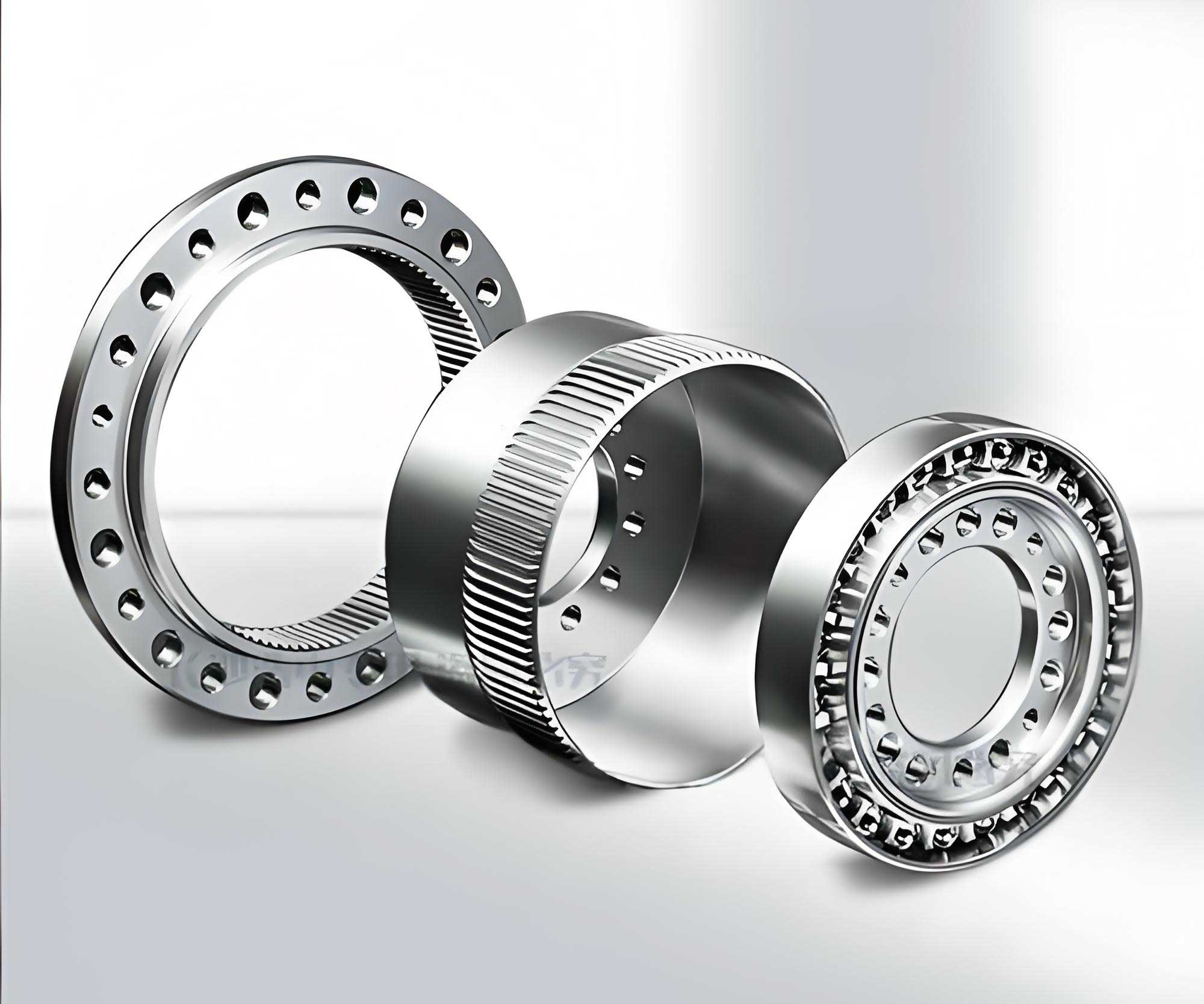
A double-wave harmonic drive gear is chosen as the subject of this study. The operating parameters are as follows: load torque T = 30 N·m (assumed steady), wave generator speed ωB = 3000 rpm, gear ratio u = 100, module m = 0.3 mm, and pressure angle α = 20°.
The key geometric parameters for the gears are summarized in the table below:
| Component | Parameter | Symbol | Value |
|---|---|---|---|
| Flexspline (Cup-type) | Number of Teeth | zR | 200 |
| Profile Shift Coefficient | xR | 3.45 | |
| Addendum Coefficient | haR* | 0.6 | |
| Dedendum Coefficient | hfR* | 1.35 | |
| Circular Spline | Number of Teeth | zG | 202 |
| Profile Shift Coefficient | xG | 3.48 | |
| Addendum Coefficient | haG* | 1 | |
| Fillet Coefficient | hfG* | 1.2 |
Modeling of the Cup-type Flexspline
To simplify the modeling process, the flexspline geometry was slightly simplified: the fillet between the gear rim and the cylinder, as well as the bolt holes on the flange, were omitted. However, the fillets at the transitions between the cup bottom, the flange, and the cylinder were retained to prevent stress concentrations due to deformation. The material for the flexspline is 32CrMnSiNiA. The primary dimensions are: cylinder length L = 48 mm, nominal wall thickness δ = 0.48 mm, thickness under the tooth root δf = 0.56 mm, gear rim width bR = 12 mm, front rim width b1 = 2.4 mm, inner diameter dR = 60 mm, cup bottom fillet radius R2 = 3 mm, flange outer diameter dT = 36 mm, and flange thickness H = 4 mm.
Modeling of the Cam-type Wave Generator
A cam-type wave generator typically consists of a cam and a flexible ball bearing. Modeling this assembly in detail is complex and computationally expensive. Therefore, a simplified approach was adopted: the wave generator was modeled as a rigid body. The outer contour of the flexible bearing’s outer ring was used to define the wave generator profile. To approximate the deformation of the bearing outer ring under the flexspline’s pressure, the cross-sectional profile of the wave generator was defined as a circular arc with a large radius.
The contour of the wave generator follows a cosine curve, described in polar coordinates by the equation:
$$ \rho_R = R_m + \omega_0 \cos(2\phi) $$
where $\rho_R$ is the radial coordinate of the contour, $R_m$ is the radius of the neutral curve of the undeformed flexspline (30 mm), $\omega_0$ is the maximum radial deformation of the flexspline (0.285 mm), and $\phi$ is the polar angle measured from the major axis.
Modeling of the Circular Spline
For modeling and computational efficiency, the circular spline was modeled as a simple ring. The material is 45 steel. Its main dimensions are: outer diameter dWG = 85 mm, inner diameter (tip diameter) daG = 62.088 mm, and axial width bT = 14 mm.
Finite Element Analysis and Results
The three-dimensional finite element model of the harmonic drive gear assembly was built in ABAQUS. The simulation was conducted in two sequential steps. First, the implicit solver (ABAQUS/Standard) was used to simulate the assembly process of the wave generator into the flexspline. The resulting assembly stress and deformation state were then imported as the initial condition for the second step. Subsequently, the explicit solver (ABAQUS/Explicit) was employed to simulate the dynamic operation of the harmonic drive gear under load. This two-step process provides insights into the flexspline’s behavior during both assembly and operation.
The results are presented in a cylindrical coordinate system with its origin at the geometric center of the flexspline. The starting position ($\phi = 0^\circ$) is defined at the major axis of the engagement region. The direction is clockwise-positive. Radial deformation is positive for expansion and negative for contraction. Circumferential (tangential) deformation is positive counter-clockwise and negative clockwise.
Results of the Wave Generator Assembly Simulation
During assembly, the flexspline undergoes initial deformation and develops assembly stresses. Understanding this initial state is crucial for assessing the performance of the harmonic drive gear.
Initial Deformation of the Flexspline
Based on the assumption that the initial deformation function matches the wave generator contour, the theoretical deformation functions are:
$$ \omega_{theory} = \omega_0 \cos(2\phi) $$
$$ v_{theory} = \frac{\omega_0}{2} \sin(2\phi) $$
where $\omega$ is radial deformation and $v$ is circumferential deformation.
The FEA results show that both radial and circumferential deformations decrease along the length of the cylinder from the cup opening towards the closed end. The maximum radial deformation occurs near the cup opening at the major axis, with a value of 0.3543 mm, which is slightly larger than $\omega_0$ due to contact and elastic effects. The maximum circumferential deformation occurs near the cup opening at approximately $\phi = 45^\circ$ and $135^\circ$, with a value of 0.179 mm.
A comparison between FEA results and theoretical predictions reveals deviations, as summarized below:
| Deformation Type | Observation from FEA Comparison | Maximum Absolute Error | Maximum Error Rate |
|---|---|---|---|
| Radial ($\omega$) | FEA value > Theory at $\phi=0^\circ, 180^\circ$. FEA value < Theory at $\phi=90^\circ, 270^\circ$, indicating a gap at the minor axis. | 0.00762 mm | 2.6% |
| Circumferential ($v$) | Deformation curve shows a slight shift towards the major axis. Zero-crossings remain at $\phi = 0^\circ, 90^\circ, 180^\circ, 270^\circ$. | 0.00439 mm | 2.87% |
These findings indicate that the theoretical initial deformation functions contain minor errors but remain a reasonably good approximation.
Assembly Stress in the Flexspline
The assembly induces a biaxial bending state (circumferential and axial) in the flexspline cylinder, generating both normal and shear stresses. The analysis reveals a maximum von Mises stress of 125.1 MPa. The maximum circumferential normal stress $\sigma_\theta$ is 102.4 MPa, and the maximum circumferential shear stress $\tau_{\theta z}$ is 20.79 MPa. Both maxima are located on the outer surface in the transition region between the gear rim and the cylinder at the major axis. The significantly higher value of $\sigma_\theta$ indicates that the assembly stress is predominantly composed of circumferential normal stress.
The variation of these stresses along the cylinder length is examined at three cross-sections (IV, V, VI), located at 0.27L, 0.28L, and 0.30L from the cup opening, respectively.
| Stress Component | Trend Along Cylinder Length | Values at Sections IV, V, VI |
|---|---|---|
| Circumferential Normal Stress $\sigma_\theta$ | Decreases monotonically from the rim towards the cup bottom. | 11.05 MPa, 5.77 MPa, 0.016 MPa (drops to ~0.015% of rim value). |
| Circumferential Shear Stress $\tau_{\theta z}$ | Exhibits a transition zone: decreases initially then increases slightly near the cup bottom, influenced by the stiffening effect of the diaphragm. | See Figure 14 for pattern. |
At the gear rim cross-section (Section III), the stress distribution is highly influenced by the teeth:
- Circumferential Normal Stress ($\sigma_\theta$): Shows significant fluctuation with a double-peak pattern near the major axis, indicating high stress concentration and potential for fatigue initiation.
- Circumferential Shear Stress ($\tau_{\theta z}$): Exhibits large, irregular fluctuations, especially at the major axis, due to non-uniform stiffness from the teeth and concentrated loading.
Results of the Dynamic Transmission Simulation
Under dynamic load, the meshing forces alter the deformation shape and internal stress distribution, leading to the cyclic stresses responsible for fatigue.
Flexspline Deformation Under Dynamic Load
The dynamic radial and circumferential deformations at different time instances (0, T/4, T/2, 3T/4, T, where T is the wave generator rotation period) were analyzed. Two key observations are:
- Radial Deformation: The deformation magnitude increases progressively from the start to the end of the simulated cycle due to dynamic impact. Furthermore, in certain regions, the radial deformation curve deviates from a perfect sinusoidal shape due to meshing impacts.
- Circumferential Deformation: The deformation magnitude also increases over time. The entire deformation curve shifts upward, and its phase angle exhibits a slight offset, resulting from the combined effect of the load and dynamic冲击.
Flexspline Stress Under Dynamic Load
The time-history of von Mises stress at a node on the neutral layer was tracked for several cross-sections (I to VI, from cup opening to bottom).
| Region / Section | Dynamic von Mises Stress Characteristics | Maximum Value |
|---|---|---|
| Gear Rim (Sections I, II, III) | Stress fluctuates with large amplitude and high frequency. The curve shows four distinct peaks per wave generator revolution, corresponding to stress cycles at the major and minor axes. | 482.6 MPa (Section II) |
| Cylinder (Sections IV, V, VI) | Stress amplitude and fluctuation frequency are significantly lower compared to the rim region. The stress level decays rapidly along the length. | 147.4 MPa (Section IV) |
The stress in the gear rim region (Section II) is approximately 4.3 times higher than in the far cylinder region (Section VI). This confirms that stress is heavily concentrated in the gear rim area, which is the most critical region for fatigue failure in a harmonic drive gear. The four-peak pattern in the rim’s stress history directly relates to the double-wave deformation, leading to two full stress cycles per revolution.
Conclusion
This investigation utilized a detailed three-dimensional finite element model within ABAQUS to simulate both the assembly and dynamic operation of a harmonic drive gear. The study provides accurate insights into the deformation and stress distribution within the flexspline.
Key findings regarding the assembly state are:
- The initial deformation of the flexspline shows slight deviations from the classical theoretical cosine/sine functions, but the error is acceptably small.
- Assembly stress is dominated by circumferential normal stress. This stress decays rapidly along the cylinder length. The circumferential shear stress exhibits a non-monotonic trend in a transition zone near the cup bottom.
- At the gear rim, the circumferential normal stress distribution is heavily modulated by the teeth, showing a double-peak pattern near the major axis, while shear stress shows erratic fluctuations.
Key findings regarding the dynamic operational state are:
- Under load, the radial deformation curve loses its perfect sinusoidal shape in some regions due to meshing impacts. The circumferential deformation curve undergoes a slight phase shift.
- Dynamic von Mises stress in the gear rim region is significantly higher and more volatile than in the cylinder. The stress history in the rim features four distinct peaks per wave generator revolution, corresponding to two full stress cycles. In contrast, stress fluctuation in the cylinder region is relatively mild.
This analysis underscores the critical importance of the gear rim region in the design and life prediction of harmonic drive gears, as it is the primary locus of high cyclic stress that drives fatigue failure.