
In my research on precision transmission systems, I have focused on improving the performance of harmonic drive gears, which are critical components in robotics and precision positioning due to their compact size, high reduction ratios, and accuracy. Traditional harmonic drive gears often use involute tooth profiles, but these exhibit limitations such as limited conjugate motion, reduced torsional stiffness, and lower dynamic performance. To address these issues, I have developed a novel double-circular-arc tooth profile for harmonic drive gears, specifically designed for elliptical wave generators, which are commonly used in industrial applications. This design ensures continuous conjugate motion throughout the engagement process, enhancing strength, transmission accuracy, and stiffness. In this article, I will detail the design methodology, parameter selection, mathematical modeling, and experimental validation of this double-circular-arc tooth profile for harmonic drive gears, emphasizing its advantages over conventional involute profiles.
The harmonic drive gear operates on the principle of elastic deformation, where a flexible spline (flexspline) meshes with a rigid spline (circular spline) via a wave generator. The wave generator, typically an elliptical cam, deforms the flexspline into an elliptical shape, enabling tooth engagement and disengagement. For harmonic drive gears, the tooth profile must accommodate this dynamic deformation to maintain conjugate motion—where the tooth surfaces remain in continuous contact without interference. My investigation into existing circular-arc profiles, such as those from Japan and Russia, revealed that they are tailored for specific wave generators (e.g., cosine cam or four-roller types) and may not be directly applicable to elliptical wave generators. Therefore, I aimed to create a double-circular-arc basic rack that guarantees conjugate motion for harmonic drive gears with elliptical wave generators, leveraging the kinematics of harmonic drive engagement.
To design the double-circular-arc tooth profile, I first established key parameters based on the meshing characteristics of harmonic drive gears. Unlike general gear transmissions, harmonic drive gears require careful consideration of parameters like tooth height, engagement depth, pressure angle, and clearances to avoid interference and ensure smooth operation. I derived these parameters through analytical studies and optimization, as summarized in the table below:
| Parameter | Symbol | Range or Value | Description |
|---|---|---|---|
| Module | m | 0.5 mm to 1.0 mm | Standard module for small harmonic drive gears |
| Full Tooth Height | h | 1.8m to 2.2m | Total height of the tooth to balance strength and clearance |
| Flexspline Addendum | h_a | 0.7m to 1.0m | Height from pitch circle to tooth tip for flexspline |
| Flexspline Dedendum | h_f | 1.1m to 1.5m | Height from pitch circle to tooth root for flexspline |
| Tip Clearance | C_a | 0.2m to 0.35m | Radial clearance between tooth tips to prevent contact |
| Nominal Pressure Angle | α_0 | 25° | Angle defining tooth inclination, optimized for harmonic drive gears |
| Tooth Thickness Ratio | K = s_f / s_a | 1.3 | Ratio of space width to tooth thickness on pitch circle |
| Lateral Clearance | j_1 | 0.01m to 0.02m | Side gap between teeth to accommodate manufacturing tolerances |
| Engagement Clearance | j_2 | 0.1m to 0.13m | Gap at tooth entry to avoid interference during meshing |
These parameters were selected through iterative analysis to minimize stress concentrations and maximize contact in harmonic drive gears. For instance, the tooth height is reduced compared to standard gears to account for the limited engagement angle in harmonic drive systems, while the pressure angle of 25° aligns with the average meshing angle observed in harmonic drive gears. The tooth thickness ratio K = 1.3 increases the flexspline slot width, reducing bending stiffness and improving fatigue life—a critical factor for harmonic drive gears. The clearances j_1 and j_2 ensure smooth meshing without tooth tip interference, which is common in harmonic drive gears due to the flexspline deformation.
The deformation of the flexspline under an elliptical wave generator is fundamental to the tooth profile design. I modeled the flexspline as a thin-walled cylinder with a neutral circle of radius r. Under the elliptical cam, the radial displacement w, tangential displacement v, and normal rotation μ at an angular coordinate φ are derived from elliptic integrals. Let a and b be the semi-major and semi-minor axes of the ellipse, with k^2 = (a^2 – b^2)/b^2. The radial displacement is given by:
$$ w(φ) = a f(φ) – r $$
where f(φ) is expanded as:
$$ f(φ) = \frac{1}{\sqrt{1 + k^2 \sin^2 φ}} = 1 – \frac{1}{2} k^2 \sin^2 φ + \frac{3}{8} k^4 \sin^4 φ – \frac{15}{48} k^6 \sin^6 φ + \frac{105}{384} k^8 \sin^8 φ – \frac{945}{3840} k^{10} \sin^{10} φ + \cdots $$
The tangential displacement and normal rotation are:
$$ v(φ) = rφ – a \int f(φ) dφ $$
$$ μ(φ) = \frac{1}{r} \left( v – \frac{dw}{dφ} \right) $$
These equations describe the flexspline’s shape during operation, which directly influences the tooth meshing in harmonic drive gears. To analyze the conjugate motion, I employed an invariant matrix method that encapsulates the kinematics of harmonic drive gears. This matrix, denoted as M, depends only on the wave generator type and motion parameters, allowing efficient computation of conjugate tooth profiles for any given tooth shape. For an elliptical wave generator, the elements of M are derived from w(φ), v(φ), μ(φ), and their derivatives with respect to φ. This approach simplifies the design process for harmonic drive gears, as the same matrix can be reused for different tooth profiles.
The double-circular-arc tooth profile consists of convex and concave arcs on both the flexspline and rigid spline. I defined the tooth profiles in a coordinate system attached to the flexspline tooth. For the flexspline’s convex arc (right side), let ρ_a be the arc radius, α_0 = 25° the nominal pressure angle, and h_a the addendum. The center offset parameters X_a (shift distance) and l_a (offset) are:
$$ X_a = ρ_a \sin α_0 – \frac{h_a}{2} $$
$$ l_a = \sqrt{ρ_a^2 – X_a^2} – \frac{s_a}{2} $$
where s_a is the tooth thickness on the pitch circle. In the flexspline tooth coordinate system, the convex arc equation is:
$$ \mathbf{r}_{S11} = (ρ_a \cos α_a – x_{oa}) \mathbf{i} + (ρ_a \sin α_a + y_{oa}) \mathbf{j} + u_a \mathbf{k} $$
$$ \mathbf{n}_{S11} = \cos α_a \mathbf{i} + \sin α_a \mathbf{j} $$
Here, (x_{oa}, y_{oa}) = (-l_a, h – h_a + t/2 – X_a) is the center coordinates, with t as the flexspline wall thickness, α_a the pressure angle at any point on the arc, and u_a a longitudinal parameter. Similarly, for the flexspline’s concave arc (right side), with radius ρ_f and center (x_{of}, y_{of}) = (πm/2 + l_f, h – h_a + t/2 + X_f), the equations are:
$$ \mathbf{r}_{S12} = (x_{of} – ρ_f \cos α_f) \mathbf{i} + (y_{of} – ρ_f \sin α_f) \mathbf{j} + u_f \mathbf{k} $$
$$ \mathbf{n}_{S12} = -\cos α_f \mathbf{i} – \sin α_f \mathbf{j} $$
where X_f and l_f are the shift and offset for the concave arc, and α_f is the local pressure angle. These profiles are optimized to ensure conjugate motion throughout the engagement in harmonic drive gears. By substituting these equations into the invariant matrix M, I computed the theoretical conjugate profiles for the rigid spline. The convex arc of the flexspline generates two conjugate profiles on the rigid spline: S_{21} in region I and S_{22} in region II. Numerical fitting showed that S_{21} can be accurately approximated by a circular arc, which serves as the concave arc of the rigid spline. Similarly, the concave arc of the flexspline must generate a conjugate profile S’_{22} that matches S_{22} to avoid interference—a key requirement for harmonic drive gears.
The design process for the double-circular-arc tooth profile in harmonic drive gears involves several steps, as outlined below:
| Step | Description | Objective |
|---|---|---|
| 1 | Design flexspline convex and concave arcs (S_{11} and S_{12}) | Maximize flexspline strength and minimize stress |
| 2 | Compute conjugate profiles S_{21} and S_{22} from S_{11} using invariant matrix M | Determine rigid spline arcs that ensure conjugate motion |
| 3 | Fit S_{21} to a circular arc for rigid spline concave profile | Simplify manufacturing for harmonic drive gears |
| 4 | Compute conjugate profile S_{23} from S_{12} and verify it matches S_{22} | Avoid interference in harmonic drive gears during meshing |
| 5 | Finalize tooth profiles for both flexspline and rigid spline | Achieve continuous “dual-conjugate” engagement in harmonic drive gears |
This process ensures that during meshing, the harmonic drive gear exhibits a “dual-conjugate” zone where both convex and concave arcs of the flexspline simultaneously engage with the corresponding arcs of the rigid spline. This phenomenon is unique to double-circular-arc harmonic drive gears and significantly enhances torsional stiffness and transmission accuracy. The final basic rack profiles are shown schematically below, with the flexspline featuring symmetric double arcs and the rigid spline having complementary arcs. To visualize the tooth engagement in harmonic drive gears, I include an illustration of the meshing process:
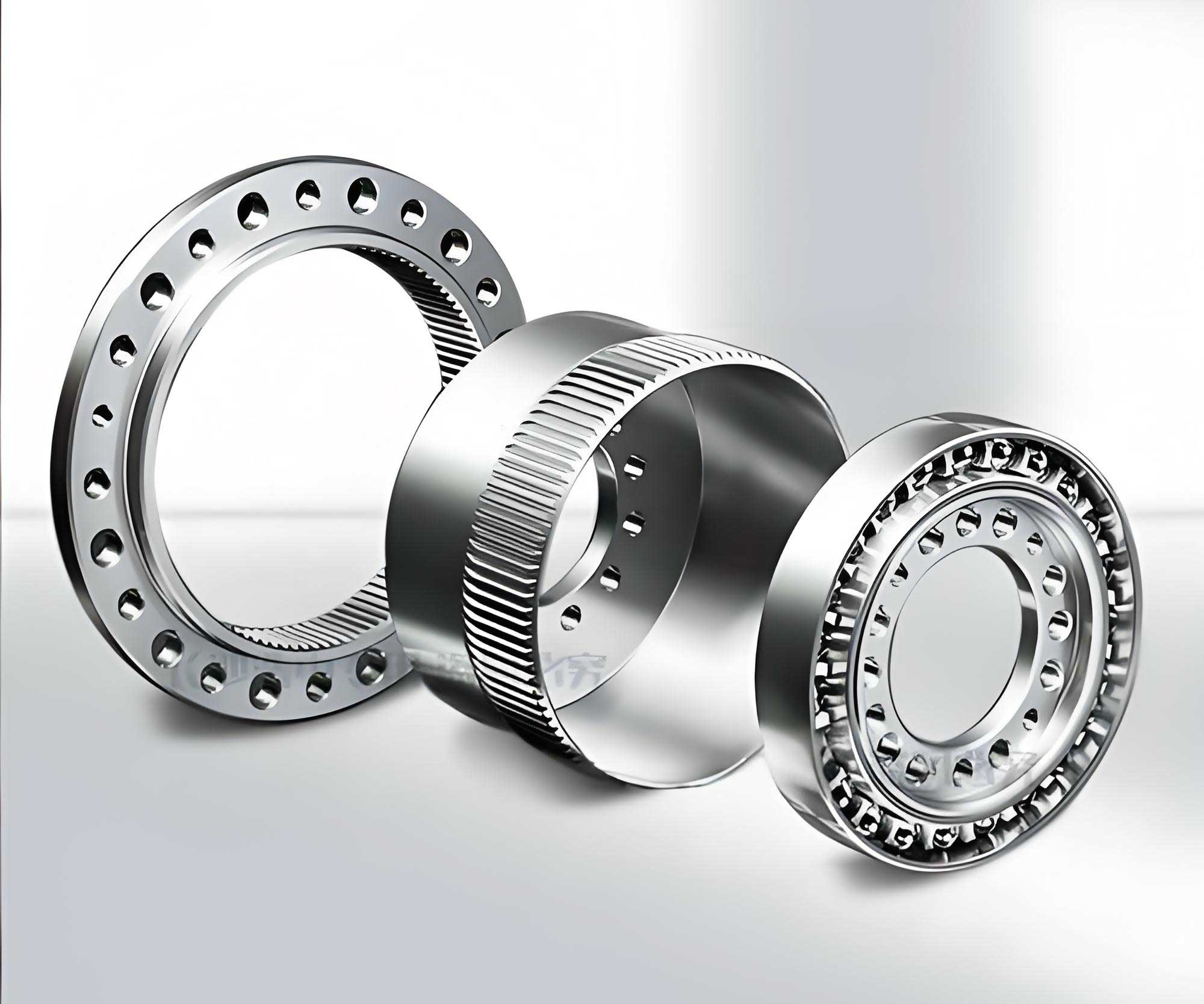
The mathematical optimization of parameters like ρ_a, ρ_f, X_a, and l_f was performed using numerical methods, as analytical solutions are intractable due to elliptic integrals. The fitting error for the circular arcs was on the order of 10^{-6} mm, well within manufacturing tolerances for harmonic drive gears. This design is specifically tailored for elliptical wave generators, making it compatible with common harmonic drive gear production techniques. Unlike involute profiles, which only achieve conjugate motion in narrow zones, the double-circular-arc profile maintains conjugate contact across the entire engagement arc, increasing the number of tooth pairs in contact and distributing loads more evenly in harmonic drive gears.
To validate the design, I manufactured cutting tools and prototype harmonic drive gears based on the double-circular-arc basic rack. Hobs for flexspline machining and shaper cutters for rigid spline machining were produced for modules m = 0.5 mm, 0.6 mm, 0.7 mm, 0.8 mm, and 1.0 mm. For instance, the hob and cutter for m = 1.0 mm are shown in the figure above, demonstrating practical feasibility. A prototype harmonic drive gear with m = 1.0 mm, reduction ratio i = 100, and an elliptical wave generator was assembled and tested. Comparative experiments were conducted against a conventional involute-profile harmonic drive gear of similar specifications.
The results highlighted the advantages of double-circular-arc harmonic drive gears. Finite element analysis revealed that the maximum root stress in the flexspline was reduced by 25.52% compared to involute profiles, indicating improved fatigue life and load capacity. Transmission accuracy tests showed a 24.27% increase in motion accuracy for the double-circular-arc harmonic drive gear, attributed to the continuous conjugate motion. Torsional stiffness was measured under loading and unloading cycles, as summarized in the table below:
| Load Condition | Torsional Stiffness Increase | Description |
|---|---|---|
| Unloading (low torque) | 28% to 66% higher | Stiffness enhancement as torque decreases in harmonic drive gears |
| Loading (high torque) | 20% to 42% higher | Stiffness improvement under increasing torque in harmonic drive gears |
These stiffness gains are crucial for dynamic performance in applications like robotics, where harmonic drive gears must respond precisely to varying loads. The “dual-conjugate” engagement zone likely contributes to this by providing more simultaneous tooth contacts, reducing elastic deformation in harmonic drive gears. Additionally, the larger root fillet radius in double-circular-arc profiles further boosts flexspline strength, addressing a common failure mode in harmonic drive gears.
In terms of manufacturing, the double-circular-arc design for harmonic drive gears offers good processability. The hobs and cutters can be fabricated using standard gear-cutting techniques, and the tooth profiles do not require helical teeth to maintain continuity—unlike general circular-arc gears—simplifying production for harmonic drive gears. This aligns with industrial practices for harmonic drive gear manufacturing, where straight teeth are preferred for ease of assembly and cost-effectiveness. The design also accommodates standard clearances and tolerances, ensuring reliable performance in harmonic drive gears under real-world conditions.
Looking forward, the double-circular-arc tooth profile presents opportunities for further optimization in harmonic drive gears. Parameters like the radius difference Δρ between convex and concave arcs could be fine-tuned for specific applications, such as high-precision or high-torque harmonic drive gears. Additionally, the invariant matrix method can be extended to other wave generator types, broadening the applicability of this design for harmonic drive gears. My ongoing research explores adaptive algorithms for tooth profile generation, aiming to further enhance the efficiency and durability of harmonic drive gears.
In conclusion, I have developed a double-circular-arc basic rack for harmonic drive gears with elliptical wave generators, ensuring continuous conjugate motion and “dual-conjugate” engagement. Through mathematical modeling, parameter optimization, and experimental validation, this design demonstrates superior performance in strength, accuracy, and stiffness compared to traditional involute profiles for harmonic drive gears. The methodology leverages kinematic principles and numerical fitting to create practical tooth profiles, supported by manufactured tools and prototypes. This advancement contributes to the evolution of harmonic drive gears, enabling more reliable and dynamic transmission systems in robotics and precision machinery. Future work will focus on scaling the design for larger harmonic drive gears and integrating it with advanced materials to push the boundaries of harmonic drive gear technology.