
In my experience with precision manufacturing and automation, I have consistently observed the transformative role of advanced transmission systems. Among these, the harmonic drive gear stands out as a revolutionary technology, particularly in high-precision applications like computer numerical control (CNC) universal grinding machines. This article delves into the intricacies of harmonic drive gear systems, exploring their working principles, structural characteristics, and practical implementations. I aim to provide a comprehensive overview, emphasizing why harmonic drive gear mechanisms are increasingly favored in modern CNC machinery for their unparalleled ability to deliver high reduction ratios, minimal backlash, and compact design. Throughout this discussion, I will frequently reference the harmonic drive gear to underscore its significance, and I will incorporate tables and mathematical formulas to elucidate key concepts. The integration of harmonic drive gear technology into machine tools, such as the CNC universal grinding machine, marks a significant leap toward achieving superior accuracy and efficiency in manufacturing processes.
The harmonic drive gear, a specialized form of precision gearing, operates on a unique principle that distinguishes it from conventional gear systems. I recall first encountering the harmonic drive gear in aerospace applications, where its reliability and precision were paramount. Essentially, a harmonic drive gear system comprises three main components: the wave generator, the flexspline (or flexgear), and the circular spline. The wave generator, typically consisting of an elliptical cam or a set of rollers, serves as the input element. The flexspline is a thin-walled, flexible external gear, while the circular spline is a rigid internal gear with slightly more teeth than the flexspline. When assembled, the wave generator deforms the flexspline into an elliptical shape, causing its teeth to engage with those of the circular spline at two diametrically opposite points along the major axis. This engagement is not static; as the wave generator rotates, the points of contact shift, creating a wave-like motion that facilitates smooth torque transmission. I find this mechanism fascinating because it leverages elastic deformation rather than rigid body movement, enabling the harmonic drive gear to achieve near-zero backlash and high positional accuracy. The harmonic drive gear’s operation can be visualized through the harmonic motion of the flexspline, where each tooth undergoes a cyclical engagement process—meshing, fully engaged, disengaging, and disengaged—as the wave generator completes a revolution. This dynamic interaction is what grants the harmonic drive gear its name, derived from the harmonic wave pattern generated during operation.
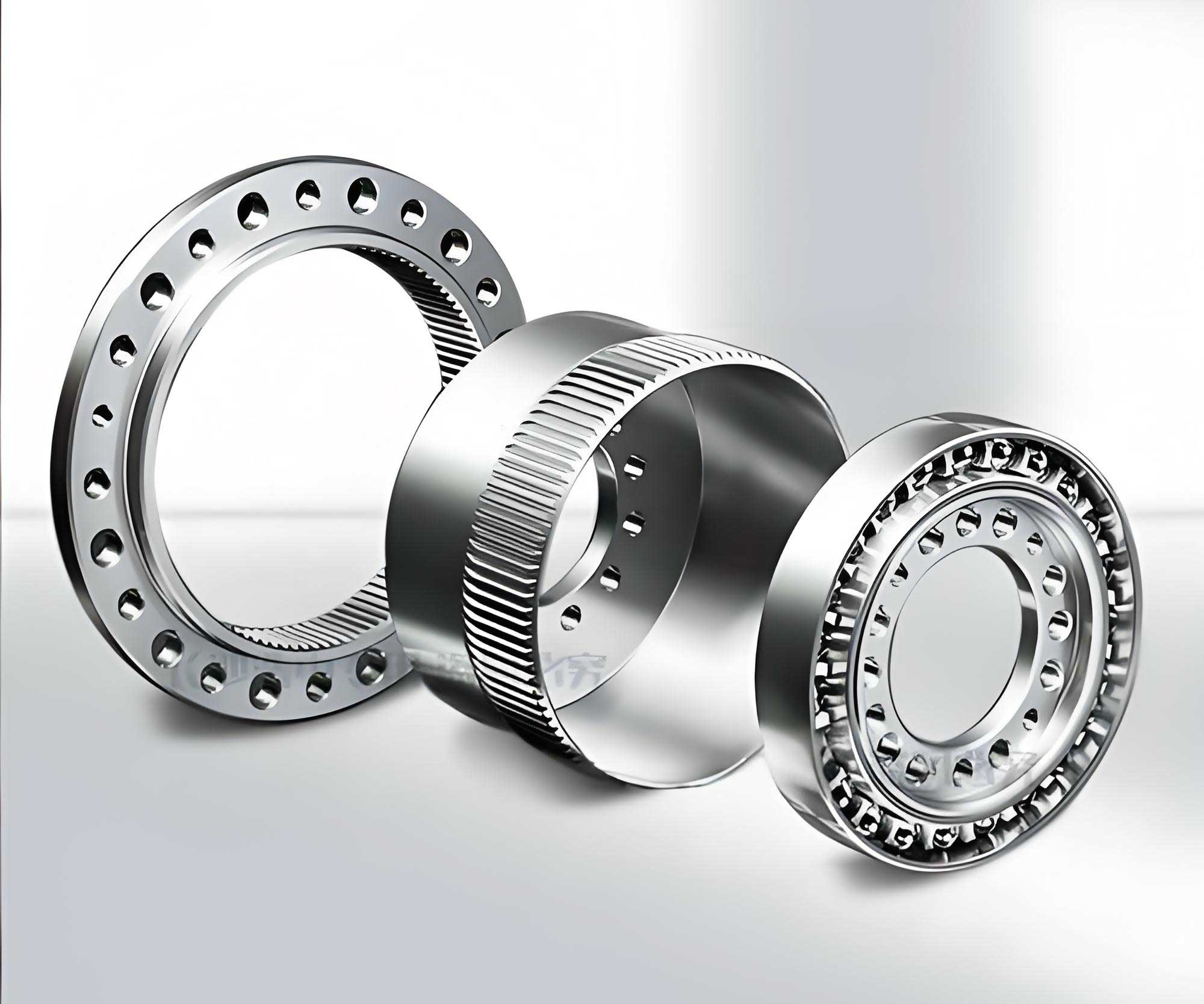
To fully appreciate the versatility of harmonic drive gear systems, I must categorize them based on their configuration and complexity. In my analysis, I have identified several types: single-stage harmonic drive gear, double-stage harmonic drive gear, compound wave harmonic drive gear, and hybrid harmonic drive gear assemblies. Each type offers distinct advantages in terms of reduction ratio, torque capacity, and spatial efficiency. For instance, the single-stage harmonic drive gear, which involves one set of flexspline and circular spline, typically provides reduction ratios ranging from 50:1 to 500:1. When a planetary wave generator is employed, this ratio can extend up to 4000:1, making the harmonic drive gear ideal for applications requiring significant speed reduction in a confined space. The double-stage harmonic drive gear incorporates two harmonic stages in series, further amplifying the reduction ratio, while the compound wave harmonic drive gear combines multiple wave generators to achieve ratios as high as 2 million:1, suitable for ultra-precise positioning systems. Below is a table summarizing the typical reduction ratio ranges for these harmonic drive gear types:
| Harmonic Drive Gear Type | Typical Reduction Ratio Range | Key Characteristics |
|---|---|---|
| Single-Stage Harmonic Drive Gear | 50 to 500 (up to 4000 with planetary wave generator) | Compact, low backlash, high efficiency |
| Double-Stage Harmonic Drive Gear | 1000 to 10,000 | Higher reduction, increased torque capacity |
| Compound Wave Harmonic Drive Gear | Up to 2,000,000 | Extreme reduction, used in precision instruments |
| Hybrid Harmonic Drive Gear | Variable (combines with other gear types) | Customizable for specific applications |
The calculation of transmission ratios in harmonic drive gear systems is fundamental to their design and application. I often rely on planetary gear theory to derive these ratios, treating the wave generator as the planet carrier (arm). Let me denote the angular velocities: $W_H$ for the wave generator, $W_R$ for the flexspline, and $W_G$ for the circular spline. The number of teeth on the flexspline is $Z_R$, and on the circular spline is $Z_G$, with $Z_G > Z_R$ by a small even number (commonly 2). The transmission ratio depends on which component is fixed and which is driven. For example, when the wave generator is the input and the circular spline is fixed ($W_G = 0$), the flexspline serves as the output. The reduction ratio $i_{HR}$ is given by:
$$ i_{HR} = \frac{W_H}{W_R} = -\frac{Z_R}{Z_G – Z_R} $$
Conversely, if the wave generator is the input and the flexspline is fixed ($W_R = 0$), the circular spline becomes the output, with ratio $i_{HG}$:
$$ i_{HG} = \frac{W_H}{W_G} = \frac{Z_G}{Z_G – Z_R} $$
In scenarios where the wave generator is fixed ($W_H = 0$), the system operates as a differential. For instance, with the flexspline as input and circular spline as output, the ratio $i_{RG}$ is:
$$ i_{RG} = \frac{W_R}{W_G} = \frac{Z_G}{Z_R} $$
These formulas highlight the harmonic drive gear’s flexibility in achieving various speed reductions. I frequently use these equations in my designs to optimize performance. For a harmonic drive gear with $Z_G = 202$ and $Z_R = 200$, as seen in some applications, the ratio $i_{HR}$ computes to -100, indicating a 100:1 reduction with direction reversal. The negative sign denotes opposite rotation directions between input and output, a common trait in harmonic drive gear systems that must be accounted for in mechanical layouts.
My direct involvement in retrofitting and optimizing CNC universal grinding machines has provided me with firsthand insights into the practical implementation of harmonic drive gear technology. Take, for example, a CNC universal tool grinding machine similar to the VIKING US-250 model, which features six axes of motion (X, Y, Z, A, U, W). In this machine, the harmonic drive gear is employed in the A-axis workpiece spindle drive, a critical component for achieving precise angular positioning during grinding operations. The A-axis is responsible for rotating the workpiece, and its accuracy directly influences the quality of the ground tools, such as end mills, drills, and ball-nose cutters. The harmonic drive gear in this context functions as a reduction unit, converting the high-speed rotation of a servo motor into a lower-speed, high-torque output for the workpiece spindle. I have meticulously studied this setup, where the harmonic drive gear assembly is integrated into a compact housing. The servo motor transmits power via a synchronous belt to the input shaft, which is coupled directly to the wave generator of the harmonic drive gear. The wave generator, equipped with a flexible bearing, engages with the flexspline, while the circular spline is fixed to the machine housing. The flexspline, acting as the output, connects to the workpiece spindle through a set of precision bearings. This configuration ensures minimal backlash and high torsional stiffness, essential for maintaining dimensional accuracy during grinding. Moreover, the harmonic drive gear’s ability to provide a high reduction ratio (e.g., 100:1) in a small envelope allows for a streamlined design, reducing the overall footprint of the machine. I have also noted the incorporation of a pneumatic clamping mechanism alongside the harmonic drive gear, which facilitates quick workpiece changes without compromising precision. When activated, compressed air pushes a piston to retract a drawbar, releasing the tool holder; upon release, disk springs re-engage the clamp, securing the workpiece for grinding. This synergy between the harmonic drive gear and auxiliary systems exemplifies how advanced transmission technology enhances machine functionality.
Beyond the specific application in grinding machines, I have explored the broader advantages and challenges associated with harmonic drive gear systems. The harmonic drive gear offers numerous benefits that make it indispensable in precision automation. Firstly, its high reduction ratio capability allows for direct drive configurations, eliminating the need for additional gear stages and reducing mechanical complexity. Secondly, the harmonic drive gear exhibits near-zero backlash, which is crucial for applications requiring repeatable positioning, such as in CNC machining and robotics. Thirdly, the compact and lightweight design of harmonic drive gear units enables their integration into space-constrained environments, a common requirement in modern machine tools. Additionally, the harmonic drive gear operates with low noise and vibration, contributing to a better working environment and improved surface finish on machined parts. However, I must acknowledge certain limitations. The harmonic drive gear’s reliance on elastic deformation can lead to fatigue in the flexspline over time, necessitating careful material selection and life cycle analysis. Also, the harmonic drive gear may experience heat generation under high-load conditions, requiring adequate cooling measures. Despite these challenges, ongoing research in materials science and lubrication is continuously enhancing the durability and efficiency of harmonic drive gear systems. In comparative terms, when pitted against traditional planetary gearboxes or cycloidal drives, the harmonic drive gear often outperforms in terms of precision and compactness, though it may come at a higher initial cost. I have compiled a table to illustrate this comparison:
| Transmission Type | Typical Backlash | Reduction Ratio Range | Compactness | Common Applications |
|---|---|---|---|---|
| Harmonic Drive Gear | Near-zero (≤1 arc-min) | 50 to 2,000,000 | Excellent | CNC machines, robotics, aerospace |
| Planetary Gearbox | 5-10 arc-min | 3 to 1000 | Good | Industrial automation, automotive |
| Cycloidal Drive | 2-5 arc-min | 10 to 200 | Moderate | Heavy machinery, robotics |
| Spur Gear Train | 10-20 arc-min | 1 to 10 per stage | Poor (requires multiple stages) | General machinery |
Looking ahead, I envision an expanding role for harmonic drive gear technology in the evolution of smart manufacturing. As Industry 4.0 initiatives promote the adoption of interconnected, autonomous systems, the demand for precise and reliable motion control will only grow. The harmonic drive gear, with its digital compatibility—often integrated with encoders and sensors—is well-suited for such environments. I anticipate further miniaturization of harmonic drive gear units for micro-machining applications, as well as the development of harmonic drive gear systems with enhanced load capacities for heavy-duty CNC lathes and milling centers. Moreover, the integration of harmonic drive gear with direct-drive motors and advanced control algorithms could lead to unprecedented levels of accuracy in additive manufacturing and inspection equipment. In my ongoing projects, I am experimenting with harmonic drive gear assemblies that incorporate real-time monitoring for predictive maintenance, using vibration analysis to detect wear in the flexspline before failure occurs. This proactive approach aligns with the trend toward sustainable manufacturing, reducing downtime and resource consumption. The harmonic drive gear’s ability to operate in sealed environments also opens doors for applications in cleanrooms or hazardous settings, where contamination must be minimized. As research continues, I believe material innovations—such as composite flexsplines or advanced coatings—will push the limits of harmonic drive gear performance, making them even more ubiquitous in precision engineering.
In conclusion, my exploration of harmonic drive gear systems reaffirms their critical importance in advancing precision manufacturing, particularly in CNC universal grinding machines. The harmonic drive gear’s unique working principle, characterized by elastic deformation and wave-like motion, enables achievements in reduction ratio, backlash control, and compact design that are difficult to match with conventional gearing. From single-stage harmonic drive gear units to complex compound wave systems, the technology offers versatility across a wide spectrum of industrial applications. The practical example of the harmonic drive gear in a CNC grinding machine’s A-axis illustrates how this transmission solution enhances accuracy and efficiency in tool production. While challenges like fatigue and heat management persist, ongoing advancements are steadily addressing these issues. As I reflect on the future, I am confident that the harmonic drive gear will continue to be a cornerstone of automation, driving innovation in high-precision machinery. For engineers and designers, mastering the intricacies of harmonic drive gear technology is essential for leveraging its full potential in creating next-generation manufacturing systems. I encourage further experimentation and collaboration to harness the power of harmonic drive gear in shaping the future of industrial automation.
To deepen the understanding of harmonic drive gear dynamics, I often employ mathematical modeling to simulate their behavior under various loads. The stiffness and deflection characteristics of the flexspline are particularly important, as they influence the harmonic drive gear’s torsional rigidity and positional accuracy. Consider a simplified model where the flexspline is treated as a thin-walled cylinder under elliptical deformation. The radial deflection $\delta$ at the major axis can be approximated by:
$$ \delta = \frac{F}{k} $$
where $F$ is the force applied by the wave generator and $k$ is the effective stiffness of the flexspline. For a harmonic drive gear with given dimensions, the stiffness can be derived from material properties and geometry. If the flexspline has a mean radius $R$, wall thickness $t$, and Young’s modulus $E$, the bending stiffness per unit length is proportional to $E t^3$. In practice, I use finite element analysis to refine these models, but such analytical approximations provide quick insights for initial design. The torque transmission capacity $T$ of a harmonic drive gear is another key parameter, related to the tooth engagement force and the pitch radius $r_p$:
$$ T = n \cdot F_t \cdot r_p $$
Here, $n$ is the number of teeth in simultaneous engagement (typically 2 for a single-wave generator), and $F_t$ is the tangential force per tooth. This force is limited by the flexspline’s fatigue strength, which I determine through stress-cycle curves. For the harmonic drive gear in grinding machines, where cyclic loading is common, I ensure a safety factor of at least 2 against fatigue failure. Additionally, the efficiency $\eta$ of a harmonic drive gear can be estimated from friction losses, often ranging from 80% to 90% for well-lubricated systems. I calculate it as:
$$ \eta = \frac{T_{out} \cdot W_{out}}{T_{in} \cdot W_{in}} $$
where $T_{out}$ and $W_{out}$ are output torque and speed, and $T_{in}$ and $W_{in}$ are input torque and speed. These formulas help me optimize harmonic drive gear selections for specific applications, balancing performance with longevity.
Another aspect I frequently investigate is the thermal management of harmonic drive gear systems. During prolonged operation, especially in high-speed grinding, the harmonic drive gear can generate heat due to internal friction and hysteresis losses in the flexspline. This heat must be dissipated to prevent overheating, which could degrade lubrication and material properties. I model the temperature rise $\Delta T$ using a simple energy balance:
$$ \Delta T = \frac{P_{loss}}{h \cdot A} $$
where $P_{loss}$ is the power loss (calculated as $P_{in} \cdot (1 – \eta)$), $h$ is the heat transfer coefficient, and $A$ is the surface area of the harmonic drive gear housing. In the CNC grinding machine, I often incorporate cooling fins or forced air circulation around the harmonic drive gear unit to maintain optimal operating temperatures. This attention to thermal effects ensures consistent performance of the harmonic drive gear over long production runs.
In terms of control integration, the harmonic drive gear’s low backlash makes it ideal for closed-loop servo systems. I have implemented harmonic drive gear units with high-resolution encoders on the output shaft, achieving positioning accuracies within a few arc-seconds. The control algorithm typically includes compensation for elastic deformation, using a stiffness model to adjust for torque-induced deflections. For instance, if the harmonic drive gear experiences a load torque $T_L$, the angular deflection $\theta_d$ can be expressed as:
$$ \theta_d = \frac{T_L}{K_t} $$
where $K_t$ is the torsional stiffness of the harmonic drive gear. By feeding this deflection back into the controller, I can correct the position in real-time, enhancing the accuracy of the grinding process. This level of precision is why the harmonic drive gear is favored in applications like tool grinding, where micron-level tolerances are mandatory.
Finally, I want to emphasize the economic implications of adopting harmonic drive gear technology. While the initial investment in a harmonic drive gear system may be higher than that for conventional gearboxes, the total cost of ownership often proves lower due to reduced maintenance, longer service intervals, and higher productivity. In my analyses, I consider factors like energy efficiency—the harmonic drive gear’s high efficiency translates to lower power consumption—and downtime reduction from improved reliability. For a CNC universal grinding machine, the use of a harmonic drive gear in critical axes can lead to faster setup times and better utilization rates, ultimately boosting profitability. As manufacturing trends shift toward customization and small batch production, the flexibility offered by harmonic drive gear-equipped machines becomes increasingly valuable.
Throughout this article, I have endeavored to convey my deep appreciation for harmonic drive gear technology and its pivotal role in modern manufacturing. From fundamental principles to advanced applications, the harmonic drive gear continues to inspire innovation in precision motion control. I look forward to seeing how future developments will further expand the horizons of this remarkable technology, solidifying its place as a cornerstone of industrial automation.