
In the field of power transmission, achieving high reduction ratios with substantial torque capacity in a compact package remains a significant engineering challenge. Conventional harmonic drive gear systems, renowned for their high precision and excellent reduction ratios, are fundamentally limited by the fatigue strength of their flexible spline. This limitation creates a direct conflict between the necessary deformation for wave generation and the component’s ability to bear heavy loads, thus restricting their application in high-power scenarios. To transcend this barrier, a novel architecture has been developed: the movable-toothed end-face harmonic drive gear. This configuration synthesizes the principle of wave generation from traditional harmonic drives with the force-transmission mechanism of movable-tooth (or “oscillating roller”) gears. The primary innovation lies in replacing the continuous, deformable flexspline with a set of discrete, rigid teeth (the “movable teeth”) that oscillate axially within a stationary carrier. This design effectively decouples the wave-generating function from the primary load-bearing structure, allowing for a significant increase in module size, the number of simultaneously engaged teeth, and consequently, the transmissible power. This advancement promises to extend the benefits of harmonic drive gear technology—namely, high single-stage reduction ratios, compactness, and low backlash—into domains requiring robust, high-torque speed reducers, such as heavy machinery, mining, and marine applications.
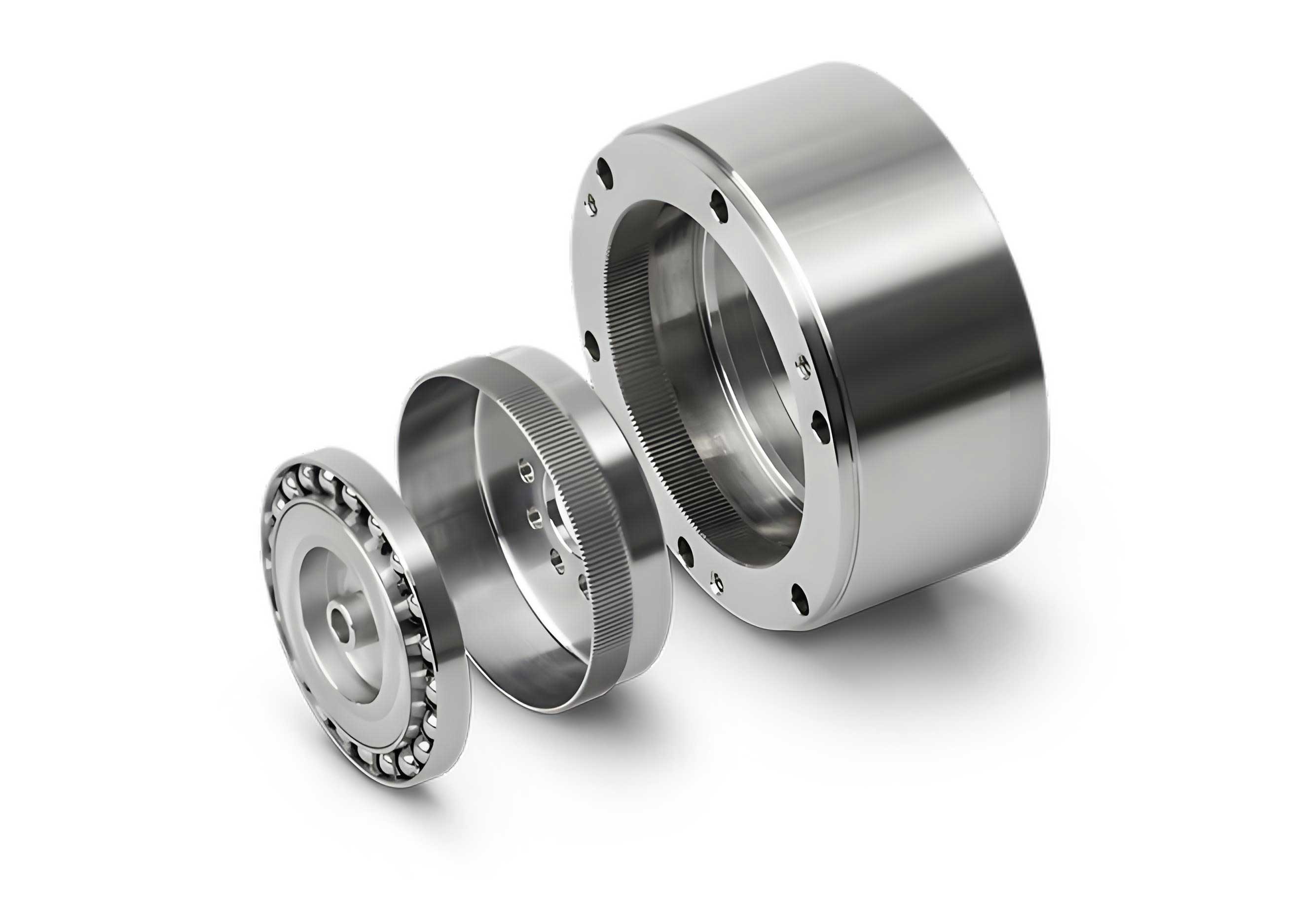
The core mechanism of this movable-toothed end-face harmonic drive gear involves two critical meshing pairs. The first pair (Pair A) is between the wave generator and the rear ends of the movable teeth. The second pair (Pair B) is between the front ends of the movable teeth and an end-face gear. For simplicity in initial design and manufacturing, the theoretical tooth surfaces for both pairs are often defined as multi-start Archimedean helicoids, where the generatrix is a straight line perpendicular to and intersecting the axis of rotation. While geometrically straightforward, this theoretical profile introduces a critical dynamic flaw. As the wave generator rotates, it compels each movable tooth to undergo a reciprocating axial motion. At the precise instant a movable tooth passes over the crest or trough (the “tooth top” or “tooth root”) of the wave generator’s profile, its axial velocity must instantaneously reverse direction. This results in a theoretically infinite acceleration, subjecting the entire transmission system to severe inertial shock, potential vibration, and risk of mechanical failure. This issue is not unique to Pair A; a similar condition occurs at the corresponding engagement points with the end-face gear in Pair B. Therefore, to ensure smooth operation and practical viability, a methodical modification of the theoretical tooth surfaces is imperative. The objective is to reshape the crest and root regions of the wave generator and the corresponding zones on the end-face gear and movable teeth, creating a smooth, continuous transition that allows the movable tooth’s axial velocity to change gradually from a positive value, through zero, to a negative value, thereby eliminating the shock.
Several geometric forms can be employed for this transition, including circular arcs, sinusoidal curves, or polynomial surfaces. This analysis advocates for the use of a quadratic (second-order polynomial) curve for the modification. This method offers an excellent balance: it provides a continuous first derivative (slope) for smooth velocity transition, its curvature can be easily controlled, and it leads to tractable mathematical formulations for design and verification. The following sections detail the derivation of the modified profiles for both meshing pairs and establish the fundamental principle governing their interdependent dimensions.
Mathematical Derivation of Tooth Surface Modification
1. Modification of the Wave Generator and Movable Tooth Rear End (Pair A)
To visualize the modification, consider the tooth surface of meshing Pair A intersected by a cylindrical surface of radius `r`. When this developed surface is laid out flat, the theoretical profile appears as a straight line with a constant slope. The modification zones at the wave generator’s crest and root will appear as curved segments connecting these straight-line sections.
1.1 Crest Modification of the Wave Generator
For the crest region, a local coordinate system is established on the developed plane, as illustrated conceptually below. The `ξ`-axis lies along the line connecting the start and end points of the modification zone. The `z`-axis represents the axial direction, positive from the tooth root to the tooth top. The origin `O` is at the midpoint of the modification zone.
Let the quadratic curve for the modified crest of the wave generator be represented as:
$$ z = f(ξ) = aξ^2 + bξ + c $$
where `a`, `b`, `c` are coefficients to be determined. To ensure a smooth (tangent) connection with the unmodified, theoretical tooth flank, the curve must satisfy boundary conditions at the start `(-ξ_0)` and end `(ξ_0)` of the modification zone:
- The height `z` must be zero at both boundaries, connecting to the theoretical line.
- The slope `dz/dξ` at the boundaries must equal the slope `k_0` of the theoretical tooth flank.
Thus, the conditions are:
$$ f(ξ_0) = 0, \quad f(-ξ_0) = 0, \quad f'(ξ_0) = -k_0, \quad f'(-ξ_0) = k_0 $$
The slope `k_0` is the tangent of the lead angle `θ` of the theoretical Archimedean helicoid:
$$ k_0 = \tan θ = \frac{h U}{2π r} $$
where `h` is the axial lead (tooth height) of the wave generator profile and `U` is its number of waves (starts).
Solving the system of equations yields:
$$ a = -\frac{k_0}{2ξ_0}, \quad b = 0, \quad c = \frac{k_0 ξ_0}{2} $$
Therefore, the modification curve in the developed plane is:
$$ z = f(ξ) = -\frac{k_0}{2ξ_0} ξ^2 + \frac{k_0 ξ_0}{2} $$
The parameter `ξ_0` is related to the axial height `h_{W1}` allocated for the wave generator’s crest modification. Since the theoretical flank is a straight line in this development, the relationship is `ξ_0 = h_{W1} / k_0`. Substituting this and the expression for `k_0` gives:
$$ z = f(ξ) = -\frac{h^2 U^2}{8π^2 r^2 h_{W1}} ξ^2 + \frac{h_{W1}}{2} $$
Recognizing that the developed circumferential coordinate relates to the angular rotation as `ξ = r φ_{W1}`, where `φ_{W1}` is the wave generator’s rotation angle from the crest’s symmetric point, we obtain the defining equation for the modified surface on the cylinder of radius `r`:
$$ z = f_1(φ_{W1}) = -\frac{h^2 U^2}{8π^2 h_{W1}} φ_{W1}^2 + \frac{h_{W1}}{2} \quad \text{(1)} $$
Crucially, this equation is independent of the radius `r`. This means that for a given rotation angle `φ_{W1}`, the axial height `z` is constant across all radial sections. Therefore, these quadratic curves on different cylindrical sections collectively form a coherent, well-defined transition surface.
1.2 Corresponding Modification on the Rear End of the Movable Tooth
To maintain continuous contact with the modified wave generator crest, the rear surface of the movable tooth must be modified with a complementary quadratic profile. A similar derivation, considering the necessary axial offset and opposite concavity, yields the following profile for the movable tooth’s rear-end modification when it is in contact with the wave generator crest:
$$ z = f_2(φ_{W1}) = \frac{h^2 U^2}{8π^2 h_1} φ_{W1}^2 + \frac{h_{W1}}{2} \quad \text{(2)} $$
Here, `h_1` is the axial height of the modification zone on the rear end of the movable tooth.
1.3 Kinematic Relationship and Axial Displacement
Consider the kinematic interaction. When the wave generator (assumed as the input, with the carrier fixed) rotates through a small angle `Δφ_{W1}`, its modified crest surface pushes the movable tooth axially by a distance `Δz_{W1}`. At the point of tangency between the two modified surfaces, their slopes and positions must match. Solving this condition leads to the following relationship for the induced axial displacement:
$$ Δz_{W1} = \frac{h^2 U^2}{8π^2 (h_{W1} + h_1)} (Δφ_{W1})^2 \quad \text{(3)} $$
This quadratic relationship confirms that the axial velocity of the movable tooth changes smoothly and continuously as it traverses the crest region, starting from a constant positive value, decreasing to zero at the crest’s apex (`φ_{W1}=0`), and then increasing in the negative direction.
1.4 Root Modification of the Wave Generator
A parallel derivation for the root region of the wave generator (using a suitably defined local coordinate system) gives the modification curve:
$$ z’ = f_3(φ_{W2}) = \frac{h^2 U^2}{8π^2 h_{W2}} φ_{W2}^2 – \frac{h_{W2}}{2} \quad \text{(4)} $$
where `φ_{W2}` is the rotation angle from the root’s symmetric point and `h_{W2}` is the modification height for the wave generator root. The corresponding axial displacement imparted to the movable tooth in this region is:
$$ Δz_{W2} = \frac{h^2 U^2}{8π^2 (h_{W2} – h_1)} (Δφ_{W2})^2 \quad \text{(5)} $$
The following table summarizes the key modification parameters and equations for Pair A:
| Component & Region | Modification Height | Governing Equation (z vs. Angle) | Induced Axial Displacement |
|---|---|---|---|
| Wave Generator (Crest) | `h_{W1}` | `z = -\frac{h^2 U^2}{8π^2 h_{W1}} φ_{W1}^2 + \frac{h_{W1}}{2}` | `Δz_{W1} = \frac{h^2 U^2}{8π^2 (h_{W1}+h_1)} Δφ_{W1}^2` |
| Movable Tooth Rear (Crest contact) | `h_1` | `z = \frac{h^2 U^2}{8π^2 h_1} φ_{W1}^2 + \frac{h_{W1}}{2}` | – |
| Wave Generator (Root) | `h_{W2}` | `z’ = \frac{h^2 U^2}{8π^2 h_{W2}} φ_{W2}^2 – \frac{h_{W2}}{2}` | `Δz_{W2} = \frac{h^2 U^2}{8π^2 (h_{W2}-h_1)} Δφ_{W2}^2` |
2. Modification of the End-Face Gear and Movable Tooth Front End (Pair B)
The same quadratic modification philosophy is applied to the second meshing pair between the movable teeth and the end-face gear. The end-face gear, which acts as the output in a standard configuration, has its own lead `h_E` and number of teeth `Z_E`. Its theoretical profile is also an Archimedean helicoid.
2.1 Root Modification of the End-Face Gear
For the root region of the end-face gear (which contacts the movable tooth when the wave generator is at its crest), the modification curve is derived as:
$$ z = f_4(φ_{E2}) = -\frac{h_E^2 Z_E^2}{8π^2 h_{E2}} φ_{E2}^2 + \frac{h_{E2}}{2} \quad \text{(6)} $$
where `φ_{E2}` is the end-face gear’s rotation angle from its root’s symmetric point and `h_{E2}` is the associated modification height.
2.2 Crest Modification of the End-Face Gear
For the crest region of the end-face gear (contacting the movable tooth when the wave generator is at its root), the curve is:
$$ z = f_5(φ_{E1}) = \frac{h_E^2 Z_E^2}{8π^2 h_{E1}} φ_{E1}^2 – \frac{h_{E1}}{2} \quad \text{(7)} $$
where `φ_{E1}` and `h_{E1}` are the corresponding angle and modification height.
2.3 Modification on the Front End of the Movable Tooth
The front end of the movable tooth is also modified. For contact with the end-face gear root, its profile is:
$$ z = f_6(φ_{E2}) = -\frac{h_E^2 Z_E^2}{8π^2 h_2} φ_{E2}^2 + \frac{h_{E2}}{2} \quad \text{(8)} $$
where `h_2` is the modification height on the movable tooth’s front end.
2.4 Kinematic Relationships for Pair B
The axial displacements imparted to the movable tooth by the end-face gear modifications are:
$$ Δz_{E2} = \frac{h_E^2 Z_E^2}{8π^2 (h_{E2} – h_2)} (Δφ_{E2})^2 \quad \text{(9)} $$ (from gear root)
$$ Δz_{E1} = \frac{h_E^2 Z_E^2}{8π^2 (h_{E1} + h_2)} (Δφ_{E1})^2 \quad \text{(10)} $$ (from gear crest)
The parameters and equations for Pair B are summarized below:
| Component & Region | Modification Height | Governing Equation (z vs. Angle) | Induced Axial Displacement |
|---|---|---|---|
| End-Face Gear (Root) | `h_{E2}` | `z = -\frac{h_E^2 Z_E^2}{8π^2 h_{E2}} φ_{E2}^2 + \frac{h_{E2}}{2}` | `Δz_{E2} = \frac{h_E^2 Z_E^2}{8π^2 (h_{E2}-h_2)} Δφ_{E2}^2` |
| End-Face Gear (Crest) | `h_{E1}` | `z = \frac{h_E^2 Z_E^2}{8π^2 h_{E1}} φ_{E1}^2 – \frac{h_{E1}}{2}` | `Δz_{E1} = \frac{h_E^2 Z_E^2}{8π^2 (h_{E1}+h_2)} Δφ_{E1}^2` |
| Movable Tooth Front (Root contact) | `h_2` | `z = -\frac{h_E^2 Z_E^2}{8π^2 h_2} φ_{E2}^2 + \frac{h_{E2}}{2}` | – |
The Fundamental Principle of Modification Height Coordination
The movable tooth is a rigid body. For the transmission to function correctly after modification, the kinematic chain must remain consistent. Specifically, when the wave generator’s crest pushes the movable tooth axally by `Δz_{W1}`, the movable tooth must, in turn, push against the root of the end-face gear, causing an axial displacement `Δz_{E2}` at that interface. Since the movable tooth is rigid and the carrier is fixed, these two axial displacements must be equal to maintain proper contact and force transmission through the unmodified, linear sections of the teeth. This is the cardinal condition for the integrity of the movable-toothed end-face harmonic drive gear assembly:
$$ Δz_{W1} = Δz_{E2} \quad \text{(11)} $$
Substituting equations (3) and (9) into (11):
$$ \frac{h^2 U^2}{8π^2 (h_{W1} + h_1)} (Δφ_{W1})^2 = \frac{h_E^2 Z_E^2}{8π^2 (h_{E2} – h_2)} (Δφ_{E2})^2 $$
For standard engagement, the gear ratio when the carrier is fixed and the wave generator is the input is:
$$ i_{WE} = \frac{Z_E}{U} \quad \text{(12)} $$
The angular motions are related by:
$$ Δφ_{W1} = i_{WE} \cdot Δφ_{E2} = \frac{Z_E}{U} Δφ_{E2} \quad \text{(13)} $$
Substituting (12) and (13) into the equality condition and simplifying (assuming the lead `h` of the wave generator and `h_E` of the end-face gear are designed to be equal for conjugate motion, i.e., `h = h_E`) yields the first fundamental relationship between modification heights:
$$ h_{W1} + h_1 = h_{E2} – h_2 $$
or,
$$ h_{E2} = h_{W1} + h_1 + h_2 \quad \text{(Principle 1)} $$
Applying the same logic to the other phase of motion—where the wave generator root engages the movable tooth rear end, and the movable tooth front end engages the end-face gear crest—and enforcing the equality `Δz_{W2} = Δz_{E1}` leads to the second fundamental relationship:
$$ h_{W2} – h_1 = h_{E1} + h_2 $$
or,
$$ h_{W2} = h_{E1} + h_1 + h_2 \quad \text{(Principle 2)} $$
These two principles form the cornerstone for designing a functional and smooth-operating movable-toothed end-face harmonic drive gear. They dictate that the modification heights are not independent but are algebraically linked across the two meshing pairs and the movable tooth itself.
Design Implications and Advantages of the Quadratic Modification
The derivation and principles above have profound implications for the design and manufacturing of high-performance harmonic drive gear systems of this new type.
- Elimination of Theoretical Shock: The primary goal is achieved. By ensuring the axial velocity of the movable teeth follows a smooth, parabolic function of time (implied by the `(Δφ)^2` relationship) during direction reversal, the acceleration remains finite and continuous. This dramatically reduces dynamic loads, noise, and wear, enhancing the reliability and lifespan of the transmission.
- Design Consistency: The derived quadratic surfaces, such as in equation (1), are independent of the radial coordinate `r`. This is a significant advantage. It means the modified surface is a surface of revolution based on a parabolic axial profile, which is far simpler to model, analyze, and manufacture than a radius-dependent surface would be.
- Clear Design Rules: Principles 1 and 2 provide unambiguous equations for the designer. Once the basic transmission parameters (`U`, `Z_E`, `h`) and practical constraints (such as allowable contact stress, which influences the choice of `h_1` and `h_2`) are set, the necessary modification heights for the wave generator (`h_{W1}`, `h_{W2}`) and the end-face gear (`h_{E1}`, `h_{E2}`) are directly determined. This removes guesswork from the profile design process. The relationships can be succinctly captured in a final summary table:
| Principle | Governing Equation | Physical Meaning |
|---|---|---|
| 1 (Crest-Root Engagement) | `h_{E2} = h_{W1} + h_1 + h_2` | The end-face gear root modification height must accommodate the sum of the wave generator crest modification and both movable tooth end modifications. |
| 2 (Root-Crest Engagement) | `h_{W2} = h_{E1} + h_1 + h_2` | The wave generator root modification height must accommodate the sum of the end-face gear crest modification and both movable tooth end modifications. |
- Manufacturing Feasibility: Quadratic (parabolic) profiles are well within the capabilities of modern CNC machining, grinding, and even precision casting techniques. The fact that they are surfaces of revolution further simplifies tool path generation.
- Foundation for Advanced Development: This mathematical framework serves as the essential理论基础 for optimizing the harmonic drive gear transmission. It allows for subsequent analysis of load distribution along the modified zone, contact stress minimization, efficiency calculation, and thermo-mechanical modeling under operational loads.
In conclusion, the movable-toothed end-face harmonic drive gear represents a promising evolution in gear technology, aiming to break the power-density barrier of traditional harmonic drives. The challenge of inertial shock inherent in its theoretical kinematics is effectively resolved through a systematic quadratic modification of the tooth surfaces. The derived mathematical models provide explicit, radius-independent equations for the modified profiles of both the wave generator and the end-face gear. Most importantly, the analysis yields two fundamental coordination principles that mathematically link the modification heights of all interacting components. These principles ensure kinematic consistency and force transmission integrity after modification. This comprehensive approach to tooth surface modification not only validates the feasibility of this novel harmonic drive gear configuration but also establishes a solid, quantitative foundation for its detailed design, precision manufacturing, and successful application in demanding, high-torque power transmission systems.