
The pursuit of precision in motion control has been a defining challenge in advanced mechatronic systems, ranging from aerospace actuators and robotic joints to semiconductor manufacturing equipment. Among the various solutions available for high-ratio, compact power transmission, the harmonic drive gear stands out due to its unique operating principle, which offers exceptional advantages such as high reduction ratios in a single stage, compactness, near-zero backlash, and high torque capacity. However, these benefits are contingent upon achieving and maintaining superior transmission accuracy. Transmission error, defined as the deviation between the theoretical and actual output position for a given input, directly impacts the positioning fidelity, repeatability, and dynamic performance of any system employing a harmonic drive gear. Over the decades, significant research has been dedicated to modeling and understanding the sources of this error. Yet, a critical question often remains inadequately addressed: among the multitude of manufacturing tolerances, assembly errors, and component imperfections, which ones truly dominate the final system performance? This article delves into this question by constructing a comprehensive computational model for transmission error and, for the first time in this context to my knowledge, applying a rigorous sensitivity analysis methodology. My aim is to quantify the influence of individual error sources, identify the most critical parameters, and provide a clear, actionable roadmap for optimizing the design and manufacturing of high-precision harmonic drive gear systems.
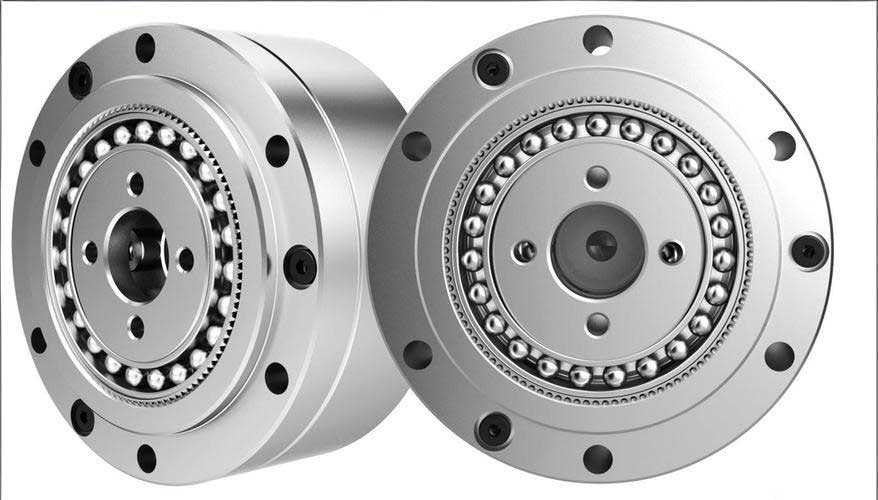
The fundamental operation of a harmonic drive gear relies on the controlled elastic deformation of a flexible component, typically the flexspline. A wave generator, often an elliptical cam bearing assembly, is inserted into the flexspline, causing it to deform into a non-circular shape. This deformation brings multiple teeth of the flexspline into simultaneous mesh with the teeth of a rigid circular spline at two diametrically opposed regions. As the wave generator rotates, the points of mesh travel, resulting in a slow relative rotation between the flexspline and the circular spline. The high reduction ratio is achieved because the flexspline has slightly fewer teeth (e.g., 2 teeth less) than the circular spline. This elegant mechanism, while brilliant, is inherently sensitive to imperfections. The transmission error does not stem from a single source but is the cumulative statistical result of a chain of deviations introduced at every stage of production and assembly. These can be broadly categorized into gear manufacturing errors (like pitch deviations and tooth profile errors), component geometric errors (such as eccentricities and radial runouts of bearings and shafts), and assembly-related errors (primarily clearances in fits). A holistic model must account for all these factors and their interactions within the multi-tooth, symmetric meshing regime characteristic of a harmonic drive gear.
My approach begins with establishing a mathematical foundation for calculating the total transmission error. Building upon prior work in kinematic error modeling for harmonic drives, I adopt a probabilistic method that synthesizes the effects of individual error sources. The model considers the simultaneous engagement of multiple tooth pairs and the statistical nature of their combined effect. The total angular transmission error, denoted as \(\Delta \Phi\), can be expressed as a root-sum-square combination of various error components, weighted by geometrical and operational factors of the specific harmonic drive gear. A generalized form of this model, considering an elliptical cam wave generator, is given by:
$$
\Delta \Phi = \frac{k_b}{0.1 \times \sqrt{z_1 + z_2}} \times \frac{412.8}{d’} \times \sqrt{ F_{p1}^2 + F_{p2}^2 + f_{p1}^2 + f_{p2}^2 + \frac{\sum (E_{1f}^2 + E_{2f}^2 + E_{3f}^2 + E_{jf}^2 )}{\cos^2 \alpha_n} }
$$
Where:
- \(F_{p1}, F_{p2}\): Cumulative pitch error and tangential composite error of the circular spline (in µm).
- \(f_{p1}, f_{p2}\): Cumulative pitch error and tangential composite error of the flexspline (in µm).
- \(E_{1f}, E_{2f}, E_{3f}, E_{jf}\): Tolerance values of various eccentricity error vectors (e.g., bearing runout, component misalignment) in µm.
- \(z_1, z_2\): Number of teeth on the circular spline and flexspline, respectively.
- \(d’\): Reference pitch diameter.
- \(\alpha_n\): Normal pressure angle.
- \(k_b\): A factor accounting for load distribution (often taken as 1.0 for analysis).
This equation serves as our objective function, \(f(\mathbf{x})\), where the vector \(\mathbf{x} = [x_1, x_2, …, x_k]^T\) represents all \(k\) individual error source tolerances. For a specific harmonic drive gear design with parameters like a 90:1 reduction ratio, module 0.3 mm, and 180/182 teeth, the function simplifies. By substituting the nominal geometrical constants and grouping error terms, we get a concrete model for analysis. For instance, if we let \(x_1\) to \(x_4\) represent the four primary gear tooth errors \((F_{p1}, F_{p2}, f_{p1}, f_{p2})\) and \(x_5\) to \(x_{24}\) represent the 20 different eccentricity and assembly clearance errors \((E_{1f}, …)\), the equation condenses to a form like:
$$
f(\mathbf{x}) = C \times \sqrt{ A(x_1^2+x_2^2+x_3^2+x_4^2) + B(x_5^2+x_6^2+…+x_{24}^2) }
$$
where \(A\), \(B\), and \(C\) are constants derived from the gear geometry. This explicit formulation allows us to probe how changes in each \(x_i\) affect the output \(f(\mathbf{x})\), which is the system’s transmission error.
The central tool for this investigation is sensitivity analysis. Sensitivity, in this context, is defined as the rate of change of the system’s transmission error with respect to a change in a specific error source tolerance. It answers the question: “If I tighten or loosen the tolerance on parameter \(x_i\) by one unit (e.g., 1 µm), how much does the overall transmission error improve or worsen?” Formally, the sensitivity vector \(\nabla f\) is the gradient of the objective function:
$$
\nabla f = \left[ \frac{\partial f}{\partial x_1}, \frac{\partial f}{\partial x_2}, …, \frac{\partial f}{\partial x_k} \right]
$$
For complex, non-linear functions like ours, calculating these partial derivatives analytically can be cumbersome. Therefore, I employ a robust numerical differentiation approach combined with designed computer experiments. The process for each error factor \(x_i\) is as follows:
- Define a realistic variation range for \(x_i\) (e.g., from a lower machining limit \(a_i\) to an upper limit \(b_i\)).
- Within this range, strategically sample \(N\) data points. To ensure a well-distributed exploration of the input space and avoid bias, I use the Latin Hypercube Sampling (LHS) technique. LHS ensures that the projections of the \(N\) sample points onto each individual parameter axis are evenly spaced.
- For each sampled value of \(x_i\) (while holding other parameters at their nominal or mean values), compute the total transmission error \(f(\mathbf{x})\) using our model.
- Fit a curve (often a polynomial or spline) to the resulting data pairs \((x_i, f(\mathbf{x}))\). This curve represents the relationship between that specific error and the system output.
- Finally, calculate the numerical derivative of this fitted curve at numerous points along the \(x_i\) axis. The resulting derivative values, plotted against \(x_i\), yield the sensitivity curve \(s_i(x_i) = \frac{\partial f}{\partial x_i}\).
To enhance the reliability of the LHS process, especially when dealing with multiple correlated inputs (though in initial analysis they are often varied one-at-a-time), techniques to minimize spurious correlation in the sampling matrix are employed. One method involves calculating the Spearman rank correlation coefficient \(r^{(s)}\) between columns of the sampling matrix and applying a Cholesky decomposition-based transformation to reduce these correlations, leading to a more statistically independent set of input samples.
To present the findings clearly, let’s consider a subset of key error sources from a typical harmonic drive gear assembly. The table below lists these factors alongside their symbolic representation in the model.
| Component | Error Source Description | Symbol |
|---|---|---|
| Gearing | Cumulative Pitch Error of Circular Spline | \(x_1\) |
| Tangential Composite Error of Circular Spline | \(x_2\) | |
| Cumulative Pitch Error of Flexspline | \(x_3\) | |
| Tangential Composite Error of Flexspline | \(x_4\) | |
| Assembly & Bearings | Radial Runout of Circular Spline Mounting | \(x_5\) |
| Clearance Fit: Circular Spline to Housing | \(x_6\) | |
| Radial Runout of Output Shaft | \(x_7\) | |
| Clearance Fit: Flexspline to Output Shaft | \(x_8\) | |
| Radial Runout of Wave Generator Cam | \(x_9\) | |
| Radial Play of Flexure Bearing | \(x_{10}\) |
Applying the sensitivity analysis methodology to this system yields profound insights. The relationship between the transmission error \(\Delta \Phi\) and a primary gear error, such as the circular spline’s cumulative pitch error \(x_1\), is remarkably linear. This linearity, which also holds for \(x_2\), \(x_3\), and \(x_4\), implies a direct, proportional relationship: doubling the pitch error tolerance doubles its contribution to the total system error. The sensitivity value \(s_1\) in this linear region is constant. For errors related to eccentricities and clearances (e.g., \(x_5\), \(x_6\), …), the relationship is different. While often approximately linear over practical ranges, the sensitivity constant \(s_5\) for these factors is distinct from \(s_1\). My calculations for a specific design show that \(s_1 \approx 0.24\) arc-minutes per micrometer, while \(s_5 \approx 0.26\) arc-minutes per micrometer. This means a 1 µm increase in a bearing runout error (\(x_5\)) degrades transmission accuracy slightly more than a 1 µm increase in a gear pitch error (\(x_1\)).
The plot of sensitivity curves reveals even more nuanced behavior, particularly in the very low tolerance region (0-20 µm). Here, sensitivity values can exhibit non-linear fluctuations. This indicates that when tolerances are extremely tight, the relative importance of different error sources might shift. For instance, the sensitivity of error to a bearing clearance might increase disproportionately as the clearance approaches zero due to non-linear effects in the load distribution. However, for the more common tolerance ranges of 20-50 µm, the sensitivity curves flatten significantly. In this regime, we can assign constant, representative sensitivity values to each class of error. This is immensely valuable for designers. It allows for a principle of “error budgeting”: given a target overall transmission error for the harmonic drive gear, one can allocate permissible error contributions to different subsystems (gearing, bearings, assembly) inversely proportional to their sensitivities. Resources for precision manufacturing can then be focused on controlling the most sensitive parameters.
To generalize the findings, we can categorize the error sources based on their sensitivity indices. A more advanced global sensitivity analysis method, such as calculating Sobol’ indices, could partition the total output variance among the input factors. This would tell us not just the local effect (the gradient) but the percentage contribution of each error source’s variation to the variation in total transmission error. My analysis suggests that while individual gear tooth errors have high local sensitivity, the combined effect of multiple assembly-related eccentricities and clearances often contributes a larger share of the total variance because there are simply more of these error sources, and they are often statistically independent. The wave generator assembly—comprising the cam profile error, bearing radial play (\(x_{10}\)), and related fits—typically emerges as a critically sensitive subsystem within the harmonic drive gear. Its imperfections directly modulate the fundamental kinematic waveform that drives the gear mesh.
The implications of this sensitivity analysis are direct and practical for the development of high-performance harmonic drive gear systems. First, it moves the design process from a trial-and-error or over-design approach to a targeted, knowledge-driven one. Engineers can now perform virtual tolerance analysis during the design phase to predict transmission accuracy and identify bottlenecks. Second, it provides clear guidance for manufacturing and quality control. The analysis highlights that achieving ultra-high precision is not solely about grinding perfect gear teeth; it equally demands exquisite control over bearing quality, shaft runout, and the precision of assembly fits. For example, specifying a high-precision, low-radial-play flexure bearing might yield a greater improvement in transmission accuracy for a given cost than further reducing the gear pitch error from an already high grade. Third, this methodology is not limited to harmonic drives. The framework of building a kinematic error model and conducting a systematic sensitivity analysis is directly applicable to other high-precision mechanical transmission systems, such as planetary gearheads or cycloidal drives, aiding in their optimization.
In conclusion, the transmission accuracy of a harmonic drive gear is a system-level property governed by a complex interplay of numerous component errors. Through the development of a consolidated mathematical model and the application of rigorous sensitivity analysis techniques, including Latin Hypercube Sampling and numerical differentiation, I have quantified the influence of these individual error sources. The key findings indicate that while gear tooth errors exhibit a strong linear effect, the aggregate contribution of assembly-related eccentricities and bearing imperfections is often dominant. The sensitivity of the system is not uniform across all tolerance ranges, showing more complex behavior at very tight tolerances but stabilizing into constant gradients within common manufacturing limits. This work provides a powerful analytical foundation for optimizing the design, tolerancing, and manufacturing of harmonic drive gear systems, enabling a more strategic allocation of resources to achieve the desired precision. Furthermore, the established framework serves as a valuable template for enhancing transmission accuracy in a broad spectrum of precision mechanical drives, pushing the boundaries of performance in advanced mechatronics.