
In modern machinery and equipment, threaded connections are one of the most widely used detachable joint methods. Over 60% of components in contemporary machines feature threaded hole structures. For large-scale equipment such as ships, the threads are often large in size and high in strength, requiring significant torque for tightening and loosening operations. Ordinary wrenches fall short of meeting these technical demands. Consequently, various torque-amplifying wrenches have emerged in the international market, including hydraulic wrenches and pneumatic wrenches. However, these tools come with inherent technical limitations. Hydraulic wrenches involve complex hydraulic systems and equipment, while pneumatic wrenches suffer from severe vibration and noise, require air supply systems, and pose operational inconveniences. Moreover, the diverse range of torque-amplifying wrenches available globally is often prohibitively expensive, deterring many domestic users. Given these challenges, I explore the feasibility of applying harmonic drive gear technology to torque-amplifying wrenches. Harmonic drive gears are known for their simple structure, few components, compact size, and wide transmission ratio range. A single-stage harmonic drive gear can achieve transmission ratios between 50 and 300, while double-stage systems can reach ratios from 3000 to 60000. Additionally, due to the large number of meshing teeth, low relative sliding velocity between tooth surfaces, high load-bearing capacity, low noise, and relatively high transmission efficiency, harmonic drive gears maintain excellent performance even at high transmission ratios. In summary, the harmonic drive gear mechanism offers compactness, high transmission ratios, and significant power transmission capabilities. Utilizing it as the main transmission component in a wrench ensures a compact, lightweight tool with unparalleled advantages over other transmission methods. Furthermore, integrating harmonic drive gear into torque-amplifying wrenches allows small input torques to drive high-torque threaded connections, offering high cost-effectiveness and broad applicability in practical production. Currently, harmonic drive gear torque-amplifying wrenches are not available on the international market. However, as a means of transmitting high torque, harmonic drive gears demonstrate exceptional performance, including minimal space occupancy, ease of operation, and high efficiency, showcasing superiority that other transmission devices struggle to match. In this article, I delve into the design of a torque-amplifying wrench based on harmonic drive gear technology, systematically analyzing its system composition, working principles, characteristics, and application prospects.
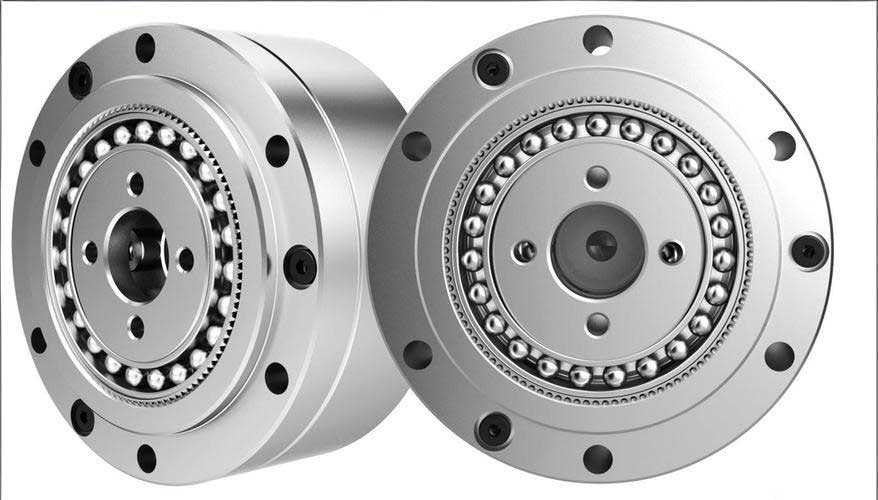
The harmonic drive gear mechanism is central to this innovative wrench design. It consists of three primary components: the wave generator, the flexspline, and the circular spline. The wave generator is a non-circular component that induces controlled elastic deformation in the flexspline. The flexspline is a thin-walled gear that undergoes periodic deformation under the influence of the wave generator. The circular spline is a rigid gear that remains in its original state during operation. The interaction between these components enables high reduction ratios. The transmission ratio for a harmonic drive gear can be expressed as:
$$ i = \frac{N_f}{N_f – N_c} $$
where \( i \) is the transmission ratio, \( N_f \) is the number of teeth on the flexspline, and \( N_c \) is the number of teeth on the circular spline. For instance, if \( N_f = 100 \) and \( N_c = 98 \), the transmission ratio \( i = 50 \). This fundamental principle allows for significant torque amplification. The following table summarizes typical transmission ratios for harmonic drive gear configurations:
| Configuration | Transmission Ratio Range | Key Characteristics |
|---|---|---|
| Single-Stage Harmonic Drive Gear | 50 – 300 | Compact, high efficiency, low noise |
| Double-Stage Harmonic Drive Gear | 3000 – 60000 | Extreme reduction, suitable for high-torque applications |
The advantages of harmonic drive gears extend beyond high transmission ratios. They exhibit high positional accuracy, zero backlash, and the ability to transmit motion through sealed walls, making them ideal for precision applications. In the context of torque-amplifying wrenches, these features translate to reliable, efficient, and user-friendly tools. The compact nature of harmonic drive gears allows the wrench to remain lightweight and maneuverable, even when designed for high-torque outputs. This is particularly beneficial in confined spaces, such as those encountered in shipbuilding or large machinery maintenance.
Now, let’s examine the structural composition of the harmonic drive gear torque-amplifying wrench. The overall design incorporates several key components that work in unison to achieve torque amplification. A cross-sectional view reveals the integration of harmonic drive gear elements into a handheld tool. The primary parts include the socket, flexspline, circular spline housing, connecting rod, and handle. The socket features a front end with a screw engagement hole and a rear end housing the wave generator. The wave generator has a non-circular outer circumference, typically elliptical, which deforms the flexspline. The flexspline is positioned around the wave generator, with bearing balls placed between them to reduce friction. Both the wave generator and flexspline are enclosed within the circular spline housing. The outer surface of the flexspline and the inner surface of the circular spline housing are equipped with gear teeth, which partially mesh due to the deformation induced by the wave generator. The connecting rod is attached to the rear of the circular spline housing, and the handle is connected to the end of the rod. This assembly forms a complete harmonic drive gear system within the wrench, enabling the conversion of a small input torque at the handle into a large output torque at the socket. The following table details the components and their functions:
| Component | Material (Suggested) | Function |
|---|---|---|
| Socket | Alloy Steel | Engages with bolts or nuts; transmits output torque |
| Wave Generator | 45 Steel, heat-treated | Induces deformation in flexspline; input component |
| Flexspline | 20CrNiMoA, heat-treated | Elastically deforms to mesh with circular spline; torque transmission |
| Circular Spline Housing | 45Cr, heat-treated | Provides rigid gear surface; houses the harmonic drive gear |
| Connecting Rod | 45 Carbon Steel | Connects handle to circular spline housing; transmits input torque |
| Handle | Ergonomic Grip Material | User interface for applying input force |
The wrench also incorporates specialized sockets and a universal joint handle to enhance versatility. The socket set comprises multiple hex-shaped sockets of varying sizes, arranged sequentially according to bolt specifications. This allows users to select the appropriate socket for different fasteners, ensuring a secure and stable connection. The sockets can be easily swapped without compromising connection reliability. For different nut sizes, custom-designed sockets are available, making the wrench suitable for a wide range of threaded connections and mechanical structures. The universal joint handle enables operation in obstructed or confined spaces. It includes a swiveling mechanism that allows the handle to pivot, facilitating access to bolts or nuts in deep recesses or tight spots. This design is particularly useful in applications where direct linear access is limited, such as in engine compartments or structural frameworks.
Additionally, a responsive structure can be integrated into the wrench for precision torque control. This structure involves a microcontroller-based opto-acoustic system. Similar to systems described in literature, it allows users to set a desired torque value via calibration on the wrench. When the applied torque reaches the preset value, the system triggers a visual or auditory signal and automatically disengages the force, preventing over-tightening. This feature is especially valuable in assembly operations where specific torque specifications must be met, such as in automotive or aerospace industries. The responsive mechanism enhances safety and accuracy, reducing the risk of fastener failure due to improper torque.
The manufacturing requirements for the harmonic drive gear torque-amplifying wrench are critical to its performance and durability. Given that the wrench transmits high torque from the handle via the connecting rod, material selection and treatment are paramount. The connecting rod and handle should be made from high-quality 45 carbon steel to withstand mechanical stress. The wave generator, as a key input component, is preferably fabricated from 45 steel and subjected to modulation heat treatment to enhance hardness and wear resistance. The circular spline housing, requiring high strength and rigidity, is best made from 45Cr alloy steel and similarly heat-treated. The most critical component, the flexspline, should be manufactured from 20CrNiMoA alloy steel. After proper heat treatment, the tooth surface hardness can reach 34 HRC, with shear fatigue limits and bending fatigue limits achieving 320 MPa and 630 MPa, respectively. During welding processes, suitable welding electrodes must be used, and preheating should be applied to ensure weld strength and prevent cracks. These material choices and treatments ensure the wrench can endure repetitive high-torque applications without premature failure.
The working principle of the wrench revolves around the harmonic drive gear transmission system. As mentioned, the system comprises the wave generator, flexspline, and circular spline. When an input torque is applied to the handle, it rotates the connecting rod, which drives the wave generator. The non-circular shape of the wave generator causes the flexspline to deform elastically, creating a traveling wave that engages with the teeth of the circular spline housing. Due to the difference in the number of teeth between the flexspline and circular spline, each rotation of the wave generator results in a small relative rotation between the flexspline and circular spline. This kinematic relationship leads to a high reduction ratio. The torque amplification can be derived from the power conservation principle. In an ideal system, input power equals output power, neglecting losses. The power equation is:
$$ P = T \omega $$
where \( P \) is power, \( T \) is torque, and \( \omega \) is angular velocity. For the input and output sides:
$$ P_{in} = T_{in} \omega_{in} $$
$$ P_{out} = T_{out} \omega_{out} $$
Assuming \( P_{in} = P_{out} \), we have:
$$ T_{in} \omega_{in} = T_{out} \omega_{out} $$
The transmission ratio \( i \) relates the angular velocities:
$$ i = \frac{\omega_{in}}{\omega_{out}} $$
Thus, the torque amplification factor is:
$$ \frac{T_{out}}{T_{in}} = i $$
This demonstrates that the output torque is amplified by the transmission ratio of the harmonic drive gear. For instance, with a transmission ratio of 100, applying an input torque of 10 Nm yields an output torque of 1000 Nm. In practice, efficiency \( \eta \) must be considered, modifying the equation to:
$$ T_{out} = \eta i T_{in} $$
where \( \eta \) is the transmission efficiency, typically high for harmonic drive gears, often above 80% even at large ratios. This principle enables the wrench to generate substantial torque with minimal user effort, making it feasible for dismantling tight or large-diameter threaded connections in industrial settings.
The characteristics and application performance of the harmonic drive gear torque-amplifying wrench set it apart from conventional torque tools. First, the torque amplification factor is significantly higher than that of other wrenches. Given that harmonic drive gear systems can achieve transmission ratios up to 60000, the theoretical torque multiplication can reach hundreds or even thousands of times under ideal conditions. This surpasses the capabilities of hydraulic or pneumatic wrenches, which typically rely on fluid pressure and may have limited amplification. Second, the cost-effectiveness is superior. Hydraulic and pneumatic wrenches require auxiliary systems such as pumps or compressors, driving up costs to thousands or tens of thousands of dollars per unit. In contrast, the harmonic drive gear wrench has a simpler mechanical design, resulting in lower manufacturing costs and easier maintenance, making it accessible to a broader user base. Third, the wrench is structurally simple, compact, and lightweight. The integration of harmonic drive gear minimizes bulk, allowing the tool to be used in various environments, including overhead or confined spaces. Additionally, it operates quietly without the need for external power sources, reducing energy consumption and operational complexity. The following table compares the harmonic drive gear wrench with other torque-amplifying tools:
| Tool Type | Torque Amplification | Cost | Noise Level | Power Source | Portability |
|---|---|---|---|---|---|
| Harmonic Drive Gear Wrench | Very High (up to 60000x) | Low | Low | Manual | High |
| Hydraulic Wrench | High | High | Moderate | Hydraulic System | Low |
| Pneumatic Wrench | Moderate | Moderate | High | Air Compressor | Moderate |
| Planetary Gear Wrench | Moderate (up to 100x) | Moderate | Low | Manual | High |
The application performance of the wrench largely depends on the fatigue life of the harmonic drive gear, particularly the flexspline. Through simulation analysis, it has been observed that the tooth ends and roots of the flexspline are the initial sites of fatigue damage. Cracks tend to propagate along the axis of the flexspline from the inner side of the teeth toward the tail. This behavior is influenced by stress concentrations caused by the cyclic deformation induced by the wave generator. The fatigue life can be estimated using stress-life approaches. For example, the modified Goodman equation for alternating stress is:
$$ \frac{\sigma_a}{S_e} + \frac{\sigma_m}{S_{ut}} = 1 $$
where \( \sigma_a \) is the alternating stress amplitude, \( \sigma_m \) is the mean stress, \( S_e \) is the endurance limit, and \( S_{ut} \) is the ultimate tensile strength. For the flexspline material 20CrNiMoA, with proper heat treatment, \( S_e \) can be derived from fatigue tests. Ensuring that operational stresses remain below these limits is crucial for longevity. Additionally, lubrication between meshing teeth can reduce wear and extend service life. Regular maintenance, such as inspecting for tooth damage and reapplying lubricant, will enhance durability in demanding applications.
The potential applications of the harmonic drive gear torque-amplifying wrench are vast. In shipbuilding, it can be used to tighten or loosen large-diameter bolts on hulls or engines. In power generation, it facilitates maintenance of turbines and generators. In construction, it aids in assembling steel structures. The wrench’s compact size makes it suitable for aerospace applications, where access is often limited. Moreover, its manual operation eliminates the need for external power, making it ideal for remote or off-grid locations. The responsive torque control feature ensures precision in critical assemblies, such as in automotive braking systems or medical equipment manufacturing. By leveraging the unique advantages of harmonic drive gear, this tool can revolutionize high-torque fastening tasks across industries.
In conclusion, the harmonic drive gear torque-amplifying wrench represents a novel and reliable solution for torque amplification in manual tools. The harmonic drive gear mechanism addresses power transmission and torque multiplication challenges with unparalleled efficiency. Its advantages over other transmission forms—such as compactness, high reduction ratios, and low noise—make it indispensable in various fields. The wrench derived from this technology offers higher torque output compared to other types, while maintaining simplicity, small volume, and light weight. Operators can generate torques dozens of times greater than their input force, reducing physical strain and improving productivity. With its high cost-effectiveness and broad applicability, the harmonic drive gear wrench holds significant promise for widespread adoption in industrial practices. Future research could focus on optimizing materials for the flexspline to further enhance fatigue resistance, or integrating smart sensors for real-time torque monitoring. As technology advances, the harmonic drive gear will continue to inspire innovative tools that push the boundaries of mechanical design.