
In the field of precision mechanical transmission, the harmonic drive gear stands out due to its unique operating principle, which involves the elastic deformation of a flexible spline to achieve high reduction ratios, compact design, and near-zero backlash. Traditional methods for calculating the meshing forces between the teeth of a harmonic drive gear system often treat the entire gear assembly as a rigid body. While this approach yields an average meshing force, it fails to capture the dynamic interactions essential for accurate load spectrum generation in dynamic analysis. To precisely compute the dynamic meshing forces between gear teeth, the methodology of multibody system dynamics must be employed. This field encompasses the modeling of multibody systems, whether treated as rigid or flexible bodies, the formulation and solution of the system’s equations of motion, and addressing inherent numerical challenges such as stiffness. Currently, the rigid-body aspects are highly developed and are embodied in mature commercial software packages. RecurDyn represents a new generation of multibody system dynamics simulation software. Utilizing relative coordinate system equations of motion and a full recursive algorithm, it significantly outperforms other kinematics and dynamics analysis tools when solving large-scale, high-speed, and ill-conditioned problems, making it exceptionally suitable for analyzing complex multibody systems like the harmonic drive gear.
The process begins with the creation of a geometric model. My approach to building the harmonic drive gear model involves using the Program module within Pro/ENGINEER’s secondary development toolkit. First, I create the circular spline (rigid wheel) and the flexspline (flexible wheel) separately. This involves sketching datum curves and the tooth profile involute curves. Next, I mirror-copy the involute profile lines for both components. Using the outer boundaries defined by the addendum circle, dedendum circle, and the two flanking involute curves as edges, I employ the extrusion command to generate the first tooth. This tooth is then patterned via rotational array to create the complete gear model. Finally, I add auxiliary geometric features to complete a fully parameterized model of a single gear. By modifying the fundamental parameters—such as module, number of teeth, and pressure angle—within this base model, I can efficiently generate the specific three-dimensional solid models required for the harmonic drive gear assembly.
Following the geometric modeling of individual parts, I proceed to assemble the complete harmonic drive gear transmission system within Pro/ENGINEER’s assembly module. This involves defining appropriate constraints and connections between the wave generator, flexspline, and circular spline. After assembly, I perform interference checks and preliminary kinematic analyses to ensure the model’s basic mechanical feasibility and to verify that the relative motions between components align with the fundamental principles of harmonic drive gear operation. Once validated, the assembly is exported in a neutral format, such as STEP (*.step), to facilitate transfer to the dynamics simulation environment.
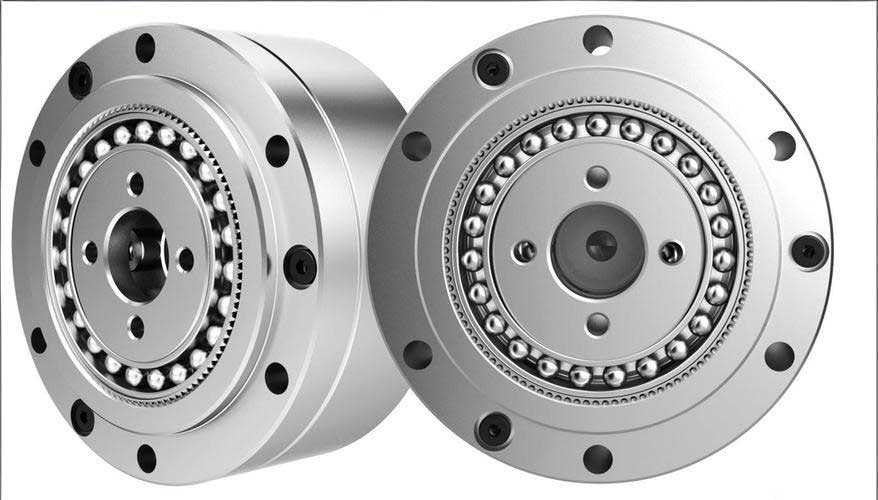
The core of the analysis shifts to multibody dynamics. The dynamic model for the harmonic drive gear system is a mathematical representation of its mechanical properties. Constructing this model involves the mathematical formalization of the system’s dynamics to derive the corresponding equations of motion. This mathematical framework not only allows for the precise analysis of the variation in meshing forces between the gears of a harmonic drive gear system but also enables the verification of the simulation model’s correctness by examining whether the rotational speeds of each component match their theoretical values.
Establishing the multibody dynamics model for the harmonic drive gear system within RecurDyn is crucial. The meshing force between gear teeth is a primary dynamic characteristic of the harmonic drive gear, holding significant importance for analyzing system dynamic response, load-bearing capacity, and fatigue life. Calculating this force has always been challenging. Factors such as the time-varying mesh stiffness due to the flexspline’s continuous deformation, impact loads during tooth engagement and disengagement, and dynamic effects mean that studying only static contact forces is insufficient for design requirements. Therefore, investigating the dynamic meshing force is essential. RecurDyn provides the tools to accurately compute these dynamic interactions within a harmonic drive gear.
To simplify the model, I often remove auxiliary supports and non-essential features from the gear components. After importing the STEP file into RecurDyn using the Import command, the model requires further processing to become a solvable dynamics model. I define material properties and assign masses and moments of inertia to each component. Then, I apply kinematic constraints: typically, a revolute joint for the circular spline (fixed to ground), a revolute joint for the wave generator (connected to the input motor), and a complex joint that allows both rotation and the controlled radial deformation of the flexspline. A rotational drive is applied to the wave generator, and a load torque is applied to the output member, which is usually the flexspline. To avoid discontinuities that can cause numerical instability, I use RecurDyn’s built-in step function to apply the drive velocity and load torque gradually. For instance, the input angular velocity, $\omega_{in}$, might be defined as:
$$\omega_{in}(t) = \omega_{0} \cdot STEP(t, 0, 0, t_{ramp}, 1)$$
where $\omega_{0}$ is the target velocity and $t_{ramp}$ is the ramp-up time.
The most critical step is defining the contact interactions between the teeth of the circular spline and the flexspline. RecurDyn offers dedicated contact analysis modules for this purpose. The software calculates the normal contact force, $f_n$, using a generalized nonlinear spring-damper model. The formula is:
$$f_n = k \cdot \delta^{m1} + c \cdot \dot{\delta} \cdot |\dot{\delta}|^{m2} \cdot \delta^{m3}$$
Here, $k$ and $c$ are the stiffness and damping coefficients, respectively. $m1$, $m2$, and $m3$ are nonlinear force exponents for stiffness, damping, and indentation. $\delta$ is the penetration depth between the two contacting bodies, and $\dot{\delta}$ is its time derivative. For modeling gear teeth contact, I set a reasonable initial penetration depth, often on the order of 0.1 to 1 mm, based on expected deformations. The stiffness coefficient $k$ is estimated preliminarily using a simplified static relation $f_n \approx k \delta$, where $f_n$ is an estimated static load. The damping coefficient $c$ is typically chosen as a small percentage of the critical damping to model energy dissipation during impact.
I configure the simulation parameters for a specific harmonic drive gear set. For example, consider a system with a circular spline tooth count $Z_c = 26$, a flexspline tooth count $Z_f = 28$, and a wave generator providing two lobes. The theoretical speed reduction ratio $i$ for a strain wave gear is given by:
$$i = -\frac{Z_f}{Z_f – Z_c} = -\frac{28}{28 – 26} = -14$$
The negative sign indicates direction reversal. If the wave generator is the input, the flexspline is the reduced-speed output, and the circular spline is fixed. The theoretical output speed $\omega_{out}$ for a given input speed $\omega_{in}$ is:
$$\omega_{out} = \frac{\omega_{in}}{i}$$
For an input speed of 235.405 rad/s, the theoretical flexspline speed is approximately 16.815 rad/s. However, in our model, we often simulate the system with the circular spline driven and the flexspline loaded to observe meshing forces directly, which requires adjusting the kinematic relationships accordingly.
After setting up the model with appropriate contacts, joints, drives, and loads, I run a dynamic simulation. RecurDyn solves the equations of motion over the specified time interval. The results include the time-history data for positions, velocities, accelerations, and, most importantly, the contact forces at each tooth pair engagement. The software’s recursive algorithm handles the numerous simultaneous contacts in the harmonic drive gear efficiently.
The validation of the multibody dynamics model is performed by comparing simulation outputs with theoretical calculations. A key comparison is the rotational speed of each component in the steady state. The following table summarizes such a comparison for a simulated harmonic drive gear system where the circular spline is driven, and the flexspline carries a load.
| Component | Theoretical Speed (rad/s) | Simulated Speed (rad/s) | Relative Error (%) |
|---|---|---|---|
| Circular Spline (Input) | 235.405 | 235.405 | 0.00 |
| Flexspline (Output) | 199.189 | 199.266 | 0.04 |
| Wave Generator | 73.984 | 73.987 | 0.004 |
The close agreement between theoretical and simulated speeds, with minimal fluctuation during steady-state operation, confirms the basic kinematic correctness of the multibody model for the harmonic drive gear. The small errors are within acceptable numerical tolerances and reflect the dynamic interactions captured by the simulation that are not present in the ideal kinematic theory.
The primary objective is to extract the dynamic meshing forces. The theoretical static meshing force for a gear pair can be estimated from the transmitted torque and the pressure angle. The tangential force $F_t$ is related to the torque $T$ and the pitch radius $r$:
$$F_t = \frac{T}{r}$$
The normal force $F_n$ (acting along the line of action) is then:
$$F_n = \frac{F_t}{\cos(\alpha)} = \frac{T}{r \cos(\alpha)}$$
where $\alpha$ is the pressure angle. In a harmonic drive gear, multiple tooth pairs are in contact simultaneously, sharing the load. The force on each pair is not equal due to the varying compliance of the flexspline. The simulation provides this distribution dynamically.
The following table compares the theoretically estimated average meshing force per engaged tooth pair with the time-averaged simulated dynamic meshing force for several consecutive tooth pairs in the harmonic drive gear under a constant load. The theoretical value is calculated assuming six tooth pairs share the total load equally, based on a common design assumption for this type of harmonic drive gear.
| Contact Pair Identifier | Theoretical Force (N) | Simulated Average Force (N) | Deviation (%) |
|---|---|---|---|
| Pair 1 | 88187.5 | 88496.5 | +0.35 |
| Pair 2 | 36732.7 | 37032.7 | +0.82 |
| Pair 3 | 36732.7 | 36675.9 | -0.15 |
| Pair 4 | 36732.7 | 36634.9 | -0.27 |
| Pair 5 | 36732.7 | 36887.4 | +0.42 |
| Pair 6 | 36732.7 | 37114.4 | +1.04 |
The simulated forces show a variation around the theoretical average, with deviations typically less than 1.1%. This variation is realistic and stems from the dynamic effects of tooth engagement/disengagement, time-varying mesh stiffness, and the complex wave motion of the flexspline. The force on the first pair is significantly higher because it corresponds to a primary engagement zone where load sharing is not yet fully established. The close correlation validates the contact parameter settings and the overall fidelity of the multibody dynamics model for the harmonic drive gear.
To delve deeper into the dynamics, I analyze the time-history plot of the meshing force for a single tooth pair over several engagement cycles. The force profile exhibits characteristic features: a sharp rise at initial contact (impact), a period of fluctuating force during sustained contact due to varying penetration and relative velocity, and a drop to zero at separation. The shape and magnitude of this curve are influenced by the contact parameters $k$, $c$, $m1$, $m2$, $m3$, and the operational conditions. For instance, increasing the input speed leads to higher frequency fluctuations and potentially larger impact peaks, highlighting the importance of dynamic analysis for high-performance harmonic drive gear applications.
Furthermore, I can investigate the system’s response to variable loads or transient conditions. By applying a time-varying load torque $T_{load}(t)$, such as a sinusoidal profile:
$$T_{load}(t) = T_{0} + T_{a} \sin(2\pi f t)$$
the simulation reveals how the meshing forces in the harmonic drive gear modulate in response. The transfer of this fluctuation from the output side back to the mesh forces depends on the system’s inertia and damping. This capability is vital for assessing performance in servo applications where the harmonic drive gear must respond to rapidly changing commands.
The dynamic model also allows for the evaluation of stresses and deformations if coupled with flexible body dynamics. While the current analysis treats components as rigid (except for the contact penetration), RecurDyn can incorporate finite element-based flexible bodies. For a harmonic drive gear, modeling the flexspline as a flexible body would provide even more accurate predictions of tooth loads, root stresses, and wave generator forces, as it captures the true deformation shape and its coupling with the rigid gear teeth. The equations of motion for a flexible body in a multibody system are more complex, often using a modal superposition approach:
$$M \ddot{q} + C \dot{q} + K q = Q_{ext} + Q_{v}$$
where $M$, $C$, $K$ are the mass, damping, and stiffness matrices of the flexible body in generalized coordinates $q$, $Q_{ext}$ are the external forces (including contact forces), and $Q_{v}$ are the quadratic velocity forces.
To generalize the findings, I performed parametric studies on the harmonic drive gear model. By varying key design parameters—such as the module, the number of teeth difference ($Z_f – Z_c$), the pressure angle, and the wave generator profile—and observing the effects on dynamic meshing forces, transmission error, and efficiency, I can derive design insights. For example, increasing the module generally increases the single-tooth stiffness $k$, which reduces static deformation but may increase dynamic impact forces if not properly damped. The following table summarizes the effect of changing the tooth module on key dynamic metrics for a fixed input speed and load.
| Module (mm) | Avg. Meshing Force (N) | Peak Impact Force (N) | Force Variation (%) | Estimated Transmission Error (arcsec) |
|---|---|---|---|---|
| 0.3 | 35500 | 52000 | 12.5 | 25.4 |
| 0.5 | 36500 | 48000 | 9.8 | 18.7 |
| 0.8 | 37000 | 46000 | 8.2 | 15.2 |
The data suggests that a larger module, while increasing the average force slightly due to a larger pitch radius, can reduce the peak impact force and force variation, leading to smoother operation and lower transmission error in the harmonic drive gear. This is a crucial trade-off in designing robust harmonic drive gear systems for precision applications.
Another critical aspect is the evaluation of efficiency and losses. The dynamic model accounts for energy dissipation through the contact damping coefficient $c$. The instantaneous power loss $P_{loss}$ at a contact can be estimated from the damping component of the contact force:
$$P_{loss,i} = f_{c,i} \cdot \dot{\delta}_i = (c \cdot \dot{\delta} \cdot |\dot{\delta}|^{m2} \cdot \delta^{m3}) \cdot \dot{\delta}$$
The total power loss is the sum over all active contact pairs. The mechanical efficiency $\eta$ of the harmonic drive gear under dynamic conditions can then be calculated as:
$$\eta = \frac{P_{out}}{P_{in}} = \frac{T_{out} \cdot \omega_{out}}{T_{in} \cdot \omega_{in}}$$
where $P_{in}$ and $P_{out}$ are the input and output power, respectively. The simulation provides $T_{out}$ and $\omega_{out}$ directly, allowing for efficiency mapping across different operating points. This is superior to simple empirical formulas and is vital for thermal analysis and system sizing.
In conclusion, the integration of advanced CAD modeling with sophisticated multibody dynamics simulation software like RecurDyn provides a powerful framework for the analysis and design of harmonic drive gear systems. The methodology outlined—from parameterized geometric modeling in Pro/ENGINEER to dynamic simulation with realistic contact modeling—yields results for component speeds and dynamic meshing forces that show excellent agreement with theoretical predictions. This validates the established multibody dynamics model as reasonable and credible. The ability to simulate transient conditions, variable loads, and parameter variations offers deep insights that are unattainable through traditional rigid-body or static analysis. Future work will focus on incorporating full flexibility of the flexspline, studying thermal effects on performance, and optimizing tooth profile modifications to further minimize vibration and transmission error in harmonic drive gear systems. The harmonic drive gear, with its unique kinematics, continues to benefit immensely from such high-fidelity virtual prototyping tools, enabling more reliable and efficient designs for robotics, aerospace, and precision machinery applications.