
In my extensive experience with precision motion control systems, the harmonic drive gear stands out as a cornerstone technology. Its unique operating principle, based on elastic deformation, enables exceptional performance in terms of high reduction ratios, compactness, and positional accuracy. However, the very flexibility that grants it these advantages also introduces complex error dynamics. Understanding and quantifying these transmission errors is not merely an academic exercise; it is a critical requirement for the design, manufacturing, and integration of these reducers into high-performance systems such as aerospace actuators, robotic joints, and precision instrumentation. In this article, I will share a comprehensive analysis of transmission error in harmonic drive gears, drawing from theoretical foundations and practical experimental validation.
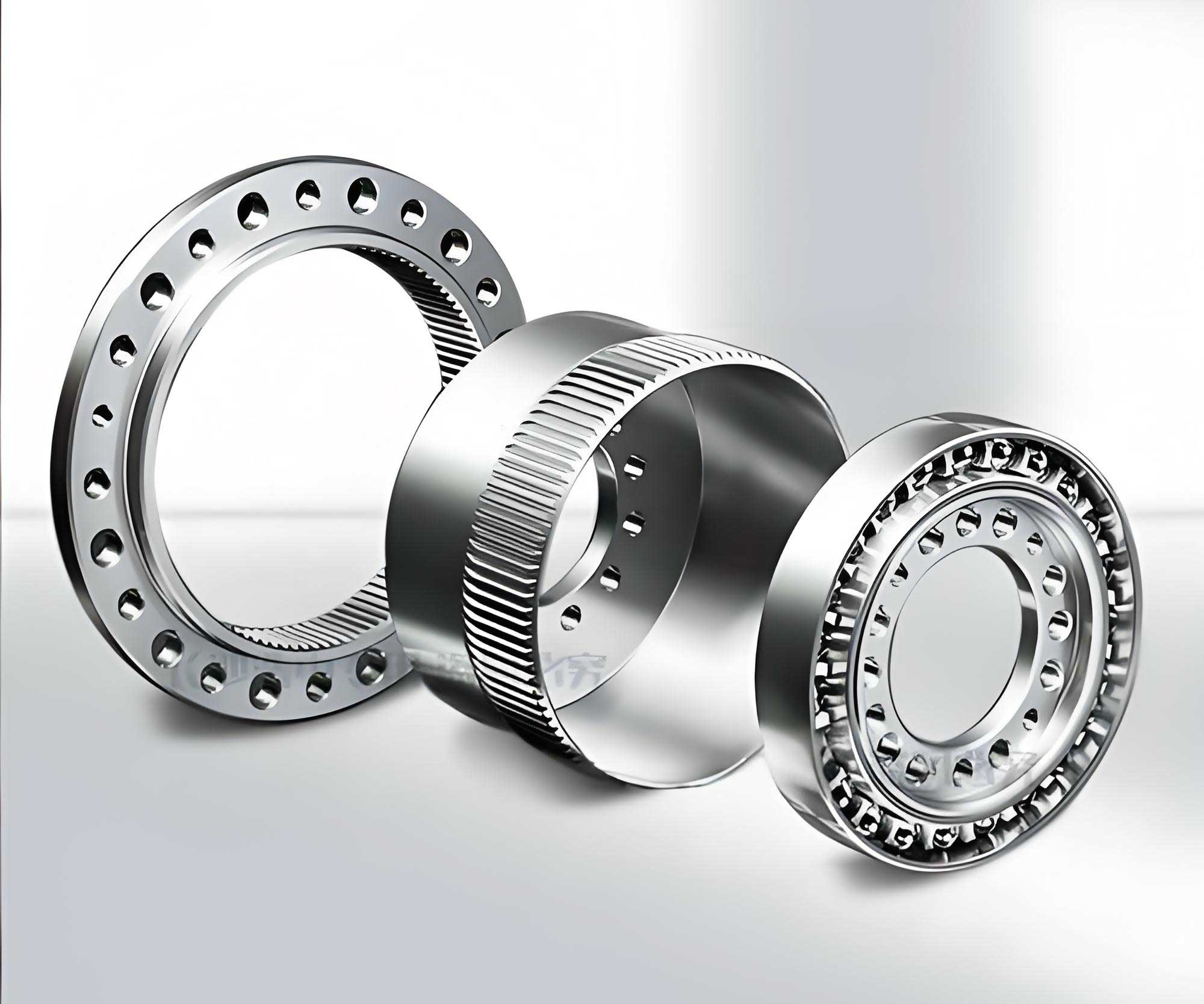
The fundamental operation of a harmonic drive gear relies on the controlled elastic deformation of a thin-walled component, known as the flexspline. This concept is rooted in thin-shell elastic deformation theory. The system typically comprises three key elements: a circular spline (the rigid internal gear), a flexspline (the flexible external gear), and a wave generator (an elliptical bearing assembly). The wave generator, upon rotation, induces a controlled elliptical deformation in the flexspline. This deformation causes the teeth of the flexspline to engage with those of the circular spline at two diametrically opposite regions, and through this moving elastic wave, rotary motion is transmitted with a high reduction ratio. The kinematics can be derived by considering the relative motion. Let ω_H be the absolute angular velocity of the wave generator, ω_F be that of the flexspline, and ω_C be that of the circular spline. Applying a relative motion of (-ω_H) to the entire assembly, we can analyze the system as a standard gear train. The transmission ratio i of this converted system is given by the ratio of the number of teeth on the circular spline (z_C) to the number on the flexspline (z_F). The relationship is expressed as:
$$ i^{H}_{FC} = \frac{\omega_F – \omega_H}{\omega_C – \omega_H} = -\frac{z_C}{z_F} $$
where the negative sign indicates opposite rotation directions between the flexspline and circular spline when the circular spline is fixed. This kinematic ideal, however, is perturbed by several physical imperfections that collectively constitute the transmission error. The performance of a harmonic drive gear is ultimately limited by these errors, which I categorize primarily into three interrelated types: backlash, stiffness-dependent error, and kinematic or motion error.
Backlash, or lost motion, is the angular displacement available at the output when the input direction is reversed without moving the output. In a harmonic drive gear, this is not merely a simple geometric gap. It arises from a combination of manufacturing tolerances, assembly clearances within the wave generator bearings, and the subtle elastic recovery of the flexspline. When we analyze the tooth engagement, the instantaneous circumferential backlash J_t between a tooth pair can be approximated from their profile coordinates. If we denote a point on the flexspline tooth profile as K1 (X_K1, Y_K1) and the corresponding closest point on the circular spline as K2 (X_K2, Y_K2), the linear backlash is:
$$ J_t \approx \sqrt{(X_{K2} – X_{K1})^2 + (Y_{K2} – Y_{K1})^2} $$
Under load, the elastic deformation of the components reduces the effective clearance. The net operational backlash J under a torque T is J = J_t – J_e, where J_e is the reduction due to elastic deformation. The total angular backlash φ_bh, expressed in arcminutes, aggregates contributions from shaft twist (Δ_s), geometric radial play (Δ_g), and flexspline torsional wind-up (Δ_f):
$$ \varphi_{bh_{max}} = \frac{(\Delta_s + \Delta_g + \Delta_f)}{d’} \times 3438 $$
Here, d’ is the reference diameter. This backlash is a critical source of non-linearity, especially in bidirectional positioning tasks.
The second major source of error is related to the torsional stiffness of the harmonic drive gear. The torque-angle relationship is inherently nonlinear, exhibiting hysteresis. However, for practical servo analysis, it is often approximated as a linear function within a operational range. The torsional stiffness K is defined as the ratio of applied torque to the resulting angular deflection. Therefore, the angular error Δ_e induced by an external load torque T, due to finite stiffness, is simply:
$$ \Delta_e = T \cdot \lambda_{\Sigma} $$
where λ_Σ is the total compliance (inverse of stiffness) of the drive train, which includes the compliance of the harmonic drive gear itself and other elements in the system. This load-dependent error is significant in applications where the torque varies during operation.
The most comprehensive metric is the overall transmission error (TE). It encompasses the kinematic inaccuracies arising from imperfections in the manufacturing and assembly of all components—the wave generator’s profile error, the tooth profile errors of both splines, and run-out errors. The harmonic drive gear benefits from error averaging due to the large number of teeth in simultaneous contact (often 15-30% of total teeth). If Δφ_g is the transmission error of an equivalent conventional gear pair, the error for a harmonic drive gear Δφ_hg can be statistically lower:
$$ \Delta\varphi_{hg} = \Delta\varphi_g \cdot \frac{k_B}{\sqrt{z_{mD}}} $$
In this equation, z_mD is the actual average number of tooth pairs in contact, and k_B is a statistical coefficient. However, this must be augmented to include the wave generator error and, for a complete model in bidirectional systems, the effects of backlash and stiffness under load. A more comprehensive expression for the peak-to-peak transmission error, considering these factors, is:
$$ \Delta\varphi_{hg} = \pm \left[ \frac{k_B}{\sqrt{z_{mp}}} \left( 0.25 \sum_{j=1} \Delta F_{\Sigma j} + \frac{\pi d’}{8 \omega_0 i_h} \sum_{n=1} \Delta\rho_n \right) + \sqrt{ \left(0.4 \sum_{j=1} \Delta F_{\Sigma j}\right)^2 + \left( \frac{\pi d’}{8 \omega_0 i_h} \right)^2 \sum_{n=1} (\Delta\rho_n)^2 } \right] \times \frac{4128}{d’} + \Delta_e $$
Where ΔF_Σj represents cumulative profile errors, Δρ_n represents wave generator radial error components, ω_0 is a reference speed, and i_h is the gear ratio. This formula underscores the multifaceted nature of error in a harmonic drive gear.
To validate these theoretical models and quantitatively assess the performance of harmonic drive gears, we designed and built a specialized transmission error test system. The core philosophy was to enable high-resolution measurement of both static and dynamic error under controlled loading conditions. A high-precision servo motor acts as the input driver, its rotation angle precisely measured by an encoder (Angle Sensor 1). The harmonic drive gear unit under test is mounted on a rigid frame. Its output shaft is connected to a high-sensitivity torque sensor, which in turn couples to a programmable magnetic powder brake for applying precise load torque. A second high-resolution encoder (Angle Sensor 2) is directly mounted on the output shaft to measure its angular position. All sensor data is acquired synchronously by a data acquisition system and processed by a computer. This setup allows us to command precise input rotations and simultaneously record the actual input and output angles, with the difference defining the instantaneous transmission error.
We conducted systematic tests on a commercial precision harmonic drive gear unit. The static test involves moving the input to a series of discrete angular positions (e.g., 24 points per revolution), pausing to allow any transients to settle, and recording the steady-state output angle. This reveals the kinematic error and backlash. The dynamic test involves running the input at a constant speed (e.g., 100 RPM) while continuously sampling the input and output angles at a high rate (e.g., 10 kHz), revealing errors related to dynamics and vibration. Tests were performed both unloaded and under a constant load of 60 Nm. The results are summarized in the following tables and analysis.
| Test Condition | Direction | Average Transmission Error (arc-min) | Peak-to-Peak Error (arc-min) |
|---|---|---|---|
| No Load | Forward | -1.6 | ~5.2 |
| No Load | Reverse | -1.9 | ~5.8 |
| 60 Nm Load | Forward | +3.3 | ~7.5 |
| 60 Nm Load | Reverse | +3.1 | ~7.3 |
The static data shows several key characteristics of this harmonic drive gear. First, the average error is small, on the order of a few arcminutes, confirming the basic high precision of the device. The shift in average error from negative (unloaded) to positive (loaded) is directly attributable to the torsional wind-up predicted by the stiffness model—the output lags under load. The magnitude of this shift, approximately 4.9 arcminutes, aligns with the calculated stiffness error Δ_e for this unit. The backlash, inferred from the difference between the forward and reverse curves at the same position, was measured to be less than 2 arcminutes for this high-precision harmonic drive gear, which is remarkably low.
The dynamic testing provides a richer picture of the harmonic drive gear’s behavior during operation. The error signal is no longer a set of discrete points but a continuous function of time or input angle. Spectral analysis of this signal reveals periodic components corresponding to various error sources. The fundamental period often corresponds to one revolution of the wave generator, reflecting its manufacturing imperfections. Higher harmonics relate to tooth meshing frequency and its multiples. The following table categorizes the primary spectral components observed in the dynamic error signal of a typical harmonic drive gear:
| Error Source | Characteristic Frequency | Typical Amplitude (arc-min) | Remarks |
|---|---|---|---|
| Wave Generator Eccentricity | 1 x WG Revolution | 1.0 – 3.0 | Dominant low-frequency error |
| Tooth Meshing | Tooth Count x WG Revolution | 0.5 – 1.5 | High-frequency “ripple” |
| Component Run-out | 2 x WG Revolution, etc. | 0.2 – 0.8 | Elliptical deformation harmonics |
| Structural Resonance | System Dependent (50-500 Hz) | Variable | Excited by meshing forces |
Under dynamic conditions and load, the total error observed was within ±6 arcminutes, which meets the precision requirements for many high-end applications. The dynamic error trajectory clearly shows the superposition of the stiffness-induced shift, the kinematic wave generator error, and the high-frequency tooth meshing ripple. This comprehensive error profile is essential for developing advanced compensation algorithms in servo controllers. By modeling the harmonic drive gear’s error as a function of angle and load, feedforward compensation can significantly improve tracking performance.
In conclusion, the transmission error of a harmonic drive gear is a complex but manageable phenomenon. Through a rigorous analysis combining thin-shell elasticity theory, gear kinematics, and statistical error modeling, we can decompose it into constituent parts: backlash, stiffness-dependent error, and kinematic motion error. The derived formulas provide a framework for predicting performance based on design and manufacturing parameters. Furthermore, the implementation of a dedicated test system capable of both static and dynamic measurements is indispensable for empirical validation and quality assurance. The data unequivocally shows that modern precision harmonic drive gears can achieve transmission errors better than ±6 arcminutes, even under load. However, achieving this consistently requires meticulous control over manufacturing tolerances, assembly processes, and component quality. For the system designer, understanding these error sources is the first step toward mitigating their effects, either through selective component sourcing, system stiffness management, or sophisticated software-based error compensation. The harmonic drive gear remains a uniquely capable solution for compact, high-ratio precision reduction, and its performance continues to improve as our understanding of its error dynamics deepens.