
In my research on precision transmission systems, I have focused on the torsional behavior of harmonic drive gears under small torque conditions. Harmonic drive gears, also known as strain wave gears, are critical components in aerospace, robotics, and high-precision manufacturing due to their high reduction ratios, compact design, and exceptional accuracy. However, a significant challenge arises in applications requiring minimal torque: the torsional stiffness of the harmonic drive gear input shaft often deviates from theoretical expectations, exhibiting pronounced hysteresis that can impact system performance. To investigate this phenomenon, I developed a specialized test system to measure the torsional stiffness and hysteresis of a harmonic drive gear input shaft under bidirectional torque loading. This article details my methodology, findings, and analysis, aiming to provide insights into the nonlinear elastic behavior of harmonic drive gears in low-torque regimes.
The fundamental principle of harmonic drive gear operation relies on the elastic deformation of a flexible spline (flexspline) meshing with a rigid circular spline (circular spline) under the action of a wave generator. This unique mechanism allows for high torque transmission and precision, but it also introduces compliance. Specifically, the input shaft, typically connected to the wave generator, may exhibit torsional deflection when subjected to torque, and this deflection is not perfectly linear or reversible—a property known as hysteresis. Hysteresis in harmonic drive gears can lead to positioning errors, reduced stiffness, and energy losses, which are particularly problematic in servo systems and precision instrumentation. My goal was to quantify this behavior by measuring the angle-torque relationship of the input shaft under controlled conditions.
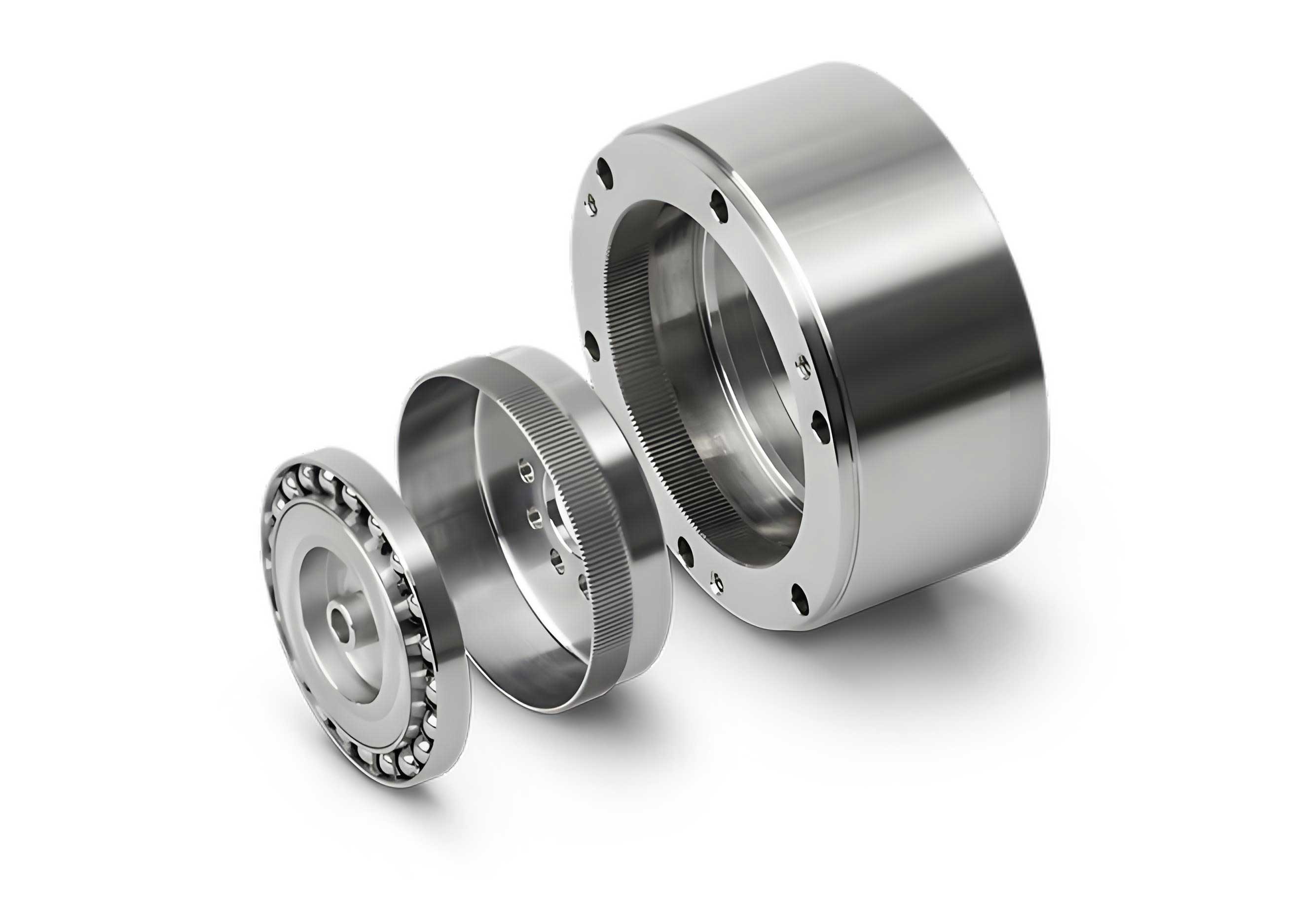
To achieve this, I designed a torsional stiffness test system that applies pure rotational torque to the input shaft of the harmonic drive gear without inducing parasitic motions. The system configuration involved fixing the output shaft (connected to the flexspline) and mounting a torque loading disk rigidly to the input shaft (wave generator). Torque was applied in the form of a force couple, ensuring a net moment without translational forces. This was accomplished using a symmetric arrangement of pulleys, wires, and calibrated weights, allowing for continuous bidirectional torque variation from -0.36 N·m to +0.36 N·m. The angular displacement of the input shaft was measured non-invasively using a CCD camera targeting a marker on the torque disk, with image processing algorithms calculating the rotation angle. This approach minimized external influences on the harmonic drive gear, ensuring reliable data.
The core of the measurement lies in the application of a force couple. In mechanics, a force couple consists of two parallel forces equal in magnitude, opposite in direction, and separated by a perpendicular distance. The torque \( \tau \) produced is given by:
$$ \tau = F \times d $$
where \( F \) is the force magnitude and \( d \) is the distance between the forces (the moment arm). In my system, the torque disk had a radius \( r \), and forces were applied tangentially via wires connected to weight pans. By adding or removing weights, I could precisely control the torque. For instance, a weight mass \( m \) generates a force \( F = mg \), where \( g \) is acceleration due to gravity (approximately 9.81 m/s²). The resulting torque for a force couple applied at the disk perimeter is:
$$ \tau = 2 \times (mg) \times r $$
assuming two symmetric weights. The system allowed incremental torque steps of 0.0981 N·m per 100-gram weight change, based on \( r = 0.05 \) m. This enabled detailed mapping of the angle-torque curve.
Angular displacement was determined using vision-based metrology. A target with two circular markers was affixed to the torque disk. The CCD camera captured images before and after torque application. Using image processing software, I extracted the centroid coordinates of the markers. Let the initial marker centroids be \( (x_1, y_1) \) and \( (x_2, y_2) \), defining a reference line with slope \( k_1 \). After rotation, the new centroids \( (x_3, y_3) \) and \( (x_4, y_4) \) yield a line with slope \( k_2 \). The rotation angle \( \theta \) is calculated as:
$$ \theta = \arctan(k_2) – \arctan(k_1) $$
To ensure accuracy, I employed a least-squares circle fitting algorithm to determine the centroids. For a set of edge points \( (x_i, y_i) \) on a marker boundary, the circle equation is \( (x – a)^2 + (y – b)^2 = r^2 \), where \( (a, b) \) is the center and \( r \) the radius. Minimizing the sum of squared residuals:
$$ Q = \sum_{i \in E} \left[ (x_i – a)^2 + (y_i – b)^2 – r^2 \right]^2 $$
leads to the normal equations:
$$ \frac{\partial Q}{\partial a} = 0, \quad \frac{\partial Q}{\partial b} = 0, \quad \frac{\partial Q}{\partial r} = 0 $$
Solving these yields precise center coordinates, reducing errors from pixel discretization. This method achieved an angular resolution of better than 0.01° in my tests.
The test procedure involved multiple cycles to assess repeatability and the effect of flexspline orientation. I began with the flexspline at an initial position (denoted 0°). Torque was applied in sequences: positive torque unloading (from +0.36 N·m to 0), negative torque loading (from 0 to -0.36 N·m), negative torque unloading (from -0.36 N·m to 0), and positive torque loading (from 0 to +0.36 N·m). After each cycle, I rotated the flexspline by 60° relative to the fixed circular spline and repeated the measurements, collecting data for six distinct orientations (0°, 60°, 120°, 180°, 240°, and 300°). This allowed me to evaluate whether hysteresis and stiffness varied with assembly angle, which could indicate asymmetries in the harmonic drive gear components.
The torsional stiffness \( k \) of the harmonic drive gear input shaft is defined as the ratio of torque change to angular deflection:
$$ k = \frac{\Delta \tau}{\Delta \theta} $$
where \( \Delta \tau \) is the incremental torque and \( \Delta \theta \) is the corresponding angular change in radians. In practice, stiffness can vary along the torque range, so I computed segmental stiffness values for each phase of the loading cycle. Hysteresis, in this context, refers to the maximum angular difference between loading and unloading curves at the same torque magnitude within a full cycle. It quantifies the energy loss due to internal friction and elastic dissipation in the harmonic drive gear.
My results revealed consistent nonlinear behavior across all flexspline orientations. The angle-torque curves exhibited pronounced hysteresis loops, characteristic of systems with internal damping or backlash. Below, I summarize the stiffness and hysteresis data for two representative orientations (60° and 120°) in table form, followed by a detailed analysis.
| Flexspline Orientation | Loading Phase | Torque Range (N·m) | Stiffness \( k \) (N·m/rad) | Hysteresis (degrees) |
|---|---|---|---|---|
| 60° | Positive Unloading | +0.36 to 0 | 4.36 | 51.89° |
| Negative Loading | 0 to -0.36 | 0.29 | ||
| Negative Unloading | -0.36 to 0 | 3.59 | ||
| Positive Loading | 0 to +0.36 | 0.33 | ||
| 120° | Positive Unloading | +0.36 to 0 | 4.19 | 49.37° |
| Negative Loading | 0 to -0.36 | 0.32 | ||
| Negative Unloading | -0.36 to 0 | 5.08 | ||
| Positive Loading | 0 to +0.36 | 0.33 |
The data clearly show a stark contrast in stiffness between phases where torque decreases from a saturated value (unloading) and phases where torque increases from zero after a direction change (loading). For the harmonic drive gear at 60° orientation, stiffness during positive unloading was 4.36 N·m/rad, while during negative loading—when torque reversed from zero to negative—it dropped to 0.29 N·m/rad. Similarly, at 120°, positive unloading stiffness was 4.19 N·m/rad, and negative loading stiffness was 0.32 N·m/rad. This pattern held across all orientations: unloading phases exhibited relatively high stiffness (typically 4–5 N·m/rad), whereas loading phases after torque reversal showed markedly lower stiffness (approximately 0.3 N·m/rad). The hysteresis magnitude remained around 50° (e.g., 51.89° at 60°, 49.37° at 120°), with minimal variation due to flexspline angle.
To further elucidate the stiffness variation, I performed curve fitting on the angle-torque data. Let \( \theta(\tau) \) represent the angular response as a function of torque. During unloading from positive torque, the relationship can be approximated linearly:
$$ \theta_u(\tau) = \theta_0 + \frac{\tau}{k_u} $$
where \( k_u \) is the unloading stiffness. During loading from zero after reversal, the response is more compliant:
$$ \theta_l(\tau) = \theta_0′ + \frac{\tau}{k_l} $$
with \( k_l \ll k_u \). The hysteresis loop arises because \( \theta_0 \neq \theta_0′ \), indicating a permanent angular offset or slip. I observed that the stiffness reduction was most acute in the torque range of ±0.1 to ±0.2 N·m, where the harmonic drive gear input shaft exhibited a sort of “softening” behavior. This suggests that internal components, such as the flexspline teeth and wave generator bearings, undergo micro-slip or elastic settling when torque direction changes.
The implications for harmonic drive gear applications are significant. In precision systems where small torque variations are common, such as in robotic joints or satellite antennas, the low stiffness during torque reversal can lead to reduced bandwidth and increased error. For instance, in a closed-loop control system, the controller might compensate for the compliance, but the hysteresis could cause limit cycles or instability. My measurements indicate that the harmonic drive gear hysteresis is largely independent of flexspline orientation, implying that it is an intrinsic property of the gear assembly, possibly due to preload, friction distribution, or material memory effects.
To generalize the findings, I propose a phenomenological model for the harmonic drive gear torsional behavior. The total angular deflection \( \theta \) can be decomposed into elastic and hysteretic components:
$$ \theta = \theta_e + \theta_h $$
The elastic part follows Hooke’s law: \( \theta_e = \tau / k_e \), where \( k_e \) is the nominal elastic stiffness. The hysteretic part \( \theta_h \) depends on torque history and can be modeled using a Bouc-Wen or Preisach formulation. For simplicity, I used a bilinear hysteresis model with stiffness switching:
$$ k(\tau, \dot{\tau}) = \begin{cases}
k_u & \text{if } \dot{\tau} < 0 \text{ (unloading)} \\
k_l & \text{if } \dot{\tau} > 0 \text{ and } |\tau| < \tau_c \\
k_u & \text{if } \dot{\tau} > 0 \text{ and } |\tau| \geq \tau_c
\end{cases} $$
where \( \dot{\tau} \) is the torque rate, and \( \tau_c \) is a critical torque magnitude (around 0.15 N·m in my tests) where stiffness transitions. This model captures the essence of my observations: the harmonic drive gear input shaft is stiff when unloading or at high torque, but becomes compliant when torque reverses and remains low until a threshold is crossed.
I also analyzed the energy dissipation per cycle. The hysteresis loss \( W_h \) is the area enclosed by the angle-torque loop:
$$ W_h = \oint \tau \, d\theta $$
For a typical cycle from +0.36 N·m to -0.36 N·m and back, I computed \( W_h \) numerically from my data. The average dissipation was approximately 0.018 J per cycle. This energy loss, though small, can accumulate in dynamic applications, leading to heating and efficiency reduction in the harmonic drive gear.
In terms of measurement uncertainty, I considered several factors. The torque accuracy depended on weight calibration and pulley friction. Using an electronic balance, I ensured weight masses were within ±0.1 gram, translating to a torque uncertainty of ±0.00098 N·m. Angular measurement error stemmed from camera resolution (1400×1000 pixels) and circle fitting algorithm. Through calibration with a high-precision rotary stage, I estimated an angular uncertainty of ±0.02°. The combined standard uncertainty for stiffness was less than 5% relative, sufficient for comparative analysis.
To enhance the test system, I envision integrating real-time torque sensing via strain gauges and automated image acquisition for faster data collection. This would allow dynamic stiffness characterization of harmonic drive gears under varying speeds and loads. Additionally, environmental factors like temperature could be controlled to study thermal effects on hysteresis.
My conclusions are as follows: the harmonic drive gear input shaft exhibits significant torsional hysteresis and stiffness nonlinearity under small torque. Unloading phases show stiffness values of 4–5 N·m/rad, while loading phases after torque reversal drop to about 0.3 N·m/rad, with the most pronounced compliance near ±0.15 N·m. Hysteresis remains consistent at approximately 50° regardless of flexspline orientation, indicating a robust assembly property. These findings underscore the need for careful modeling of harmonic drive gears in precision applications, particularly where bidirectional torque is present. Future work should explore material treatments, lubrication, and design modifications to mitigate hysteresis without compromising the advantages of harmonic drive gear technology.
In summary, through meticulous testing and analysis, I have quantified the torsional behavior of a harmonic drive gear input shaft, revealing insights that can inform design and control strategies. The harmonic drive gear, while exceptional in many respects, requires attention to its nonlinear stiffness and hysteresis to fully exploit its potential in high-performance systems. I hope this research contributes to the ongoing advancement of precision transmission technologies.