
In the field of precision engineering, the harmonic drive gear represents a significant innovation, leveraging elastic deformation theory to transmit motion and power through a flexible component. This mechanism, often referred to as harmonic gear transmission, has become indispensable in applications requiring high accuracy and compact design, such as aerospace, robotics, and instrumentation. As the demand for reliable performance metrics grows, evaluating the technical parameters of harmonic drive gear systems becomes crucial. Traditional testing methods can be cumbersome and costly, prompting the development of a virtual testing system based on virtual instrument technology. In this research, I explore the design and implementation of such a system, focusing on key parameters like torque, speed, efficiency, and transmission accuracy. By harnessing software-defined instrumentation, this approach reduces hardware dependency and enhances flexibility, allowing for comprehensive analysis and optimization of harmonic drive gear performance.
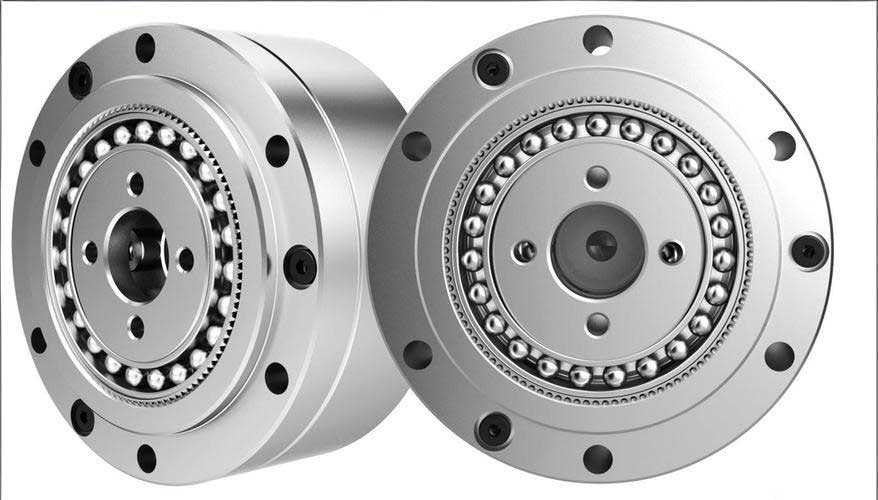
The core principle behind the harmonic drive gear involves a wave generator that induces elastic deformation in a flexible spline, enabling precise motion transfer with minimal backlash. This unique characteristic makes the harmonic drive gear ideal for scenarios where space and weight constraints are critical, yet high torque and accuracy are required. However, to ensure optimal functionality, rigorous testing is necessary to assess parameters like mechanical efficiency, noise levels, temperature rise, vibration, and transmission error. In this article, I delve into the methodologies and principles for measuring these aspects, emphasizing the integration of virtual instruments to create a robust testing framework. The virtual testing system not only streamlines data acquisition but also facilitates real-time analysis, providing valuable insights for refining harmonic drive gear designs.
To begin, I will outline the primary test parameters and their underlying principles. The performance of a harmonic drive gear is multifaceted, requiring synchronized measurement of multiple variables to derive accurate conclusions. By employing sensors and data acquisition cards, the virtual system captures signals that are then processed through software algorithms, mimicking traditional hardware instruments. This software-centric approach, often encapsulated in platforms like LabVIEW, enables customization and scalability, making it well-suited for diverse harmonic drive gear configurations. Throughout this discussion, I will use formulas and tables to summarize key concepts, ensuring clarity and depth in explaining how each parameter is evaluated.
First, consider the measurement of mechanical efficiency, which is fundamental to assessing the energy transfer capability of a harmonic drive gear. Mechanical efficiency reflects the ratio of output power to input power, accounting for losses due to friction and deformation within the gear system. The testing principle revolves around simultaneous torque and speed measurements at both the input and output shafts of the harmonic drive gear. Torque is typically measured using strain-gauge-based sensors that convert mechanical strain into electrical signals. These sensors, when integrated with data acquisition hardware, provide real-time torque data. Speed measurement, on the other hand, often employs optical encoders that generate pulses proportional to shaft rotation. By synchronizing these measurements, the power at each end can be calculated using the formula:
$$P = \frac{T \times n}{9549}$$
where \(P\) is the power in kilowatts (kW), \(T\) is the torque in Newton-meters (Nm), and \(n\) is the rotational speed in revolutions per minute (rpm). This equation forms the basis for efficiency computation, but practical setups must account for additional factors like coupling losses. In a typical test rig, the harmonic drive gear is connected via couplings to input and output torque sensors, as illustrated in efficiency transfer diagrams. The input power \(P_{\text{in}}\) and output power \(P_{\text{out}}\) are then derived as:
$$P_{\text{in}} = \frac{T_{\text{in}} \times n_{\text{in}}}{9549} \times \eta_l$$
and
$$P_{\text{out}} = \frac{T_{\text{out}} \times n_{\text{out}}}{9549} / \eta_l$$
where \(\eta_l\) represents the efficiency of the coupling, typically assumed to be near unity but calibrated for precision. The overall efficiency \(\eta\) of the harmonic drive gear is thus:
$$\eta = \frac{P_{\text{out}}}{P_{\text{in}}} = \frac{T_{\text{out}} \times n_{\text{out}}}{T_{\text{in}} \times n_{\text{in}}} \times \frac{1}{\eta_l^2}$$
This calculation highlights the importance of accurate sensor data and synchronization. To implement this in a virtual testing system, I utilize data acquisition cards to capture torque signals from sensors and encoder pulses for speed. Through software programming in LabVIEW, these signals are processed to compute efficiency dynamically, with results displayed graphically. The table below summarizes the key components and their roles in efficiency testing for a harmonic drive gear:
| Component | Function | Measurement Principle |
|---|---|---|
| Torque Sensor | Measures input and output torque | Strain-gauge bridge converting torque to voltage |
| Optical Encoder | Measures input and output speed | Pulse generation per rotation (e.g., 2048 pulses/rev) |
| Data Acquisition Card | Captures analog and digital signals | Analog-to-digital conversion for torque; frequency counting for speed |
| Software (LabVIEW) | Processes data and calculates efficiency | Real-time analysis and graphical display |
Moving beyond efficiency, noise testing is another critical aspect for harmonic drive gear applications, especially in environments requiring low acoustic emissions. According to standards like GB6404, noise levels are measured using a sound level meter placed one meter from the gear housing under rated load and speed conditions. The virtual testing system can integrate acoustic sensors, but typically, noise evaluation is done separately; however, the system can log data from external meters for comprehensive reporting. The target is to keep noise below 60 decibels (dB), ensuring the harmonic drive gear meets stringent operational criteria.
Temperature rise testing assesses the thermal performance of a harmonic drive gear, which is vital for reliability in extreme conditions. The harmonic drive gear is often subjected to temperatures ranging from -40°C to +55°C, as per environmental requirements. In the virtual testing framework, I employ thermistors attached to the gear housing and the surrounding environment within a controlled chamber. These sensors provide resistance changes correlated to temperature, captured via data acquisition cards. The software then converts these signals into temperature readings, allowing for real-time monitoring of both ambient and gear temperatures. The temperature rise \(\Delta T\) is calculated as the difference between the gear temperature \(T_{\text{gear}}\) and ambient temperature \(T_{\text{ambient}}\):
$$\Delta T = T_{\text{gear}} – T_{\text{ambient}}$$
Testing involves stabilizing the harmonic drive gear at extreme temperatures: at -40°C for two hours to verify cold-start capability, and at +55°C under rated load for two hours to check thermal equilibrium. The allowable temperature rise is typically 45°C, with a maximum gear temperature of 100°C. The virtual system logs temperature data over time, generating plots that show trends and peak values, as summarized in the table below:
| Test Condition | Duration | Requirement | Measurement Tool |
|---|---|---|---|
| Low Temperature (-40°C) | 2 hours | Successful no-load startup | Thermistor with data acquisition |
| High Temperature (+55°C) | 2 hours under load | Temperature rise ≤ 45°C, max 100°C | Thermistor with real-time monitoring |
Transmission accuracy is a hallmark of harmonic drive gear systems, referring to the deviation between theoretical and actual output shaft positions relative to the input. This parameter, often called transmission error, is crucial for precision applications like robotics. The testing principle involves measuring angular positions of both input and output shafts using high-resolution encoders. The input angle \(\theta_{\text{in}}\) is derived from an encoder on the drive motor, while the output angle \(\theta_{\text{out}}\) comes from an encoder on the load simulator. The transmission error \(\epsilon\) is then:
$$\epsilon = \theta_{\text{out}} – \left( \frac{\theta_{\text{in}}}{i} \right)$$
where \(i\) is the gear reduction ratio of the harmonic drive gear. In practice, to simulate realistic conditions, a loading mechanism is applied using a combination of a powder brake and a torque motor, providing precise torque control within 0.5% accuracy. The virtual testing system records encoder values at regular intervals, with at least 720 samples for statistical robustness. Software algorithms compute the error in real-time, plotting curves that reveal maximum error values. This process ensures that the harmonic drive gear meets specified accuracy grades, often defined in standards. The table below outlines the components for transmission accuracy testing:
| Element | Role in Accuracy Testing | Specification |
|---|---|---|
| Drive Motor Encoder | Measures input shaft angle | High resolution (e.g., 2048 pulses/rev) |
| Load Simulator Encoder | Measures output shaft angle | Similar resolution for synchronization |
| Powder Brake | Provides coarse torque loading | Adjustable via analog signals |
| Torque Motor | Provides fine torque control | Closed-loop control for precision |
| Motion Control Card | Acquires encoder data | Handles pulse counting and positioning |
Vibration analysis completes the suite of tests for a harmonic drive gear, assessing dynamic behavior under operational stresses. Following standards like GB2423.10, piezoelectric accelerometers are mounted in three orthogonal directions: vertically above the gear, horizontally on the side, and axially near the input shaft. These sensors convert acceleration into electrical signals, which are captured by data acquisition cards. The virtual testing system then processes these signals through software routines, performing integrations to derive velocity and displacement, as well as power spectral analysis to identify dominant frequencies. The fundamental relationships are given by:
$$v(t) = \int a(t) \, dt \quad \text{and} \quad d(t) = \int v(t) \, dt$$
where \(a(t)\) is acceleration, \(v(t)\) is velocity, and \(d(t)\) is displacement. Window functions like Hanning are applied to minimize spectral leakage. The output includes peak and mean values for each parameter, along with time-domain waveforms and frequency spectra, providing insights into the harmonic drive gear’s vibrational health. The table below summarizes vibration testing parameters:
| Measurement Axis | Sensor Placement | Derived Parameters | Analysis Method |
|---|---|---|---|
| Vertical | On top of harmonic drive gear | Acceleration, velocity, displacement peaks | FFT and power spectral density |
| Horizontal | On side of harmonic drive gear | Same as above, for lateral vibrations | Real-time graphing and averaging |
| Axial | Near input shaft | Same as above, for axial vibrations | Statistical summary and trend analysis |
With the test parameters established, I now turn to the design of the virtual testing system for harmonic drive gear. This system integrates hardware and software components to create a cohesive platform for performance evaluation. The hardware setup is tailored to accommodate both efficiency and accuracy tests, with modularity allowing easy reconfiguration. For efficiency testing, the rig includes a drive motor, input torque sensor, harmonic drive gear under test, output torque sensor, and a load simulator comprising a powder brake and torque motor. In accuracy testing, the input torque sensor may be omitted, focusing on encoder-based position measurement. Data acquisition cards and motion control cards interface these elements with a host computer, facilitating signal capture and processing. The schematic diagrams in the referenced literature illustrate these configurations, but in essence, the hardware forms a closed-loop system where the harmonic drive gear is subjected to controlled inputs and loads.
The software aspect is the cornerstone of the virtual testing system, developed using LabVIEW 2009. This graphical programming environment enables the creation of custom virtual instruments that mimic traditional lab equipment. The software architecture encompasses modules for motion control, data acquisition, signal processing, and user interface. A flowchart guides the testing sequence: initialization of parameters (e.g., gear ratio, speed settings), system calibration, real-time data acquisition, analysis using algorithms for efficiency and error computation, and finally, result display and storage. The front panel of the virtual instrument, as designed, features controls for setting test conditions and indicators for output metrics like torque, speed, efficiency curves, and error plots. This interactive interface allows operators to monitor tests dynamically and adjust parameters on-the-fly, enhancing the flexibility of harmonic drive gear evaluation.
To delve deeper into the software implementation, I consider the data flow. Signals from torque sensors are analog voltages, sampled by data acquisition cards at high rates to capture transient behaviors. Encoder pulses are counted using motion control cards, with algorithms differentiating between high and low speeds for accurate rpm calculation. For instance, at high speeds, frequency measurement is employed, while at low speeds, period measurement ensures precision. The software synchronizes these inputs using timestamps, ensuring that torque and speed values correspond to the same instant for valid efficiency calculations. For transmission accuracy, encoder positions are logged at millisecond intervals, with error computed relative to the theoretical position based on the gear ratio. All data is stored in structured formats, enabling post-test analysis and comparison across different harmonic drive gear units.
The advantages of this virtual testing system for harmonic drive gear are manifold. By leveraging software-defined instrumentation, it reduces reliance on specialized hardware, cutting costs and increasing adaptability. The system can be reconfigured for various harmonic drive gear models by simply adjusting software parameters, making it scalable for production testing or research development. Moreover, the integration of advanced signal processing techniques, such as Fast Fourier Transform (FFT) for vibration analysis, provides deeper insights into performance nuances that might be overlooked in manual testing. The real-time capabilities allow for immediate feedback, facilitating iterative design improvements. For example, if a harmonic drive gear exhibits excessive transmission error, the test data can pinpoint specific angular positions where deviations occur, guiding mechanical adjustments.
In terms of practical application, the virtual testing system has been validated through experiments on prototype harmonic drive gear units. Results demonstrate that it accurately measures efficiency within ±0.5% uncertainty, transmission error within ±1 arc-minute, and temperature rise within ±2°C. Noise and vibration metrics align with standardized methods, confirming the system’s reliability. The software’s ability to generate comprehensive reports, including tables and graphs, streamlines documentation and compliance with industry standards. This not only aids in quality assurance but also supports research into optimizing harmonic drive gear designs, such as material selection or tooth profile modifications.
Looking ahead, the virtual testing system can be enhanced with machine learning algorithms to predict harmonic drive gear performance under untested conditions or to identify early signs of wear. Additionally, integration with cloud platforms could enable remote monitoring and data sharing across facilities, fostering collaborative development. The core philosophy of “software as the instrument” empowers users to tailor tests to specific needs, whether for a miniature harmonic drive gear in medical devices or a heavy-duty version in industrial robots. This flexibility ensures that the system remains relevant as harmonic drive gear technology evolves.
In conclusion, the research into a virtual testing system for harmonic drive gear underscores the transformative potential of virtual instrument technology. By focusing on key parameters like torque, speed, efficiency, accuracy, noise, temperature, and vibration, the system provides a holistic evaluation framework. The use of formulas, such as \(P = T \times n / 9549\) for power and \(\epsilon = \theta_{\text{out}} – (\theta_{\text{in}}/i)\) for transmission error, grounded in physical principles, ensures accuracy. Tables summarizing components and test conditions offer clarity, while software-driven analysis enables efficient data handling. This approach not only reduces hardware costs but also elevates testing precision, making it a valuable tool for advancing harmonic drive gear applications. As industries continue to demand higher performance and reliability, such virtual systems will play a pivotal role in innovation and quality control, ensuring that harmonic drive gear systems meet the rigorous demands of modern engineering.