
In the field of precision mechanical systems, harmonic drive gears are renowned for their high torque capacity, compact design, and excellent positional accuracy. These advantages make harmonic drive gears indispensable in applications such as robotics, aerospace, and industrial automation. However, the dynamic performance of harmonic drive gears is critically dependent on their torsional stiffness, which directly influences system stability, vibration characteristics, and overall reliability. While extensive research has been conducted on the dynamic modeling of harmonic drive gears under ideal conditions, the impact of cracks—a common failure mode in mechanical components—on torsional stiffness remains underexplored. In this article, we address this gap by integrating fracture mechanics, material mechanics, and system dynamics theories to systematically analyze how cracks in key components, including the wave generator, flexspline, and output shaft, affect the torsional stiffness of harmonic drive gears. We derive analytical formulas for flexibility and stiffness coefficients, present computational methods suitable for engineering applications, and provide illustrative examples to validate our approach. The goal is to offer a practical framework for assessing the integrity and performance of harmonic drive gears in real-world scenarios where material flaws and fatigue cracks may arise.
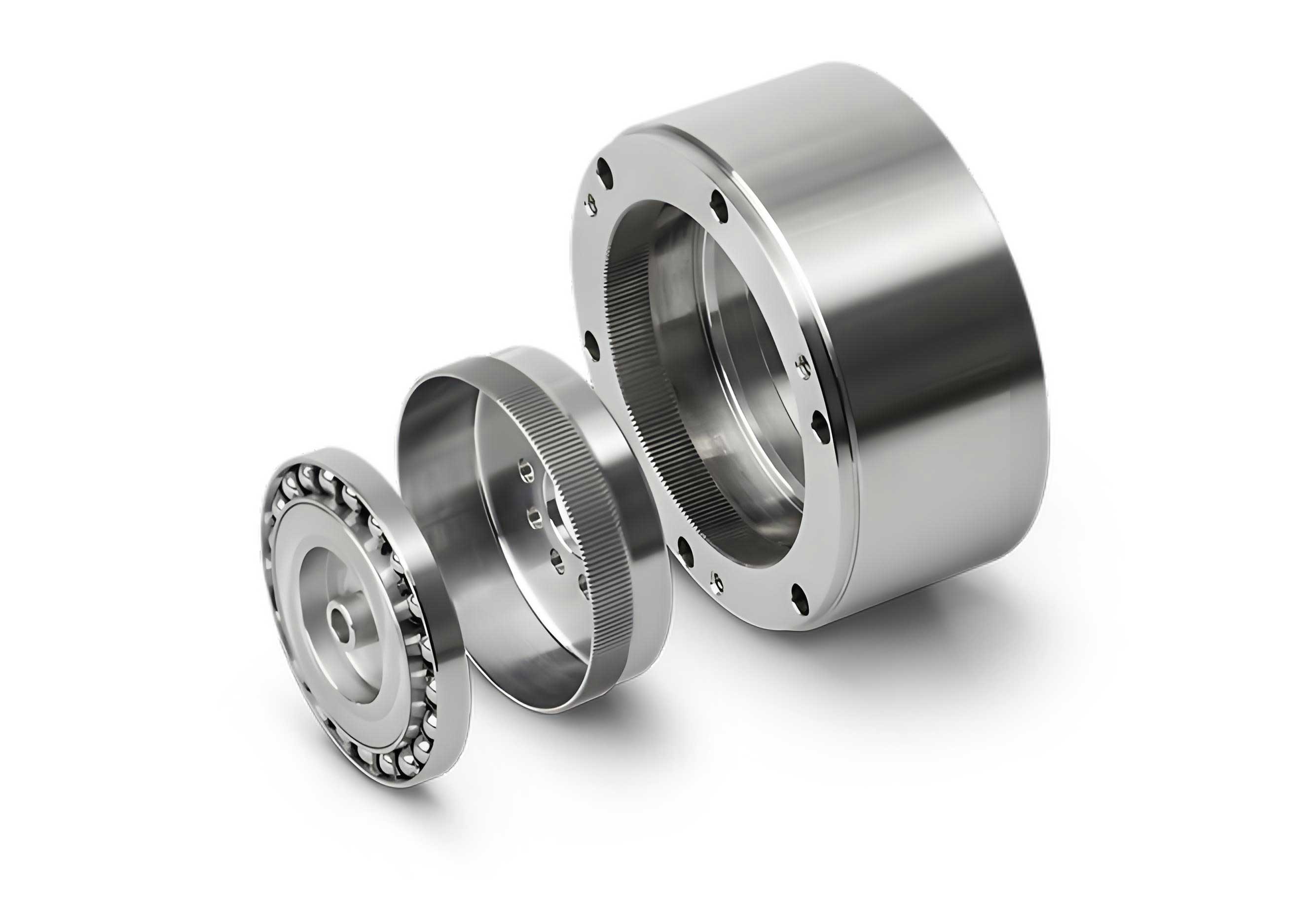
The torsional stiffness of a harmonic drive gear is a fundamental parameter in dynamic system equations, governing the relationship between applied torque and angular deformation. It is typically represented by a stiffness coefficient, denoted as \(K_{HD}\), which is the inverse of the total flexibility coefficient \(\lambda_{\sum}\) of the system’s basic components. These components include the wave generator, the flexspline, and the output shaft. In an ideal, crack-free state, the total flexibility is the sum of the individual flexibilities:
$$\lambda_{\sum} = \lambda_H + \lambda_f + \lambda_{so}$$
Consequently, the torsional stiffness coefficient is given by:
$$K_{HD} = \frac{1}{\lambda_{\sum}} = \frac{1}{\lambda_H + \lambda_f + \lambda_{so}}$$
Here, \(\lambda_H\), \(\lambda_f\), and \(\lambda_{so}\) represent the flexibility coefficients of the wave generator, flexspline, and output shaft, respectively, with units of rad/(N·mm). The stiffness coefficient \(K_{HD}\) has units of N·mm/rad. When cracks develop in any of these components, additional flexibility is introduced, altering the overall stiffness. To quantify this effect, we employ fracture mechanics principles, which relate crack geometry and material properties to changes in compliance.
According to fracture mechanics, the presence of a crack area \(A\) leads to a change in strain energy \(\Delta U\), which in turn induces additional displacement \(\Delta u\) and additional flexibility coefficient \(\Delta \lambda\). The energy release rate \(G\) is a key parameter, defined for mixed-mode loading as:
$$G = \frac{K_I^2}{E’} + \frac{K_{II}^2}{E’} + \frac{K_{III}^2}{E’}(1 – \nu)$$
where \(K_I\), \(K_{II}\), and \(K_{III}\) are the stress intensity factors for Mode I (opening), Mode II (sliding), and Mode III (tearing) cracks, respectively; \(E’\) is the generalized elastic modulus; and \(\nu\) is Poisson’s ratio. For a generalized load \(P\), the additional displacement and flexibility can be expressed as:
$$\Delta u = \frac{\partial (\Delta U)}{\partial P} = \int_0^A \frac{\partial G}{\partial P} dA$$
$$\Delta \lambda = \frac{\partial^2 (\Delta U)}{\partial P^2} = \int_0^A \frac{\partial^2 G}{\partial P^2} dA$$
Since stress intensity factors are proportional to the applied load, the ratios \(K_I/P\), \(K_{II}/P\), and \(K_{III}/P\) depend only on geometry and crack dimensions. Thus, we can derive explicit formulas for additional flexibility. This forms the basis for our analysis of each component in a harmonic drive gear system.
We begin with the wave generator, which often consists of a cam or roller assembly with bearings. Cracks in bearing rings, particularly the inner ring, are most critical due to high stress concentrations. For a semi-elliptical surface crack, the Mode I stress intensity factor is approximated as:
$$K_I = 1.95 \sigma \sqrt{\frac{a}{Q}}$$
where \(a\) is the crack depth, \(Q\) is the surface crack parameter, and \(\sigma\) is the circumferential stress. The stress in the inner ring is primarily due to operational loads, neglecting effects like interference fits and centrifugal forces for simplicity. The maximum contact pressure from radial load \(F_r\) is:
$$\sigma_{\text{max}} = \frac{3F_r}{2\pi a’ b’}$$
where \(a’\) and \(b’\) are the dimensions of the Hertzian contact ellipse. The circumferential stress component is \(\sigma = \frac{1}{2} \beta \sigma_{\text{max}}\), with \(\beta\) being a function of \(a’/b’\). Integrating over the crack area, the additional radial displacement due to the crack is:
$$\Delta u_H = 0.217 t_i \left( \frac{\beta a}{a’ b’} \right)^2 \frac{F_r^2}{E Q}$$
where \(t_i\) is the thickness of the inner ring. The additional radial stiffness coefficient is then:
$$\Delta K_G = \frac{F_r}{\Delta u_H} = \frac{E Q}{0.217 F_r t_i \left( \frac{\beta a}{a’ b’} \right)^2}$$
The radial stiffness without cracks, \(K_{G0}\), accounts for elastic deformations of bearings, wave generator elements, and supports. The total radial stiffness with cracks is \(K_G = K_{G0} – \Delta K_G\). This radial stiffness is converted to torsional flexibility referenced to the output shaft:
$$\lambda_H = \frac{k_r}{K_G} \cdot \frac{\pi}{2 d_1 U w_0 i_h}$$
Here, \(k_r\) is the force transmission coefficient, \(d_1\) is the pitch diameter of the flexspline, \(U\) is the wave number, \(w_0\) is the radial displacement, and \(i_h\) is the gear ratio. This formulation highlights how cracks in the wave generator of a harmonic drive gear reduce stiffness and increase flexibility.
Next, we consider the flexspline, a thin-walled cylindrical component that undergoes elastic deformation. Cracks in the flexspline often originate at the tooth root and propagate at an angle, typically 45°, under torsional loading, resulting in mixed-mode I-II fracture. The stress intensity factors for a small inclined crack are:
$$K_I = \tau \sin 2\beta \sqrt{\pi a}, \quad K_{II} = \tau \cos 2\beta \sqrt{\pi a}$$
where \(\tau\) is the shear stress, given by \(\tau = T / (2\pi r_m^2 \delta)\), with \(T\) as the output torque, \(r_m\) as the mean radius of the undeformed flexspline, and \(\delta\) as the wall thickness at the tooth ring. Setting \(\beta = 45^\circ\) and including factors for stress non-uniformity \(K_u\) and dynamic load \(K_d\), the additional flexibility due to the crack is:
$$\Delta \lambda_f = \int_0^A \frac{2}{E} \left[ \left( \frac{K_I}{T} \right)^2 + \left( \frac{K_{II}}{T} \right)^2 \right] dA = \frac{K_u K_d a^2}{2\pi E r_m^4 \delta}$$
The crack-free flexibility of the flexspline, derived from material mechanics, is:
$$\lambda_{f0} = \frac{k_f k_G c_L}{0.1 \mu \left[ 1 – (1 – 2 c_\delta)^4 \right] d_1^3}$$
where \(c_L = L/d_1\) is the relative length of the flexspline cylinder, \(c_\delta = \delta/d_1\) is the relative wall thickness, \(k_f\) is a shape coefficient (0.83 for bell-shaped, 1.0 for cylindrical), \(k_G\) is a structural coefficient (0.83 for cup-shaped, 1.0 otherwise), and \(\mu\) is the shear modulus. The total flexspline flexibility is \(\lambda_f = \lambda_{f0} + \Delta \lambda_f\). This demonstrates the sensitivity of harmonic drive gear stiffness to flexspline integrity.
Finally, the output shaft, which transmits torque from the harmonic drive gear, may develop annular cracks subject to combined normal and shear stresses, leading to mixed-mode I-III fracture. The additional flexibility is:
$$\Delta \lambda_{so} = \int_0^A \left[ \frac{2}{E} \left( \frac{K_I}{P} \right)^2 + \frac{1}{\mu} \left( \frac{K_{III}}{T} \right)^2 \right] dA$$
For a shaft with an annular crack, the stress intensity factors are:
$$K_I = M_P \cdot \frac{4P}{\pi d_e^2} \sqrt{\pi a}, \quad K_{III} = M_M \cdot \frac{16T}{\pi d_e^3} \sqrt{\pi a}$$
where \(P\) is the crack-opening force, \(d_e = d_s – 2a\) is the effective diameter considering the crack depth, \(d_s\) is the shaft diameter, and \(M_P\) and \(M_M\) are geometry-dependent coefficients given by:
$$M_P = 0.5 \left( \frac{d_e}{d_s} \right)^{\frac{1}{2}} + 0.25 \left( \frac{d_e}{d_s} \right)^{\frac{3}{2}} + 0.188 \left( \frac{d_e}{d_s} \right)^{\frac{5}{2}} + 0.182 \left( \frac{d_e}{d_s} \right)^{\frac{7}{2}} + 0.166 \left( \frac{d_e}{d_s} \right)^{\frac{9}{2}}$$
$$M_M = 0.376 \left( \frac{d_e}{d_s} \right)^{\frac{1}{2}} + 0.188 \left( \frac{d_e}{d_s} \right)^{\frac{3}{2}} + 0.141 \left( \frac{d_e}{d_s} \right)^{\frac{5}{2}} + 0.117 \left( \frac{d_e}{d_s} \right)^{\frac{7}{2}} + 0.102 \left( \frac{d_e}{d_s} \right)^{\frac{9}{2}} + 0.078 \left( \frac{d_e}{d_s} \right)^{\frac{11}{2}}$$
Integrating over the crack area \(dA = 2\pi a \, da\), we obtain:
$$\Delta \lambda_{so} = \frac{16 M_P^2 a^2}{\pi E d_e^4} + \frac{512 M_M^2 a^3}{3 \mu d_e^6}$$
The crack-free flexibility of the output shaft is:
$$\lambda_{so0} = \frac{L_s}{0.1 \mu d_s^4}$$
where \(L_s\) is the shaft length. For stepped shafts, an equivalent diameter should be used. The total output shaft flexibility is \(\lambda_{so} = \lambda_{so0} + \Delta \lambda_{so}\). This analysis underscores the importance of output shaft design in maintaining the torsional stiffness of harmonic drive gears.
To illustrate the practical application of these formulas, we present a detailed example for a harmonic drive gear with a transmission ratio \(i^{(2)}_{H1} = 100\), radial displacement \(w_0 = 0.8\) mm, flexspline pitch diameter \(d_1 = 160\) mm, wall thickness \(\delta = 2.24\) mm, length \(l = 160\) mm, and a two-wave configuration. The flexspline is cylindrical cup-shaped, the wave generator is a cam type, and the output shaft is hollow with outer diameter \(d_{s1} = 70\) mm and inner diameter \(d_{s2} = 45\) mm. Material properties are elastic modulus \(E = 2.1 \times 10^5\) MPa and shear modulus \(\mu = 8 \times 10^4\) MPa. The force transmission coefficient is \(k_r = 0.35\). We assume crack depths of \(a = 0.1\) mm in all components for comparison, though in practice, crack depths should be measured via non-destructive testing.
The calculations proceed stepwise: first, compute the flexibility coefficients without cracks; second, determine the additional flexibilities due to cracks; third, sum these to obtain total flexibilities; and finally, derive the torsional stiffness. The results are summarized in the following tables to clarify the contributions of each component.
| Component | Flexibility (10^{-10} rad/(N·mm)) |
|---|---|
| Wave Generator (\(\lambda_{H0}\)) | 3.407118 |
| Flexspline (\(\lambda_{f0}\)) | 2.3588039 |
| Output Shaft (\(\lambda_{so0}\)) | 6.9062941 |
| Total (\(\lambda_{\sum0}\)) | 12.672216 |
| Component | Additional Flexibility (10^{-10} rad/(N·mm)) |
|---|---|
| Wave Generator (\(\Delta \lambda_H\)) | 0.151377 |
| Flexspline (\(\Delta \lambda_f\)) | 0.0000014 |
| Output Shaft (\(\Delta \lambda_{so}\)) | 0.000039 |
| Component | Total Flexibility (10^{-10} rad/(N·mm)) |
|---|---|
| Wave Generator (\(\lambda_H\)) | 3.558495 |
| Flexspline (\(\lambda_f\)) | 2.3588053 |
| Output Shaft (\(\lambda_{so}\)) | 6.9063331 |
| Total (\(\lambda_{\sum}\)) | 12.8236336 |
| Condition | Torsional Stiffness (10^5 N·mm/rad) | Change |
|---|---|---|
| Without Cracks (\(K_{HD0}\)) | 7.89127 | — |
| With Cracks (\(K_{HD}\)) | 7.7981 | -1.2% |
The tables reveal that the presence of cracks reduces the overall torsional stiffness of the harmonic drive gear by approximately 1.2% for the given parameters. Notably, the wave generator contributes about 28% to the total flexibility, the flexspline 19%, and the output shaft 53%. This distribution emphasizes that enhancing the stiffness of the output shaft and wave generator is crucial for mitigating crack-induced degradation in harmonic drive gears. Although the flexspline crack impact appears minimal in this example, deeper or more complex cracks could substantially increase flexibility. Engineers must therefore prioritize crack inspection and design robustness in these components to ensure reliable harmonic drive gear performance.
Beyond this example, we can extend the analysis to various crack geometries and loading conditions. For instance, multiple cracks or irregular shapes may require numerical integration of the flexibility formulas. Additionally, environmental factors like temperature fluctuations and corrosive environments can accelerate crack growth, further affecting stiffness. We recommend incorporating safety factors and regular maintenance schedules for harmonic drive gears operating under harsh conditions. The derived formulas provide a foundation for predictive maintenance models, enabling early detection of stiffness loss before catastrophic failure.
In conclusion, our integrated approach combining fracture mechanics, material mechanics, and system dynamics offers a comprehensive method for evaluating the influence of cracks on the torsional stiffness of harmonic drive gears. The analytical expressions for flexibility and stiffness coefficients are straightforward to implement in engineering calculations, facilitating rapid assessment of harmonic drive gear integrity. By accounting for cracks in the wave generator, flexspline, and output shaft, designers and maintenance teams can better predict dynamic behavior, optimize component dimensions, and enhance system reliability. Future work could explore experimental validation, finite element analysis comparisons, and the effects of crack propagation over time. Ultimately, understanding these nuances is vital for advancing the durability and efficiency of harmonic drive gears in modern mechanical systems.
The harmonic drive gear, with its unique operating principle, remains a cornerstone of precision motion control. As demands for higher performance and longevity increase, addressing failure modes like cracking becomes ever more critical. We hope this article serves as a valuable resource for researchers and practitioners aiming to safeguard the torsional stiffness and overall functionality of harmonic drive gears in diverse applications. Through continued innovation and rigorous analysis, the robustness of harmonic drive gears can be sustained, ensuring their pivotal role in technology advancement.